

Alan Mays' photos
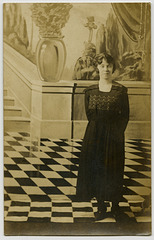
She Couldn't Escape Her Checkered Past
| |
|
|
|
A patterns photo for the Vintage Photos Theme Park.
A real photo postcard with a unique backdrop.

I Wish I Could Catch You
| |
|
|
|
This type of Victorian "hidden name" calling card consists of an underlying card--this one has scalloped edges--with a colorful printed "scrap" covering the name that's printed on the card. In this case, the name hidden underneath the scrap is "Blanchie V. Wherley." The scrap, which is only glued to the card along the left-hand edge, can be carefully lifted from the right in order to reveal the name.
To understand how this works, see the following illustration (below), which demonstrates how to lift the scrap to uncover the name printed on the card.
The chromolithographed die-cut scraps often featured typical Victorian motifs, such as flowers, birds, and hands. Other scraps had patriotic themes, including U.S. flags, presidents, and Union generals of the American Civil War.
For additional examples of this type of Victorian card, see below or take a look at my Hidden Name Calling Cards album.
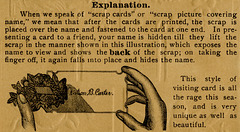
Explanation of Hidden Name Calling Cards
| |
|
|
Explanation
When we speak of "scrap cards" or "scrap picture covering name," we mean that after the cards are printed, the scrap is placed over the name and fastened to the card at one end. In presenting a card to a friend, your name is hidden till they lift the scrap in the manner shown in this illustration, which exposes the name to view and shows the back . of the scrap; on taking the finger off, it again falls into place and hides the name.
This style of visiting card is all the rage this season [1886], and is very unique as well as beautiful.
--Excerpt from an 1886 sample sheet with illustrations of calling cards for sale by the Connecticut Steam Card Works, Hartford, Conn.
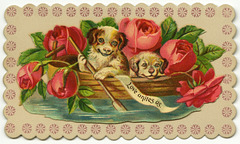
Love Unites Us
| |
|
|
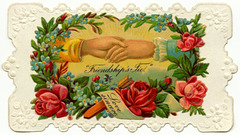
Friendship's Tie

The Sea May Rise and Mountains Fall
| |
|
|
"The sea may rise and mountains fall, but my love for thee will live through it all. Sweet dreams and glad awakernings be thine."

To the Keeper of My Heart
| |
|
|
"To the keeper of my heart. Price net to agents, twenty for 15 cts. Agents charge 25 cents."
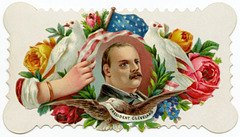
President Grover Cleveland
| |
|
|
|
A hidden name calling card with an illustration of U.S. President Grover Cleveland .
Cleveland married Frances Clara Folsom in 1886 during his first term as president, and she was also the subject of a similar calling card :
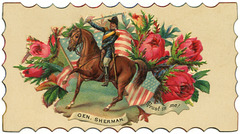
General Sherman Calling Card
| |
|
|
"Gen. Sherman. Trust in me!"
Printing hidden under scrap: "Our Generals. 12 for 30 cents. Fringed 12 for 80 cents."
See also calling cards for General Hancock and General Logan .
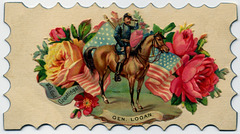
General Logan Calling Card
| |
|
|
"Gen. Logan. With fond greetings!"
See also calling cards for General Hancock and General Sherman .
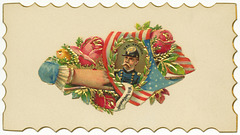
General Hancock Calling Card
| |
|
|
"Gen. Hancock. With fond greetings."
American Civil War General Winfield Scott Hancock appears on this hidden name calling card.
See also calling cards for General Logan and General Sherman .
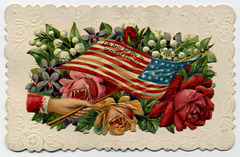
Flag Calling Card
| |
|
|
"Life bear for you its sweetest flowers."
No name is printed underneath the scrap, which means that this was probably a sample calling card.
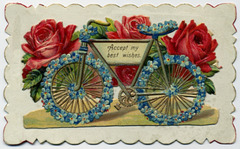
Bicycle Calling Card
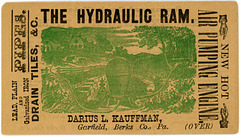
The Hydraulic Ram, Darius L. Kauffman, Garfield, P…
| |
|
|
In this advertising trade card from the 1880s, Darius L. Kauffman revealed his passion for the hydraulic ram , which is essentially a water-powered water pump. The front of the card (above) illustrates a ram in action. One pipe draws water from a pond or steam in the wooded area on the right, and then the ram mechanism uses pressure from the water flow to send water through another pipe so that it travels up the hill on the left to reach the livestock grazing there.
On the back of the card (see below), Kauffman described the hydraulic ram as "a perfectly simple, effective, and durable machine," which can be used "for forcing a portion of a spring or brook to many points, at any required distance to a mile or more, and elevations to 300 feet, at the rate of 10 to 1000 gallons per hour." In this way, it can "furnish a constantly running stream of water to irrigate land, supply dwellings, creameries, livestock, factories, villages, R.R. stations, &c."
In addition to hydraulic rams, Kauffman also offered to install "hot air pumping engines," which burned fuel--coal, wood, or gas--to provide the energy for pumping water, and to supply accessories like pipes and tiles for his customers.
Tragically, Kauffman died at the age of 33 as he was discussing the hydraulic ram. The Harrisburg Telegraph (Harrisburg, Pa), on Tuesday, April 16, 1889, p. 2, reported his death in this brief note:
"An Inventor's Sudden Death. Reading, Pa., April 16. Darius L. Kauffman, an inventor, of Garfield, this county [Berks County], died suddenly at Mossersville, Lehigh county. He was explaining the mechanism of a hydraulic ram in which he was interested, when he fell forward and in a few moments expired. Death was caused by paralysis of the heart."
The Hydraulic Ram.
☞New Hot☜
Air Pumping Engine.
Lead, Plain, and Galvanized Iron Pipes. Drain Tiles, &c.
Darius L. Kauffman, Garfield, Berks Co., Pa. (over)
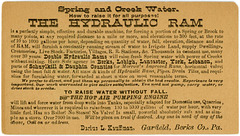
The Hydraulic Ram Is a Perfectly Simple, Effective…
| |
|
|
For information about Darius L. Kauffman and hydraulic rams, see the front of this advertising trade card: The Hydraulic Ram, Darius L. Kauffman, Garfield, Pa., 1880s .
Spring and Creek Water.
How to raise it for all purposes!
The Hydraulic Ram is a perfectly simple, effective, and durable machine, for forcing a portion of a spring or brook to many points, at any required distance to a mile or more, and elevations to 300 feet, at the rate of 10 to 1000 gallons per hour, depending on quantity of water, fall, elevation, distance, and size of ram, will furnish a constantly running stream of water to irrigate land, supply dwellings, creameries, livestock, factories, villages, R.R. stations, &c. Thousands in constant use, many over 30 years. Double hydraulic rams will raise fresh spring water with power of creeks without mixing. Have sole agency in Berks, Lehigh, Lancaster, York, Lebanon, and parts of Schuylkill and Dauphin counties for Morrow's Improved Rams, horizontal valve; using the least fall and water. All sizes and kinds of hydraulic rams, pipes, drain tiles, and requisites for furnishing water, forwarded at short notice on most reasonable terms.
We prefer to direct, and put them up personally to obtain the best results. Experience is very important. Our work warranted to give entire satisfaction. You need not pump, carry water, or drive stock to creeks.
To Raise Water without Fall.
☞The hot air pumping engine will lift and force water from deep wells into tanks, especially adapted for domestic use, quarries, mines, and whatever it is required to raise from 100 to 5000 gallons of water per hour, with very little fuel. Has no boiler! No steam! No valve! Is small, powerful, absolutely safe, and as simple as a stove. Over 7000 in use. Will be given on trial if desired. Anyone in need of any of the above, call on or address
Darius L. Kauffman, Garfield, Berks Co., Pa.
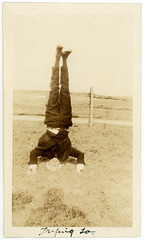
Trying To
| |
|
|
An upside down photo for the Vintage Photos Theme Park.
"Trying to" stand on his head, and it looks like he succeeded!
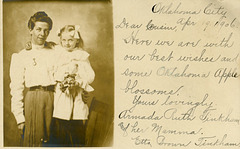
Armada and Her Mamma with Oklahoma Apple Blossoms,…
| |
|
|
|
"Oklahoma City, Apr. 19, 1906. Dear Cousin, Here we are with our best wishes and some Oklahoma apple blossoms. Yours lovingly, Armada Ruth Tinkham and her mamma, Etta Brown Tinkham."
Etta Brown Tinkham also sent a second real photo postcard to her cousin on the same date (she must have sent them both in an envelope since there's no address, stamp, or postmark on either of them). See Greetings from the Future Popcorn King, Oklahoma City, Okla., 1906 :
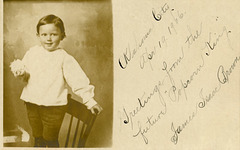
Greetings from the Future Popcorn King, Oklahoma C…
| |
|
|
"Oklahoma City, Apr. 19, 1906. Greetings from the future 'Popcorn King,' James Isaac Brown."
"Popcorn King"? Huh?
Well, after a bit of searching, I finally located a brief newspaper article, "Is Called 'Popcorn King,'" Oklahoma State Capital (Guthrie, Okla.), July 21, 1909, p. 2, that sheds some light on the subject: "Shawnee, Okla., July 20.--Four years ago Isaac A. Brown of Pittsburg, Pa., came to Oklahoma with a view of locating and establish[ing] himself in business. He saw his opportunity in Oklahoma City and embraced it. Brown is known far and wide as the 'popcorn king' of the new state [Oklahoma became the 46th state in 1907]. He manufactures an average of thirty-five pounds of popcorn a day and a near total of six tons a year."
As far I've been able to determine, Isaac A. Brown, the Popcorn King named in the article, is the father of James Isaac Brown, the Future Popcorn King who's pictured above. Unfortunately, I haven't found any further evidence regarding the later reign of father or son as Popcorn King.
Etta Brown Tinkham, who wrote the message about the Future Popcorn King, was apparently James Isaac Brown's mother or stepmother. She wrote another message on a second real photo postcard on the same date as this one. See Armada and Her Mamma with Oklahoma Apple Blossoms, Oklahoma City, Okla., 1906 (is the Future Popcorn King holding the same kind of apple blossoms, or might he be grasping a handful of popcorn instead?).
