

Traktor 49's favorite photos
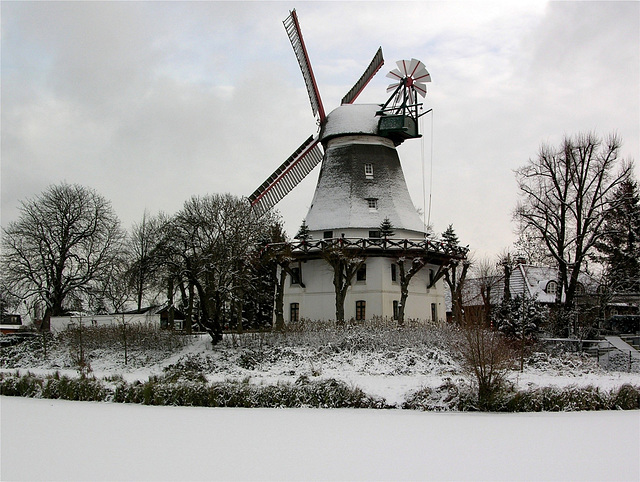

Kirchdorfer Windmühle Johanna
Schnee am 20.12.2010.
Farbfoto ! ☺
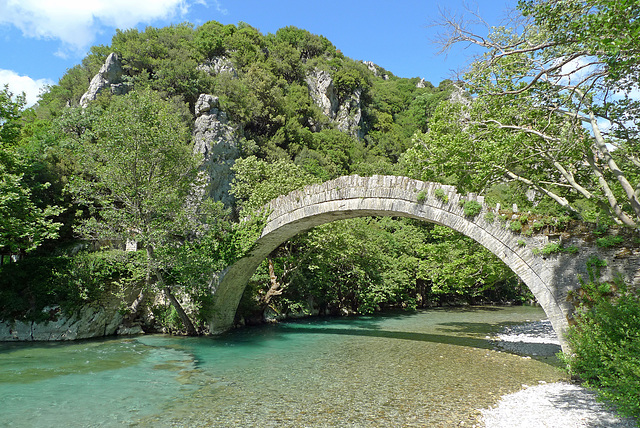
Greece - Κleidonia Bridge
After an unsuccessful attempt in 1844, finally the Kleidonia (also Klidonia) Bridge was built in 1853. This one-arch bridge spans the Voidomatis river in a verdant valley. The construction was paid by Balkiz Hanum, spouse of the Turk Malik-pasha.
The elongated arch has a length of 20 meters and a height of 9.15 meters. The path over the bridge is 3,20 meters wide. The bridge is considered being the end of the Vikos Gorge .
The Kleidonia Bridge is not only known for its beautiful arch, its location among plane trees and scenic views, but also boasts of a history of a bloody feud between two families for reasons of honor.
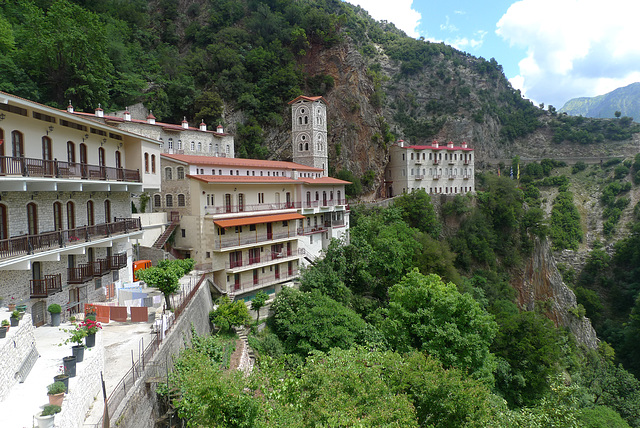
Greece - Monastery of Prousos
The Monastery of Prousos (Monastery of Panagia Prousiotissa = Virgin Mary of Prousos) is built in beautiful surroundings on a steep rock and above the deep canyon of the river Karpenisiotis . According to the tradition, it was founded in 829 by monks Dionysios and Timotheos, who brought with them the icon of Virgin Mary from Prousa in Asia Minor. However, it is more possible that the monastery was established between the 12th and 14th century.
The monastery has a main building where Virgin Mary Prousiotissa is worshiped and a part where the cells of ther monks are located. A small museum is housed in the monastery with several exhibits such as icons dating back to the 15th and 16th century, sacred vestments, silver and golden chalices and handwritten codes and typography books.
During the War of Independence against the Turks, it was a refuge for Greek rebels. In August 1944 German troops burnt down a large part of the monastery, destroying many relics, handscripts, books and items of everyday use. The monastery has been rebuilt several times.
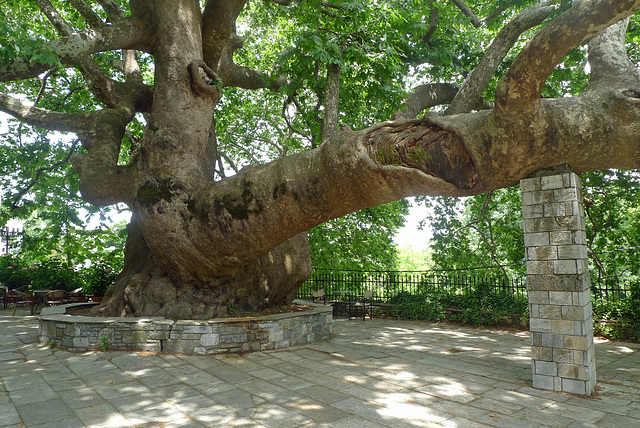
Greece - Tsgarada, plane tree
The plane tree in Tsagarada is one of the oldest trees in Europe. It is located in the square of Tsagarada in front of the Agia Paraskevi (PiP4).
According to foresters, the tree is around 1000 years old. The circumference of the trunk measures over 15 meters. The crown of the plane tree is so large that it is difficult to measure it. Its perimeter may even be 40 meters. The branches are as thick as a tree trunk. The general condition of the tree is very good. However, the trunk has a cavity which is closed with a metal sheet. One of the branches is supported by a marble pillar.
What might have not been taken into account for the age of the tree is that its roots start at about four meters under the paving of the square. Therefore, a large part of the trunk is “buried” for many years now at a depth of at least four meters.
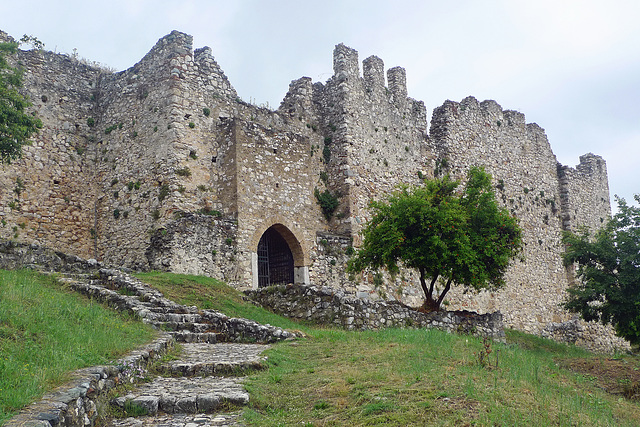
Greece - Platamon Castle
Platamon Castle is dating back to the middle Byzantine period (10th century AD). It is situated at the location of the ancient city of Heraclia. The name “Platamon” appears for the first time in an imperial order of 1198 but, most probably, there was already a Byzantine castle there, since the 10th century.
Following the fall of Constantinople during the 4th Crusade in 1204, Lombardian crusaders took over the land and built a castle on top of the remains of the old structure. The castle functioned as a strategic lookout point over the passage between Macedonia and southern Greece. Despite their efforts to retain control of the castle, it wasn’t long before the Byzantines took it over again. In 1218, the Komnenos, a Byzantine noble family, established dominion over the castle.
The Turks captured the castle in 1385 and paid much attention to its maintenance because they needed the castle to control the strategically important area. After a short break between 1425 and 1427, when the Venetians managed to conquer the castle, the Turks returned and stayed until the beginning of the 20th century.
During World War II, in April 1941, a unit of New Zealanders tried to defend Platamon but were forced to leave after the bombardment of the castle by the Germans.
The Castle of Platamon is located southeast of Mount Olympus near the village of Platamon. The landmark of the castle is the well-preserved octagonal tower with a height of 16 meters.
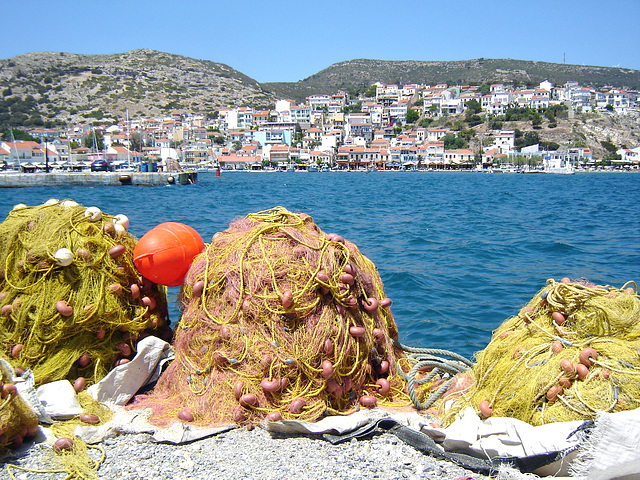
Greece - Samos, Pythagorion
Pythagorion is one the most picturesque villages on the island of Samos. It is named after the famous philosopher and scientist Pythagoras. Pythagorion has a beautiful port where many beautiful old sailing ships, fishing boats and ferries to other islands moor. This harbour is maybe one of the oldest ports in the Mediterranean sea.
The town with its traditional old houses with red-tiled roofs is built amphitheatrically around the bay, where the ancient town of the island was found during excavations..
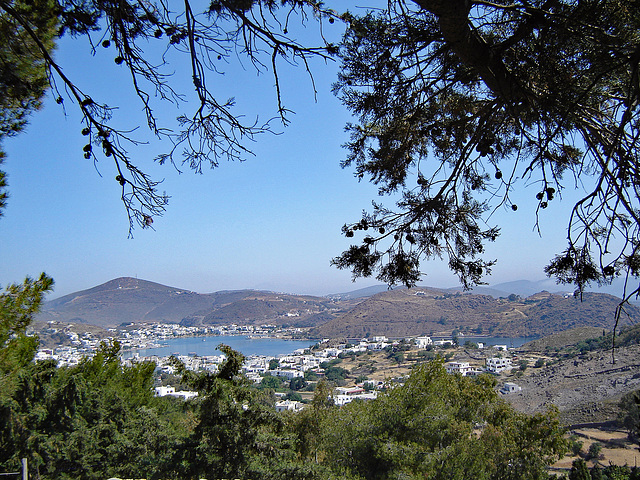
Greece - Patmos
Patmos is inhabited since 3000 BC, but the identity of its first inhabitants is still unknown. Finds have excavated various buildings, cemeteries, fortresses, and evidence of an ancient acropolis, testifying the existence of a densely populated area in the past.
Patmos declined when the Romans conquered it. It was used as a place of exile for convicts. This is how Apostle John came to Patmos. He conveyed the inhabitants to Christianity and wrote the Book of Revelation, the Apocalypse. Patmos then became a place of worshipping and pilgrimage and actually.
During the Byzantine times, the inhabitants of Patmos built a Grand Royal Basilica in honor of Saint John. During the Arab raids from the 6th to the 9th century the basilica was destroyed. In 1101 the construction of the Monastery of Saint John the Theologian started. The fame of the monastery grew and a settlement started to expend around it. During the end of the 12th century, the island of Patmos was transformed into a large commercial center.
In 1522, the Turks came to the island; after a while, they left the island, which they just forced to pay some taxes. When the Turkish-Venetian Wars ended, tranquillity returned to Patmos and the island flourished, becoming once again an important commercial center. Massive fortifications were built around the monastery as a protection from the pirates. In 1655, Patmos was governed by the monks and prospered again. Its growth stopped in 1659, when the Venetians, conquered and destroyed the island of Patmos. With shipping, commerce and the efforts of the inhabitants, Patmos regained its lost nobility, glamour and prosperity.
The Russians conquered the island in 1770, after the Turkish-Venetian War. The Greek Revolution started in 1821 and managed to gain the independence of Greece in 1832. The treaty signed in London did not include the islands of the Dodecanese as part of the newly built Greek State and therefore fell again under Turkish occupation.
The Italians occupied all the islands of the Dodecanese in 1912, with of course Patmos, and remained there until 1943, when the Germans took over the island. In 1945, the Germans left and the island of Patmos remained autonomous until 1948 when it joined the rest of independent Greece with the rest of the Dodecanese Islands.
In 1981, Greece declared Patmos a “Sacred Island'', and in 1999 UNESCO included The Historic Centre (Chora) with the Monastery of Saint John the Theologian and the Cave of the Apocalypse in its World Heritage Site List. Patmos is also part of the COESIMA network, as one of the seven most important pilgrimage sites in Europe.
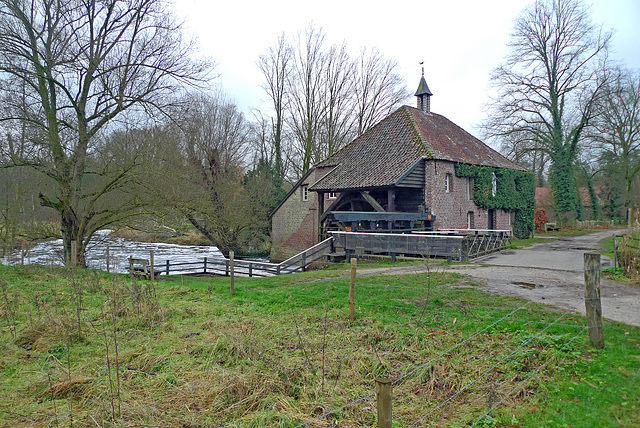
Nederland - Nunhem, Leumolen
October 2023 marked the 250th anniversary of the “Leumolen” (Leu Mill); counting from the time of its rebuilding in 1773. The mill is also known as St. Ursula's Mill.
There had been a mill at this location on the Leubeek for much longer. In 1461, a will first mentioned the “Leumolen” under the name “Molen aan de Leu”. It is possible that the mill had existed even much longer, with a charter mentioning a mill in Nunhem as early as the 13th century. The water mill from 1461 no longer exists; the loam mill was rebuilt in brick in the period 1771-1775. An oil mill was added to the existing grain mill. The mill house was completed in 1773, and the oil mill in 1775.
A major change to the mill took place in 1911 when the water wheel was replaced by a turbine. In 1956, “Staatsbosbeheer” - a Dutch government organisation for forestry and management of nature reserves - bought the water mill. During a restoration in 1960-1961, the water wheel returned.
After this restoration, only the grain mill was still in operation, but in 2008 the oil mill was also restored. The “Leumolen” is one of six water-powered oil mills in the Netherlands and the only one to house a flour mill and an oil mill under one roof.
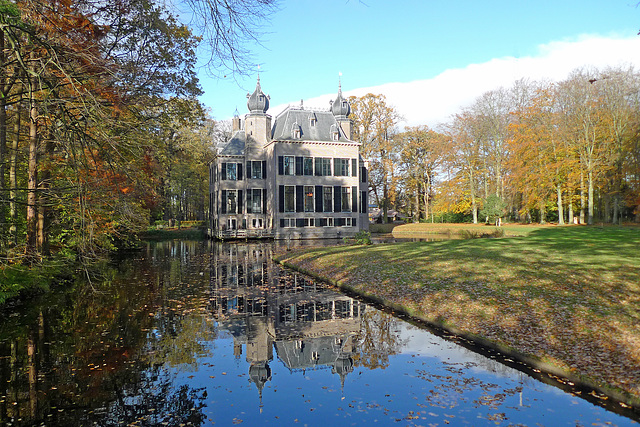
Nederland - Oegstgeest, Kasteel Oud-Poelgeest
The country estate Oud-Poelgeest (officially Kasteel Oud-Poelgeest) was built in 1668 in the Dutch Neoclassical style on the foundations of the medieval castle Alkemade. This castle was destroyed by Spanish troops in 1574.
The well-known humanist and physician Herman Boerhaave lived here between 1724 and 1738. He grew plants at Oud-Poelgeest for which there was no room in the botanical garden of Leiden University.
In the 19th century, four towers were built on the square house - making it look more like a castle - along with the coach house. The grounds also contain a gardener's house, a neo-Gothic chapel and a well dating from 1550. These building and the surrounding park are protected as a Dutch national monument.
Today, the coach house is a hotel-restaurant. The castle is used as a conference centre
Jump to top
RSS feed- Latest favorites - Subscribe to the favorite docs of Traktor 49
- ipernity © 2007-2026
- Help & Contact
|
Club news
|
About ipernity
|
History |
ipernity Club & Prices |
Guide of good conduct
Donate | Group guidelines | Privacy policy | Terms of use | Statutes | In memoria -
Facebook
X
