


Les halles

Market halls are part of French culture


Revel - La halle central
Like most other "bastides" Revel has a layout like a chequerboard. Right in the very center here stands a belltower, surrounded by the wooden structure of "la halle central", filling the central block. Pierre-Paul Riquet has lived in Revel, before he started the construction of the "Canal du Midi" in 1667. The nearby "Lac de Saint-Ferréol" was created at that time, to provide water to the canal (about 30kms south).
-
When I reached this place walking the Via Tolosana in August 2011, the battery of my camera was flat. I ould not take a fresh photo. So just recycle this shot. Nothing had changed over the year.
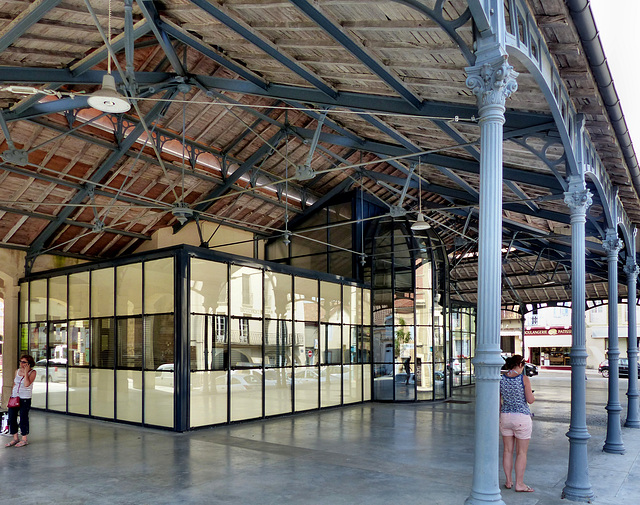
Boulogne-sur-Gesse - Halle
Boulogne-sur-Gesse was founded as a "bastide" in the 13th century, near the Cistercian Abbey of Bonnefont, that existed already since 1136.
Today the town has a population of about 1600, an impressive "hôtel de ville" next to "Notre-Dame-de-l'Assomption" (previous uploads) , an interesting open air market (no photos) and this airy market hall. In the center of the hall is the "Tourist Information".
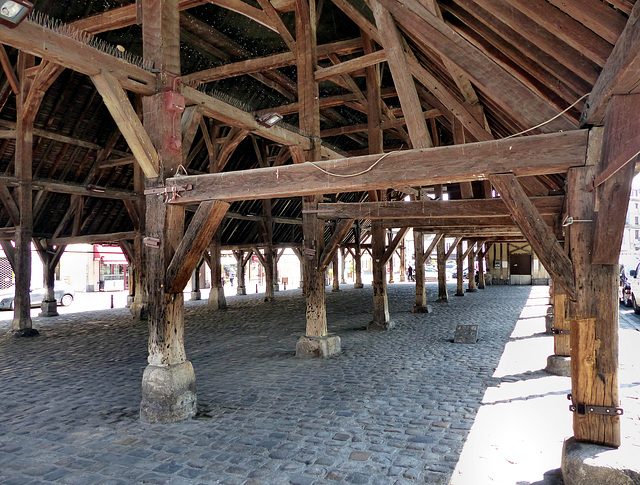
Arpajon - La Halle
In 1470, Louis Malet Graville, Seigneur of Chartres, commissioned to build this hall, to create a prosperous market here. The rectangular hall is about 35 meters long and 18 meters wide, it is one of the largest in the region. 48 old oak beams on sandstone-foundations hold up the roof.
In 1820, the Duc Mouchy, descendant of the noble family, sold the hall to the city of Arpajon. Meanwhile the hall is well restorated and twice per week, here is the market.
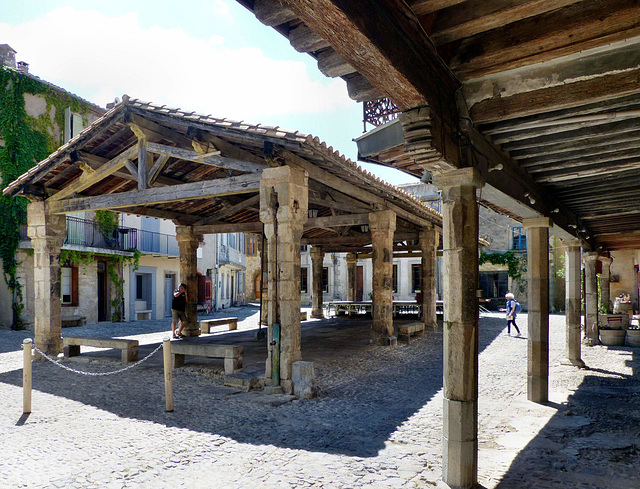
Lagrasse - La halle
A convent existed in the valley of the River Orbieu already in the 7th century. In 779 Charlemagne sponsored the convent that developed to the wealthy and powerful Abbaye Sainte-Marie over the next centuries.
Lagrasse, one of the "Plus Beaux Villages de France" ("The most beautiful villages of France"), that grew around the abbey. has a population of about 550.
The market hall is located in the center of the village.
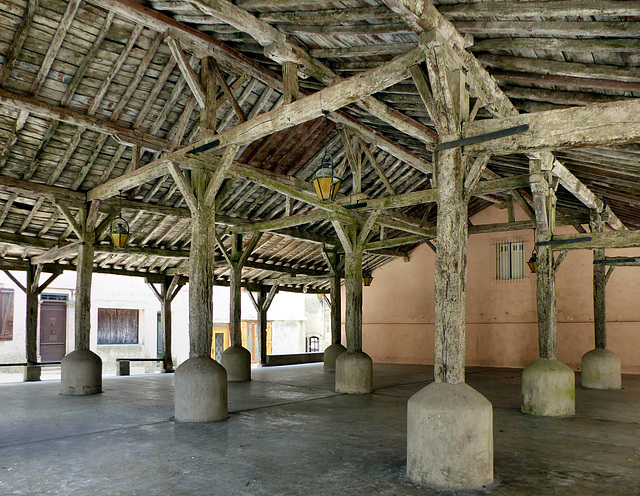
Fanjeaux - La halle
In medieval times Fanjeaux, located on a steep hill, was a pretty large village with a population of about 3000 (today 700). It was an important place during the Albigensian Crusade. Dominic Gúzman (future "Saint Dominic"), who preached against the Cathars had settled nearby and Simon de Montfort´s armee had the headquarters during the crusade here for five years.
In 1355, during the Hundred Years` War, troops led by Edward of Woodstock (aka "The Black Prince", "Prince noir") conquered and destroyed Fanjeaux, that got rebuilt and strongly fortified by a surrounding wall and 14 (!) towers.
Located in the center of Fanjeaux is this shady market-hall.
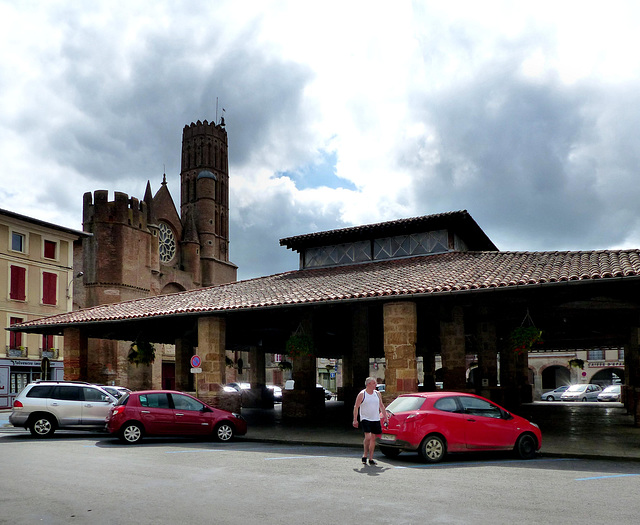
Montesquieu-Volvestre - La Halle
Raymond VII, the Count of Toulouse, who signed the Treaty of Paris (1229), that ended the Albigensian Crusade and the political autonomy of Occitan, founded the town in a loop of the River Arize in 1238 as a bastide.
The town still has the typical layout - and a central square right in its center. Here is the market hall and behind Saint-Victor, the parish church.
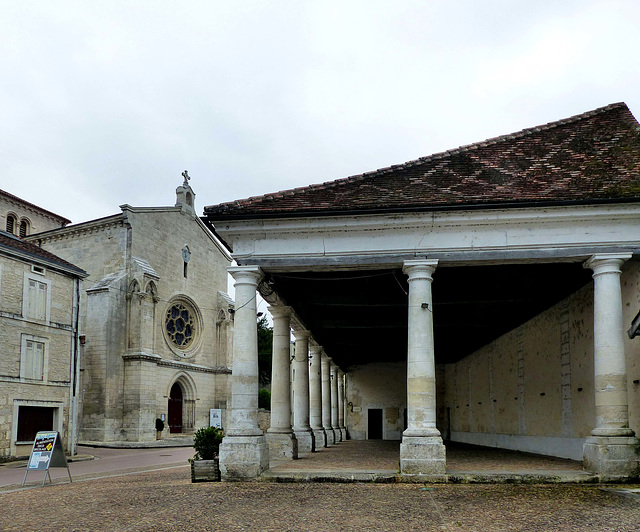
Lisle - La Halle
A market hall with an added lavoir (wash basin) did exist in Lisle since centuries. In 1846 it was decided to tear down the old hall - and replace it by this posh new one. It was inaugurated on 12. November 1856. To the left is Saint Martin, the parish church.
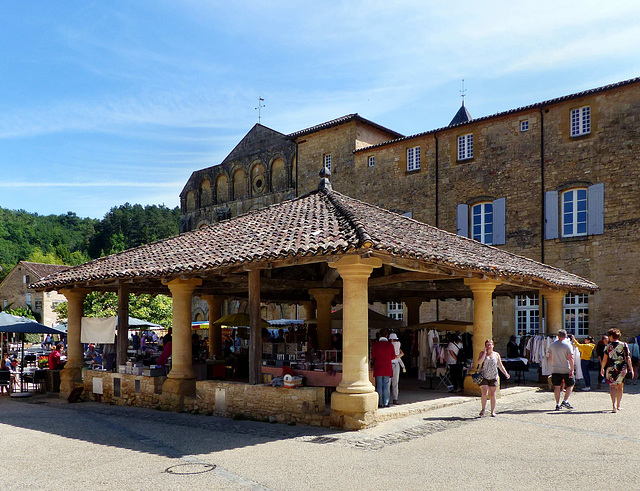
Abbaye de Cadouin
A hermitage was founded here by Géraud de Salles, a friend of Robert de Arbrissel, the of the Cistercian abbey of Fontevrault. In 1119 the hermitage was made an abbey, connected to the Abbaye de Pontigny. The Abbaye de Cîteaux ceded twelve monks to Cadouin for the first settlement of the monastery.
Around 1200 the monastery came into possession of the "Saint-Suaire de Cadouin". This was believed to be the facecloth from the tomb of Christ, said to have been brought from Antioch by a priest after the first crusade. This relic made the abbey an important place of pilgrimage on the way to Santiago and brought it great prestige and wealth. Even Louis IX of France ("St. Louis"), Richard I of England ("Richard the Lionheart") and Emperor Charles V ("Charles Quint") visited Cadouin to see the relic.
The war of the 14th century let the pilgrimage come to an end and let the abbey decline. In 1357 the abbey was ruined and only two monks stayed to guard the shroud, that was transferred to Toulouse in 1392. This transport of shroud to Toulouse deprived the abbey of donations.
The shroud returned and with the strong support of the French Kings, the abbey recovered after 1455. Thanks to royal protection, the cloister was rebuilt in an extravagant way. The revive the economy this market hall next to the abbey was erected.
Though the authenticity of the shroud was attested in 1644, the abbey did never fully recover after the Wars of Religions. During the French Revolution, the abbey was dissolved and got looted. In 1793 the abbey, apart from the church, was sold as a national property.
The abbey was famous for its library, but most books were burnt in the village square.
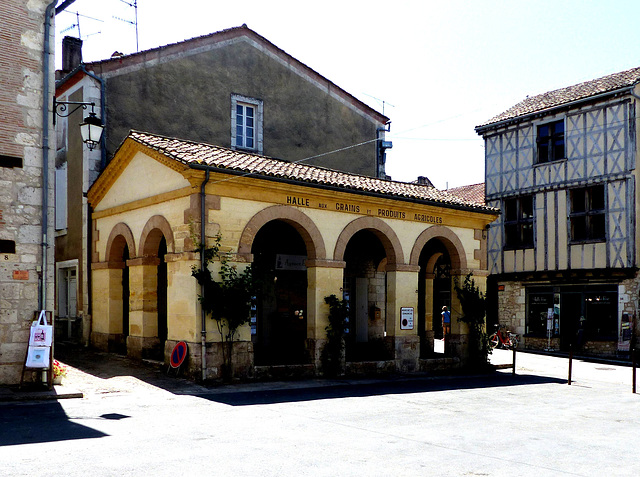
Issigeac - HALLE aux GRAINS et PRODUITS AGRICOLES
Legends tell, that Issigeac developed around a Benedictine monastery established by Saint Cybard. A convent dedicated to Saint Peter existed here indeed from the 7th century on.
Pope Eugene III mentioned the convent around 1053. In 1317 a bishopric was established in Sarlat, but first bishop claimed, that the revenues were not sufficient to meet the episcopal duties. So he asked Pope John XXII to add the deanery of Issigeac with all the income to the see of Sarlat. The Pope agreed.
In 1482 the Bishop of Sarlat chased the monks out of the monastery and established canons here. Around that time the reconstruction of the church started. During the Wars of Religion, the Protestants set fire and partially demolished the church, but the Bishop of Sarlat had it rebuilt.
Like most town in France, Issigeac has a market hall.
Jump to top
RSS feed- Latest items - Subscribe to the latest items added to this album
- ipernity © 2007-2025
- Help & Contact
|
Club news
|
About ipernity
|
History |
ipernity Club & Prices |
Guide of good conduct
Donate | Group guidelines | Privacy policy | Terms of use | Statutes | In memoria -
Facebook
X
