


Nativities


Athens - Byzantine and Christian Museum
| |
|
Athens, the southernmost capital on the European mainland, is one of the world's oldest cities, with its recorded history spanning over 3,400 years. According to Greek mythology the city was named after Athena, the ancient Greek goddess of wisdom. Classical Athens was one of the most powerful city-states in ancient Greece. It was a centre for democracy, the arts, education and philosophy, and was highly influential throughout the European continent, particularly in Ancient Rome. For this reason it is often regarded as the cradle of Western civilisation and the birthplace of democracy.
Founded in 1914, it is now located in the former villa of the Duchess of Plaisance, also known as the Villa Ilissia, in close proximity to the War Museum. It houses more than 25,000 exhibits, artifacts from the 3rd century AD to the late Middle Ages.
Nativity, marble, Athens, 13th c.

Athens - Byzantine and Christian Museum
| |
|
Athens, the southernmost capital on the European mainland, is one of the world's oldest cities, with its recorded history spanning over 3,400 years. According to Greek mythology the city was named after Athena, the ancient Greek goddess of wisdom. Classical Athens was one of the most powerful city-states in ancient Greece. It was a centre for democracy, the arts, education and philosophy, and was highly influential throughout the European continent, particularly in Ancient Rome. For this reason it is often regarded as the cradle of Western civilisation and the birthplace of democracy.
Founded in 1914, it is now located in the former villa of the Duchess of Plaisance, also known as the Villa Ilissia, in close proximity to the War Museum. It houses more than 25,000 exhibits, artifacts from the 3rd century AD to the late Middle Ages.
The Nativity, marble slab, Naxos, 4th c. early 5th c
Huesca - San Pedro el Viejo
| |
|
The Monasterio de San Pedro el Viejo ("Saint Peter the Old") is a former Benedictine monastery built within the 12th century. A church had existed here (built on the place of a Roman temple) since Visigothic times and even, when the Moors hold Huesca, this church was in use.
Christian troops conquered Huesca in 1096 and from 1117 on Benedictines with obvious ties to Cluny reconstructed the church and erected a monasterio here.
Of course the Benedictian monastery needed a decent cloister. This got erected adjoining the church around 1140. Many of the capitals, carved in the style of the "Master of Agüero" (aka "Master of San Juan de la Peña"), are creations done during the renovation of San Pedro el Viejo end of the 19th century.
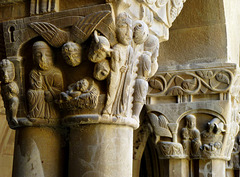
The Nativity - seen twice.
In the foreground is the old capital from the 12th century, while in the background a kind of "copy", carved in the second half of the 19th century, can be seen.
Étampes - Notre-Dame-du-Fort
| |
|
Since the times of Hugh Capet, the first King of the Franks of the House of Capet, Étampes was an important place. It was a crown domain between Paris and Orleans. Hugh´s son Robert II (aka "Robert the Pious") built a stronghold here and founded a collegiate here in the 11th century.
The former collegiate church Notre-Dame-du-Fort was erected within the 12th century in (traditional) Romanesque and (modern) Gothic style. Only the crypt dates back to the earlier 10th century-church. Here the relics of the martyrs Cantius, Cantianus, and Cantianilla were kept. The popular saints were orphaned siblings beheaded during Diocletian's persecution. "Robert the Pious" had transferred the relics to Étampes from Milano.
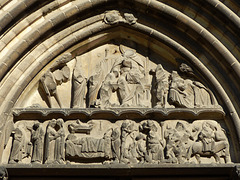
Meanwhile Notre-Dame-du-Fort serves the parish. In 1562, during the first War of Religions, the Calvinist troops raided and ransacked the church. Here is, what the vandals left of the tympanum over the western portal, erected within the 13th century. All carvings that could be reached during the fury iconoclasm are severely damaged. In case something was spared, it got smashed during the French Revolution.
"The story" can still be seen.
It starts in the left corner of the low tier
(from left to right)
- the Annunciation (Luke 1:26-39)
- the Visitation (Luke 1:39–56)
- the Nativity of Jesus
- the Annunciation to the shepherds (Luke 2:8–14)
- the Massacre of the Innocents (Matthew 2:16-18)
- the Flight into Egypt (Matthew 2:13-15)
The upper tier depicts in the center
- the Adoration of the Magi. Mary seated on a wooden throne.
- I am not sure about the left side. The Magi´s three horses?
Is there a wing of an angel?
- to the right are the Dreaming Magi.
Pisa - Baptistry
| |
|
The construction of the "Battistero di San Giovanni" started in 1152 to replace an older baptistry. Since its completion in 1363 the transition from (Pisan) Romanesque to (Pisan) Gothic style was visible.
The baptistry was designed by Diotisalvi, who signed and dated the building ("1153"), similar to the "Chiesa del Santo Sepolcro" (previous uploads), he had designed some decades before.
The baptistry is about 54 m high, with a circumference of 107 m.
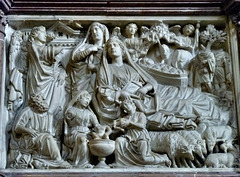
The pulpit of the baptistry is a masterpiece created in 1255-60 by Nicola Pisano, father of Giovanni Pisano. The pulpit's reliefs depict scenes from the life of Christ. Pisono´s works are strongly influenced by classical art and many see Pisano as a precursor of Italian Renaissance sculpture.
Here is the Nativity scene of the pulpit. There is the "Annunciation", the "Annunciation to the shepherds", Jesus in the manger, the "First Bath" - and in the center majestically recumbent Virgin Mary - just like an Etruscan tomb sculpture.
Pisa - Duomo di Santa Maria Assunta
| |
|
|
The construction of the "Duomo" began in 1064 by the architect Busketo, who with this structure set the model for the distinctive Pisan Romanesque style of architecture.
When the construction of this cathedral started, Pisa was on a height of political (and financial) power. Pisa was an important commercial centre controlling large parts of the Mediterranean merchant fleet and navy.
In 1017 Pisa had militarily supported the Sardinian "Giudicati" (regional kings) to defeat Saracen troops in the north of Sardinia. Between 1030 and 1035, Pisa defeated rival towns in Sicily. In 1051–1052 admiral Jacopo Ciurini conquered Corsica. In 1063 admiral Giovanni Orlando, coming to the aid of the Norman Roger I, took Palermo from the Saracen. The gold treasure taken from the Saracens in Palermo allowed the Pisans to start the building of the cathedral.
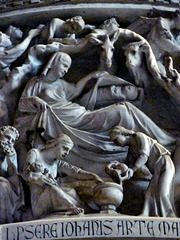
The elaborately carved pulpit was carved by Giovanni Pisano (1302–1310) probably in cooperation with his father Nicola, who created the pulpit in the neighbouring baptistry. The hexagonal pulpit survived the fire, that severely damaged the cathedrale in 1595. It was packed away during the renovation.
After centuries it got rediscovered and is back in the cathedral since 1926. It is a masterwork. Influenced by French Gothic and Ancient Roman art, Pisano and his father are precursors of the Italian Renaissance.
One of the pulpit´s nine large reliefs depicts the Nativity. Here is a detail. Mary recumbent like an Etruscan lady looks at the baby. Below - the midwives prepare the "First Bath".
Lucca - Duomo di Lucca
| |
|
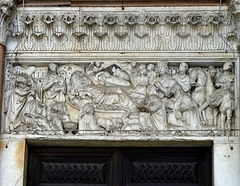
Lucca existed already in Etruscan times and became a Roman colony in 180 BC. The Diocese of Lucca dates back to the first century, legends tell, that St. Paulinus, a disciple of St. Peter, was the first Bishop of Lucca. In medieval times Lucca was the residence of the Margraves of Tuscany. After the death of Matilda of Tuscany (1115), Lucca constituted itself as an independent republic. Actually the "Republic of Lucca" existed from 1160 to 1805.
The Cathedral of Saint Martin is the seat of the Archbishop of Lucca. The construction of the cathedral started in 1063, when Anselm (later Pope Alexander II) was bishop here.
The western facade was begun in 1204 by Guido Bigarelli, who later sculpted (and signed!) the the octogonal baptismal font in the center of the Pisan Baptistery. He is one of the many gifted artists, that came from the area around the Lake Como and are known as "Comacine masters".
The main theme of the reliefs of cathedral´s western wall, inside the portico, is the life of Saint Martin (previous uploads), but there is of course more.
Here a Nativity scene with the Adoration of the Magi. It reminds on the works in Pisa (Baptistry, Duomo), but does not have the elegance. Here again Mary is depicted like a Etruscan lady.
Verona - Basilica di San Zeno
| |
|
Already Theodoric the Great, King of the Ostrogoths, may have funded a church, erected over the tomb of Saint Zeno, who, following the legends, was born in Mauretania and died around 380 in Verona.
The erection of the present church began in the 9th century. Soon after San Zeno´s relics were translated into the new church. At that time Charlemagne´s son Pepin (aka "Pepin of Italy") resided in Verona and a large Benedictine monastery grew all around the church.
When the Magyars invaded Italy in the early 10th century, the church got severely damaged, but the relics were not harmed, as they had been taken out and were hidden. In 967, a new church was built with the patronage of Otto I.
On January 3, 1117, the church was damaged by an earthquake, that ruined so many buildings in Northern Italy. The church was restored and got enlarged in 1138.
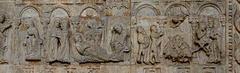
The façade is striking! It was created in two different stages. The portico and the portal were carved before 1138 by Niccolò (see "Duomo de Verona") and his school. During the second half of the 12th century Master Guglielmo ("Gugliemus") completed the facade.
These reliefs, probably carved by Niccolò (and/or his school), depict:
The "Annunciation", the "Visitation", the "Nativity". the "Annunciation to the shepherds" and the Magi talking to Herod.
Mary has already this "etruscan" posture, that later was often used by Bonnano and Andrea Pisano (eg pulpits in the Baptistery and Duomo in Pisa).
Gannat - Sainte Croix
| |
|
The parish church Sainte Croix in Gannat is the result of a very long and complex history. Two apses and some parts of the transept date back to the 12th century.
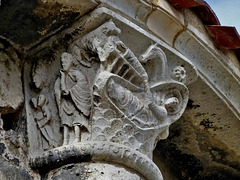
Outside one of the romanesque apses is this remarkable nice capital, depicting the Nativity.
On the right is an angel in the sky above two shepherds. The shepherds standing close together in a gesture of scare and surprise. To the right a very large Joseph. Contemplating in a typical pose, holding the elbow, the hand at his chin. Next to Josph´s head the rear part of the ox.
On the center of the capital is Mary resting in a boatlike bed, crowned by a halo. Connected via a spiraled chord to Jesus, who is tightly swaddled and placed in a manger. Above him the ox and a horse, what in this context can be a very elegant ass.
Dolianova - Cattedrale di San Pantaleo
| |
|
|
|
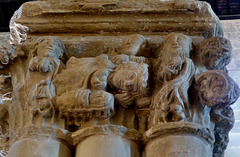
A diocese of Dolia (the ancient name of Dolianova) existed from 1089 until 1503, when it was merged into the archdiocese of Cagliari. The "Cattedrale di San Pantaleo", the bishop's seat of the former diocese, was erected within the 12th and the 13th century. It got consecrated in 1289.
The church was built in Pisan-Romanesque style. The workshops, that decorated the façade and the outer walls had a significantly different style, than the artists, that worked inside the building.
Here is the Nativity scene, carved within the 13th century.
Around the same time Nicola Pisano started to create the Nativity scene for the pulpit of the Baptistery in Pisa.
Trogir - Cathedral of St. Lawrence
| |
|
|
Trogir was founded by Greek colonists in the 3rd century BC. In Roman times this was an important harbour town. From the 9th century on Trogir was under Croatian rule and later part of the Byzantine empire. A diocese was established in the 11th century, in 1107 the Hungarian-Croatian King Coloman ("The Bookish", "Kálmán Könyves") granted the autonomy.
Saracen troops conquered Trogir in 1123 and demolished most of it. From 1420 upto 1797 Trogir belonged to the Republic of Venice. For a short while it belonged to the Napoleonic kingdom of Italy, but upto 1918 Trogir was part of the Habsburg Empire.
Trogir is more than 2000 years old. It grew under the influence of the ancient Greeks, the Romans, and the Venetians... Trogir's medieval core, surrounded by walls, comprises (about 10) churches, houses and palaces from the Romanesque, Gothic, Renaissance and Baroque periods.
Since 1997 the centre of Trogir is a "UNESCO World Heritage Site".
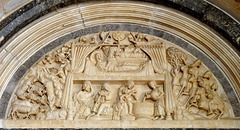
The Cathedral of St. Lawrence was erected from 1213 on the foundations of cathedral destroyed by the Saracens in 1123. Most of the work was done in the 13th century.
This cathedral is world wide known for Master Radovan´s portal seen here. The portal was carved by the local architect and sculptor Master Radovan (and his workshop). It was completed and signed by Radovan in 1240.
The tympamum over the main doors.
The grand drape has risen - and seen "on stage" is the Nativity.
Mary in childbed, Jesus behind her, watched by ox and ass. Below them, the midwives prepare the "First Bath", watched by Joseph. To the left are the shepherd (herding goats) - and to the right, the Magi approaching Bethlehem on horsebacks. There are many inscriptions. The main line is on the bottom, as it gives the title "post partum" (childbed), the author "Raduanum" and the date, as work was completed, when "Treguan from Florence was bishop of Trogir"
"Fundatur valve post partum virginis alme per Raduanum cunctis hac arte preclarum ut patet ex ipsis sculpturis et ex anagliphis anno milleno duceno bisque viceno presule Tuscano Floris ex urbe Treguano".
Trogir - Cathedral of St. Lawrence
| |
|
Trogir was founded by Greek colonists in the 3rd century BC. In Roman times this was an important harbour town. From the 9th century on Trogir was under Croatian rule and later part of the Byzantine empire. A diocese was established in the 11th century, in 1107 the Hungarian-Croatian King Coloman ("The Bookish", "Kálmán Könyves") granted the autonomy.
Saracen troops conquered Trogir in 1123 and demolished most of it. From 1420 upto 1797 Trogir belonged to the Republic of Venice. For a short while it belonged to the Napoleonic kingdom of Italy, but upto 1918 Trogir was part of the Habsburg Empire.
Trogir is more than 2000 years old. It grew under the influence of the ancient Greeks, the Romans, and the Venetians... Trogir's medieval core, surrounded by walls, comprises (about 10) churches, houses and palaces from the Romanesque, Gothic, Renaissance and Baroque periods.
Since 1997 the centre of Trogir is a "UNESCO World Heritage Site".
The Cathedral of St. Lawrence was erected from 1213 on the foundations of cathedral destroyed by the Saracens in 1123. Most of the work was done in the 13th century.
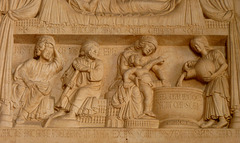
This cathedral is world wide known for Master Radovan´s portal. The portal was carved by the local architect and sculptor Master Radovan (and his workshop). It was completed and signed by Radovan in 1240.
The tympanum depicts scene from the Nativity.
Here the "First Bath" is being prepared by two midwives, while Joseph and a shepherd ("Pastor") watch them. Inscribed on the vessel is
"vergitur in co(n)ca qui diluit scel(er)a cuncta"
what connects it to the baptism, when the sins are washed away.
Pistoia - San Bartolomeo in Pantano
| |
|
"San Bartolomeo in Pantano" was founded between 726 and 764 by the Lombard physician Gaiduald on swampy ground (= pantano) . A Benedictian convent was established here under the protection of the Marquises of Tuscany.
In 1433 the Benedictines were replaced by Canons Regular. End of the 18th century the monastery was given to the Vallumbrosan Order, which remained here in 1810. Then church became a parish church.
San Bartolomeo in Pantano of today was erected mid 12th century, commissioned by Abbot Buono in 1159. The facade, divided into five compartments with arches, is characteristic for the Pistoiese Romanesque style.
The interior had been modified and altered a couple of times over the centuries, but a renovation undertaken in the 1950s broight back the Romanesque church. The pulpit, created by Guido da Como (aka Guido Bigarelli) in 1250, got restaurated as well.
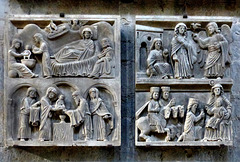
Here are two panels of the pulpit.
T. right - Annunciation
T. left - Nativity / First Bath
B. right - Adoration of the Magi
B. left - Presentation at the Temple

Arezzo - Santa Maria della Pieve
| |
|
Santa Maria della Pieve was erected over the remains of an earlier church from the early 12th century on. It was was the stronghold of the city's struggle against its feudal bishops, who were building the nearby Cathedral and a palace, that was rather a castle just outside the city walls.
It took about two centuries to complete Santa Maria della Pieve, and so there is a mix of Romanesque and Gothic styles. Most unusual is the the facade faces this small street (today "Corso Italia"), while the apse borders to the Piazza Grande.
This carving is titled "PSEPIO", "Presepio" is Italian for "Nativity Scene". A very nice "First Bath" watched by really huge Joseph.
Lavaur - Cathédrale Saint-Alain
| |
|
Lavaur was a bastion of the Cathars in the 12th century. In 1211, after a siege, it was taken by Catholic troops, lead by Simon de Montfort. Dame Guiraude de Laurac, lady of Lavaur at the time, was thrown down a well and stoned to death. About 400 Cathars perished in the flames of one of the largest stakes of the Crusade. The Albigensian Crusade had so many cruelties.
A priory was founded by monks from the Benedictine abbey of Saint-Pons-de-Thomieres was founded here in 1098. At that time a ruined church, dedicated to Saint-Alain, a legendary local monk, existed already. The Benedictines rebuilt that church, that got destroyed in 1211 during the siege of the Montfort´s Catholic armee.
The present church was rebuilt from the monks in the second half of the 13th century. When in 1317 Pope John XXII founded the diocese of Lavaur this church became a cathedral. At that time a couple of small dioceses were founded (eg. Mirepoix, Saint-Papoul, Alet, Rieux..) to increase the presence of Catholic "control" in the former Cathar area.
It is claimed locally, that the Cathédrale Saint-Alain is one of the oldest gothique méridional churches. Younger than the Church of the Jacobins and the Cathédrale Saint Etienne in Toulouse and Notre-Dame-du-Bourg in Rabastens, but older than Sainte-Cecile in Albi.
The gothique méridional style was really modern, when the cathedral was built, but as seen here the Romanesque style was as well still "alive".
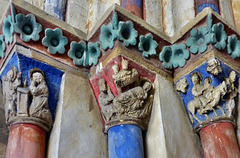
The portal is a perfect mixture. Here are three capitals of the portal´s left side.
The "Annunciation", the "Nativity", the "Flight into Egypt".
Benet - Sainte-Eulalie
| |
|
|
A Benedictian piory existed here since the 11th century. A large church for the convent was erected from the 12th century on. Of this church only the western facade survived. Though weathered and vandalized the facade still has many elements of the Romanesque church. When the church got rebuilt, after the naves had collapsed, in the 15th century large buttresses were needed, to stabilize the structure.
During the French Revolution served as a Temple of Reason and was later used as a saltpeter factory, what means explosive gunpowder (sulfur + charcoal + saltpeter was produced here.
Benet is a small town, west of Niort, in the Vendée, the department where in 1793 the "War in the Vendée", an uprise against the young republic, was fought. The counterrevolutionary rebellion ended, when tens of thousands of civilians were massacred by the Republican army.
A closer look onto Sainte-Eulalie´s facade.
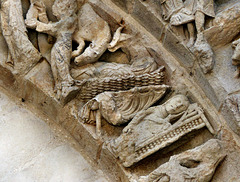
The elaborate archivolt around the central window makes clear, why this is known as a "bible de pierre", a bible from stone. Many biblical scenes can be found here. The carving style is delicate and reminds on works in the Charente (eg Fenioux).
Here is the Nativity scene.
From right - to left:
(Weathered) Joseph, contemplating, Virgin Mary, exhausted in childbed, Baby Jesus (rather tall already) in the crib, watched by ass and ox.
Bremen - Cathedral
| |
|
Charlemagne founded, during the Saxon Wars, the diocese of Bremen. In 787 Saint Willehad became the first Bishop. He erected the first (wooden) church here in 789. Three years later Saxons attacked Bremen and burned down its timber cathedral. The "new" cathedral, erected by Willehad´s successors burnt down with many buildings around in 1041, due to arson.
The cathedral was rebuilt as a pillared basilica. A (still existing) crypt was built under the west part of the nave. The archbishop even brought craftsmen from Lombardy to embellish the cathedral. This may have been expensive, so he tried to be pennywise, by tearing down parts of the fortification and using the stones for the cathedral. This was not wise, as it lead to the return of the Saxons, sacking Bremen and the cathedral in 1064.
The cathedral again was rebuilt probably within the 12th century, the lower storeys of the western façade and towers are constructed in Romanesque style. Continuing the construction over the next centuries, the styles changed.
What is seen today is largely the result of a reconstruction of the 19th century, after the citizens had decided to restore the cathedral to its medieval glory. The cathedral was reopend in 1901. The former catholic cathedral belongs to the Bremian Evangelical Church.
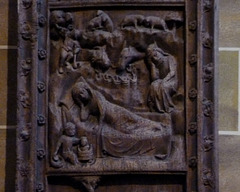
It was rather dark inside the church in late October. Sorry! This carving depicts the Nativity. Joseph is dreaming, Mary is in childbed - and Jesus is sitting in the bathtub. A "first bath".
Cologne - Schnütgen Museum
| |
|
Cologne is the fourth-largest city in Germany - and one of the oldest. A Germanic tribe, the Ubii, had a settlement here, this was named by the Romans "Oppidum Ubiorum". In 50 AD, the Romans founded "Colonia Claudia Ara Agrippinensium", the city then became the provincial capital of "Germania Inferior".
A city with such a history has -of course- many museums. One is the "Museum Schnütgen", devoted to medieval art. In 1906, the collection of Alexander Schnütgen, a theologian and passionate art collector, was donated to the city.
Since 1956, the museum has occupied the Romanesque church of St. Cäcilien (1130-1160), that was once part of a monastery founded in 881. An annex was added in the 1950s, but even now only about 10% of all artefacts can be displayed as of course the collection has expanded since Schnütgen´s donation.
www.museum-schnuetgen.de/Info
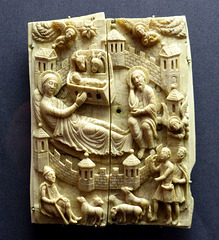
The Nativity of Christ.
Carved from walfus ivory 1150/1160 in Cologne.
Jump to top
RSS feed- Latest items - Subscribe to the latest items added to this album
- ipernity © 2007-2026
- Help & Contact
|
Club news
|
About ipernity
|
History |
ipernity Club & Prices |
Guide of good conduct
Donate | Group guidelines | Privacy policy | Terms of use | Statutes | In memoria -
Facebook
X
