


Medievial Musicians, dancers and acrobats

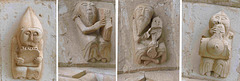
Miñón de Santibáñez - San Pedro
| |
|
Today Miñón de Santibáñez has less than 20 inhabitants. There must have been a larger population when St. Pedro was erected in the 11th century.
The portal of San Pedro is very interesting.
On the outer archivolt sits a kind of medieval orchestra. The musicians could be related to the "Elders of the Apocalypse", but they lack the usual attributes (perfume bottles, crowns...).

Macqueville – Saint-Étienne
| |
|
|
Saint-Étienne is the parish church of Macqueville, a village of a population of about 300. The western front looks very unspectacular, compared to most Romanesque churches of the Saintonge, but there are many corbels along the nave and a very nice side portal.
Two musicians
Migron – Saint-Nazaire
| |
|
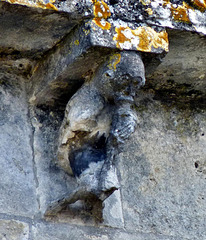
Saint-Nazaire was erected in the 12th century. The church has a very elaborate southern portal. The geometrical design of the archivolts is typical for the "style saintongeais". Above the archivolts are some interesting corbels.
Asses playing harps are very common "animal-musicians".
A monkey playing horn or flute is rarely seen.
Bussière-Badil - Notre-Dame-de-la-Nativité
| |
|
A priory had existed here already from 768 on. The Benedictine abbey was founded 1088, the church of today was built in the 12th century replacing a previous, smaller church, erected probably in the 10th century.
The abbey belonged to the Sacra di San Michele Abbey in Piedmont (more than 700 kms east). The church was strongly fortified and had battlements, watchtowers and even moats at that time.
The facade got heavily vandalized during the French Revolution, when the rioting revolutionists used hammers to destroy sculptures and carvings.
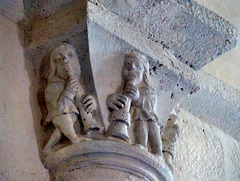
Obviously the vandals could not enter the interior. All the capitals along the nave are undamaged. Here are three flutists. Actually I have never seen such complex flutes. Maybe one of the "pre-1800"-experts can tell me something about.
Belleville - Abbatiale de l'Assomption
| |
|
A settlement has existed here already before Romans and Gauls settled here, the town Belleville was actually founded by the House of Beaujeu. Humbert III de Beaujeu (+ 1194), the 8th Sir de Beaujeu, had a city wall built and founded a commanderie that in 1158 was converted into a Augustinian priory and 6 years later became an abbey.
The church, that now serves the parish is the only remaining structure of this abbey. The construction of the large church (63m long) started in 1168. It was completed only 11 years later and was consecrated and dedicated to the Virgin in 1179.
The nave (and the choir) seem already early Gothic in some parts. The church was the burial site for the House of Beaujeu. Though much of the interior got destroyed durig the Wars of the Religions, there are still nice (and well restored) Romanesque carvings and capitals here.
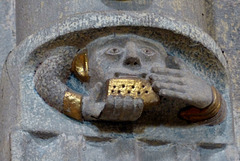
A musician playing a kind of flute
León - Basílica de San Isidoro
| |
|
|
León was founded in 68 AD for a Roman legion from which they were supposed to pacify the rebellious mountain dwellers of Asturias and Cantabria. The name of the settlement that was then developed is based on a refined form of the Latin word "legio".
After the end of the Roman Empire, the city was conquered by the Visigoths and in 712 by the Moors. In 856, after the reconquest under King Ordoño I of Asturias, the city was repopulated. Ordoño II made León the capital of his kingdom of León in 914. Sacked by Almanzor in about 987, the city was reconstructed and repopulated by Alfonso V,
León was an important stop on the Way of St. James to Santiago de Compostela. Traders and artisans settled in the suburbs and had a strong influence on the development of the city from the 13th century onwards. In the early Middle Ages, the city became prosperous through the cattle trade. However, from the 16th century until the 19th century, the economy and population declined.
The Basílica de San Isidoro de León is located on the site of an ancient temple to the Roman god Mercury. In the 10th century, the kings of León established a community of Benedictine sisters on the site.
Following the conquest of the area by Al-Mansur (938–1002), the church was destroyed and the area devastated. León was repopulated and a new church and monastery established in the 11th century by Alfonso V of León.
In 1063 the basilica was dedicated to Saint Isidore of Seville. Isidore was the archbishop of Seville and the most celebrated academic of Visigothic Spain in the period preceding the Arab invasions. With the agreement of the Muslim ruler of Seville, Isidore's relics were brought to Leon where they could be interred on Christian soil.
The church benefited from its position on the pilgrimage route to Santiago de Compostella. Sculptors, stonemasons, and artists from across Europe gathered to work on the monastery.
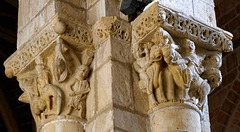
There are interesting capitals along the nave
Musicians and dancers to the left - Lion tamers to the right
Toro - Colegiata de Santa María la Mayor
| |
|
|
The town of Toro lies on a plateau above the Duero River about 40 km east of Zamora.
In medieval times Toro had some importance. Ferdinand III of Castile was crowned king in Toro in 1230, his wife Elisabeth of Swabia died here five years later.
The large collegiate church Colegiata de Santa María la Mayor, whose construction began in 1160 under Alfonso VII, but lasted possibly even until the end of the 13th century. During the reign of the Catholic Monarchs, it was elevated to a collegiate church.
The architectural highlight of the church building is the two-story crossing tower (“cimborrio”) with its sixteen-sided floor plan, with four sides being particularly highlighted by round corner towers, which serve both for architectural decoration and for static stabilization. While the corner towers in the lower part hardly have any architectural decoration, the two levels of the central tower with their windows - accompanied by small columns and ending in oriental-looking multi-aisle arches - are designed in exactly the same way.
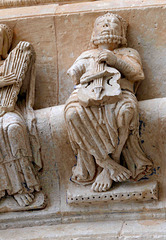
While the main portal is Gothic (see previous uploads), the north portal is Romanesque. The orchestra of the 24 Elders of the Apocalypse are populating the outer archivolt.
This musician plays with his eyes closed. Why did the artist carve a small penis onto his garment?
Teruel - Iglesia de San Pedro
| |
|
|
The place, once inhabited by Celtiberians, was taken by the Romans. In the 8th century, the Arab-Moorish armies advanced into the area and gave it the name Tirwal. In 1171, the Aragonese king Alfonso II conquered Tirwal to strengthen his kingdom's southern border after the Almohads captured the city of Valencia. He “founded” Teruel what empowered him to facilitate the repopulation of the region.
After the inhabitants took part in the conquest of Valencia, Teruel was granted the title of city in 1347 by Pedro IV of Aragon. In the Middle Ages, the Jewish and Mudejar communities gained significant importance in the city's social and economic life.
During the Spanish Civil War, the city changed hands several times and was virtually destroyed. The German Junkers Ju-87 dive bombers were used for the first time in the Battle of Teruel. After the final conquest by Franco's troops, the infamous Condor Legion also briefly used the airfield. It is estimated, that the two sides suffered up to 140,000 casualties between them in the three-month battle.
Today Teruel is a thriving town with a population of about 36.000.
In 1220 disciples of Saint Francis of Assisi founded a Franciscan monastery in Teruel, whose hermitage was demolished on the orders of the Archbishop of Zaragoza to begin building of this church in 1392.
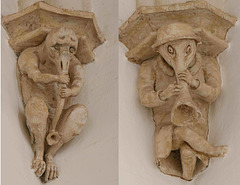
The Mudejar cloister dates to the 14th century. Some very strange musicians perform here.
Córdoba - Museo Arqueológico
| |
|
|
Córdoba shares its history with many cities in Southern Spain. It was Carthaginian and Roman (from 260BC on), later it belonged to the Byzantine Empire for two decades, was looted by the Vandals before the Visigoths conquered it in 572. In 711 it was taken by the by the Umayyad army and became a provincial capital.
At that time a Christian church erected by the Visigoths was on the site, it was divided and shared by Muslims and Christians. In 784 the Christian half was purchased by Emir Abd al-Rahman I, who then demolished the church and started to build the grand mosque of Córdoba on its ground. The Mezquita reached its current dimensions in 987 with the completion of the outer naves and courtyard. It covers an area of more than 23.000 m².
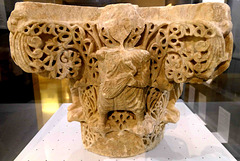
Nothing in Cordoba compares to the Mezquita-Cathedral, but this place has a very long history - and an interesting archaeological museum.
"Musicians" Capital
Marble, Califal., 2nd half of qoth century
Rodeiro - Igrexa de San Vicente
| |
|
|
San Vicente is the parish of the municipality of Rodeiro. The first documentary mention of Rodeiro dates back to 1368, the church may .be a century older.
The floor plan consists of a single rectangular nave and an apse connected by a triumphal arch. The walls are made of granite blocks laid in stone in regular rows. The upper part of the west façade was altered in modern times when the bell tower was rebuilt and replaced by a baroque tower.
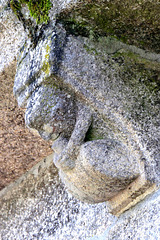
There are some interesting corbels under the roof.
A musician playing a dolium
Romsey - Abbey
| |
|
The Norman-era church, named Romsey Abbey, now serves the parish. Until the Dissolution of the Monasteries it was the church of a Benedictine nunnery.
The church was originally built during the 10th century. The religious community continued to grow and a village grew around it. Both suffered already in the 10th century, when Viking raiders sacked the village and burnt down the original church in 993. However, the abbey was rebuilt in stone in around 1000 and the village quickly recovered. The abbey and its community of nuns flourished and was renowned as a seat of learning – especially for the children of the nobility.
In Norman times a substantial, new stone abbey was built on the old Anglo-Saxon foundation (circa 1130 to 1140). In this general period, the community prospered and by 1240 the nuns numbered more than 100.
The abbey continued to grow and prosper until the Black Death struck the town in 1348. While it is thought that as much as half of the population of the town – which was then about 1,000 – died as a result, the number of nuns fell by over 80% to 19. 72 nuns died including Abbess Johanna. This so affected the area that the overall prosperity of the abbey dwindled.
Although the community of nuns itself was forcibly dispersed in the Dissolution of the Monasteries, the abbey buildings were not demolished. This was because the abbey church had a substantial section dedicated to St Lawrence which served as a place of worship for the townspeople.
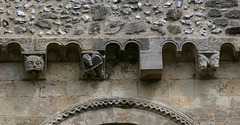
Corbels
Exeter - Cathedral
| |
|
|
|
After the conquest of Britain under Emperor Claudius, the Romans founded the city of "Isca Dumnoniorum" on the site where a Celtic settlement already existed. Numerous sections of the Roman city wall have survived to this day.
In the 7th century, the city fell to Wessex. An Anglo-Saxon monastery was built here around 680. In 876, the Danes attacked Exeter and occupied it briefly, but Alfred the Great was able to drive them out a year later and had the Roman city wall repaired. In 893, Alfred was able to hold the city against a Danish attack for a second time.
In 1001, the Danes again failed to take control of Exeter. However, after the town came into the possession of Emma of Normandy in 1002 through her marriage to Æthelred the Unready as part of her dowry, Emma's steward allowed the Danes under Sven Forkbeard to enter Exeter and sack the city the following year.
In 1050 the seat of the bishopric, formed in 1032 from the bishoprics of Cornwall and Crediton, was transferred to Exeter and Leofric became the first bishop of the bishopric of Exeter.
In 1068 the town was besieged by Norman troops of William the Conqueror, to whom it had refused to swear allegiance, and surrendered after 18 days. The Norman ruler had the fortress of Rougemont built here. However, the Bishop of Exeter also acted as a landowner and feudal lord, as mentioned in the Domesday Book.
In the early stages of the civil war that broke out after the death of Henry I, Baldwin de Redvers held Exeter for three months in 1136 against King Stephen, but then surrendered. Henry II granted Exeter its first charter.
In the 13th century, Exeter developed into the most important city in the southwest of England. It exported tin and cloth, among other things. From 1295 onwards, it sent representatives to the English Parliament.
Exeter had to survive several more sieges, for example in 1467 during the Wars of the Roses, in 1497 by the pretender to the throne Perkin Warbeck and in 1549 by insurgents from Cornwall and Devon who rebelled against the religious reforms of Edward VI, while Exeter remained loyal to the king.
During the English Civil War (1642-1649), Exeter was initially on the side of the supporters of Parliament, but was conquered by the Royalists in 1643 and held for King Charles I for almost three years.
Construction of the cathedral began in 1112 in the Norman/Romanesque style. The outer walls of the nave and the two colossal square towers, which now serve as the transept, are still preserved from this building. The architect of the Romanesque predecessor had resorted to this unusual solution because the crossing towers, which had previously been built according to English tradition, had collapsed.
The new Gothic building began in 1224. The Lady Chapel, a single-nave building with three bays, marked the beginning. Around 1280/90, the retrochoir and the nave followed in the dimensions of the Romanesque church. At about the same time (1270/1280), the chapter house was added to the south transept.
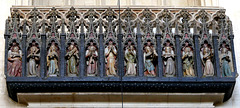
The 14th century minstrels´ gallery has 14 carved angels with different musical instruments.
Exeter - Cathedral
| |
|
|
After the conquest of Britain under Emperor Claudius, the Romans founded the city of "Isca Dumnoniorum" on the site where a Celtic settlement already existed. Numerous sections of the Roman city wall have survived to this day.
In the 7th century, the city fell to Wessex. An Anglo-Saxon monastery was built here around 680. In 876, the Danes attacked Exeter and occupied it briefly, but Alfred the Great was able to drive them out a year later and had the Roman city wall repaired. In 893, Alfred was able to hold the city against a Danish attack for a second time.
In 1001, the Danes again failed to take control of Exeter. However, after the town came into the possession of Emma of Normandy in 1002 through her marriage to Æthelred the Unready as part of her dowry, Emma's steward allowed the Danes under Sven Forkbeard to enter Exeter and sack the city the following year.
In 1050 the seat of the bishopric, formed in 1032 from the bishoprics of Cornwall and Crediton, was transferred to Exeter and Leofric became the first bishop of the bishopric of Exeter.
In 1068 the town was besieged by Norman troops of William the Conqueror, to whom it had refused to swear allegiance, and surrendered after 18 days. The Norman ruler had the fortress of Rougemont built here. However, the Bishop of Exeter also acted as a landowner and feudal lord, as mentioned in the Domesday Book.
In the early stages of the civil war that broke out after the death of Henry I, Baldwin de Redvers held Exeter for three months in 1136 against King Stephen, but then surrendered. Henry II granted Exeter its first charter.
In the 13th century, Exeter developed into the most important city in the southwest of England. It exported tin and cloth, among other things. From 1295 onwards, it sent representatives to the English Parliament.
Exeter had to survive several more sieges, for example in 1467 during the Wars of the Roses, in 1497 by the pretender to the throne Perkin Warbeck and in 1549 by insurgents from Cornwall and Devon who rebelled against the religious reforms of Edward VI, while Exeter remained loyal to the king.
During the English Civil War (1642-1649), Exeter was initially on the side of the supporters of Parliament, but was conquered by the Royalists in 1643 and held for King Charles I for almost three years.
Construction of the cathedral began in 1112 in the Norman/Romanesque style. The outer walls of the nave and the two colossal square towers, which now serve as the transept, are still preserved from this building. The architect of the Romanesque predecessor had resorted to this unusual solution because the crossing towers, which had previously been built according to English tradition, had collapsed.
The new Gothic building began in 1224. The Lady Chapel, a single-nave building with three bays, marked the beginning. Around 1280/90, the retrochoir and the nave followed in the dimensions of the Romanesque church. At about the same time (1270/1280), the chapter house was added to the south transept.
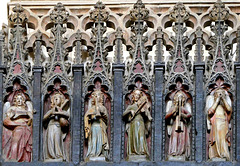
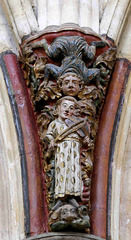
The 14th century minstrels´ gallery has angels with musical instruments. A more detailed look. The second from left plays a bagpipe.
Exeter - Cathedral
| |
|
|
After the conquest of Britain under Emperor Claudius, the Romans founded the city of "Isca Dumnoniorum" on the site where a Celtic settlement already existed. Numerous sections of the Roman city wall have survived to this day.
In the 7th century, the city fell to Wessex. An Anglo-Saxon monastery was built here around 680. In 876, the Danes attacked Exeter and occupied it briefly, but Alfred the Great was able to drive them out a year later and had the Roman city wall repaired. In 893, Alfred was able to hold the city against a Danish attack for a second time.
In 1001, the Danes again failed to take control of Exeter. However, after the town came into the possession of Emma of Normandy in 1002 through her marriage to Æthelred the Unready as part of her dowry, Emma's steward allowed the Danes under Sven Forkbeard to enter Exeter and sack the city the following year.
In 1050 the seat of the bishopric, formed in 1032 from the bishoprics of Cornwall and Crediton, was transferred to Exeter and Leofric became the first bishop of the bishopric of Exeter.
In 1068 the town was besieged by Norman troops of William the Conqueror, to whom it had refused to swear allegiance, and surrendered after 18 days. The Norman ruler had the fortress of Rougemont built here. However, the Bishop of Exeter also acted as a landowner and feudal lord, as mentioned in the Domesday Book.
In the early stages of the civil war that broke out after the death of Henry I, Baldwin de Redvers held Exeter for three months in 1136 against King Stephen, but then surrendered. Henry II granted Exeter its first charter.
In the 13th century, Exeter developed into the most important city in the southwest of England. It exported tin and cloth, among other things. From 1295 onwards, it sent representatives to the English Parliament.
Exeter had to survive several more sieges, for example in 1467 during the Wars of the Roses, in 1497 by the pretender to the throne Perkin Warbeck and in 1549 by insurgents from Cornwall and Devon who rebelled against the religious reforms of Edward VI, while Exeter remained loyal to the king.
During the English Civil War (1642-1649), Exeter was initially on the side of the supporters of Parliament, but was conquered by the Royalists in 1643 and held for King Charles I for almost three years.
Construction of the cathedral began in 1112 in the Norman/Romanesque style. The outer walls of the nave and the two colossal square towers, which now serve as the transept, are still preserved from this building. The architect of the Romanesque predecessor had resorted to this unusual solution because the crossing towers, which had previously been built according to English tradition, had collapsed.
The new Gothic building began in 1224. The Lady Chapel, a single-nave building with three bays, marked the beginning. Around 1280/90, the retrochoir and the nave followed in the dimensions of the Romanesque church. At about the same time (1270/1280), the chapter house was added to the south transept.
A musician with an acrobat and a dog
Rioux - Notre-Dame de l’Assomption
| |
|
Not much is known about the history of Notre-Dame de l’Assomption, an outstanding example of the specific "style saintongeais".
As the structure is so masterly built and has such sophisticated carvings, it is believed, that this was a priory church, when it was built mid of the 12th century.
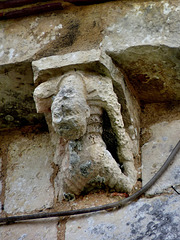
The apse of Notre-Dame de l’Assomption has an enormous richness on Romanesque carvings. Some corbels depict musicians and acrobats. Here is another, small, little weathered contortionist - and a power line.
Pontevedra - Santa Clara
| |
|
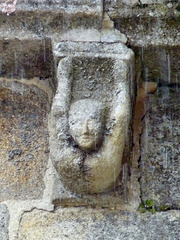
It´s raining cats and dogs, while (since about 700 years) a very flexible acrobat under
the roof of the "Convento de Santa Clara" shows his - backside.
Matha - Saint-Hérie
| |
|
Monks, lay brothers and workers from the Benedictian Abbaye royale of Saint-Jean-d'Angély (20kms northwest), started to build this church end of the 11th century. The Benedictian abbey, part of the cluniac network, had been founded by Louis the Pious´ son Pepin I of Aquitaine in the 9th century. Given up during the Viking raids, the abbey grew rich, famous and important, when the Via Turonensis developed. Thousends of pilgrims followed that way and as a relic of John the Baptist was kept in the abbey, this was a major halt on the "chemin". The abbey sponsored the building of dozends of churches in the Poitou.
The church was dedicated to Saint-Hérie (aka "Saint Arediu", "Arède d'Atane"). The village around the church was consequently named "Saint-Herie" before it got merged into the small town of Matha.
During the 100 Years´War, the area changed hands a couple of times, before the "Battle of Taillebourg" 1242 (30kms west) ended the "Saintonge-War".
The Wars of Religion were even worse for Saint-Hérie. Only the facade and the southern wall of the nave survived the fury. Matha was a stronghold of the Huguenots, who were evicted and exiled after the "Edict of Nantes" got revoked in 1685. Following that all protestant churches existing in the town got leveled to the ground.
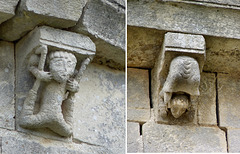
Though only two outside walls of the Romanesque structure are standing, there are many nice corbels. When there are musicians (previous upload) there should be dancers - or concortionists. Here are two contortionists, the left skinny one has extremly log shanks - and tiny feet.
Bouhet - Saint-Laurent
| |
|
The parish church of Bouhet was erected within the 12th/13th century. It was the church of a priory dependent on the abbey of Saint-Jean de Montierneuf in Poitiers. The church was terribly mutilated during the Wars of Relegions and so only a few parts of the Romanesque structure survived and can be seen today.
When it was tried to "rebuilt what was left of the the church after the destruction, it was not possible to put back the carvings "in situ", as most of the church was just gone.
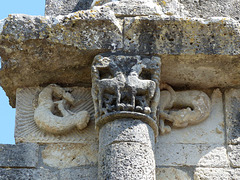
Here is an acrobat, two beasts on the capital in the center and (half of) a lion, chewing the tail.
Jump to top
RSS feed- Latest items - Subscribe to the latest items added to this album
- ipernity © 2007-2026
- Help & Contact
|
Club news
|
About ipernity
|
History |
ipernity Club & Prices |
Guide of good conduct
Donate | Group guidelines | Privacy policy | Terms of use | Statutes | In memoria -
Facebook
X
