


Domes

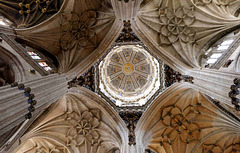
Salamanca - Catedral Nueva
| |
|
|
Salamanca is a "real city" with a population of more than 140.000 inhabitants.
Under Roman and Visigothic rule called “Helmantica,” the city developed into an important trading center. In the 8th century, Salamanca was taken by the Moors, but in 939 it became Christian again as a result of the Battle of Simancas. Salamanca became a border town to the Islamic south of the Iberian Peninsula and was subsequently exposed to constant attacks, which resulted in depopulation and only after the conquest of Toledo by Alfonso VI. León's rule ended in 1085. In 1102 the period of repopulation began. The Christian new settlers rose against Castile-León in 1162 and called on Portugal for help in 1163, which occupied Salamanca for two years.
Salamanca experienced its heyday in the 16th century. In 1524, the construction of the church and monastery of San Esteban began and at the same time, the new cathedral was built.
The "New Cathedral" ("Catedral Nueva") is, together with the "Old Cathedral" ("Catedral Vieja"), one of the two cathedrals of Salamanca. It is the seat of the Diocese of Salamanca.
Following the Reconquista, the Salamanca grew in population and prosperity. The old Romanesque cathedral no longer met the size and representational demands of the bishop, university, and city. In 1513, construction began on the ew bishop's church, which was designed to have enormous dimensions. The northern transept arm of the old church was demolished for this purpose. The ceremonial consecration of the new cathedral did not take place until 1733 after a long, eventful construction history. During the Lisbon earthquake of 1755, the central dome and the bell tower collapsed. The reconstruction was completed by 1762.
Looking up in the central nave
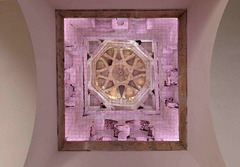
Toledo - El Cristo de la Luz
| |
|
|
In 192 BC, the Romans conquered the area and founded the outpost Toletum. Due to its iron ore deposits, Toledo developed into an important settlement. Since the first barbarian invasions, the ancient walls were reinforced. In 411 the Alans and later the Visigoths conquered the city. Toledo was the capital of the Visigoths' empire from about 531 to 711.
The Moors conquered the place in 712. Toledo experienced its heyday during the period of Moorish rule as Ṭulayṭula during the Caliphate of Córdoba until its conquest by Alfonso VI in 1085, after a four-year siege. In 1088, only a few years after the conquest, Archbishop Bernard of Toledo obtained confirmation from Pope Urban II that Toledo should hold the "primatus in totis Hispaniarum regnis" (primacy in all the kingdoms of the Iberian dominions). The Archbishop of Toledo is still today the Primate of the Catholic Church of Spain.
In the 12th and 13th centuries, the Toledo school of translators translated ancient philosophical writings (Plato, Aristotle) that had been translated from Greek into Arabic, but also genuinely Arabic writings from the fields of astronomy, mathematics, Islamic religion and theology into Latin.
After the conquest by Alfonso VI, Toledo became the residence of the Kingdom of Castile in 1087 and remained the capital of Spain until 1561.
El Cristo de la Luz was erected in 999 as a mosque. It is in much the same state as it was when it was originally built. The Arabic inscription in Kufic on the building states that Musa Ibn Ali built it.
Legend has it that a shaft of light guided the king to a figurine of the crucified Christ that had been hidden for centuries. The legend says that King Alfonso VI arrived in Toledo after capturing the city in 1085 when his horse fell in front of this chapel.
In 1186, Alfonso VIII gave the building to the Knights of the Order of St John, who established it as the Chapel of the Holy Cross (Ermita de la Santa Cruz). It was at this time that the mosque was renamed and the apse was added.
The small, almost cubic mosque (side lengths and height are each about eight meters) has a square ground plan. About half of the building material used is fired brick and half is roughly hewn quarry stone, which is mostly arranged in horizontal bands, following the Roman model. After the conquest of Toledo in 1085, the mosque building was converted into a church. In the 12th century this was expanded in the Mudejar style, so the former mosque became a kind of narthex. Inside the former mosque. Under the dome of the former mosque.
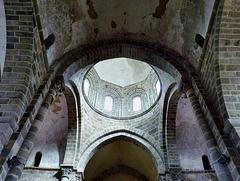
Le Dorat - Collégiale Saint-Pierre
| |
|
The collegiate church Saint-Pierre (aka "St-Pierre-aux-Liens") dates back to the 12th century, though many alterations and the fortification seen here, were done later.
A church and convent that existed here, got looted and burnt down by the Normans in 866. It was named "Scotorum", so it may be have been founded by Scottish/Irish monks.
Around 980 a collegiate was founded here, dedicated to Saint Peter. Under the first monks were Israël and his disciple Theobald, who later became the patron saints of Le Dorat. The church of the collegiate was set on fire by local villagers during a regional war in 1013 and burnt down. The newly built church got consecrated in 1063 - and burnt down in 1080.
Soon after this a crypt was built, but the erection of the church above the crypt did not start before 1112. When in 1130, the choir and the radial chapels were completed, the relics of Saint Israël and Saint Theobald were "translated" into the church, what attracted obviously lots of pilgrims following the Via Lemovicensis to a little detour.
In the following centuries Le Dorat was threatened by and involved into many wars and feuds and so town and church got heavily fortified. That did not help, when in 1567 a Huguenot-armee of 15.000 troops conquered the place, killed about 400 inhabitants and looted town and convent.
All buildings of the collegiate got lost after the French Revolution, only the really large church (74,70 m long) survived the times and now serves as a parish church.
The dome over the crossing.
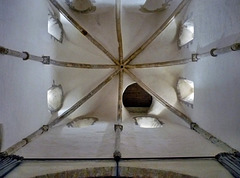
Orval - Sainte-Hélène
| |
|
|
Already within the 7th century a convent, following the Rule of Saint Colomban, existed here upto the Viking raids. New monastic life flourished, when benefactor Renaud d'Orval donated land to the Abbay Sainte-Trinité in Lessay - and a priory was founded here in the 11th century.
The parish church "Sainte-Hélène", erected end of the 11th century, was the priory´s church. The nave is Romanesque, the crossing is probably only a few decades younger. Here are the vaults of the crossing.
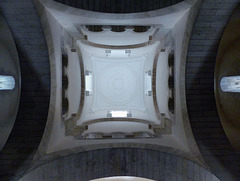
Germigny-des-Prés - Oratory
| |
|
|
This small church in a Germigny des Pres (pop. 750), was built to serve as the private chapel of Bishop Theodulf of Orléans, who had a sumptuous "villa" here.
Theodulf, one of Charlemagne's important counselors, had written the Libri Carolini (aka "Opus Caroli regis contra synodum") at Charles´ request, before Charlemagne appointed him Bishop of Orléans as well as abbot of Fleury Abbey (= "St-Benoit-sur-Loire"), just 7kms east.
All the remains of the residence are gone, destroyed by the Vikings. The "oratorium", that has many parallels to Charlemagne´s palace chapel in Aachen ("Aix-la-Chapelle"), is the last remaining structure. The church was consecrated on January 3, 806.
Odo of Metz (aka "Odo of Armenia") who had worked as a master builder/architect already in Aachen may have worked here as well. The style is clearly influenced by byzantine or even moorish ideas.
In 817, three years after Charlemagne had died, Theodulf was accused of treason and imprisoned in Angers until he died in 821.
The church became part of a priory and was used by the parish since the 13th century, when the western wall and apse were removed to make way for a traditional Latin nave. That Romanesque nave was in turn replaced by the present larger one in the 15th or 16th century.
The renovation, that was completed end of the 19th century, was not done with much "respect": much of the Carolingian masonry was replaced, two flanking apsidioles were removed, the crossing tower was shortened, most capitals were replaced. But this is still a wonderful carolingian chapel and one of the oldest still existing in France.
Under the dome in the center of the oratory.
Valencia - Mercado Central
| |
|
|
|
According to the Roman historian Titus Livius "Valentia" was founded by Consul Decimus Iunius Brutus Callaicus in the 4th century BC,
A century later "Valentia Edetanorum" became one of the first Hispanic cities to become a Roman colony.
The city made rapid progress after the Arab conquest in 711, reaching 15,000 inhabitants in the Caliphate of Córdoba. The Amirids and the Dhun Nunids ruled in “Balansiya”. In 1094, El Cid, a Castilian noble, conquered the city. The conquest was not carried out on behalf of one of the Christian kingdoms, but on the Cid's own account, who proclaimed himself "Señor de Valencia" and thus created a kind of private kingdom. He was able to defend the city against several Almoravid attacks, and after his death in 1099, his widow Jimena managed to hold Valencia until 1102, when it fell to the Almoravids, and a little later to the Almohads.
After the victory of the united Christian armies over the Almohads in the Battle of Las Navas de Tolosa (1212), Moorish Spain fell apart again into individual small kingdoms, including a Taifa from Valencia.
It was finally conquered in 1238 by Jaime I de Aragón (aka "el Conquistador"), after a five-month siege.
In the 15th century, the city grew rapidly and developed into one of the largest Mediterranean ports and an important trade and financial center. At the beginning of the 15th century the city had around 40,000 inhabitants; in 1483 around 75,000 people lived here. During this time, numerous Gothic city palaces were built.
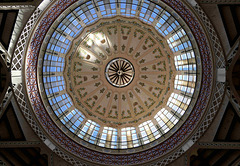
The covered market is located in the historic center of Valencia. A market hall was inaugurated here in 1839, however, towards the end of the century this had become too small for the city's population. A design by Alejandro Soler March and Francisco Guardia Vial for a larger hall was accepted in 1910. The construction of the current building was started in 1914 and completed in 1928.
The Art Nouveau building consists of two halls and has a total area of 8000 m². The basic structure of the larger hall resembles a Christian church, as the two wide main aisles form a Latin cross. Above the intersection of the main aisles, there is a dome 14 meters in diameter and 27 meters high. Adjacent to the shorter main corridor is the smaller octagonal hall, which has another dome in the middle.
Montesiepi - Eremo di Montesiepi
| |
|
|
On the hill, neighbouring to the former "Abbazia di San Galgano" just seen, is the "Eremo di Montesiepi", erected over San Galgano´s tomb.
Legends tell, that the knight Galgano Guidotti (later "San Galgano") had visions. In one vision he arrived accompanied by archangel Michael on top of the Monte Siepi, where he met Jesus and the twelve Apostles.
Galgano Guidotti decided to live a pious life as a hermit and planted his sword in the ground, from where nobody could remove it. The handle of this sword can actually still be seen inside the rotunda. It is said, that many people have tried to steal the sword. There is even a mummified hand of a thief that tried to remove the sword.
A few years after Galgano Guidotti had died in 1181, he got canonized. A pilgrimage started soon after - and the construction of the rotunda started.
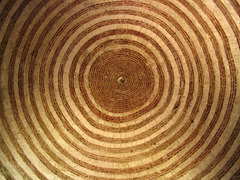
Here is the round dome of the rotunda.
Pretty mesmerizing.
Mantova - Rotonda di San Lorenzo
| |
|
|
Mantua (ital. Mantova) was a settlemt on the banks of River Mincio in Etruscan times. In Roman times veteran soldiers were placed here. About 70 BC the Roman poet Virgil was born nearby.
After the end of the Roman Empire Mantua was invaded in turn by Goths, Byzantines, Longobards, and Franks. In the 11th century, Mantua became a possession of Boniface of Canossa, marquis of Tuscany.
During the 12th century the course of the River Mincio was altered, creating lakes, to reinforce the city's natural protection. Three of these lakes still remains today.
Under the House of Gonzaga, that ruled Mantua for more than three centuries (sometimes in a very despotic way), the city developed and became a center of Renaissance art. At the end of the long war of the Mantuan Succession the city was under Austrian rule.
Mantua was part of the Napoleon's Kingdom of Italy, the city returned to Austria in 1814. A revolt against the Austrians was suppressed by the Austrian army in 1855. Finally in 1866 Mantua and the Lombardy were incorporated into the Kingdom of Italy.
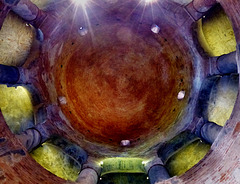
The "Rotonda di San Lorenzo" is the oldest structure in Mantua, going back to the 11th century. This was during the reign of the Canossa family, so the building is often connected to Matilda of Canossa (aka "Matilda of Tuscany"), a powerful supporter of Pope Gregory VII during the Investiture Controversy. But actually there is no proof.
The design is for sure inspired by the Holy Sepulchre church in Jerusalem.
The church fell in disrepair and got deconsecrated in 1579. It was used as a storage room, dwellings and shops. About two centuries later, the church was completely forgotten but got rediscovered end of the 19th century. 1909 - 1911 the building got reconstructed. All external additions got removed, so the brickwork, typical for lombardian architecture of the 11th century, van be seen. As the roof was missing, designs from other rotundas in Northern Italy were studied - and so today the church looks perfect.
The rotunda is "sunken" below the street level. A flight of stairs runs down to the entrance. The reason may be, that the church was built on the round foundations of an ancient Roman temple, dedicated to Venus.
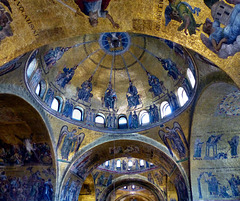
Venezia - Basilica di San Marco
| |
|
Venice (ital. Venezia) is one of the most important tourist destinations worldwide with about 30 million visitors each year.
As each tourist takes at least 100 photos (minimum!) in Venice 3000000000 photos are taken here per year, what means more than 8 millions per day. Many of them are uploaded and can be found in the web.
-
The interior of St. Mark's Basilica´s is absolutely overwhelming. People taking photos are frowned about by the otherwise friendly guardians. As I could not find a pov in the nave, I climbed up to the gallery. So here are the domes...
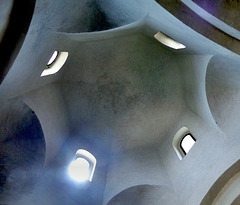
Mariano Comense - Battistero di San Giovanni Batti…
| |
|
|
The Baptistery dedicated to St. John the Baptist, is located next to the church of Santo Stefano. The baptistery is a quadrangular building with apses, having an octagonal dome. It dates to the early 11th century.
I could see the interior of the baptistery, as a very friendly sacristan unlocked the door. Grazie mille!
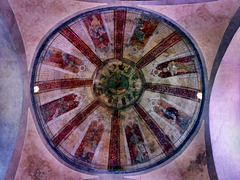
Cahors - Cathédrale Saint-Étienne
| |
|
|
The Cahors Cathedral was erected between 1080 and 1135. It got consecrated by Pope Calixtus II in 1119. The same pope, who two years later could imprison his rival "Antipope" Gregory VIII. Four years later, Calixtus ended the Investiture Controversy by agreeing with Emperor Henry V on the Concordat of Worms.
During the times of medieval pilgrimage this cathedral was an important place on the "Via Podiensis", as the "Sainte Coiffe" could be venerated here. This "Holy Headdress" was believed to have been used during Jesus' burial. It had been given to Aymatus, Bishop of Cahors, by Charlemagne. A relic similar to the "Shroud of Turin".
The most prominent features are probably the two domes. Both domes had (15th c.) frescoes, but only here they could get restored after centuries of neglect.
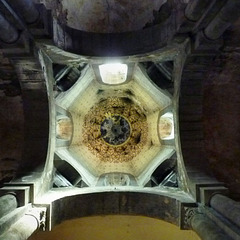
Volvic - Saint-Priest
| |
|
There are two products, this small town, near Riom is pretty famous for.
There are the black stones from Volvic, used all over the Auvergne. The gothic cathedral in Clermont-Ferrand is built from the black stones, coming from Volvic.
The younger product is the "Volvic" mineral water. Zillions of plastic bottles, filled with Volvic-water leave this place every week or month.
Long time before Danone (Evian, Badoit, La Salvetat....) entered the stage in Volvic, this place was owned by St. Priest (aka Priest de Clermont, aka Saint Praejectus), bishop of Clermont. St. Priest was stabbed to death here in 676 and immediately was venerated as a martyr. His sucessor Avitor founded an abbey here, that later was depending from Mozac (1169).
Standing in the center of the crossing - and looking up.
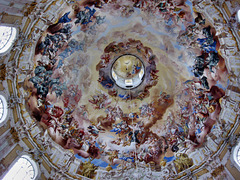
Ettal - Kloster
| |
|
The fresco under the dome. Unfortunately I did not dare to lay down on to the ground in the center. And I did not know, if, in case I would do it, I would be able to get up again without help. Next time, I´ll try to do..
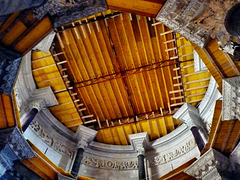
Split - Cathedral of Saint Domnius
| |
|
Split, the largest city of Dalmatia, was (just like neighbouring Trogir) as the Greek colony in the 4th century BC. Roman emperor Diocletian had a palace built as a retirement residence near Salona, the capital of the Roman province of Dalmatia at that time.
After the Romans abandoned the site, the Palace remained empty for several centuries, but when Salona was sacked by Avars and Slavs in the 7th century, the walled Palace of Diocletian was settled by refugees from Salona.
Since the the palace has been occupied, with residents making their homes and businesses within the palace basement and directly in its walls. Today the remains of the palace form about half the old town and city center of Split.
In 1979 the historic center of Split was included into the UNESCO list of World Heritage Sites.
The Cathedral of Saint Domnius ("Katedrala Svetog Duje") is in the center of ancient Diocletian's Palace. The octogonal building was erected in the early 4th century as Emperor Diocletian's mausoleum. Today this church is the seat of the archbishop of the archdiocese of Split-Makarska - and one of the oldest cathedrals worldwide.
Standing under the dome of the cathedral, that once was a mausoleum.
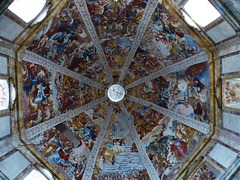
Massa Martana - Santa Maria della Pace
| |
|
Massa Martana has a lovely medieval center, that is still walled and houses some interesting churches. I arrived too early here, as the fog was still in.
"Santa Maria della Pace" outside the town, is located a little higher than Massa Martana, so there it was less foggy already. The construction of the church started in 1521 next to the old Via Flaminia. After completion the church was handed over to the "Third Order of Saint Francis" (aka "Order of Penance of Saint Francis"), who erected a convent here and added a dome to the church.
The large fresco under the the octagon´s cupola was created by Giovanni Antonio Polinori, between 1647 and 1649.
A convent still exists here:
www.provinciasanfrancescotor.it/MassaMartana.htm
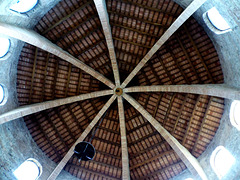
Perugia - San Michele Arcangelo
| |
|
Perugia was an Umbrian settlement on top of a mountain that became a Roman colonia around 250 BC. In 547 Totila´s Ostrogoth troops looted the city after a long siege. Legends tell, that Perugia´s bishop Herculanus, who negotiated with Totila in behalf of his folks, got beheaded by the Ostrogoths, making St. Herculanus (aka "Sant' Ercolano") to the city´s patron saint.
In the 9th century, with the consent of the Carolingians, it passed under the popes. Within the 11th century gained independency. After a long conflict, in 1370 the city signed a treaty accepting a papal legate, but already 5 years later the vicar-general of the Papal States was expelled by a popular uprising. During the Italian Wars Perugia passed through many hands until Condottiero Braccio da Montone reached a concordance with the Papacy. It did not bring peace to the city, but led to the "Salt War" in 1540, that had started as a protest against paying new taxes on salt. The papal troops forced a surrender.
Within a few years, more than hundred houses, as well as churches and monasteries were destroyed and used as building material to built an enormous fortress, the "Rocca Paolina". The fort was for centuries a symbol of oppressive papal rule.
-
San Michele Arcangelo is a paleo-Christian circular building, dating to the 5th to 6th century. It is located near the ancient gate "Porta Sant'Angelo" and was probably erected on the foundations of an older temple.
The interior has an ambulatory delimited by sixteen different ancient monolithic columns, that probably were taken from Roman buildings/ruins and got reused here.
Standing under the dome.
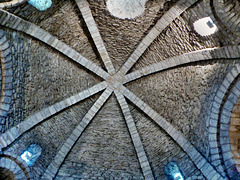
Le Teil - Saint-Étienne de Mélas
| |
|
A church is known in Mélas (now part of Le Teil), located at the Roman road connecting Lyon and Nîmes, since merovingien times. A noble lady named Fredegonde founded a nunnery in Mélas end of the 6th century, dedicated to Saint-Étienne and Saint Saturnin.
Today´s church is younger. It consists out of three parts built in different times.
The oldest part is an octogonal chapel, dated the the 9th/10th century.
The chapel could have been a baptistery or a burial chapel. I tend to the "baptistery" side, though the location is somehow odd, but the place around was sureley different about a thousand years around. The church, that we see now, did not exist.
Under the dome of the octogonal chapel.
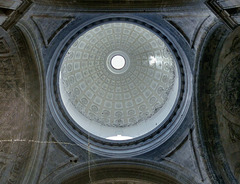
Cádiz - Catedral de la Santa Cruz de Cádiz
| |
|
|
Cádiz, located on a narrow slice of land surrounded by the sea‚ is regarded by some scholars as the oldest continuously inhabited city in Western Europe, founded by he Phoenicians around 1100 BC. Since 530 BCE it was held by Carthaginians, Hannibal visited a temple here, before he set off to cross the Alps and invade Italy.
Later the city fell to the Romans. The Visigoths destroyed the Roman city in 410, Arab troops conquered the city in 711 and called it Qādis. The Normans devasted the city in 844, but the Moors rebuilt it. Alphonso X of Castile took Cádiz from the Moors in 1262 during the Reconquista.
The city got very wealthy by the trade with America and in the 16th century got raided and looted by pirates from Northern Africa and British fleets under Francis Drake and Walter Raleigh.
Cádiz recovered and within the 18th century could afford to erect a (new) cathedral between 1722 and 1838. The cathedral is known as "The Cathedral of The Americas" because it was built with money from the trade between Spain and America. Today the huge cathedral is crumbling, so nets are located above the heads of the visitors. The dome over the crossing.
Jump to top
RSS feed- Latest items - Subscribe to the latest items added to this album
- ipernity © 2007-2026
- Help & Contact
|
Club news
|
About ipernity
|
History |
ipernity Club & Prices |
Guide of good conduct
Donate | Group guidelines | Privacy policy | Terms of use | Statutes | In memoria -
Facebook
X
