


Descent from the Cross / Deposition from the Cross

Joseph of Arimathea doing his job
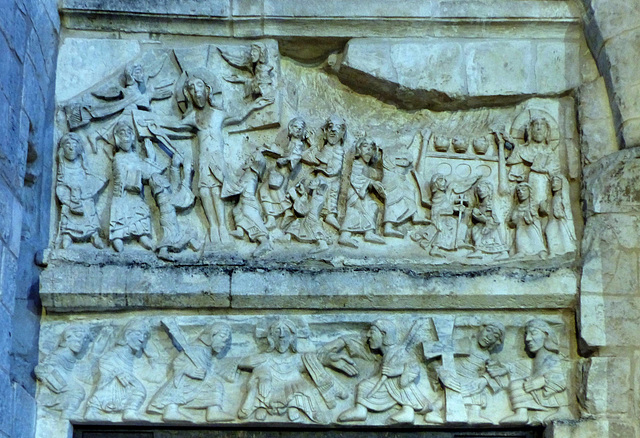

Monte Sant'Angelo - Tomba di Rotari
Legends tell, that in 490, 492 and 493 the archangel Michael appeared to a shepherd and a bishop in front of a grotto. Archangel Michael instructing them to convert that cave into a Christian church. This grotto became the site of many pilgrimages since the early Middle Ages. It is said, that this is the oldest shrine in Western Europe
When the Lombards successfully conquered southern Italy end of the 6th century, King Grimoald in 662 passed on the region to his son, Romuald I, who renovated the sanctuary and encouraged its use as a pilgrimage site. It got very popular for pilgrims on their way to Jerusalem and as well for pilgrims who had followed the Via Francigena to Rome and then continued to the grotto. Many Popes have been here, but as well Bridget of Sweden, Bernard of Clairvaux, Thomas Aquinas, Matilda of Tuscany, Otto III...
Only about 100 meters south of the sanctuary is a complex of (once) three interconnected and partially nested buildings. The apse of the Church of San Pietro, the Church of Santa Maria Maggiore and the "Tomba di Rotari" (aka "San Giovanni Battista in Tomba").
It was believed, that this was the mausoleum of the Lombardian King Rothari, but that was a misinterpretation. The consent now, is, that the 12th structure was a baptistery, dedicated to John the Baptist.
The small portal has an extraordinary very complex tympanum. The upper part is centred around the "Descent from the Cross". Joseph of Arimathea holds large pliers.
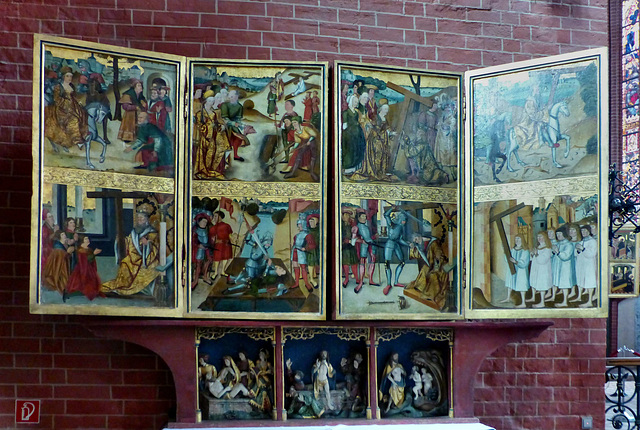
Rostock - Kulturhistorisches Museum
With more than 200.000 inhabitants Rostock is the largest city in the state of Mecklenburg-Western Pomerania.
Small Slavic settlements existed already in the 8th century. A settlement named Roztok was founded in the 11th century by Polabian Slavs. This town was burnt down by troops of the Danish king Valdemar I in 1161. Afterwards the place was settled by German traders.
After 1226 Rostock became the seat of the Lordship of Rostock.
In the 1250s the city became a member of the Hanseatic League. In the 14th century it was a powerful seaport town with 12,000 inhabitants and the largest city in Mecklenburg. Ships for cruising the Baltic Sea were constructed in Rostock. Until the last Hansa Convention in 1669, Rostock took a leading role in the Baltic Sea behind Lübeck.
-
The museum, founded mid 19th century, is hosted in the "Kloster zum Heiligen Kreuz", that got finally dissolved in 1920. The conversion into a museum began already in 1976, but the restoration of the buildings remained incomplete until 1997.
The winged Nonnenaltar (nun's altar) was created in the early 16th century. Its former location was in the church's nuns' gallery, thus the name. The wings show depictions from the legend of the finding of the cross by Empress Helena. Note the predella, depicting the entombment of Jesus, the resurrection and Christ's descent into the underworld.
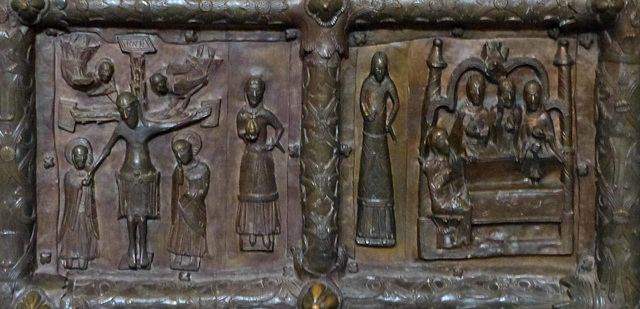
Płock - Bronze door
The town on the Vistula River has been known since the 9th century. In 1009 a Benedictine monastery was founded here. King Bolesław I the Brave built the original fortifications on the Cathedral Hill overlooking the Vistula River. In 1075, the city became the seat of a bishopric. From 1079 to 1138, during the reign of Władysław I Herman and Bolesław III. Wrymouth, the city was the capital of Poland. In 1144 the Płock Cathedral was completed, and in 1180 the first school in Poland was opened in the city, which still exists today as the Liceum Małachowianka.
he 16th century was the golden age of the city before it suffered great population losses due to plague, fire and wars. In 1657, during the Second Northern War, the Swedes destroyed Płock, including the castle, but the population rebuilt it and recovered. In the late 18th century, the old city walls were torn down and a new town was built, where many German immigrants settled.
During the second partition of Poland in 1793, the town was annexed by Prussia. In 1815 it became part of Congress Poland and later was annexed completely by the Russian Empire. In 1939, after the invasion of Poland, the city became part of the German Empire in violation of international law.
The first mention of the cathedral dates back to 1102, when Władysław I Herman was buried there. The present Romanesque cathedral was rebuilt after a fire and lasted from 1136 to 1144, being consecrated in 1144.
The Romanesque bronze door was created in Magdeburg in 1152-1154 by order of the Bishop of Płock and was originally installed in the cathedral. Through the mediation of the Bishop of Magdeburg, the order was given to Master Riquinus. Master Awram from Novgorod was also involved.
The components of the door were cast individually from bronze and nailed to the wooden door in partially reversed order. The sequence of images was changed several times and Russian inscriptions were added.
Between the panels with figural motifs there are wide borders. In total, the door consists of 26 panels. Between the panels there were borders with plant ornaments, which were replaced in the upper part by figural motifs of knights and animals.
The panels depict the cycle of redemption, starting with the scene of the creation of the first man and ending with Christ enthroned as the judge of the world, surrounded by symbols of the evangelists.
The door handles are designed in the form of lion heads holding small human heads in half-open mouths.
The door remained in Płock for about 250 years, then it was brought to Novgorod and installed in St. Sophia's Cathedral. Either it was stolen by the Lithuanians during a raid in the 13th century or it was given to the Prince of Novgorod, Simon Lingwen, the brother of Władysław II. Jagiełło.
Today there is a bronze copy in Płock. The original is in Novgorod.
Descent from the Cross and the Myrrhbearers finding the empty grave.
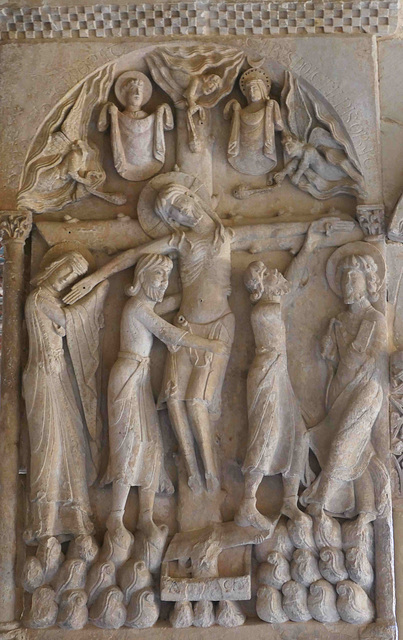
Santo Domingo de Silos - Monasterio de Santo Domingo de Silos
Santo Domingo de Silos is a village with a population of about 300 - and at least one nice hotel.
The first monastery was founded here in the Visigoth period (~ 590), but this monastery did not survive the Muslim period. A monastery was founded here again in 929, but it came to a standstill again after the raids under Almansor in the last quarter of the 10th century.
In 1002 the monastery was destroyed and had to be founded again. During the term of abbot Domingo de Silos from 1041- 1073, the monastery was strongly supported by King Ferdinand I, who was in power 1035 - 1065. Under Abbot Domingo, construction began on a Romanesque church with three naves, a transept and five apses. The consecration took place in 1088 before the construction as a whole was completed after the turn of the 12th century. After abbot Domingo's death, his veneration began and the monastery adopted him as its patron saint. It was called Santo Domingo de Silos from about 1110.
In the 18th century, there was a need for a larger church. The Romanesque church was demolished and replaced by a baroque new building.
The Romanesque cloister has two stories. The lower floor was of course built sometime earlier than the upper floor. The dates are disputed. The oldest parts may date from the late tenure of Saint Domingo. The upper one was completed around 1160/80.
The "Descent from the Cross"
Joseph of Arimathea and Nicodemus are taking Christ down from the cross after his crucifixion
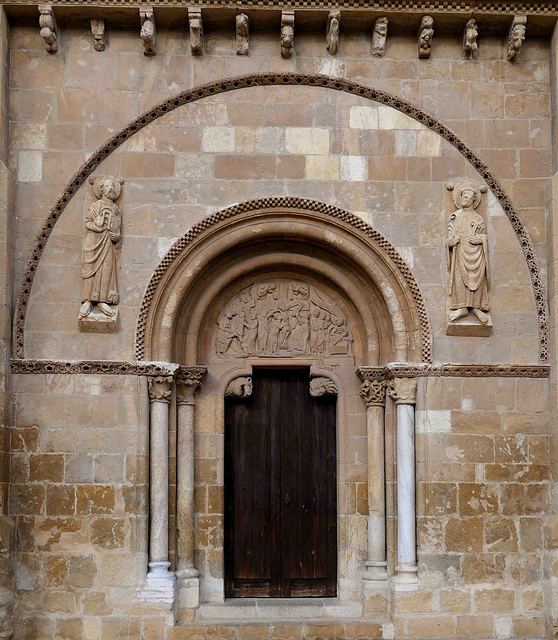
León - Basílica de San Isidoro
León was founded in 68 AD for a Roman legion from which they were supposed to pacify the rebellious mountain dwellers of Asturias and Cantabria. The name of the settlement that was then developed is based on a refined form of the Latin word "legio".
After the end of the Roman Empire, the city was conquered by the Visigoths and in 712 by the Moors. In 856, after the reconquest under King Ordoño I of Asturias, the city was repopulated. Ordoño II made León the capital of his kingdom of León in 914. Sacked by Almanzor in about 987, the city was reconstructed and repopulated by Alfonso V,
León was an important stop on the Way of St. James to Santiago de Compostela. Traders and artisans settled in the suburbs and had a strong influence on the development of the city from the 13th century onwards. In the early Middle Ages, the city became prosperous through the cattle trade. However, from the 16th century until the 19th century, the economy and population declined.
The Basílica de San Isidoro de León is located on the site of an ancient temple to the Roman god Mercury. In the 10th century, the kings of León established a community of Benedictine sisters on the site.
Following the conquest of the area by Al-Mansur (938–1002), the church was destroyed and the area devastated. León was repopulated and a new church and monastery established in the 11th century by Alfonso V of León.
In 1063 the basilica was dedicated to Saint Isidore of Seville. Isidore was the archbishop of Seville and the most celebrated academic of Visigothic Spain in the period preceding the Arab invasions. With the agreement of the Muslim ruler of Seville, Isidore's relics were brought to Leon where they could be interred on Christian soil.
The church benefited from its position on the pilgrimage route to Santiago de Compostella. Sculptors, stonemasons, and artists from across Europe gathered to work on the monastery.
Puerta del Perdón
It is called "Puerta del Perdón" because it was the door through which the pilgrims entered, to obtain the corresponding indulgences and forgiveness of sins in this church.
The tympanum is divided into three parts that show three different reliefs with three scenes: Ascension, Descent and Empty Sepulcher that the three Marys contemplate. The lintel rests on lion and dog heads.
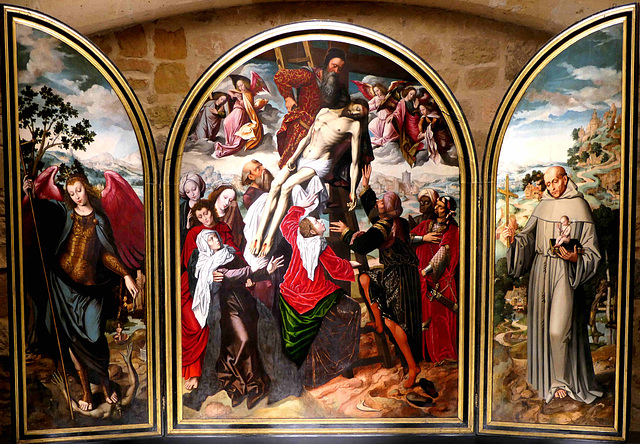
Segovia - Catedral de Segovia
A Celtic castle existed here, from which resistance against the Romans originated. The city was nevertheless taken. Afterward, it began to be built as a Roman city and became an important Roman military base.
In the second half of the 5th century, Segovia became part of the Visigoth Empire. From the 8th to the 11th centuries, Segovia was under Moorish possession. In 1085 Alfonso VI conquered the city. From the 13th to the 15th century it was a royal residence.
The predecessor of the Catedral de Segovia (aka "Santa Iglesia Catedral de Nuestra Señora de la Asunción y de San Frutos de Segovia" was a church that began around 1140 when Segovia was repopulated under Alfonso VII. This church was destroyed during a popular uprising in Castile in 1520. In 1525 the cathedral chapter decided to build a new building. The foundation stone was laid in 1525. In 1558 the building was completed up to the transept and was consecrated as a cathedral. It was erected in a late Gothic style, outdated elsewhere in Europe.
In 1614 the large spire was destroyed by lightning. It was made of mahogany imported from America and covered with fire-gilded lead. The cathedral ceilings were also damaged by the fire. During a restoration around 1620, the tower was given its current shape, reduced by 12 m in height.
The cathedral was finally consecrated in 1768. It is 105 m long and 50 m wide. The central nave is 33 m high.
The cathedral houses a large number of paintings.
Flemish painter Ambrosius Benson / ~ 1530 / Triptych of the Descent /
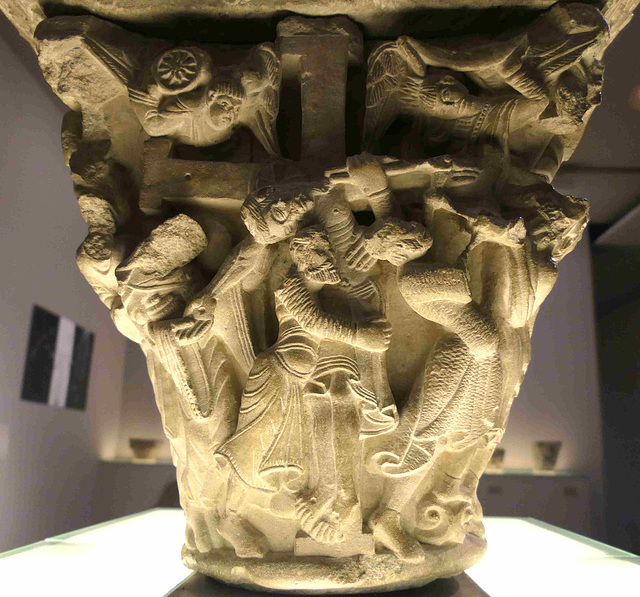
Pamplona - Museo de Navarra
In 74 BC, the Roman city was founded by Pompejus on the site of a local settlement. The city served to secure the Pyrenees crossing from Roncesvalles.
Pamplona was destroyed several times in the course of its history:
466 by the Visigoths, 542 by the Franks, 778 by Charlemagne, 924 by Abd ar-Rahman III and in 1521 during the Franco-Spanish War by troops of Francis I.
Its location on the Way of St. James from France gave the capital of the Kingdom of Navarre a boom in the 11th century. With the division of Navarre, the city ultimately came to Spain.
After the conquest of the country and its incorporation into Castile in 1512-1515, Pamplona became one of the outposts of the Spanish crown on the French border. Its mission for 300 years was to secure the border against a possible invasion from France. Fortifications and walls were a vital system of defense, but at the same time prevented the city from expanding.
The museum is located in the old hospital “Nuestra Señora de la Misericordia de Pamplona” from the 16th century. However, only the facade with the main entrance and the former chapel remain of the hospital.
The Descent from the Cross
Created by the "Maestro del claustro de la Catedral de Pamplona". ca 1150
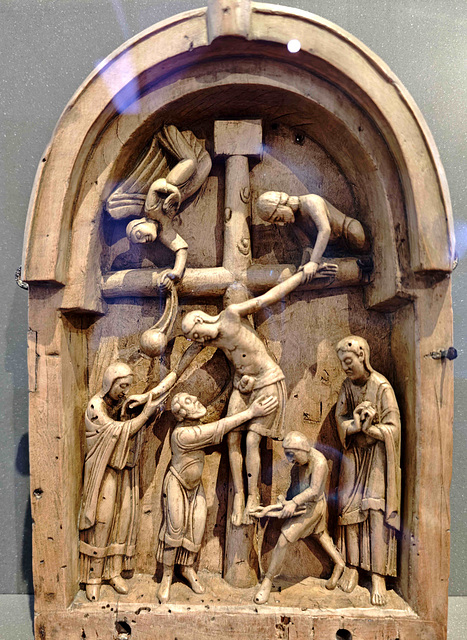
Berlin - Bode-Museum
The Bode Museum (formerly called "Kaiser-Friedrich-Museum), is a building on the Museum Island. It was built from 1898 to 1904 by order of German Emperor William II according to plans by Ernst von Ihne in Baroque Revival style.
During WWII the building suffered comparatively the least damage on Museum Island, but it was not until 1951 that it received a temporary roof. After the end of the war, the new Berlin city administration had all references to former rulers removed and in 1956, Johannes R. Becher, then Minister of Culture of the GDR, ceremoniously renamed the Kaiser Friedrich Museum the Bode Museum.
As part of the Museum Island complex, the Bode-Museum was inscribed on the UNESCO World Heritage List in 1999.
Descent from the Cross
Trier (?) / mid 11th c

Dortmund - Marienkirche
The church was built on the Hellweg, a main Medieval road connecting the free imperial town Dortmund with others. Historians suspect that the visits of Emperor Frederick I Barbarossa and his son Henry VI to the Imperial Palace in Dortmund led to the construction of the Marienkirche.
It was erected between 1170 and 1200 to serve the town's council and jurisdiction. It is the oldest extant church in Dortmund's inner city. Around 1350, a choir in Gothic architecture was built. It served as a model for the Reinoldikirche, which was built opposite of the road.
The church was destroyed in World War II, but rebuilt.
The Berswordt Altar
The paintings on the winged altarpiece date from before 1390 and depict the Annunciation to Mary on the exterior, while the interior depicts a Passion of Christ concentrated in three scenes. The name of the altarpiece goes back to the Berswordt family, whose coat of arms can be found in the corners.
The left panel of the aktar depicts Jesus Carrying the Cross. Simon of Cyrene is forced to help him. While the soldiers' servants beat him forward, several women mourn him.
The middle panel summarizes various episodes of Christ's crucifixion. It shows the collapse of Mary, supported by John. At the foot of the cross, demonic figures haggle over Jesus' robe. At the center of the middle panel is the cross with the dying Jesus, also depicting the lance thrust into his side. To the right and left of Jesus hang the thieves crucified with him. The soul of the repentant one is taken by an angel, that of the hardened one by a devil.
The right panel depicts the Deposition from the Cross. The action is limited to a few people, unlike the abundance of scenes in the central image. Joseph of Arimathea holds the body of Jesus in his arms, while others remove the nails from his feet with pliers and detach his left arm from the cross.
The painter unknown by name; he is referred to by the name "Master of the Berswordt Retable". It has been suggested that the altarpiece is an early work by Conrad von Soest, however, this is disputed.
Jump to top
RSS feed- Latest items - Subscribe to the latest items added to this album
- ipernity © 2007-2026
- Help & Contact
|
Club news
|
About ipernity
|
History |
ipernity Club & Prices |
Guide of good conduct
Donate | Group guidelines | Privacy policy | Terms of use | Statutes | In memoria -
Facebook
X
