


24 Elders

Revelation 4:4
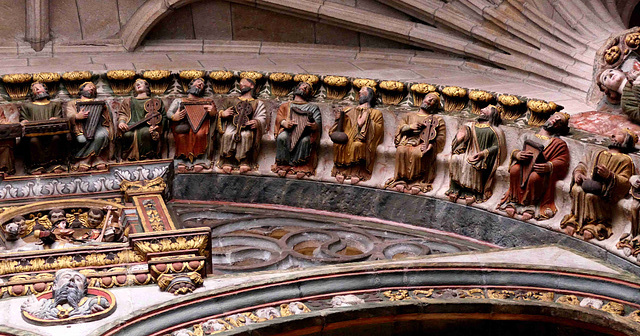
"And round about the throne were four and twenty seats; and upon the seats I saw four and twenty elders sitting, clothed in white raiment, and they had on their heads crowns of gold."
These elders are a common icon found around Europe. They usually hold instruments and sometimes (because of the smell of the rising from the tombs) perfume bottles.
And from time to time the number m… (read more)
"And round about the throne were four and twenty seats; and upon the seats I saw four and twenty elders sitting, clothed in white raiment, and they had on their heads crowns of gold."
These elders are a common icon found around Europe. They usually hold instruments and sometimes (because of the smell of the rising from the tombs) perfume bottles.
And from time to time the number m… (read more)

01 Mar 2023
2 favorites
Ourense - Catedral de Ourense
The Romans were already here and utilised the hot springs. They built a bridge over the river, the Ponte romana, creating an important communication route, which was of course secured by fortifications.
In the 5th century, Ourense became the seat of a bishopric. As the capital of the kingdom of the Suebi, Ourense flourished in the 5th and 6th centuries. The Suebi king Teodomiro († 570) built the first cathedral in Ourense after converting from Arianism to Catholicism.
Constant raids by the Moorish conquerors and the Normans devastated the city to such an extent that it remained almost uninhabited for several centuries. It was rebuilt in 1071 under King Sancho II of Castile. In the following centuries, the city gained importance as a bishop's see, but also as a trading centre. In the 13th century, Ourense was an important trading centre in Galicia due to its geographical location and its large Jewish community. The economic decline began after the expulsion of Ourense's Jews in 1492 by the Catholic Monarchs. In the centuries that followed, Ourense's importance steadily declined.
The earliest cathedral appears to have been a church dedicated to Santa María la Madre. In 550, the Suevian king Chararic built a second church here dedicated to St Martin of Tour. The cathedral was however repeatedly destroyed over the centuries by the Moors and the Northmen who invaded the city. Today's building was constructed as a Romanesque church in the 12th and 13th centuries. Gothic additions followed until the early 16th century. The consecration of the high altar was already in 1188.
The "Pórtico del Paraíso" reproduces, in a simplified manner, the structure of the "Pórtico de la Gloria" of the cathedral of Santiago de Compostela, being later than the latter.
It is a smaller-scale recreation of the Pórtico de la Gloria in Santiago. This one was creared about fifty years after it. The current polychromy dates from the 18th century, and was probably made over the original Romanesque one, of which remains can be seen in the figures on the pilasters. The intention of this sculptural work was to instruct the ancient medieval people in the sacred scriptures.
From left to right, the Old Testament prophets are depicted, while on the right are nine of the twelve apostles, and in the central arcade are the twenty-four elders of the Apocalypse with musical instruments. The smaller arch on the right also depicts the Last Judgement.
The Elders of the Apocalypse - right side
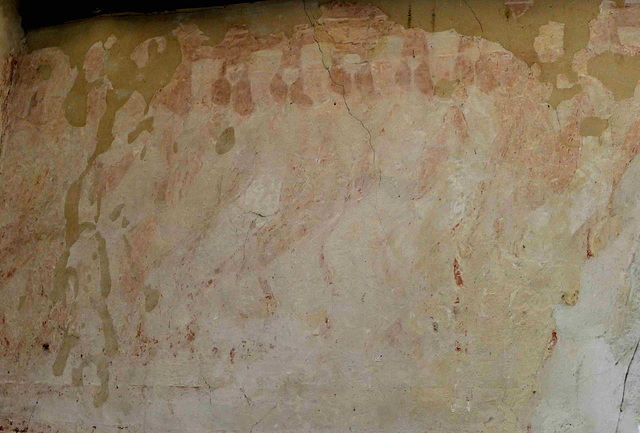
Hardham - St Botolph
St Botolph's Church in Hardham is late Saxon or early Norman. It is considered to be 11th century and was complete by 1125 at the latest. The dedication to St Botolph is generally associated with Saxon churches. Some stones and tiles used by the Romans for their nearby buildings were incorporated into the fabric of the building.
The church changed very little after tit was built. Minimal population growth over the centuries meant that enlargement was not needed; and the parish tended to be poor, with little to spend on rebuilding. Therefore, the church retained its simple appearance until the 19th century, when a porch and bell-turret were added.
In 1862, when a section of whitewash was removed a first painting was found. In 1866 the rest were uncovered. They were faded but clearly discernible.
In the early 12th century, St Pancras' Priory at Lewes, one of the richest monasteries in England, apparently supervised the decoration of the church interior with an extensive set of frescoes. Murals from the same school (the Lewes Group) can also be seen in Shoreham-by-Sea, (see previous uploads). Unusually, the frescoes cover the whole church interior.
Two of the wider themes here are Judgement and Apocalypse.
Here are the "Elders of the Apocalypse".

Lille - Palais des Beaux-Arts
The museum opened in 1809 in connection with the French Revolution, following the confiscation of works of art from noblemen and church property. A central warehouse for the Lille area was established in a former monastery building. The space was soon too small. When, after a move the space in the new town hall became insufficient, it was decided to build a new building in 1882. This building opened in 1892, but was closed in 1895 due to structural defects and reopened in 1998 with a renewed heating and ventilation system. During the First World War, the museum suffered significant damage. After the capture of Lille by German troops, certain works of art were stolen. In 1917 and 1918, parts of the collection were transported to Brussels. The museum was not reopened to the public until 1924, after extensive renovations. In 1991, the museum had to be closed due to urgent renovation work. In 1997, the museum reopened to the public. It now has 22,000 m² of space, of which 12,000 m² are available for exhibitions.
One of the
24 Elders of the Apocalypse
carved from walrus ivory.
Three other similar statues are preserved in Saint Omer, London and New York. They may have once adorned a reliquary in the Abby of St.Bertin.
Jump to top
RSS feed- Latest items - Subscribe to the latest items added to this album
- ipernity © 2007-2026
- Help & Contact
|
Club news
|
About ipernity
|
History |
ipernity Club & Prices |
Guide of good conduct
Donate | Group guidelines | Privacy policy | Terms of use | Statutes | In memoria -
Facebook
X
