


Triumphal crosses

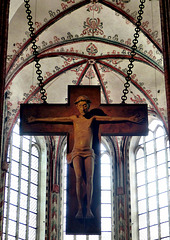
Lübeck - St. Marien
| |
|
The area around Lübeck, today a large city with a population of more than 200,000, had been settled by Slavs since the 7th century. Slavs had a settlement north of the present city called "Liubice", which was razed by the pagan Rani tribe in 1128.
15 years later Adolf II, Count of Schauenburg and Holstein, founded the modern town as a German settlement on the river island of Bucu. He built a new castle, first mentioned as existing in 1147. Adolf II had to cede the castle to the Duke of Saxony, Henry the Lion, in 1158. After Henry's fall from power in 1181, the town became an Imperial city. Emperor Barbarossa ordained that the city should have a ruling council of 20 members. With the council dominated by merchants, trade interests shaped Lübeck's politics for centuries.
In the 14th century, Lübeck became the "Queen of the Hanseatic League", being by far the largest and most powerful member of that medieval trade organization. In 1375, Emperor Charles IV named Lübeck one of the five "Glories of the Empire", a title shared with Venice, Rome, Pisa, and Florence.
Conflicts about trading privileges resulted in fighting between Lübeck (with the Hanseatic League) and Denmark and Norway – with varying outcome. While Lübeck and the Hanseatic League prevailed in conflicts in 1435 and 1512, Lübeck lost when it became involved in a civil war that raged in Denmark from 1534 to 1536. From then on Lübeck's power slowly declined. The city remained neutral in the Thirty Years' War, but the devastation from the decades-long war and the new transatlantic orientation of European trade caused the Hanseatic League – and thus Lübeck with it – to decline in importance. However, Lübeck still remained an important trading town on the Baltic Sea.
In 1160 Henry the Lion moved the bishopric of Oldenburg to Lübeck and endowed a cathedral chapter. In 1163 a wooden church was built, however, at the beginning of the 13th century, it was no longer sufficient to meet the representative demands of the self-confident burghers.
St. Marien was built 1250 - 1350. It has always been a symbol of the power and prosperity of the Hanseatic city. It situated at the highest point of the island that forms the old town.
Gothic cathedrals in France and Flanders made of natural stone were the models for the new construction of Lübeck's three-nave basilica.
St. Marien epitomizes North German "Brick Gothic" and set the standard for many churches in the Baltic region. The church embodied the towering style of Gothic architecture using brick.
The incentive for the City Council to undertake such an enormous project was rooted in the bitter dispute with the Lübeck bishopric. As a symbol of the long-distance merchants' desire for freedom and the secular power of the city, which had been free of the Empire since 1226, the church building in the immediate vicinity of Lübeck's city hall and the market square was intended to clearly and uncatchably surpass in size the city's bishop's church, Lübeck Cathedral.
The large crucifix is the work of the German artist Gerhard Marcks (1889 - 1981), who was one of the Bauhaus masters in the 1920s.
Lübeck - Dom
| |
|
The area around Lübeck, today a large city with a population of more than 200,000, had been settled by Slavs since the 7th century. Slavs had a settlement north of the present city called "Liubice", which was razed by the pagan Rani tribe in 1128.
15 years later Adolf II, Count of Schauenburg and Holstein, founded the modern town as a German settlement on the river island of Bucu. He built a new castle, first mentioned as existing in 1147. Adolf II had to cede the castle to the Duke of Saxony, Henry the Lion, in 1158. After Henry's fall from power in 1181, the town became an Imperial city. Emperor Barbarossa ordained that the city should have a ruling council of 20 members. With the council dominated by merchants, trade interests shaped Lübeck's politics for centuries.
In the 14th century, Lübeck became the "Queen of the Hanseatic League", being by far the largest and most powerful member of that medieval trade organization. In 1375, Emperor Charles IV named Lübeck one of the five "Glories of the Empire", a title shared with Venice, Rome, Pisa, and Florence.
Conflicts about trading privileges resulted in fighting between Lübeck (with the Hanseatic League) and Denmark and Norway – with varying outcome. While Lübeck and the Hanseatic League prevailed in conflicts in 1435 and 1512, Lübeck lost when it became involved in a civil war that raged in Denmark from 1534 to 1536. From then on Lübeck's power slowly declined. The city remained neutral in the Thirty Years' War, but the devastation from the decades-long war and the new transatlantic orientation of European trade caused the Hanseatic League – and thus Lübeck with it – to decline in importance. However, Lübeck still remained an important trading town on the Baltic Sea.
The "Dom zu Lübeck" (Lübeck Cathedral) is around 130 meters long, one of the longest brick churches. In 1173, Henry the Lion laid the foundation stone of the cathedral as a cathedral for the bishopric of Lübeck.
The then Romanesque cathedral was completed in about 1230 and rebuilt into a Gothic hall church between 1266 and 1335. At the same time the lengthening of the structure was done by erecting the pure Gothic east choir, completed in 1341 The length of the cathedral was doubled.
Until the Reformation, the cathedral chapter was under the control of the bishop. After the Reformation, the cathedral became the joint property of the city and the cathedral chapter until 1803, when it became the sole property of the city with the dissolution of the cathedral chapter. The adjoining monastery became the site of the Museum am Dom at the end of the 19th century.
After the heavy air raid on Lübeck on March 28-29, 1942, the eastern vault in the high choir collapsed, destroying the high altar from 1696. The fire in the neighboring cathedral museum spread to the cathedral's roof truss. Next day the spires of the tower collapsed. As a result of the war, the unsecured gable of the northern transept collapsed in 1946.
Reconstruction took several decades, as priorities here tended to be the rebuilding of Lübeck's Marienkirche. The reconstruction was finally completed in 1982.
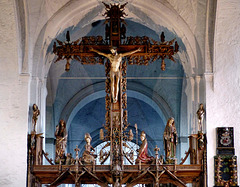
The striking 17-meter high triumphal cross by the Lübeck artist Bernt Notke, dominates the nave.
Bernt Notke (~ 1435 - 1509) was probably one of the foremost artists of his time in northern Europe. One of his main works was the "Totentanz" (Danse Macabre) in St. Marien, was destroyed, during the allied bombing of Lübeck in 1942. This Triumphal Cross got damaged but survived the war. During a restoration in the 1970s a workshop note of Bernt Notke was found inside a finger.
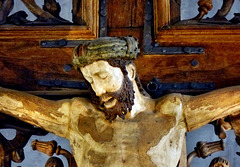
The cross was donated to the cathedral by the Lübeck bishop Albert II. Krummendiek. He is depicted among the sculptures on the triumphal cross as a donor. According to legend, Mary Magdalene looks like his mistress.
Lübeck - Dom
| |
|
The area around Lübeck, today a large city with a population of more than 200,000, had been settled by Slavs since the 7th century. Slavs had a settlement north of the present city called "Liubice", which was razed by the pagan Rani tribe in 1128.
15 years later Adolf II, Count of Schauenburg and Holstein, founded the modern town as a German settlement on the river island of Bucu. He built a new castle, first mentioned as existing in 1147. Adolf II had to cede the castle to the Duke of Saxony, Henry the Lion, in 1158. After Henry's fall from power in 1181, the town became an Imperial city. Emperor Barbarossa ordained that the city should have a ruling council of 20 members. With the council dominated by merchants, trade interests shaped Lübeck's politics for centuries.
In the 14th century, Lübeck became the "Queen of the Hanseatic League", being by far the largest and most powerful member of that medieval trade organization. In 1375, Emperor Charles IV named Lübeck one of the five "Glories of the Empire", a title shared with Venice, Rome, Pisa, and Florence.
Conflicts about trading privileges resulted in fighting between Lübeck (with the Hanseatic League) and Denmark and Norway – with varying outcome. While Lübeck and the Hanseatic League prevailed in conflicts in 1435 and 1512, Lübeck lost when it became involved in a civil war that raged in Denmark from 1534 to 1536. From then on Lübeck's power slowly declined. The city remained neutral in the Thirty Years' War, but the devastation from the decades-long war and the new transatlantic orientation of European trade caused the Hanseatic League – and thus Lübeck with it – to decline in importance. However, Lübeck still remained an important trading town on the Baltic Sea.
The "Dom zu Lübeck" (Lübeck Cathedral) is around 130 meters long, one of the longest brick churches. In 1173, Henry the Lion laid the foundation stone of the cathedral as a cathedral for the bishopric of Lübeck.
The then Romanesque cathedral was completed in about 1230 and rebuilt into a Gothic hall church between 1266 and 1335. At the same time the lengthening of the structure was done by erecting the pure Gothic east choir, completed in 1341 The length of the cathedral was doubled.
Until the Reformation, the cathedral chapter was under the control of the bishop. After the Reformation, the cathedral became the joint property of the city and the cathedral chapter until 1803, when it became the sole property of the city with the dissolution of the cathedral chapter. The adjoining monastery became the site of the Museum am Dom at the end of the 19th century.
After the heavy air raid on Lübeck on March 28-29, 1942, the eastern vault in the high choir collapsed, destroying the high altar from 1696. The fire in the neighboring cathedral museum spread to the cathedral's roof truss. Next day the spires of the tower collapsed. As a result of the war, the unsecured gable of the northern transept collapsed in 1946.
Reconstruction took several decades, as priorities here tended to be the rebuilding of Lübeck's Marienkirche. The reconstruction was finally completed in 1982.
The striking 17-meter high triumphal cross by the Lübeck artist Bernt Notke, dominates the nave.
Bernt Notke (~ 1435 - 1509) was probably one of the foremost artists of his time in northern Europe. One of his main works was the "Totentanz" (Danse Macabre) in St. Marien, was destroyed, during the allied bombing of Lübeck in 1942. This Triumphal Cross got damaged but survived the war. During a restoration in the 1970s a workshop note of Bernt Notke was found inside a finger.
The cross was donated to the cathedral by the Lübeck bishop Albert II. Krummendiek. He is depicted among the sculptures on the triumphal cross as a donor. According to legend, Mary Magdalene looks like his mistress.
A detail.
Lübeck - St.-Aegidien-Kirche
| |
|
|
The area around Lübeck, today a large city with a population of more than 200,000, had been settled by Slavs since the 7th century. Slavs had a settlement north of the present city called "Liubice", which was razed by the pagan Rani tribe in 1128.
15 years later Adolf II, Count of Schauenburg and Holstein, founded the modern town as a German settlement on the river island of Bucu. He built a new castle, first mentioned as existing in 1147. Adolf II had to cede the castle to the Duke of Saxony, Henry the Lion, in 1158. After Henry's fall from power in 1181, the town became an Imperial city. Emperor Barbarossa ordained that the city should have a ruling council of 20 members. With the council dominated by merchants, trade interests shaped Lübeck's politics for centuries.
In the 14th century, Lübeck became the "Queen of the Hanseatic League", being by far the largest and most powerful member of that medieval trade organization. In 1375, Emperor Charles IV named Lübeck one of the five "Glories of the Empire", a title shared with Venice, Rome, Pisa, and Florence.
Conflicts about trading privileges resulted in fighting between Lübeck (with the Hanseatic League) and Denmark and Norway – with varying outcome. While Lübeck and the Hanseatic League prevailed in conflicts in 1435 and 1512, Lübeck lost when it became involved in a civil war that raged in Denmark from 1534 to 1536. From then on Lübeck's power slowly declined. The city remained neutral in the Thirty Years' War, but the devastation from the decades-long war and the new transatlantic orientation of European trade caused the Hanseatic League – and thus Lübeck with it – to decline in importance. However, Lübeck still remained an important trading town on the Baltic Sea.
St. Aegidien was first mentioned in 1227. There may have even been an earlier wooden church between 1172 and 1182 under Bishop Heinrich I of Brussels, who had been abbot of the monastery of St. Aegidien in Braunschweig. The church, which originally had a single nave displays the typical features of brick Gothic architecture. The interior of the church, after the completion of the structure, has also been changed by regular renewals and renovations over the centuries, one of the oldest surviving of which took place in 1645.
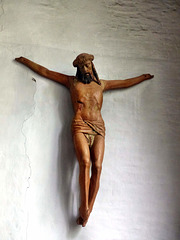
The damaged crucifix is probably from the Gothic period, when the imagery of the agony of the Crucified prevailed. The feet are pierced by a nail, which was common since about 1260.
Ratzeburg - Ratzeburger Dom
| |
|
Ratzeburg is known as an "island town" due to the location of its old town in the middle of Lake Ratzeburg and its connection with the mainland, which is only via three dams.
The town was founded on the island in the 11th century by the local ruler, Prince Ratibor of the Polabians, who was nicknamed Ratse.
In 1044 missionaries led by the monk Ansverus came into the region and built a monastery. In 1066 during a pagan rebellion, the monstery was destroayed and the monks were stoned to death. Ansverus was canonised in the 12th century and his relics were entombed in the Ratzeburg cathedral.
Heinrich der Löwe (Henry the Lion) became the ruler of the town in 1143 and established a bishopric in 1154.
The church, erected between 1160 and 1220, is located on the highest point of the northern tip of Ratzeburg's old town island. The cathedral was donated by Heinrich dem Löwen as the bishop's church of the Ratzeburg diocese.
The impressive building, erected between 1160 and 1220, is located on the highest point of the northern tip of Ratzeburg's old town island. The cathedral was donated by Henry the Lion as the bishop's church of the Ratzeburg diocese.
The cathedral is a three-nave Romanesque basilica with a transept, a Gothic cloister of the attached monastery (1251) on the north side and a massive west tower.
Some elements of the original Romanesque construction were appropriately adapted during the Gothic period.
A comprehensive restoration of the cathedral took place in the second half of the 19th century. After lightning struck during a thunderstorm in 1893, parts of the structure were destroyed by fire. Subsequent restorations were carried out until 1899. The last major restorations (1953-1966) restored the original condition.
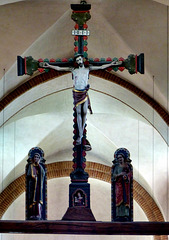
The "Triumphal Crucifix" is dated to the 13th century.
Ratzeburg - Ratzeburger Dom
| |
|
|
Ratzeburg is known as an "island town" due to the location of its old town in the middle of Lake Ratzeburg and its connection with the mainland, which is only via three dams.
The town was founded on the island in the 11th century by the local ruler, Prince Ratibor of the Polabians, who was nicknamed Ratse.
In 1044 missionaries led by the monk Ansverus came into the region and built a monastery. In 1066 during a pagan rebellion, the monstery was destroayed and the monks were stoned to death. Ansverus was canonised in the 12th century and his relics were entombed in the Ratzeburg cathedral.
Heinrich der Löwe (Henry the Lion) became the ruler of the town in 1143 and established a bishopric in 1154.
The church, erected between 1160 and 1220, is located on the highest point of the northern tip of Ratzeburg's old town island. The cathedral was donated by Heinrich dem Löwen as the bishop's church of the Ratzeburg diocese.
The impressive building, erected between 1160 and 1220, is located on the highest point of the northern tip of Ratzeburg's old town island. The cathedral was donated by Henry the Lion as the bishop's church of the Ratzeburg diocese.
The cathedral is a three-nave Romanesque basilica with a transept, a Gothic cloister of the attached monastery (1251) on the north side and a massive west tower.
Some elements of the original Romanesque construction were appropriately adapted during the Gothic period.
A comprehensive restoration of the cathedral took place in the second half of the 19th century. After lightning struck during a thunderstorm in 1893, parts of the structure were destroyed by fire. Subsequent restorations were carried out until 1899. The last major restorations (1953-1966) restored the original condition.
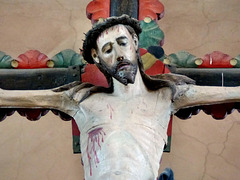
The "Triumphal Crucifix" is dated to the 13th century. Christ´s face.
Eutin - St. Michaelis
| |
|
The Slavic Abodrites settled eastern Holstein since the 7th/8th century A.D. and built a castle on an island in the "Grossen Eutiner See" (Great Eutin Lake). After the Wendish Crusade, in the course of the German settlement in the East, German and Dutch settlers migrated since the 12th century. In 1156 Eutin became a residence of the (prince) bishops of Lübeck. It received the city rights in 1257.
St. Michaelis was built in the 12th century in Romanesque style as a 40m long basilica. Due to the rise of the Lübeck Hanseatic bourgeoisie in the 13th century, disputes arose between the representatives of the bourgeois and the clerical power. Thus, Lübeck's bishop Burkhard von Serkem fled several times from Lübeck to his residence in Eutin and founded here in 1309 the collegiate chapter, which promoted the reconstruction of St. Michaelis from Romanesque to Gothic style. So at that time the choir and apse were replaced by the Gothic choir, which still exists today.
The Reformation in Eutin did not progress for a long time. For many years Catholic services were celebrated in the choir room (behind a rood screen) and Protestant services in the nave.
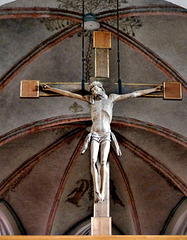
The triumphal cross is said to be from the 13th century, I think it is younger and belongs to the gothic era
Bad Segeberg - Marienkirche
| |
|
Bad Segeberg owes its existence to the "Kalkberg", a gypsum rock, that was about 120m high in the middle ages. This was the borderland between Saxons and Slavs, so Knud Lavard, Danish prince and Jarl (Earl) of Schleswig, unsuccessfully tried to build a castle here. Vizelin, the missionary of the Varrians and Abotrites, drew the attention of Emperor Lothair III to the strategic importance of the Kalkberg, whereupon the first castle was built on it in 1134. This was named "Siegesburg" (hence Segeberg).
After Emperor Lothar III had died, Slavic chief Pribislav of Wagria rebelled against the Holy Roman Empire by destroying the new castle of Segeberg.
Vicelin had founded a monastery around 1134 what was given destroyed together with the castle during Slavic raids. The monks had fled, but they did return and the foundation stone of a huge three-nave cruciform basilica with an adjoining monastery was laid around 1156/57. In 1199, the monastery church was named "eccl. S. Maria" in a Papal document, indicating that it had been consecrated in the meantime.
The later addition of a tower and a portal to the west of the church is dated to the 13th century.
The Reformation found early acceptance in Segeberg. As early as the 1520s, the first Lutheran pastors preached here. Until the dissolution of the canonry in 1564/66 the interior of the church was divided into two separate areas - for the remaining canons (in the Gothic east choir) and the Lutheran parish (in the west nave). The east choir, unused since 1564, was no longer maintained and was left to decay.
The entire nave was under renovation and closed off with large wooden panels. We could only enter the transept.
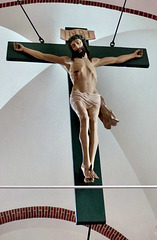
The triumphal cross from 1500.
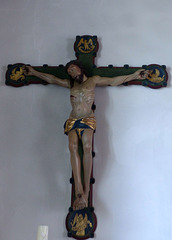
Struxdorf- St. Georg
| |
|
Struxdorf was probably more important in the Middle Ages than it is today, because a church dedicated to St. Georg stood here very early.
The Romanesque fieldstone church was built around 1230 as the first church in the area.
The triumphal cross is dated to about 1500.
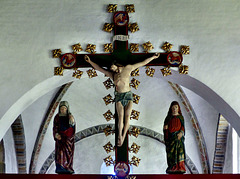
Satrup - St. Laurentius
| |
|
The large peninsula of Angeln was "administered" by the bishops in Lund (Sweden) around 1200, when the church in Satrup was built. They made sure then that still today almost every parish in Angeln has a (sometimes small) Romanesque church. The single nave Laurentius church in Satrup is quite large.
The interior is dominated by the large late Gothic triumphal cross, created around 1500.
Satrup - St. Laurentius
| |
|
The large peninsula of Angeln was "administered" by the bishops in Lund (Sweden) around 1200, when the church in Satrup was built. They made sure then that still today almost every parish in Angeln has a (sometimes small) Romanesque church. The single nave Laurentius church in Satrup is quite large.
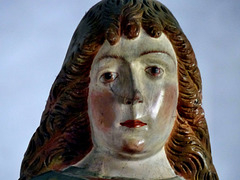
The interior is dominated by the large late Gothic triumphal cross, created around 1500. Often two persons flank the cross. The persons are usually Mary, the mother of Jesus, and one of his disciples, usually, following the Gospels, the apostle John.
John's face.
Flensburg - St. Nicolai
| |
|
|
With a population of about 90.000, Flensburg is, after Kiel and Lübeck, the third-largest town in Schleswig-Holstein.
Flensburg was founded at the latest by the middle of the 12th century at the end of the Flensburg Firth by Danish settlers, who were soon joined by German merchants. The place was considered a safe haven with protection from strong winds. Two important trade routes of the time crossed here and the large number of herrings in the firth was a factor for economic well-being. These herrings (pickled in salt) were sent across Europe in medieval times.
In 1284 Danish King Erik Glipping granted the new town charter, the content of which suggests a very lively trade. Duke Waldemar IV of Schleswig confirmed the town charter. Flensburg quickly became the most important city in the Duchy of Schleswig, a Danish fiefdom with the Danish king as feudal lord, which, in contrast to Holstein, which is adjacent to the south, did not belong to the Holy Roman Empire.
During Denmark's war against the Hanseatic League and Holstein, Danish mercenaries first conquered and looted the city in 1426, followed by Holstein and Hanseatic mercenaries in 1431.
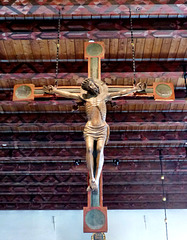
St. Nicolai is a Gothic hall church. The construction started around 1390. There were two construction stages In 1332, a smaller church stood in place of the present chancel. The building grew first on their forecourt. After completion of the four western bays, the old church was demolished and the construction continued to the east from 1440. The church is 52 meters long and 21 meters wide.
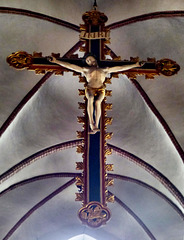
The triumphal cross
Adelby - Johanniskirche
| |
|
|
Adelby, once an old parish just east of Flensburg, is meanwhile a part of the city of Flensburg. This makes the Johanniskirche in Adelsby to Flensburg´s oldest church.
The first church here was built around 1080. About a century later a Romanesque fieldstone church got erected. In the 15th or 16th century, the porch was added in front of the main entrance.
In the 18th century, an extensive reconstruction took place. In 1726, the wooden tower was replaced by the present Baroque tower. Then the nave was raised with bricks and extended to the east as well as to the west up to the church tower. By 1780, the present hall church with a wide box choir was thus created.
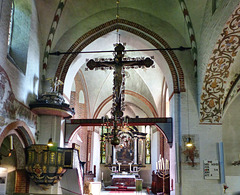
The triumphal cross
Mölln - St. Nicolai
| |
|
|
Mölln is a small town (pop. ~20.000) surrounded by lakes. It was founded in the 12th century by Knight Konrad Wackerbarth by resettling Slavic peasants into today's Old Mölln.
Around 1210, the settlement got the first fortifications. First time mentioned was the village 1188 in Barbarossa's privilege for Lübeck.
Mölln fell to Denmark in 1201 and was granted "Lübische Stadtrecht" (town charter) by King Waldemar II. 25 years later Mölln fell to the Duke of Saxe-Lauenburg in 1227. In 1230 Mölln was mentioned as the youngest parish in the Ratzeburg tithe register. The church, which was probably built around this time, was placed under the patrocinium of St. Nicholas.
Mölln was important due to the Old Salt Route, through which the salt produced in the salt mines of Lüneburg was shipped to the harbour of Lübeck. Although situated in the midst of the duchy of Lauenburg, the town was mortgaged to the Hanseatic town of Lübeck, which ruled Mölln from 1359 to 1683.
St. Nicolai, the parish church, is located on the highest point, overlooking the town and the seas around.
The construction started probably at the end of the 12th century.
The oldest parts can be attributed to the Brick Romanesque period, the south nave to the Brick Gothic period. The choir room was probably finished around 1217, when the Bishop of Ratzeburg held his first synod here.
In the 15th century, the church underwent alterations: in 1470/71, the south nave was extended and in 1497, the present baptistery and the sacristy were added.
In 1896, the church was thoroughly renovated.
Mölln - St. Nicolai
| |
|
Mölln is a small town (pop. ~20.000) surrounded by lakes. It was founded in the 12th century by Knight Konrad Wackerbarth by resettling Slavic peasants into today's Old Mölln.
Around 1210, the settlement got the first fortifications. First time mentioned was the village 1188 in Barbarossa's privilege for Lübeck.
Mölln fell to Denmark in 1201 and was granted "Lübische Stadtrecht" (town charter) by King Waldemar II. 25 years later Mölln fell to the Duke of Saxe-Lauenburg in 1227. In 1230 Mölln was mentioned as the youngest parish in the Ratzeburg tithe register. The church, which was probably built around this time, was placed under the patrocinium of St. Nicholas.
Mölln was important due to the Old Salt Route, through which the salt produced in the salt mines of Lüneburg was shipped to the harbour of Lübeck. Although situated in the midst of the duchy of Lauenburg, the town was mortgaged to the Hanseatic town of Lübeck, which ruled Mölln from 1359 to 1683.
St. Nicolai, the parish church, is located on the highest point, overlooking the town and the seas around.
The construction started probably at the end of the 12th century.
The oldest parts can be attributed to the Brick Romanesque period, the south nave to the Brick Gothic period. The choir room was probably finished around 1217, when the Bishop of Ratzeburg held his first synod here.
In the 15th century, the church underwent alterations: in 1470/71, the south nave was extended and in 1497, the present baptistery and the sacristy were added.
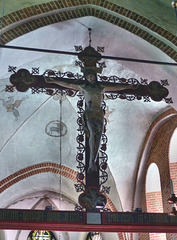
The triumphal cross is attributed to the workshop of Bernt Notke and dates from 1501.
Schwerin - Dom
| |
|
|
Schwerin is the capital German state of Mecklenburg-Vorpommern, with less than 100000 inhabitants it is the least populous of all German state capitals.
Schwerin is enclosed by lakes. In the middle part of these lakes was a settlement of the Slavic Abodrites way before 1000. The settlement was first mentioned in 1018. After Henry the Lion had defeated the Abodrites, he had the defences rebuilt and granted city rights. 1160 is therefore traditionally regarded as the "German" year of Schwerin's foundation.
After Henry the Lion had now subjugated the lands of the Obotrites, he appointed a bishop in the (already abandoned) bishopric of Mecklenburg. This bishop moved the bishopric from remote Mecklenburg to Schwerin in 1167. There, in the presence of Henry the Lion himself, an act of consecration took place in 1171 on the Romanesque predecessor building of today's cathedral. At this time, only the apse will have been completed. The entire cathedral was not consecrated until 1248. Of this building, not much is left.
When Count Heinrich von Schwerin returned from the Crusade in 1222 he presented the church the valuable relic of the Holy Blood. So the cathedral became the most important pilgrimage church in north-eastern Germany. The Romanesque basilica was too small - and so the construction of the new Schwerin Cathedral began around 1270.
In 1327 the new choir was completed. By the end of the 14th century, the transept and the nave were finished except for the vaults. Builders from Stralsund completed the windows of the nave and its vaulting in 1416, thus ending the building history of the Gothic basilica of Schwerin Cathedral.
The very most of the cathedral´s medieval furnishing got lost during the iconoclasms of the Reformation and the later "renovations". None of the 42 side-altars survived and even the "Holy Blood" relic was burned by Duke Johann Albrecht around 1550.
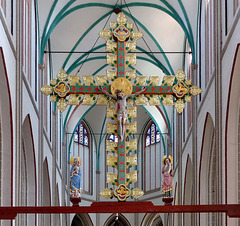
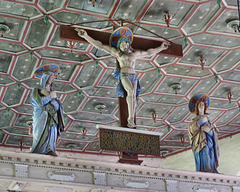
The large triumphal cross from 1420 is also not part of the original furnishings of Schwerin Cathedral but comes from Wismar's Marienkirche, whose nave was blown up in 1960.
Dorf Mecklenburg - Dorfkirche
| |
|
|
The castle complex of the Slavic Abodrites named Mikelenburg was built here in the 7th century. In the course of time, Mikelenburg became Mecklenburg the namesake for the entire Mecklenburg landscape and for the state of Mecklenburg-Vorpommern.
King Otto III first mentioned the Mecklenburg in a document in 995. After the castle was finally destroyed the village of Mecklenburg developed from the settlement of the outer castle in the 14th century.
The originally brick Gothic village church was built in the 14th century and underwent a major remodelling in the 17th century - and later.
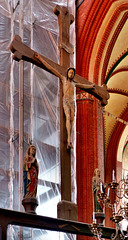
The triumphal cross was donated to the church in 1633.
Wismar - Nikolaikirche
| |
|
Slavic Obodrites lived in the area, where Wismar is now, until the end of the 12th century.
The exact date of the city's foundation is not clear, it had civic rights already in 1229 when migrants from Holstein and Westphalia settled here. The "Lübsches Stadtrecht" (town law) was confirmed in 1266. In 1259 Wismar joined a defensive agreement with Lübeck and Rostock, in order to counter the numerous Baltic pirates. Subsequently, more cities would agree to cooperate as commerce and trade were increasingly coordinated and regulated. These policies would provide the basis for the development of the "Hanseatic League". By the 13th and 14th centuries, Wismar had grown into a flourishing Hanseatic trading hub.
In 1632, during the Thirty Years' War, Sweden conquered the city, and the Swedish Crown received in the Peace of Westphalia in 1648 after the end of the Thirty Years' War.
Swedish rule over Wismar ended de facto in 1803 when Sweden pledged the city to the Duchy of Mecklenburg-Schwerin for 99 years. Formally, Wismar reverted to Germany in 1903 and Sweden waived its right to redeem the pledge.
Wismar is a typical representative of the Hanseatic League with its city-wide Brick Gothic structures and gabled patrician houses and has alongside the historical old town of Stralsund been declared the UNESCO World Heritage Site "Historic Centres of Stralsund and Wismar".
The Nicolaikirche (Church St. Nicholas) was built from 1381 until 1487 as a church for sailors and fishermen. St. Nicholas is a fine testaments to mediaeval brick architecture in northern Germany.
In 1381, the city council commissioned the master mason Heinrich von Bremen to complete the choir. The consecration of the high altar is documented for 1403. Heinrich von Bremen continued to work until 1415. In 1434 work was carried out on the north aisle and later the south aisle. Under the direction of Peter Stolp and Hermann von Münster in 1459, the work was completed to such an extent that the church could be consecrated. From 1485 to 1487, Hans Mertens built the two upper storeys of the tower, and the spire was added in 1508.
In December 1703, a storm destroyed the spire. Its parts smashed through the roof and the vaults of the nave. Many pieces of the interior furnishings were destroyed. Afterwards, the tower received a transverse gable roof and the nave a flat ceiling. The renovation of the furnishings lasted until the second half of the 18th century. It was not until 1867 that a vault was erected again. The air raids during the Second World War caused only minor damage to the church.
After the Second World War, the Nikolaikirche was the least damaged of all the large churches in Wismar. Many works of art had been stored away and thus survived the war, but the churches lay in ruins and the important Marienkirche was later blown up.
So the Nikolaikirche became home to many objects from other churches. There are even works of art that were brought here after secularisation, such as this medieval triumphal cross group from the 15th century. It comes from the secularised Dominican monastery church in Wismar.
Jump to top
RSS feed- Latest items - Subscribe to the latest items added to this album
- ipernity © 2007-2025
- Help & Contact
|
Club news
|
About ipernity
|
History |
ipernity Club & Prices |
Guide of good conduct
Donate | Group guidelines | Privacy policy | Terms of use | Statutes | In memoria -
Facebook
X
