


Gifted Animals

Animals had many much more talents in former times. Some worked as musicians.


Cordes-sur-Ciel
Cordes-sur-Ciel lies high above the banks of the Cérou river. So in 1993, when tourism got more important. So in 1993, it got the surname "sur-Ciel".
The village was founded as a bastide in 1222 by Raymond VII, Count of Toulouse, a strong opponent of the infamous Simon de Montfort during the Albigensian Crusade. It was built, to protect the scattered population of the area from conflict.
By the 1229 Treaty of Paris, Raymond conceded defeat to Louis IX of France. When in 1241, Jeanne, the Countess of Toulouse, married the brother of Louis IX Cordes became a part of France in 1271 without having been militarily conquered.
Today Cordes-sur-Ciel is a pretty tourist spot. The quaint village is well worth a stop. There are even gifted animals.
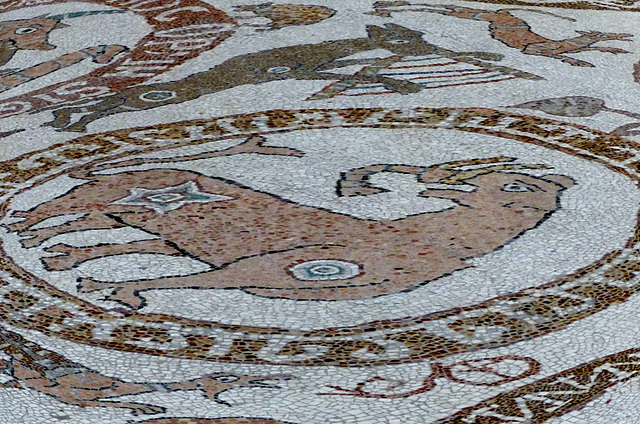
Otranto - Duomo di Otranto
Otranto occupies the site of an ancient Greek city. It gained importance in Roman times, as it was the nearest port to the eastern coast of the Adriatic Sea.
After the end of the Roman Empire, it was in the hands of the Byzantine emperors until it surrendered to the Norman troops of Robert Guiscard in 1068. The Normans fortified the city and built the cathedral, that got consecrated in 1088. When Henry VI., son of Emperor Frederick Barbarossa, married Constanze of Sicily in 1186 Otranto came under the rule of the Hohenstaufen and later in the hands of Ferdinand I of Aragón, King of Naples.
Between 1480 and 1481 the "Ottoman invasion" took place here. Troops of the Ottoman Empire invaded and laid siege to the city and its citadel. Legends tell that more than 800 inhabitants were beheaded after the city was captured. The "Martyrs of Otranto" are still celebrated in Italy, their skulls are on display in the cathedral. A year later the Ottoman garrison surrendered the city following a siege by Christian forces and the intervention of Papal forces.
Otranto had been one of the last Byzantine strongholds in Apulia, but finally, Robert Guiscard could take it. It had probably been such a stronghold, as Otranto had hosted an autocephalous bishopric, only dependent on the patriarchal see of Byzantium since 968. So (Roman) Catholicism had to perform something "convincing" for the so-long (Byzantine) Orthodox Christians. One was to erect a huge church. The Otranto Cathedral, seen in the center, was erected over the ruins of a Paleochristian church from 1080 on and was consecrated in 1088. It is 54 meters long by 25 meters wide and is built on 42 monolithic granite and marble columns.
I had returned to Otranto to see the unbelievable, breathtaking mosaic again. It was created by a monk named Pantaleon and his workshop between 1163 and 1165. Pantaleon lived at the monastery San Nicola di Casole, located a few kilometers south of Otranto.
The mosaic covers the nave, both aisles, the apse and the presbytery. This sums up to a total of 1596 m². About 10 000000 (10 million!) "tesserae" were used.
There are scholars, who have counted up to 700 different "stories", that are told here. Though, these "stories" are often disputed, as today's interpretations are mostly very "vague". German historian Carl Arnold Willemsen published the most important book about the mosaic in Italian " L'enigma di Otranto", that since the 1970s is translated in many languages. I followed his theories.
An elephant and a very gifted dog playing the harp.
As I have uploaded so many photos taken in Otranto already, I will upload now only a few. If you want to see more click here:
www.ipernity.com/doc/323415/album/1333378
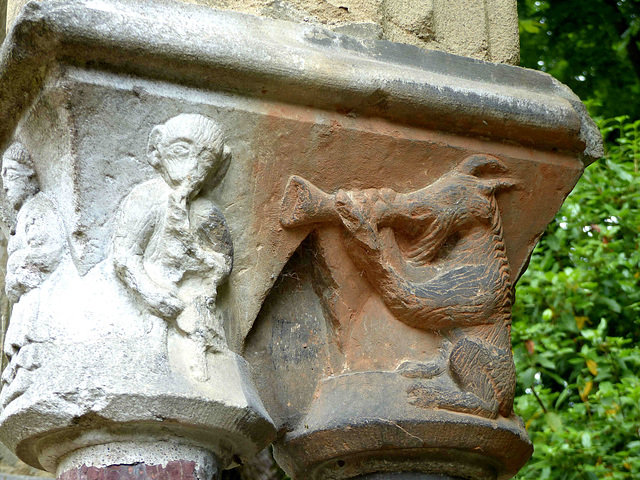
Tarbes - Jardin Massey
A ford made it easier to cross the Adour in ancient times, later the Romans settled in the area. A Christian church may have existed as early as the 4th century
Around 840 the Vikings led a devastating raid, but the town recovered and by the end of the 12th century the Count of Bigorre settled in his castle at Tarbes.
At the end of the Middle Ages, the city consisted of six separate fortified towns. During the Wars of Religion in 1569, Jeanne d'Albret's troops burned the cathedral, the convents, and other churches, as well as the bishopric. The inhabitants were massacred.
.
The Jardin Massey is a large public garden built in the 19th century by Placide Massey horticulturist of the French King Louis Philippe I and the previous chief of the Palace of Versailles' gardens. The garden contains the cloister of the Saint-Sever-de-Rustan Abbey.
Some elements of the cloister were originally built in the 15th century for the Carmelite monastery of Trie-sur-Baïse which had been severely damaged during the Huguenot Wars. These parts of the cloister were sold to the Abbey of Saint-Sever-de-Rustan for the restoration of the cloister there, as there as well a band of Huguenots, under the command of the Earl of Montgomery, had settled in the abbey for months, plundered the treasury and destroyed the church.
The abbey got restored by the monks at the end of the 16th century and remodeled in the 18th century. It became state property in 1789 and was sold privately in 1792.
In 1890, when numerous capitals had already been sold (some of which can be seen today in The Cloisters Museum in New York City), the remaining parts were bought by the city of Tarbes and moved to Jardin Massey.
Gifted animals
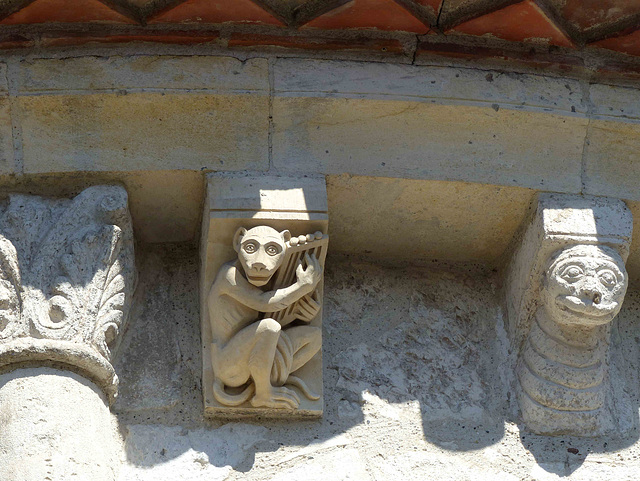
Agen - Cathédrale Saint-Caprais d'Agen
The Gallo-Roman city of Aginnum, which existed here, was very populated and had an amphitheater that could accommodate more than 10,000 people. From the end of the 3rd century , the chronicles relate the martyrdoms of Saint Caprais and Saint Foy, who are said to be buried in Aginnum. The first known bishop, named Phébade, is documented a century later.
Over the following centuries, Agen was invaded by the Vandals, the Visigoths, and the Franks before being attacked by the Vikings in the 9th century. Historians have noted three invasions: in 843, 853, and the last in 922. A great loss for Agen was when at the end of the 9th century monks from Conques could steal the relics of St. Foy and transfer them to Conques (where they still are).
In the 13th and 14th centuries, the city was contested between the English and the French. In the early stages of the Hundred Years' War, it came to the English but was conquered and recaptured twice. In 1372, the Duke of Anjou established his headquarters here. Although he lost the city the next year, he was able to retake it by 1374. While thereafter part of the towns and castles of Agenais were temporarily under English rule, Agen remained almost permanently in French hands until the end of the war.
According to tradition, a church dedicated to Saint Caprais was built at the beginning of the 5th century. A basilica dedicated to Saint Caprais certainly existed in 580, since Grégoire de Tours cites it on that date.
Agen Cathedral's structure dates to the 12th century, when it was built as a collegiate church of canons dedicated to Saint Caprasius of Agen on the foundations of a basilica sacked by the Normans in 853 but thereafter restored. It was sacked again in December 1561 during the Wars of Religion.
At the onset of the French Revolution in 1789 the church lost its religious function and was used as a fodder store before being reopened in 1796. It was elevated to the status of the cathedral of the Diocese of Agen in 1801, replacing the former cathedral dedicated to Saint Étienne, which was destroyed during the Revolution.
There are lots of weathered corbels under the roof. Some have been replaced by copies meanwhile.
Jerichow - Kloster Jerichow
The Slavs built Jerichow Castle (the name is of Slavic origin - "castle of the brave" - so not biblical) to defend their western border. Jerichow was first mentioned at the end of 1144 when Premonstratensian canons founded the Jerichow Monastery. In 1148 the canons relocated the site because of the disturbing market activity.
The monastery was founded in 1144 as a Premonstratensian monastery. The first Premonstratensian canons came from Magdeburg. In 1149 the construction of the collegiate church was started. In 1172 the church and the east wing were completed. Then, between 1180 and 1200, the construction of a crypt took place. In addition, the church was extended by the side choirs and the construction of the winter refectory and the office building followed. The summer refectory and the cloister were built between 1220 and 1230. Around the year 1250, the construction of the monastery buildings was finally completed.
The two prominent towers were built in front of the church only in 1256-1262. Accordingly, they show predominantly Gothic forms.
After the Reformation, Jerichow Monastery was dissolved in the 16th century. The last canons had to leave the monastery. During the Thirty Years' War, the Premonstratensians returned. In 1631 imperial and Swedish troops devastated the monastery building. In 1680 Jerichow finally became under Brandenburg rule. On the orders of Elector Friedrich Wilhelm of Brandenburg, the collegiate church was restored in 1685 and used as a new Reformed church for the Huguenot refugees.
Between 1853 and 1856, the monastery and its church were restored at the request of King Frederick William IV of Prussia, but around 1870 it was used as a brewery and distillery.
At the end of WWII, the western facade of the church was damaged. After the war there was a fire in the roof truss. Between 1955 and 1960, in GDR times, the monastery church was repaired and the Romanesque interior was restored. The damage to the other buildings was severe. In 1998, the entire monastery complex had to be closed by the building authorities due to structural damage.
Thus, in 1998, the entire complex had to be placed under the protection of the building supervisory authority and closed as unsafe and unfit for use. Further repair and restoration work in 1999 lifted the order, but it continued for several years.
The collegiate church is a five-bay, flat-roofed basilica. According to a document from 1172, it was essentially completed by this time. Despite the early construction time for Central Germany, the building already has a perfect brick construction technique. It is assumed that this technique was imparted by professionals from northern Italy, who continued to work on smaller church buildings after the completion of the collegiate church. The architecture of this church had a strong influence on the surrounding village churches, in which the building program was adopted in a reduced form.
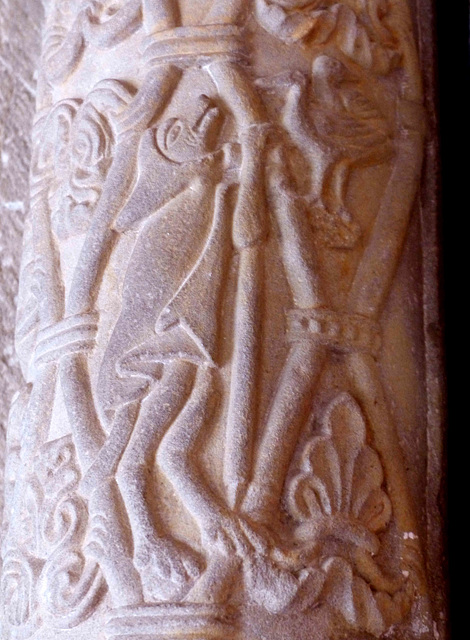
This pillar was part of the "Chorherren Portal" (portal of the Canons). Through this portal the canons entered the church. A very interesting scene, known from a fable called "Wolf's Predigt" (wolf's sermon). A wolf disguised as a monk preaches to two geese.
Mathew 7.15
"Beware of false prophets, who come to you in sheep’s clothing but inwardly are ravenous wolves."
Naumburg - Dom
Naumburg has a population of around 33,000 and is the center of the northernmost German wine-growing region Saale-Unstrut. The first written record of Naumburg dates from 1012. It was founded at the crossing of two trade-routes, Via Regia and the Regensburg Road. The successful foundation not long beforehand of a Propstei Church on the site of the later Naumburg Cathedral was mentioned in the Merseburg Bishops' Chronicles in 1021. Already in 1028 Pope John XIX gave his approval for the transfer of the bishopric from Zeitz to Naumburg. Until 1568, during the Reformation, Naumburg was the seat of the bishops
A late Romanesque new building was started around 1210. The new construction began in the nave. Of the old structure only the crypt survived. However, the construction of the new nave was soon abandoned. Instead, the construction of the new eastern parts of the cathedral began and the new building was then gradually continued to the west. It did not remain in this late-Romanesque form long for by the mid-13th century the early-Gothic west choir was added. It was likely finished by 1260. The western towers were raised by one floor shortly thereafter. In around 1330 the high-Gothic polygonal east choir was built. Additional floors were added to the western towers in the 14th and 15th centuries.
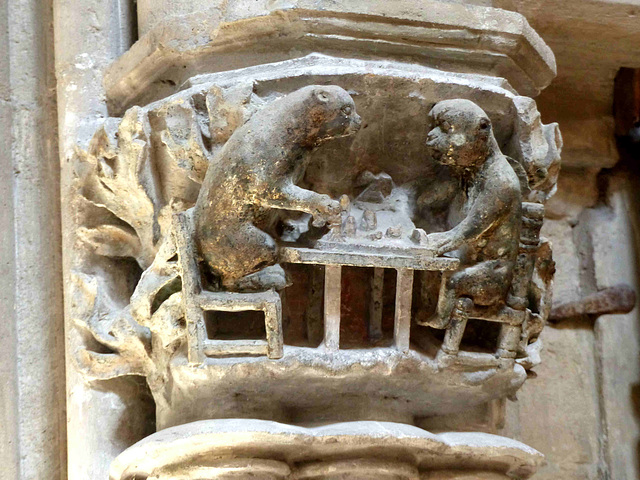
On the Romanesque capital two gifted monkeys play chess
Vitoria-Gasteiz - Basílica de San Prudencio
The Basilica of San Prudencio is located in Armentia on the southwestern outskirts of Vitoria-Gasteiz.
According to legend, Saint Prudentius was born here in the 6th century. In the 9th century, Armentia was a bishopric until it was transferred to Calahorra in 1087. The Basilica of San Prudencio then became the collegiate church of a canon's monastery, which existed until 1498. It was then that the canons gave up San Prudencio to settle in Vitoria.
The current church of San Prudencio was built towards the end of the 12th century. Between 1773 and 1776 the church underwent major changes. The south facade was demolished and the porch was built. Parts of the church's original sculptural decoration were embedded in the walls of this south porch.
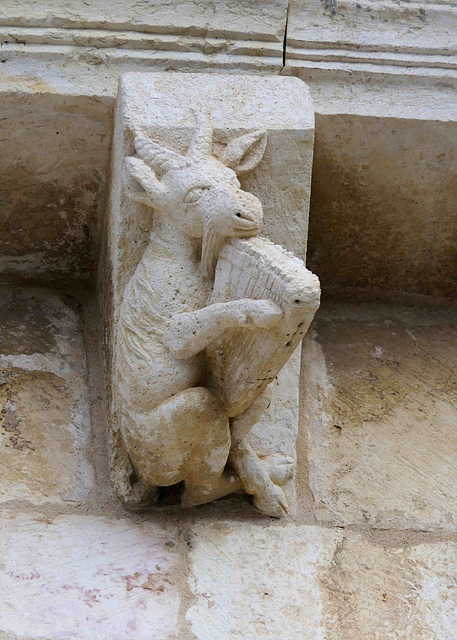
A very musical goat playing the harp
Frómista - San Martín
Today Frómista has a population of less than 1000. In previous centuries, Frómista had a significant population that lived from growing wheat.
A church and a Benedictine monastery on this site were first mentioned in the will of Queen Munia Mayor, widow of King Sancho III of Navarre, in 1066. The queen made the monastery and church partial heirs to her fortune. This fortune made possible the construction of a magnificent church, which was built in the last third of the 11th century in a construction period of 15 to 20 years, continuously and without interruption. Close links exist with the Cathedral of Jaca and the Basilica of San Isidoro, the craftsmen appear to have been partly the same.
In 1118, Queen Urraca, a great-granddaughter of Queen Munia, placed the church, monastery and associated settlement, San Martín, under the authority of the monastery of San Zoilo. San Martín thus became the priory of this monastery. Throughout the following Middle Ages, there were constant disputes between the town of Frómista and the monastery of San Zoilo over rights in and to the village of San Martín, which even led to military conflicts. It was not until 1488 that the dispute was settled.
In 1453, a Host miracle occurred in San Martín. The paten used and the host was venerated in the church until the 19th century.
From 1896 to 1904, the church was extensively restored. The restoration, which aimed to recreate a "perfect" Romanesque church, is highly controversial today.
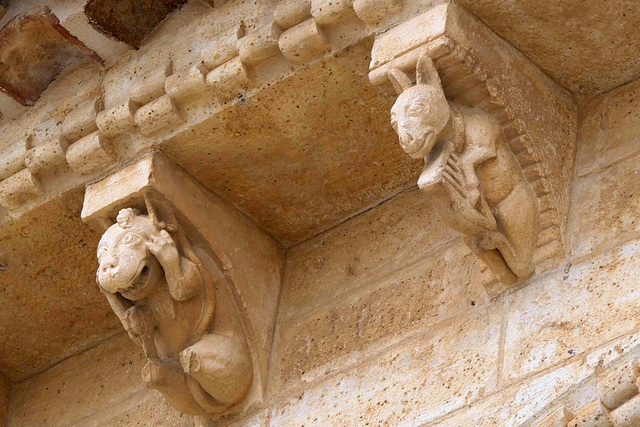
Animal musicians
León - Catedral de León
León was founded in 68 AD for a Roman legion from which they were supposed to pacify the rebellious mountain dwellers of Asturias and Cantabria. The name of the settlement that was then developed is based on a refined form of the Latin word "legio".
After the end of the Roman Empire, the city was conquered by the Visigoths and in 712 by the Moors. In 856, after the reconquest under King Ordoño I of Asturias, the city was repopulated. Ordoño II made León the capital of his kingdom of León in 914. Sacked by Almanzor in about 987, the city was reconstructed and repopulated by Alfonso V,
León was an important stop on the Way of St. James to Santiago de Compostela. Traders and artisans settled in the suburbs and had a strong influence on the development of the city from the 13th century onwards. In the early Middle Ages, the city became prosperous through the cattle trade. However, from the 16th century until the 19th century, the economy and population declined.
The main construction period of the cathedral was between 1255 and 1303.
The first architect was "Master Enrique", who had previously built the transept and nave of Burgos Cathedral between 1243 and 1260. "Master Enrique" directed the construction from 1255 to 1277, using Reims Cathedral as a model. The experience he gained in Burgos prompted him to take a risk, which paid off centuries later, as many openings later had to be bricked up for stability reasons. In the middle of the 19th century, the structure was on the verge of collapse and had to be completely restored. Reconstruction lasted from 1859 to 1901.
In 1302, the work was apparently stopped, probably for financial reasons. This may also be the reason for the comparatively short nave with only five bays, for the lack of a tower in the transept. The upper parts of the cathedral were not completed until 1439.
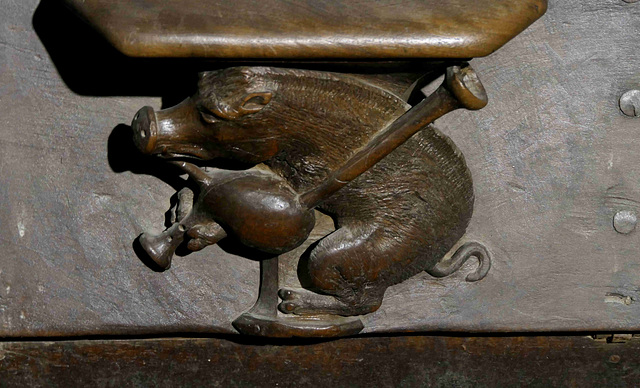
There are a number of grotesque carvings under the many misericords. - A pig playing the bagpipes
Jump to top
RSS feed- Latest items - Subscribe to the latest items added to this album
- ipernity © 2007-2026
- Help & Contact
|
Club news
|
About ipernity
|
History |
ipernity Club & Prices |
Guide of good conduct
Donate | Group guidelines | Privacy policy | Terms of use | Statutes | In memoria -
Facebook
X
