


Psychostasia / The Weighing of Souls

A person's life is assessed by weighing the soul in order to judge their fate. A Christian icon connected to the Last Judgement.
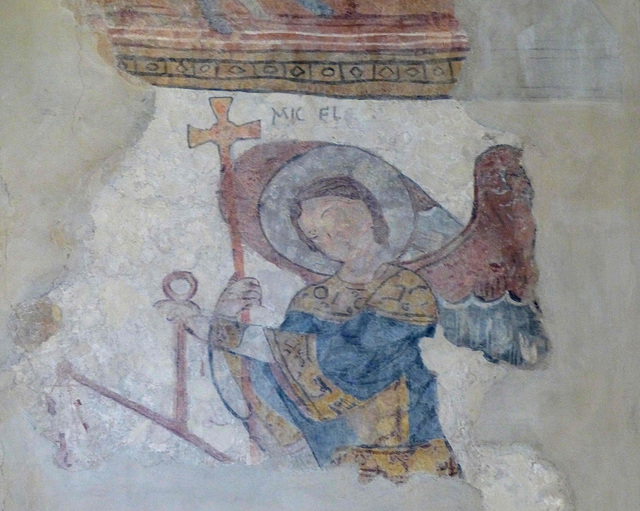

Payerne - Notre Dame
Payerne Priory (= Peterlingen), a former Cluniac monastery, was founded around 962 by Empress Adelheid as the burial place of her mother Queen Berta of Burgundy. It was annexed to the reform abbey of Cluny in 962 as one of the first daughter monasteries. It was richly endowed by the kings of Burgundy and the German emperors and had extensive landholdings In 1033, Conrad II was crowned King of Burgundy in Peterlingen.
The priory was first directly managed by the abbots from Cluny, but starting in 1050 the local prior led the monastery with increasing independence. Saint Ulrich of Zell, was prior here in the later 11th century. He later founded two Cluniac monasteries in the Black Forest.
In 1444, the antipope Felix V raised the priory to an abbey. This elevation brought no benefits to the monastery. The Reformation and the weakening of Savoy's power led to the dissolution of the monastery. After the Bernese conquest of Vaud, some of the buildings were demolished.
The former abbey church of Notre Dame is an example of Cluniac architecture and an important Romanesque church building. The current construction was started in the 11th century by Abbot Odilo of Cluny on the site of the previous 10th-century church. Parts of the previous building, including the archaic capitals, were included in the new church.
After the Reformation, the church was profaned and served in the 17th century as a bell foundry, in the 18th century as a granary, and later also as a prison and barracks. Since 1926 a careful restoration was carried out.
Psychostasia /Weighing of souls
Archangel Michael holds the scales.
The scene is part of a depiction of the Last Judgment.
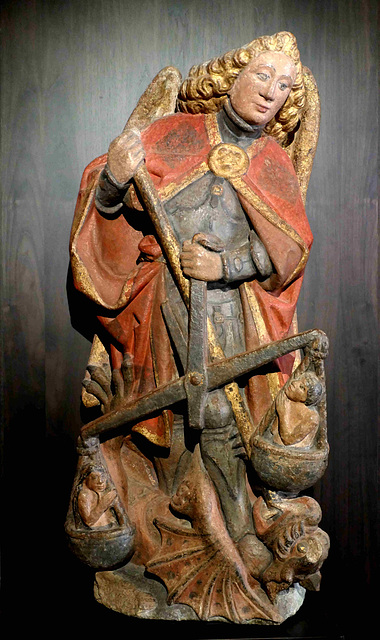
Santiago de Compostela - Museo da Catedral
According to legend, the mortal remains of the apostle St James were taken to Galicia for burial, where they were lost. Eight hundred years later, a light led a shepherd, Pelagius the Hermit, who was guarding his flock at night, to the burial site. The shepherd reported his discovery to the bishop of Iria. The bishop declared that the remains were those of St James the Apostle and immediately informed King Alfonso II in Oviedo. In honour of Saint James, the cathedral was built on the spot where his remains were said to have been found. The legend, which includes numerous miraculous events, enabled the Catholic faithful to strengthen their stronghold in northern Spain during the Reconquista against the Moors, but also led to the growth and development of the city.
This is the end if the Camino de Santiago. I arrived the first time in Santiago in 2010 and, like everyone who makes the journey on foot, was overwhelmed. Much has changed since then. Most of all, the deployment of a very unfriendly security force that leaves neither tourists nor pilgrims in peace - in a place where everyone should find peace.
The Museo da Catedral has an extraordinary collection
The "Weighing of souls", 15th entury
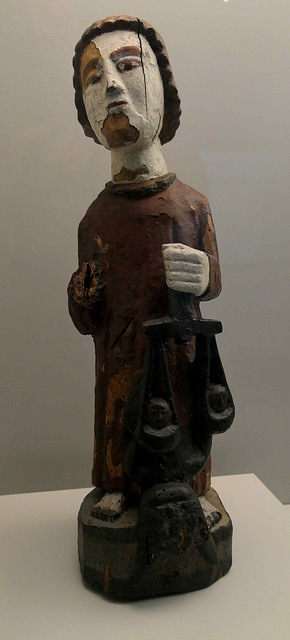
Oviedo - Museo Arqueológico de Asturias
Oviedo was founded on a hill that the Romans called Ovetao. The monks Máximo and Fromestano founded a monastery on the Roman road in 761 and built a hermitage. Later, two dozen monks from the Muslim south joined the founders and, according to a document, chose Fromestano as their first abbot. They were under the protection of Fruela I, who chose the place as a residence for his wife Munia, who gave birth here to their son and later King Alfonso II.
Alfonso II (aka "the Chaste", "el Casto" moved the capital here in 812 and made Oviedo the seat of the bishopric. In 912, however, Oviedo lost its function as capital to León under García I in the course of the reconquest. Alfonso II fortified Oviedo and furnished it with palaces and churches.
During his reign, a tomb attributed to St James the Elder was discovered in Santiago de Compostela in 812. The king travelled from Oviedo to Santiago and is said to have been the first pilgrim to Santiago. He is also said to have opened the first Way of St James, the Camino Primitivo. Until the city of León was established as both the capital of the Kingdom of León and the nexus of a safe route — the Camino Francés — the Camino Primitivo remained the most frequented route for those going to Santiago.
The Museo Arqueológico de Asturias is housed in a 16th century monastery.
The Comisión Provincial de Monumentos, founded in 1845 to protect Spanish and Asturian cultural assets and monuments, opened a museum in 1870 for artefacts from Asturias and other donated items. The Museo Arqueológico de Asturias was officially founded in 1944 and moved to its current location.
St Michael at the "weighing of souls" / 14th century
Jump to top
RSS feed- Latest items - Subscribe to the latest items added to this album
- ipernity © 2007-2026
- Help & Contact
|
Club news
|
About ipernity
|
History |
ipernity Club & Prices |
Guide of good conduct
Donate | Group guidelines | Privacy policy | Terms of use | Statutes | In memoria -
Facebook
X
