


Puglia - Apulia - Apulien

Travelling slowly in Southern Italy.
Trani - Cattedrale di San Nicola Pellegrino
| |
|
Trani may have been founded by Greek settlers, but the known history starts late. After the fall of the Western Roman Empire, it was dominated by Lombards, Byzantines, Saracens and again Byzantines. With the conquest of southern Italy by the Normans and after 50 days of siege by Robert Guiscard´s troops, Trani became part of the Norman Empire in 1073.
Already under the Byzantines, Trani had become an important port for trade with the Orient. The heyday was in the time of the crusades in the 12th and 13th centuries, when crusaders and merchants mainly went to the Holy Land from Bari and Trani. It became an episcopal see in place of Canosa, destroyed by the Saracens. Frederick II promoted the Teutonic Knights and the Jewish community and built a massive castle. Under his rule, the city reached its highest point of wealth and prosperity.
The construction of the "Cattedrale di Trani" began in 1099, over the earlier church of "Santa Maria della Scala", which went back to the 4th century.
It is dedicated to "San Nicola Pellegrino". Bari had the relics of "Saint Nicholas of Myra". The Bishop of Trani could convince Pope Urban II to canonized a young pilgrim, who had died on his way to Jerusalem in Trani in 1094 from exhaustion. The new church was intended to house the relics of "Saint Nicholas the Pilgrim".
Pina Belli d'Elia ("Puglia romanica") is sure, that this cathedral is the most important of all romanic buildings in Apulia.
The building process started at the crypt. The "translatio corporis S. Nicolai ad novam Ecclediam" took place in 1142. As parts of the old church, dedicated to Virgin Mary, were maintained, the construction is pretty complex. The "Cattedrale di Trani" was completed around 1200, the construction of the campanile started by Nicolaus Sacerdos (see "Bitonto") and completed in the mid 14th century. In the20th century the bell tower was in such a bad state, that it was completely dismantled and rebuilt in the 1950s to avoid it collapsing.
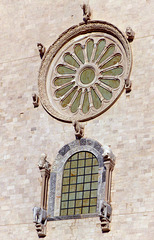
The cathedral was built from white, local stones, that change the colour from white to yellowish and reddish, during the sunset. The facade has a large rose window, surrounded by griffins and lions, what is no surprise. The window below the rose is flanked by two ELEPHANTS!

Trani - Cattedrale di San Nicola Pellegrino
| |
|
Trani may have been founded by Greek settlers, but the known history starts late. After the fall of the Western Roman Empire, it was dominated by Lombards, Byzantines, Saracens and again Byzantines. With the conquest of southern Italy by the Normans and after 50 days of siege by Robert Guiscard´s troops, Trani became part of the Norman Empire in 1073.
Already under the Byzantines, Trani had become an important port for trade with the Orient. The heyday was in the time of the crusades in the 12th and 13th centuries, when crusaders and merchants mainly went to the Holy Land from Bari and Trani. It became an episcopal see in place of Canosa, destroyed by the Saracens. Frederick II promoted the Teutonic Knights and the Jewish community and built a massive castle. Under his rule, the city reached its highest point of wealth and prosperity.
The construction of the "Cattedrale di Trani" began in 1099, over the earlier church of "Santa Maria della Scala", which went back to the 4th century.
It is dedicated to "San Nicola Pellegrino". Bari had the relics of "Saint Nicholas of Myra". The Bishop of Trani could convince Pope Urban II to canonized a young pilgrim, who had died on his way to Jerusalem in Trani in 1094 from exhaustion. The new church was intended to house the relics of "Saint Nicholas the Pilgrim".
Pina Belli d'Elia ("Puglia romanica") is sure, that this cathedral is the most important of all romanic buildings in Apulia.
The building process started at the crypt. The "translatio corporis S. Nicolai ad novam Ecclediam" took place in 1142. As parts of the old church, dedicated to Virgin Mary, were maintained, the construction is pretty complex. The "Cattedrale di Trani" was completed around 1200, the construction of the campanile started by Nicolaus Sacerdos (see "Bitonto") and completed in the mid 14th century. In the20th century the bell tower was in such a bad state, that it was completely dismantled and rebuilt in the 1950s to avoid it collapsing.
The cathedral was built from white, local stones, that change the colour from white to yellowish and reddish, during the sunset. The window of the facade is flanked by two ELEPHANTS!
Slowly approaching the elephants. They support pillars on which lions are seated (only one is visible, wearing a moustache). The elephants are anatomically very precise and for sure they are created after Frederick II´s "Cremona elephant".
Trani - Cattedrale di San Nicola Pellegrino
| |
|
|
|
Trani may have been founded by Greek settlers, but the known history starts late. After the fall of the Western Roman Empire, it was dominated by Lombards, Byzantines, Saracens and again Byzantines. With the conquest of southern Italy by the Normans and after 50 days of siege by Robert Guiscard´s troops, Trani became part of the Norman Empire in 1073.
Already under the Byzantines, Trani had become an important port for trade with the Orient. The heyday was in the time of the crusades in the 12th and 13th centuries, when crusaders and merchants mainly went to the Holy Land from Bari and Trani. It became an episcopal see in place of Canosa, destroyed by the Saracens. Frederick II promoted the Teutonic Knights and the Jewish community and built a massive castle. Under his rule, the city reached its highest point of wealth and prosperity.
The construction of the "Cattedrale di Trani" began in 1099, over the earlier church of "Santa Maria della Scala", which went back to the 4th century.
It is dedicated to "San Nicola Pellegrino". Bari had the relics of "Saint Nicholas of Myra". The Bishop of Trani could convince Pope Urban II to canonized a young pilgrim, who had died on his way to Jerusalem in Trani in 1094 from exhaustion. The new church was intended to house the relics of "Saint Nicholas the Pilgrim".
Pina Belli d'Elia ("Puglia romanica") is sure, that this cathedral is the most important of all romanic buildings in Apulia.
The building process started at the crypt. The "translatio corporis S. Nicolai ad novam Ecclediam" took place in 1142. As parts of the old church, dedicated to Virgin Mary, were maintained, the construction is pretty complex. The "Cattedrale di Trani" was completed around 1200, the construction of the campanile started by Nicolaus Sacerdos (see "Bitonto") and completed in the mid 14th century. In the20th century the bell tower was in such a bad state, that it was completely dismantled and rebuilt in the 1950s to avoid it collapsing.
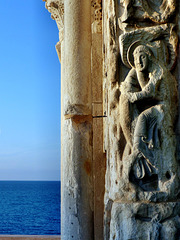
The cathedral was built from white, local stones, that change the colour from white to yeThe cathedral was built from white, local stones, that change the colour from white to yellowish and reddish, during the sunset. Some of the carvings around the central portal weathered, probably due to the near sea from where the wind blows.
Trani - Cattedrale di San Nicola Pellegrino
| |
|
Trani may have been founded by Greek settlers, but the known history starts late. After the fall of the Western Roman Empire, it was dominated by Lombards, Byzantines, Saracens and again Byzantines. With the conquest of southern Italy by the Normans and after 50 days of siege by Robert Guiscard´s troops, Trani became part of the Norman Empire in 1073.
Already under the Byzantines, Trani had become an important port for trade with the Orient. The heyday was in the time of the crusades in the 12th and 13th centuries, when crusaders and merchants mainly went to the Holy Land from Bari and Trani. It became an episcopal see in place of Canosa, destroyed by the Saracens. Frederick II promoted the Teutonic Knights and the Jewish community and built a massive castle. Under his rule, the city reached its highest point of wealth and prosperity.
The construction of the "Cattedrale di Trani" began in 1099, over the earlier church of "Santa Maria della Scala", which went back to the 4th century.
It is dedicated to "San Nicola Pellegrino". Bari had the relics of "Saint Nicholas of Myra". The Bishop of Trani could convince Pope Urban II to canonized a young pilgrim, who had died on his way to Jerusalem in Trani in 1094 from exhaustion. The new church was intended to house the relics of "Saint Nicholas the Pilgrim".
Pina Belli d'Elia ("Puglia romanica") is sure, that this cathedral is the most important of all romanic buildings in Apulia.
The building process started at the crypt. The "translatio corporis S. Nicolai ad novam Ecclediam" took place in 1142. As parts of the old church, dedicated to Virgin Mary, were maintained, the construction is pretty complex. The "Cattedrale di Trani" was completed around 1200, the construction of the campanile started by Nicolaus Sacerdos (see "Bitonto") and completed in the mid 14th century. In the20th century the bell tower was in such a bad state, that it was completely dismantled and rebuilt in the 1950s to avoid it collapsing.
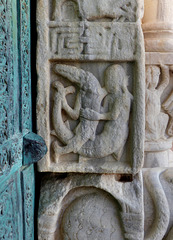
The cathedral was built from white, local stones, that change the colour from white to yellowish and reddish, during the sunset. Some of the carvings around the central portal weathered, probably due to the near sea from where the wind blows.
Trani - Cattedrale di San Nicola Pellegrino
| |
|
Trani may have been founded by Greek settlers, but the known history starts late. After the fall of the Western Roman Empire, it was dominated by Lombards, Byzantines, Saracens and again Byzantines. With the conquest of southern Italy by the Normans and after 50 days of siege by Robert Guiscard´s troops, Trani became part of the Norman Empire in 1073.
Already under the Byzantines, Trani had become an important port for trade with the Orient. The heyday was in the time of the crusades in the 12th and 13th centuries, when crusaders and merchants mainly went to the Holy Land from Bari and Trani. It became an episcopal see in place of Canosa, destroyed by the Saracens. Frederick II promoted the Teutonic Knights and the Jewish community and built a massive castle. Under his rule, the city reached its highest point of wealth and prosperity.
The construction of the "Cattedrale di Trani" began in 1099, over the earlier church of "Santa Maria della Scala", which went back to the 4th century.
It is dedicated to "San Nicola Pellegrino". Bari had the relics of "Saint Nicholas of Myra". The Bishop of Trani could convince Pope Urban II to canonized a young pilgrim, who had died on his way to Jerusalem in Trani in 1094 from exhaustion. The new church was intended to house the relics of "Saint Nicholas the Pilgrim".
Pina Belli d'Elia ("Puglia romanica") is sure, that this cathedral is the most important of all romanic buildings in Apulia.
The building process started at the crypt. The "translatio corporis S. Nicolai ad novam Ecclediam" took place in 1142. As parts of the old church, dedicated to Virgin Mary, were maintained, the construction is pretty complex. The "Cattedrale di Trani" was completed around 1200, the construction of the campanile started by Nicolaus Sacerdos (see "Bitonto") and completed in the mid 14th century. In the20th century the bell tower was in such a bad state, that it was completely dismantled and rebuilt in the 1950s to avoid it collapsing.
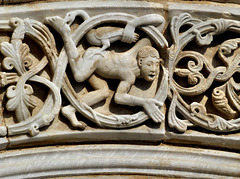
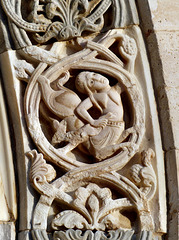
The cathedral was built from white, local stones, that change the colour from white to yellowish and reddish, during the sunset. Some of the carvings around the central portal are weathered, some have survived the times (or are perfectly restored). Here is one of them, that is really fantastic, even anatomically.
Trani - Cattedrale di San Nicola Pellegrino
| |
|
Trani may have been founded by Greek settlers, but the known history starts late. After the fall of the Western Roman Empire, it was dominated by Lombards, Byzantines, Saracens and again Byzantines. With the conquest of southern Italy by the Normans and after 50 days of siege by Robert Guiscard´s troops, Trani became part of the Norman Empire in 1073.
Already under the Byzantines, Trani had become an important port for trade with the Orient. The heyday was in the time of the crusades in the 12th and 13th centuries, when crusaders and merchants mainly went to the Holy Land from Bari and Trani. It became an episcopal see in place of Canosa, destroyed by the Saracens. Frederick II promoted the Teutonic Knights and the Jewish community and built a massive castle. Under his rule, the city reached its highest point of wealth and prosperity.
The construction of the "Cattedrale di Trani" began in 1099, over the earlier church of "Santa Maria della Scala", which went back to the 4th century.
It is dedicated to "San Nicola Pellegrino". Bari had the relics of "Saint Nicholas of Myra". The Bishop of Trani could convince Pope Urban II to canonized a young pilgrim, who had died on his way to Jerusalem in Trani in 1094 from exhaustion. The new church was intended to house the relics of "Saint Nicholas the Pilgrim".
Pina Belli d'Elia ("Puglia romanica") is sure, that this cathedral is the most important of all romanic buildings in Apulia.
The building process started at the crypt. The "translatio corporis S. Nicolai ad novam Ecclediam" took place in 1142. As parts of the old church, dedicated to Virgin Mary, were maintained, the construction is pretty complex. The "Cattedrale di Trani" was completed around 1200, the construction of the campanile started by Nicolaus Sacerdos (see "Bitonto") and completed in the mid 14th century. In the20th century the bell tower was in such a bad state, that it was completely dismantled and rebuilt in the 1950s to avoid it collapsing.
The cathedral was built from white, local stones, that change the colour from white to yellowish and reddish, during the sunset. Some of the carvings around the central portal are weathered, some have survived the times (or are perfectly restored). Here is one of them, that is really fantastic. A female centaur, having caught a hare with one hand and picking grapes with the other.

Trani - Cattedrale di San Nicola Pellegrino
| |
|
Trani may have been founded by Greek settlers, but the known history starts late. After the fall of the Western Roman Empire, it was dominated by Lombards, Byzantines, Saracens and again Byzantines. With the conquest of southern Italy by the Normans and after 50 days of siege by Robert Guiscard´s troops, Trani became part of the Norman Empire in 1073.
Already under the Byzantines, Trani had become an important port for trade with the Orient. The heyday was in the time of the crusades in the 12th and 13th centuries, when crusaders and merchants mainly went to the Holy Land from Bari and Trani. It became an episcopal see in place of Canosa, destroyed by the Saracens. Frederick II promoted the Teutonic Knights and the Jewish community and built a massive castle. Under his rule, the city reached its highest point of wealth and prosperity.
The construction of the "Cattedrale di Trani" began in 1099, over the earlier church of "Santa Maria della Scala", which went back to the 4th century.
It is dedicated to "San Nicola Pellegrino". Bari had the relics of "Saint Nicholas of Myra". The Bishop of Trani could convince Pope Urban II to canonized a young pilgrim, who had died on his way to Jerusalem in Trani in 1094 from exhaustion. The new church was intended to house the relics of "Saint Nicholas the Pilgrim".
Pina Belli d'Elia ("Puglia romanica") is sure, that this cathedral is the most important of all romanic buildings in Apulia.
The building process started at the crypt. The "translatio corporis S. Nicolai ad novam Ecclediam" took place in 1142. As parts of the old church, dedicated to Virgin Mary, were maintained, the construction is pretty complex. The "Cattedrale di Trani" was completed around 1200, the construction of the campanile started by Nicolaus Sacerdos (see "Bitonto") and completed in the mid 14th century. In the20th century the bell tower was in such a bad state, that it was completely dismantled and rebuilt in the 1950s to avoid it collapsing.
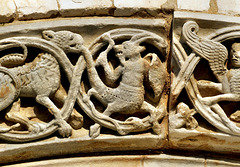
The cathedral was built from white, local stones, that change the colour from white to yellowish and reddish, during the sunset. Some of the carvings around the central portal are weathered, some have survived the times (or are perfectly restored). Here is one of them, that is really fantastic. I flipped this for 180°. A deer running off with a pomegranate?
Trani - Cattedrale di San Nicola Pellegrino
| |
|
|
Trani may have been founded by Greek settlers, but the known history starts late. After the fall of the Western Roman Empire, it was dominated by Lombards, Byzantines, Saracens and again Byzantines. With the conquest of southern Italy by the Normans and after 50 days of siege by Robert Guiscard´s troops, Trani became part of the Norman Empire in 1073.
Already under the Byzantines, Trani had become an important port for trade with the Orient. The heyday was in the time of the crusades in the 12th and 13th centuries, when crusaders and merchants mainly went to the Holy Land from Bari and Trani. It became an episcopal see in place of Canosa, destroyed by the Saracens. Frederick II promoted the Teutonic Knights and the Jewish community and built a massive castle. Under his rule, the city reached its highest point of wealth and prosperity.
The construction of the "Cattedrale di Trani" began in 1099, over the earlier church of "Santa Maria della Scala", which went back to the 4th century.
It is dedicated to "San Nicola Pellegrino". Bari had the relics of "Saint Nicholas of Myra". The Bishop of Trani could convince Pope Urban II to canonized a young pilgrim, who had died on his way to Jerusalem in Trani in 1094 from exhaustion. The new church was intended to house the relics of "Saint Nicholas the Pilgrim".
Pina Belli d'Elia ("Puglia romanica") is sure, that this cathedral is the most important of all romanic buildings in Apulia.
The building process started at the crypt. The "translatio corporis S. Nicolai ad novam Ecclediam" took place in 1142. As parts of the old church, dedicated to Virgin Mary, were maintained, the construction is pretty complex. The "Cattedrale di Trani" was completed around 1200, the construction of the campanile started by Nicolaus Sacerdos (see "Bitonto") and completed in the mid 14th century. In the20th century the bell tower was in such a bad state, that it was completely dismantled and rebuilt in the 1950s to avoid it collapsing.
The cathedral was built from white, local stones, that change the colour from white to yellowish and reddish, during the sunset. Some of the carvings around the central portal are weathered, some have survived the times (or are perfectly restored). This one is a bit weathered. The creature has the horned devil by the tail. The devil is armed with a battle-axe, not with a knightly sword.

Trani - Cattedrale di San Nicola Pellegrino
| |
|
|
Trani may have been founded by Greek settlers, but the known history starts late. After the fall of the Western Roman Empire, it was dominated by Lombards, Byzantines, Saracens and again Byzantines. With the conquest of southern Italy by the Normans and after 50 days of siege by Robert Guiscard´s troops, Trani became part of the Norman Empire in 1073.
Already under the Byzantines, Trani had become an important port for trade with the Orient. The heyday was in the time of the crusades in the 12th and 13th centuries, when crusaders and merchants mainly went to the Holy Land from Bari and Trani. It became an episcopal see in place of Canosa, destroyed by the Saracens. Frederick II promoted the Teutonic Knights and the Jewish community and built a massive castle. Under his rule, the city reached its highest point of wealth and prosperity.
The construction of the "Cattedrale di Trani" began in 1099, over the earlier church of "Santa Maria della Scala", which went back to the 4th century.
It is dedicated to "San Nicola Pellegrino". Bari had the relics of "Saint Nicholas of Myra". The Bishop of Trani could convince Pope Urban II to canonized a young pilgrim, who had died on his way to Jerusalem in Trani in 1094 from exhaustion. The new church was intended to house the relics of "Saint Nicholas the Pilgrim".
Pina Belli d'Elia ("Puglia romanica") is sure, that this cathedral is the most important of all romanic buildings in Apulia.
The building process started at the crypt. The "translatio corporis S. Nicolai ad novam Ecclediam" took place in 1142. As parts of the old church, dedicated to Virgin Mary, were maintained, the construction is pretty complex. The "Cattedrale di Trani" was completed around 1200, the construction of the campanile started by Nicolaus Sacerdos (see "Bitonto") and completed in the mid 14th century. In the20th century the bell tower was in such a bad state, that it was completely dismantled and rebuilt in the 1950s to avoid it collapsing.
The cathedral was built from white, local stones, that change the colour from white to yellowish and reddish, during the sunset.
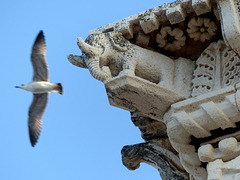
The nave and transept. There are dozens of corbels under the roof. Two of the depict elephants..
Trani - Cattedrale di San Nicola Pellegrino
| |
|
|
|
Trani may have been founded by Greek settlers, but the known history starts late. After the fall of the Western Roman Empire, it was dominated by Lombards, Byzantines, Saracens and again Byzantines. With the conquest of southern Italy by the Normans and after 50 days of siege by Robert Guiscard´s troops, Trani became part of the Norman Empire in 1073.
Already under the Byzantines, Trani had become an important port for trade with the Orient. The heyday was in the time of the crusades in the 12th and 13th centuries, when crusaders and merchants mainly went to the Holy Land from Bari and Trani. It became an episcopal see in place of Canosa, destroyed by the Saracens. Frederick II promoted the Teutonic Knights and the Jewish community and built a massive castle. Under his rule, the city reached its highest point of wealth and prosperity.
The construction of the "Cattedrale di Trani" began in 1099, over the earlier church of "Santa Maria della Scala", which went back to the 4th century.
It is dedicated to "San Nicola Pellegrino". Bari had the relics of "Saint Nicholas of Myra". The Bishop of Trani could convince Pope Urban II to canonized a young pilgrim, who had died on his way to Jerusalem in Trani in 1094 from exhaustion. The new church was intended to house the relics of "Saint Nicholas the Pilgrim".
Pina Belli d'Elia ("Puglia romanica") is sure, that this cathedral is the most important of all romanic buildings in Apulia.
The building process started at the crypt. The "translatio corporis S. Nicolai ad novam Ecclediam" took place in 1142. As parts of the old church, dedicated to Virgin Mary, were maintained, the construction is pretty complex. The "Cattedrale di Trani" was completed around 1200, the construction of the campanile started by Nicolaus Sacerdos (see "Bitonto") and completed in the mid 14th century. In the20th century the bell tower was in such a bad state, that it was completely dismantled and rebuilt in the 1950s to avoid it collapsing.
The cathedral was built from white, local stones, that change the colour from white to yellowish and reddish, during the sunset.
There are dozens of sculpted corbels under the transept´s roof. I could find two elephants. Here is one of them.

Trani - Cattedrale di San Nicola Pellegrino
| |
|
|
Trani may have been founded by Greek settlers, but the known history starts late. After the fall of the Western Roman Empire, it was dominated by Lombards, Byzantines, Saracens and again Byzantines. With the conquest of southern Italy by the Normans and after 50 days of siege by Robert Guiscard´s troops, Trani became part of the Norman Empire in 1073.
Already under the Byzantines, Trani had become an important port for trade with the Orient. The heyday was in the time of the crusades in the 12th and 13th centuries, when crusaders and merchants mainly went to the Holy Land from Bari and Trani. It became an episcopal see in place of Canosa, destroyed by the Saracens. Frederick II promoted the Teutonic Knights and the Jewish community and built a massive castle. Under his rule, the city reached its highest point of wealth and prosperity.
The construction of the "Cattedrale di Trani" began in 1099, over the earlier church of "Santa Maria della Scala", which went back to the 4th century.
It is dedicated to "San Nicola Pellegrino". Bari had the relics of "Saint Nicholas of Myra". The Bishop of Trani could convince Pope Urban II to canonized a young pilgrim, who had died on his way to Jerusalem in Trani in 1094 from exhaustion. The new church was intended to house the relics of "Saint Nicholas the Pilgrim".
Pina Belli d'Elia ("Puglia romanica") is sure, that this cathedral is the most important of all romanic buildings in Apulia.
The building process started at the crypt. The "translatio corporis S. Nicolai ad novam Ecclediam" took place in 1142. As parts of the old church, dedicated to Virgin Mary, were maintained, the construction is pretty complex. The "Cattedrale di Trani" was completed around 1200, the construction of the campanile started by Nicolaus Sacerdos (see "Bitonto") and completed in the mid 14th century. In the 20th century the bell tower was in such a bad state, that it was completely dismantled and rebuilt in the 1950s to avoid it collapsing.
The cathedral was built from white, local stones, that change the colour from white to yellowish and reddish, during the sunset.
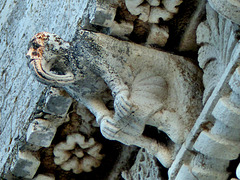
There are dozens of sculpted corbels under the transept´s roof. I could find two elephants. Here is one, who has obviously lost the tips of the tusks. The small holes show, how they once were attached.
Trani - Cattedrale di San Nicola Pellegrino
| |
|
Trani may have been founded by Greek settlers, but the known history starts late. After the fall of the Western Roman Empire, it was dominated by Lombards, Byzantines, Saracens and again Byzantines. With the conquest of southern Italy by the Normans and after 50 days of siege by Robert Guiscard´s troops, Trani became part of the Norman Empire in 1073.
Already under the Byzantines, Trani had become an important port for trade with the Orient. The heyday was in the time of the crusades in the 12th and 13th centuries, when crusaders and merchants mainly went to the Holy Land from Bari and Trani. It became an episcopal see in place of Canosa, destroyed by the Saracens. Frederick II promoted the Teutonic Knights and the Jewish community and built a massive castle. Under his rule, the city reached its highest point of wealth and prosperity.
The construction of the "Cattedrale di Trani" began in 1099, over the earlier church of "Santa Maria della Scala", which went back to the 4th century.
It is dedicated to "San Nicola Pellegrino". Bari had the relics of "Saint Nicholas of Myra". The Bishop of Trani could convince Pope Urban II to canonized a young pilgrim, who had died on his way to Jerusalem in Trani in 1094 from exhaustion. The new church was intended to house the relics of "Saint Nicholas the Pilgrim".
Pina Belli d'Elia ("Puglia romanica") is sure, that this cathedral is the most important of all romanic buildings in Apulia.
The building process started at the crypt. The "translatio corporis S. Nicolai ad novam Ecclediam" took place in 1142. As parts of the old church, dedicated to Virgin Mary, were maintained, the construction is pretty complex. The "Cattedrale di Trani" was completed around 1200, the construction of the campanile started by Nicolaus Sacerdos (see "Bitonto") and completed in the mid 14th century. In the 20th century the bell tower was in such a bad state, that it was completely dismantled and rebuilt in the 1950s to avoid it collapsing.
The cathedral was built from white, local stones, that change the colour from white to yellowish and reddish, during the sunset.
There are dozens of sculpted corbels under the transept´s roof. This person wears a very unusual beard - for sure formed by the steady wind blowing from the sea.
Trani - Cattedrale di San Nicola Pellegrino
| |
|
|
|
Trani may have been founded by Greek settlers, but the known history starts late. After the fall of the Western Roman Empire, it was dominated by Lombards, Byzantines, Saracens and again Byzantines. With the conquest of southern Italy by the Normans and after 50 days of siege by Robert Guiscard´s troops, Trani became part of the Norman Empire in 1073.
Already under the Byzantines, Trani had become an important port for trade with the Orient. The heyday was in the time of the crusades in the 12th and 13th centuries, when crusaders and merchants mainly went to the Holy Land from Bari and Trani. It became an episcopal see in place of Canosa, destroyed by the Saracens. Frederick II promoted the Teutonic Knights and the Jewish community and built a massive castle. Under his rule, the city reached its highest point of wealth and prosperity.
The construction of the "Cattedrale di Trani" began in 1099, over the earlier church of "Santa Maria della Scala", which went back to the 4th century.
It is dedicated to "San Nicola Pellegrino". Bari had the relics of "Saint Nicholas of Myra". The Bishop of Trani could convince Pope Urban II to canonized a young pilgrim, who had died on his way to Jerusalem in Trani in 1094 from exhaustion. The new church was intended to house the relics of "Saint Nicholas the Pilgrim".
Pina Belli d'Elia ("Puglia romanica") is sure, that this cathedral is the most important of all romanic buildings in Apulia.
The building process started at the crypt. The "translatio corporis S. Nicolai ad novam Ecclediam" took place in 1142. As parts of the old church, dedicated to Virgin Mary, were maintained, the construction is pretty complex. The "Cattedrale di Trani" was completed around 1200, the construction of the campanile started by Nicolaus Sacerdos (see "Bitonto") and completed in the mid 14th century. In the 20th century, the bell tower was in such a bad state, that it was completely dismantled and rebuilt in the 1950s to avoid it collapsing.
The cathedral was built from white, local stones, that change the colour from white to yellowish and reddish, during the sunset.
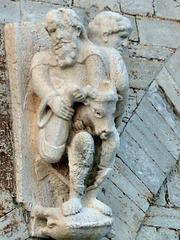
This sculpture is on the south side of the nave. I have the impression, that is was once a part of a larger group. There are two men, the left one is a "spinario", a person pulling a thorn out of his foot. From the second man, only the head is seen. Inbetween them the head of a bovine - and the men´s feet are placed on a pig. Does the left person pull a thorn out of the right men´s foot? Do both feet on top of that piggy belong to the left person? No, can´t be, then the toes would... the right foot on that pig cannot belong to the left person.. Find out!
Trani - Cattedrale di San Nicola Pellegrino
| |
|
Trani may have been founded by Greek settlers, but the known history starts late. After the fall of the Western Roman Empire, it was dominated by Lombards, Byzantines, Saracens and again Byzantines. With the conquest of southern Italy by the Normans and after 50 days of siege by Robert Guiscard´s troops, Trani became part of the Norman Empire in 1073.
Already under the Byzantines, Trani had become an important port for trade with the Orient. The heyday was in the time of the crusades in the 12th and 13th centuries, when crusaders and merchants mainly went to the Holy Land from Bari and Trani. It became an episcopal see in place of Canosa, destroyed by the Saracens. Frederick II promoted the Teutonic Knights and the Jewish community and built a massive castle. Under his rule, the city reached its highest point of wealth and prosperity.
The construction of the "Cattedrale di Trani" began in 1099, over the earlier church of "Santa Maria della Scala", which went back to the 4th century.
It is dedicated to "San Nicola Pellegrino". Bari had the relics of "Saint Nicholas of Myra". The Bishop of Trani could convince Pope Urban II to canonized a young pilgrim, who had died on his way to Jerusalem in Trani in 1094 from exhaustion. The new church was intended to house the relics of "Saint Nicholas the Pilgrim".
Pina Belli d'Elia ("Puglia romanica") is sure, that this cathedral is the most important of all romanic buildings in Apulia.
The building process started at the crypt. The "translatio corporis S. Nicolai ad novam Ecclediam" took place in 1142. As parts of the old church, dedicated to Virgin Mary, were maintained, the construction is pretty complex. The "Cattedrale di Trani" was completed around 1200, the construction of the campanile started by Nicolaus Sacerdos (see "Bitonto") and completed in the mid 14th century. In the 20th century the bell tower was in such a bad state, that it was completely dismantled and rebuilt in the 1950s to avoid it collapsing.
The cathedral was built from white, local stones, that change the colour from white to yellowish and reddish, during the sunset.
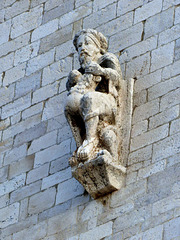
This sculpture is on the south side of the nave, carved in the same "soft" style like the other sculpture here (prev. upload). A man eating grapes. He wears sandals and a turban (?). A Muslim?
Trani - Cattedrale di San Nicola Pellegrino
| |
|
|
Trani may have been founded by Greek settlers, but the known history starts late. After the fall of the Western Roman Empire, it was dominated by Lombards, Byzantines, Saracens and again Byzantines. With the conquest of southern Italy by the Normans and after 50 days of siege by Robert Guiscard´s troops, Trani became part of the Norman Empire in 1073.
Already under the Byzantines, Trani had become an important port for trade with the Orient. The heyday was in the time of the crusades in the 12th and 13th centuries, when crusaders and merchants mainly went to the Holy Land from Bari and Trani. It became an episcopal see in place of Canosa, destroyed by the Saracens. Frederick II promoted the Teutonic Knights and the Jewish community and built a massive castle. Under his rule, the city reached its highest point of wealth and prosperity.
The construction of the "Cattedrale di Trani" began in 1099, over the earlier church of "Santa Maria della Scala", which went back to the 4th century.
It is dedicated to "San Nicola Pellegrino". Bari had the relics of "Saint Nicholas of Myra". The Bishop of Trani could convince Pope Urban II to canonized a young pilgrim, who had died on his way to Jerusalem in Trani in 1094 from exhaustion. The new church was intended to house the relics of "Saint Nicholas the Pilgrim".
Pina Belli d'Elia ("Puglia romanica") is sure, that this cathedral is the most important of all romanic buildings in Apulia.
The building process started at the crypt. The "translatio corporis S. Nicolai ad novam Ecclediam" took place in 1142. As parts of the old church, dedicated to Virgin Mary, were maintained, the construction is pretty complex. The "Cattedrale di Trani" was completed around 1200, the construction of the campanile started by Nicolaus Sacerdos (see "Bitonto") and completed in the mid 14th century. In the 20th century the bell tower was in such a bad state, that it was completely dismantled and rebuilt in the 1950s to avoid it collapsing.
The cathedral was built from white, local stones, that change the colour from white to yellowish and reddish, during the sunset.
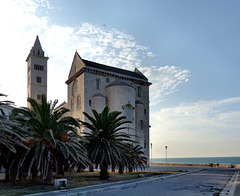
The transpt, apses and the tower, seen from a distance.
Trani - Cattedrale di San Nicola Pellegrino
| |
|
|
Trani may have been founded by Greek settlers, but the known history starts late. After the fall of the Western Roman Empire, it was dominated by Lombards, Byzantines, Saracens and again Byzantines. With the conquest of southern Italy by the Normans and after 50 days of siege by Robert Guiscard´s troops, Trani became part of the Norman Empire in 1073.
Already under the Byzantines, Trani had become an important port for trade with the Orient. The heyday was in the time of the crusades in the 12th and 13th centuries, when crusaders and merchants mainly went to the Holy Land from Bari and Trani. It became an episcopal see in place of Canosa, destroyed by the Saracens. Frederick II promoted the Teutonic Knights and the Jewish community and built a massive castle. Under his rule, the city reached its highest point of wealth and prosperity.
The construction of the "Cattedrale di Trani" began in 1099, over the earlier church of "Santa Maria della Scala", which went back to the 4th century.
It is dedicated to "San Nicola Pellegrino". Bari had the relics of "Saint Nicholas of Myra". The Bishop of Trani could convince Pope Urban II to canonized a young pilgrim, who had died on his way to Jerusalem in Trani in 1094 from exhaustion. The new church was intended to house the relics of "Saint Nicholas the Pilgrim".
Pina Belli d'Elia ("Puglia romanica") is sure, that this cathedral is the most important of all romanic buildings in Apulia.
The building process started at the crypt. The "translatio corporis S. Nicolai ad novam Ecclediam" took place in 1142. As parts of the old church, dedicated to Virgin Mary, were maintained, the construction is pretty complex. The "Cattedrale di Trani" was completed around 1200, the construction of the campanile started by Nicolaus Sacerdos (see "Bitonto") and completed in the mid 14th century. In the 20th century the bell tower was in such a bad state, that it was completely dismantled and rebuilt in the 1950s to avoid it collapsing.
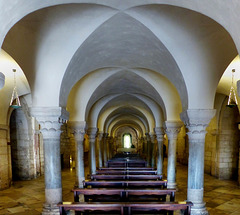
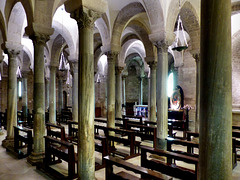
The tourists enter the building via the crypt, that in parts dates back to the church "Santa Maria della Scala", that is older, than the cathedral above it.
Trani - Cattedrale di San Nicola Pellegrino
| |
|
|
Trani may have been founded by Greek settlers, but the known history starts late. After the fall of the Western Roman Empire, it was dominated by Lombards, Byzantines, Saracens and again Byzantines. With the conquest of southern Italy by the Normans and after 50 days of siege by Robert Guiscard´s troops, Trani became part of the Norman Empire in 1073.
Already under the Byzantines, Trani had become an important port for trade with the Orient. The heyday was in the time of the crusades in the 12th and 13th centuries, when crusaders and merchants mainly went to the Holy Land from Bari and Trani. It became an episcopal see in place of Canosa, destroyed by the Saracens. Frederick II promoted the Teutonic Knights and the Jewish community and built a massive castle. Under his rule, the city reached its highest point of wealth and prosperity.
The construction of the "Cattedrale di Trani" began in 1099, over the earlier church of "Santa Maria della Scala", which went back to the 4th century.
It is dedicated to "San Nicola Pellegrino". Bari had the relics of "Saint Nicholas of Myra". The Bishop of Trani could convince Pope Urban II to canonized a young pilgrim, who had died on his way to Jerusalem in Trani in 1094 from exhaustion. The new church was intended to house the relics of "Saint Nicholas the Pilgrim".
Pina Belli d'Elia ("Puglia romanica") is sure, that this cathedral is the most important of all romanic buildings in Apulia.
The building process started at the crypt. The "translatio corporis S. Nicolai ad novam Ecclediam" took place in 1142. As parts of the old church, dedicated to Virgin Mary, were maintained, the construction is pretty complex. The "Cattedrale di Trani" was completed around 1200, the construction of the campanile started by Nicolaus Sacerdos (see "Bitonto") and completed in the mid 14th century. In the 20th century the bell tower was in such a bad state, that it was completely dismantled and rebuilt in the 1950s to avoid it collapsing.
The tourists enter the building via the crypt, that in parts dates back to the church "Santa Maria della Scala", that is older, than the cathedral above it.
Trani - Cattedrale di San Nicola Pellegrino
| |
|
|
|
Trani may have been founded by Greek settlers, but the known history starts late. After the fall of the Western Roman Empire, it was dominated by Lombards, Byzantines, Saracens and again Byzantines. With the conquest of southern Italy by the Normans and after 50 days of siege by Robert Guiscard´s troops, Trani became part of the Norman Empire in 1073.
Already under the Byzantines, Trani had become an important port for trade with the Orient. The heyday was in the time of the crusades in the 12th and 13th centuries, when crusaders and merchants mainly went to the Holy Land from Bari and Trani. It became an episcopal see in place of Canosa, destroyed by the Saracens. Frederick II promoted the Teutonic Knights and the Jewish community and built a massive castle. Under his rule, the city reached its highest point of wealth and prosperity.
The construction of the "Cattedrale di Trani" began in 1099, over the earlier church of "Santa Maria della Scala", which went back to the 4th century.
It is dedicated to "San Nicola Pellegrino". Bari had the relics of "Saint Nicholas of Myra". The Bishop of Trani could convince Pope Urban II to canonized a young pilgrim, who had died on his way to Jerusalem in Trani in 1094 from exhaustion. The new church was intended to house the relics of "Saint Nicholas the Pilgrim".
Pina Belli d'Elia ("Puglia romanica") is sure, that this cathedral is the most important of all romanic buildings in Apulia.
The building process started at the crypt. The "translatio corporis S. Nicolai ad novam Ecclediam" took place in 1142. As parts of the old church, dedicated to Virgin Mary, were maintained, the construction is pretty complex. The "Cattedrale di Trani" was completed around 1200, the construction of the campanile started by Nicolaus Sacerdos (see "Bitonto") and completed in the mid 14th century. In the 20th century the bell tower was in such a bad state, that it was completely dismantled and rebuilt in the 1950s to avoid it collapsing.
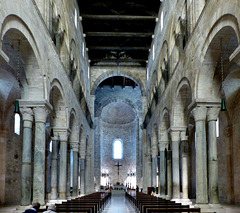
The cathedral's nave. Note that the capitals are destroyed. A result of the modification of the Baroque time.
Jump to top
RSS feed- Latest items - Subscribe to the latest items added to this album
- ipernity © 2007-2026
- Help & Contact
|
Club news
|
About ipernity
|
History |
ipernity Club & Prices |
Guide of good conduct
Donate | Group guidelines | Privacy policy | Terms of use | Statutes | In memoria -
Facebook
X
