

Martin M. Miles' photos
Andechs
| |
|
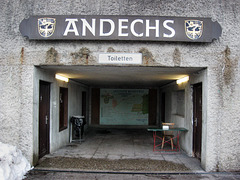
Andechs monastery is built on a steep mountain overlooking the Ammersee. It is probably the best known bavarian monastery, as it has a huge beer garden and an own brewery, producing 100.000 hectolitres of beer annualy. On summerdays thousands of tourists will be here - and have a beer, as 5% of the annual production is consumed on the spot. The visitors approaching from the car park will see this first: the restrooms. Just put the tip into the box..

Schondorf - Ammersee
| |
|
The church St. Jakobus was built on a little hump, only a few meters away from the Ammersee. Standing there and looking south, you can see the Alps.

Schondorf - St. Jakobus
| |
|
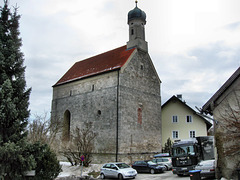
See the apse of "St. Jakobus" to the right - and a bavarian pub and beer garden to the left. This combination may have started, when the church was built. So here the pilgrims could have dinner, before the went up the stairs into the dormitory - centuries ago. Actually the floor in the church still exists, but is not used as a dorm any longer. The symbiosis of pub and church is still very strong in Bavaria. The strongest it is in nearby Andechs. But that is another story.
Schondorf - St. Jakobus
| |
|
A busy day. A truck from the "Franziskaner"-brewery just arrived and now parks behind the St. Jakobus church, built around 1200 and only meters away from the Ammersee. There is not much to see. It has a simple and clear structure, but there is a "special". It has an upper floor, that can be reached via a staircase inside. The patrozinium "Jakobus" connects the little church with the medieval pilgrimage and coming from east, having just crossed the lake, this was for sure an ideal place to stay overnight. So the room upstairs was probably used as a dormatory for pilgrims before.
Diessen - Mechthildis Stone
| |
|
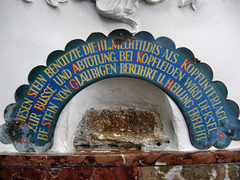
The Mechtihldis stone, used by Mathilde von Diessen (1125 - 1160). Her common name is "Mechthildis" and she is still a of a certain regional cult. Already during her lifetime, that she was a saint. A kind of female Job, she suffered lifelong from all kinds of maladies. She used this stone as a pillow against severe headache - and every day people come here to touch the stone. I was told that this is way better than strong aspirin. The water of a nearby spring helps against eye complaints.
Diessen - Marienmuenster
| |
|
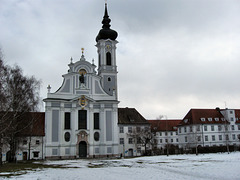
The parish church "Marienmuenster" in Diessen was the church of the abbey, founded already within the 9th. century - refounded by the Duke of Diessen 1150. The abbey was seculalaisized in 1803. Nothing out of the early time has survived, but one stone, that we´ll see later. This church was built 1732 - 1739 in baroque style.
Ammersee
| |
|
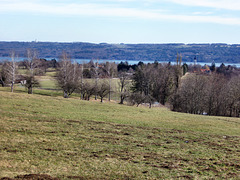
The snow finally melted on a hill overlooking the Ammersee. The town of Diessen is in the foreground. There is the steeple of the church, that belonged to an old abbey, and is now parish church. On the other side of the lake at the horizon, you see the benedictine Andechs abbey, known for it´s brewery and the wonderfull "beer-garden".. The Ammersee was a barrier for all medieval travel as it continues further south into a very swampy area. Ferries were used to cross the lake. One of the pickup points for passengers was the still existing village Wartaweil on the opposite side of the lake. "Wart a Weil" is bavarian language for "Wait A While". - - The snow was back next morning!
Peiting
| |
|
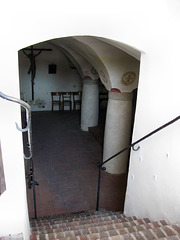
Some of the bavarian baroque parish churches still have romanesque towers/steeples (mostly with more modern roofs). Some even have crypts. The parish church in Peiting has both - but the crypt was locked. I could hold my camera through the door, but my arm was not long enough to get a better shot. I was told, that the quadratic crypt has four convex pillars.
Steingaden
| |
|
|
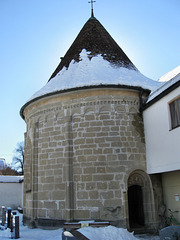
St. John´s chapel on the edge of the little graveyard is a round building, built around 1200. Probably another (small) copy of the Church of the Holy Sepulchre in Jerusalem. Actually it was moved to this place within the 15th century - and got a new roof, but there is still a small tympanon - and left and right from the entrance are two lions. As this klind of lions got out of fashion - most of the lion vanished in the wall of the later built house on the right.
Welf VI (1115 - 1191), founder of the abbey, Duke of Spoleto, margraf of Tuscany and (thanks to Bernard of Clairvaux preaching at Speyer) combattant in the Second Cruisade, and his son Welf VII (1140 -1167), who fought in Italy against the pope with Friedrich I (aka "Barbarossa") and died from malaria in Siena, have their graves here.
Steingaden
| |
|
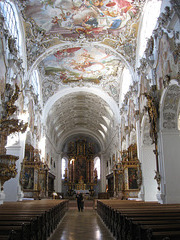
Take a close look! This was - more than 800 years ago - a pretty big
high romanesque church with a nave an two side aisles. A little bit of
the structure is still visible
Steingaden
| |
|
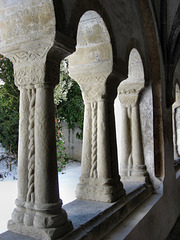
An intersting design. Two pillars - and a kind of braid inbetween.
Well the last one is not plaited..
Steingaden
| |
|
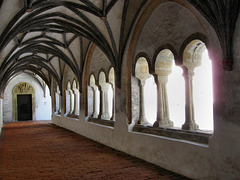
The romanesque cloister was built around 1200 (and this is what is left of it), the ceiling in gothic style is younger - around 1480.
Steingaden
Steingaden
| |
|
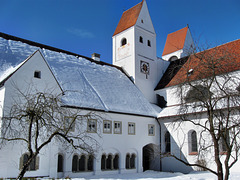
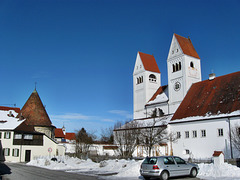
Steingaden Abbey was founded 1147 by Welf VI. son of "Henry the Black" and brother of "Henry the Proud". Welf VI was already a member of the "Younger House of Welf", as the "Older House of Welf" ended (malewise) with Welf III in 1055.
Welf III´s sister married into the italian d´Este family - and so started the "Younger House of Welf". The Welfs have been powerful counterparts to the Staufers - and the Welfs still exist - all over the place. One branch leads to George I of England, whose grandgrand....daughter is Queen Elizabeth II. Other branches take you to the late Frederica, Queen of Greeks and mother of Queen Sofia of Spain - and of course one line leads to Ernst August of Hanover married to the Princess of Hanover, aka Caroline of Monaco (daughter of Grace Kelly).
That is the thread leading from Steingaden - to London, Monaco and elsewhere. The abbey itself had a kind of volatile history. Over the first centuries the buildings were altered from romanesque to gothic style - before they were burnt down and looted 1525 during the Peasant´s War. A couple of years later, it was rebuilt in the style of the Renaissance, to get burnt down again 1646 during the Thirty Year´s War. After a new start - now in baroque and rococo - it got secularized in 1803. Then most buildings got demolished, before the main church (the "Welfenmuenster") was turned into the parish church of the village Steingaden.
Please note the little round roof on the left. We will see that again later.
Altenstadt - St. Michael
| |
|
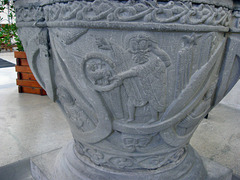
John the Baptist, prophet and preacher. He looks a little "hippiesque" here, with the beard, the long (rastalike) hair and wearing strange clothes from camel´s hair. He lives in the desert, but near the Jordan. Lots of birds around. John points to the dove on the left. Right - next to the flying sparrow sits a snipe. Or is it a small heron? John seems to walk through the reed to the river led by the Holy Spirit (dove) to Christ (lamb).
Altenstadt - St. Michael
| |
|
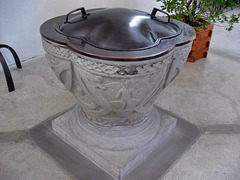
The baptismal font is so delicate, that some historians say, that it was not carved (1200) for this church. It shows Mary and the child, John the baptist, the baptism of Jesus (here) and St. Michael fighting Luzifer. Down below you can see the rivers of paradise, flowing out of the mouths of that strange heads.
Altenstadt - St. Michael
| |
|
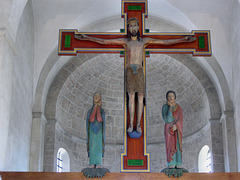
This is "bigger than life". A height of 3,18m. Majestic. Well known all over Bavaria under the name "Der grosse Gott von Altenstadt" (The Great God from Altenstadt). Carved around 1215. A "Rex Gloriae". The two adjoining sculptures (Mary and John) are copies. The originals were sold to the Bavarian National Museum, where they found a new home.
Altenstadt - St. Michael
| |
|
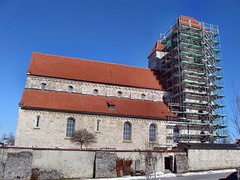
Approaching the small, unimpressing village of Altenstadt the visitor will find a really impressing romanesque basilica. The church is way too big for the village. - The original name of the village was "Scongoe". Founded on a hill over the river Lech, it controlled an old roman "highway" from Augsburg to Italy - and over the time got wealthy and proud. So they started to built this St.Michael-church between 1170 and 1220. Just after the church was built, discussions started and the whole village moved (for strategic reasons) to a new place, just a few kilometers away and started the (still existing) "Schongau", naming the old place "Altenstadt" (= old town). As there were no people to care for the abandoned church, and over the many years (fortunately) no money, to change it into gothic, baroque or rococo style, purity has survived here. Luckily. It looks probably better without that scaffolding but - after all the time, it needs constant care.
