

Chirokitia
Chirokitia
Chirokitia - Panagia tou Kampou
Chirokitia - Panagia tou Kampou
Chirokitia - Panagia tou Kampou
Chirokitia - Panagia tou Kampou
Chirokitia - Panagia tou Kampou
Chirokitia - Panagia tou Kampou
Chirokitia - Tower of Chirokitia
Kalavasos - Tenta
Kalavasos - Tenta
Kalavasos - Tenta
Kalavasos - Tenta
Limassol
Limassol - High Chaparall
Limassol
Limassol - Mister Octopus
Amathous
Amathous
Amathous
Amathous
Amathous
Amathous
Chirokitia
Kiti - Pistacia atlantica
Kiti - Panagia Angeloktisti
Kiti - Panagia Angeloktisti
Kiti - Panagia Angeloktisti
Kiti - Panagia Angeloktisti
Kiti - Panagia Angeloktisti
Kiti - Panagia Angeloktisti
Kiti - Panagia Angeloktisti
Kiti - Panagia Angeloktisti
Kiti - Panagia Angeloktisti
Kiti - Panagia Angeloktisti
Kiti - Panagia Angeloktisti
Larnaca - Djami Kebir Mosque
Larnaca - Djami Kebir Mosque
Larnaca - Zuhuri Mosque
Larnaca - Zuhuri Mosque
Larnaca - DSTRKT
Larnaca - Patsa Market
Larnaca - Pierides Museum
Larnaca - Pierides Museum
Larnaca - Pierides Museum
Keywords
Authorizations, license
-
Visible by: Everyone -
All rights reserved
-
29 visits
Chirokitia
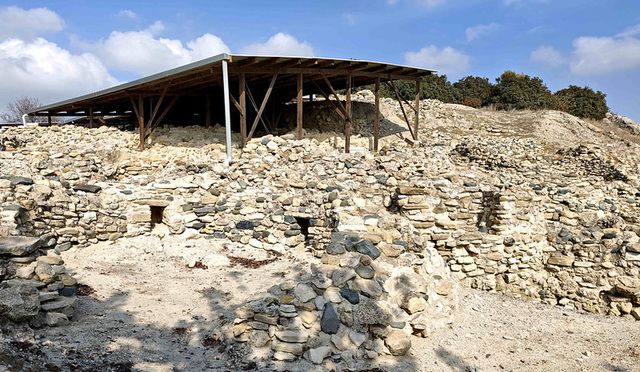

Chirokitia is a Neolithic archaeological site.
The site was discovered in 1934, and the first excavations began that same year. It was first thought that the settlement had been founded around 4000 BC. However, radiocarbon dating indicated a founding date of around 7000 BC.
Further excavations took place in the 1970s. The site was evidently inhabited from the 7th to the 4th millennium BC and had up to 600 inhabitants, who lived off livestock farming (sheep, goats, pigs) and agriculture (wheat, barley, lentils, peas). The people lived in round structures huddled close together. These buildings are organized in tight groups around an unroofed "courtyard", which scholars believe represents family groups.
This is where domesticated cats were first documented outside their African homeland. They were first introduced as pets in the 7th millennium BC and used to hunt rodents.
In 1998, the site was added to the UNESCO World Heritage List.
The site was discovered in 1934, and the first excavations began that same year. It was first thought that the settlement had been founded around 4000 BC. However, radiocarbon dating indicated a founding date of around 7000 BC.
Further excavations took place in the 1970s. The site was evidently inhabited from the 7th to the 4th millennium BC and had up to 600 inhabitants, who lived off livestock farming (sheep, goats, pigs) and agriculture (wheat, barley, lentils, peas). The people lived in round structures huddled close together. These buildings are organized in tight groups around an unroofed "courtyard", which scholars believe represents family groups.
This is where domesticated cats were first documented outside their African homeland. They were first introduced as pets in the 7th millennium BC and used to hunt rodents.
In 1998, the site was added to the UNESCO World Heritage List.
kiiti has particularly liked this photo
- Keyboard shortcuts:
Jump to top
RSS feed- Latest comments - Subscribe to the comment feeds of this photo
- ipernity © 2007-2026
- Help & Contact
|
Club news
|
About ipernity
|
History |
ipernity Club & Prices |
Guide of good conduct
Donate | Group guidelines | Privacy policy | Terms of use | Statutes | In memoria -
Facebook
X

Sign-in to write a comment.