

Mainz - Cathedral
Mainz - Rainbow Cotton Candy
Mainz - Landesmuseum
Mainz - Landesmuseum
Mainz - Landesmuseum
Mainz - Landesmuseum
Mainz - Landesmuseum
Mainz - Landesmuseum
Mainz - Landesmuseum
Mainz - Landesmuseum
Mainz - Landesmuseum
Mainz - Landesmuseum
Mainz - Landesmuseum
Mainz - Landesmuseum
Mainz - Landesmuseum
Mainz - Landesmuseum
Mainz - Landesmuseum
Mainz - Landesmuseum
Mainz - Landesmuseum
Mainz - Landesmuseum
Mainz - Landesmuseum
Mainz - Landesmuseum
Mainz - Landesmuseum
Mainz - Bischöfliches Dom- und Diözesanmuseum
Mainz - Bischöfliches Dom- und Diözesanmuseum
Mainz - Bischöfliches Dom- und Diözesanmuseum
Mainz - Bischöfliches Dom- und Diözesanmuseum
Mainz - Bischöfliches Dom- und Diözesanmuseum
Mainz - Bischöfliches Dom- und Diözesanmuseum
Mainz - Bischöfliches Dom- und Diözesanmuseum
Mainz - Bischöfliches Dom- und Diözesanmuseum
Mainz - Bischöfliches Dom- und Diözesanmuseum
Mainz - Bischöfliches Dom- und Diözesanmuseum
Mainz - Bischöfliches Dom- und Diözesanmuseum
Mainz - Bischöfliches Dom- und Diözesanmuseum
Mainz - Cathedral
Mainz - Landesmuseum
Mainz - Landesmuseum
Mainz - Landesmuseum
Mainz - Landesmuseum
Mainz - Landesmuseum
Mainz - Landesmuseum
Mainz - Landesmuseum
Mainz - Landesmuseum
Mainz - Landesmuseum
Location
Lat, Lng:
You can copy the above to your favourite mapping app.
Address: unknown
You can copy the above to your favourite mapping app.
Address: unknown
See also...
Keywords
Authorizations, license
-
Visible by: Everyone -
All rights reserved
-
74 visits
Mainz - Cathedral
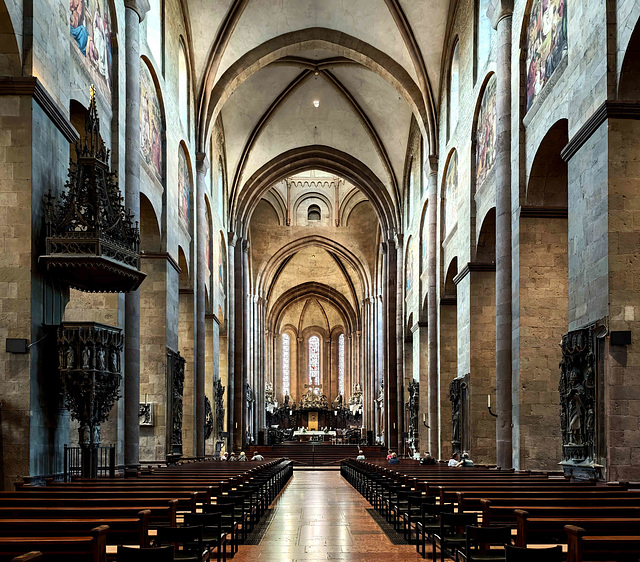

Mainz was founded around 20 BC by the Romans under the name “Mogontiacum” as a military camp. Today's capital of the state of Rhineland-Palatinate forms a metropolitan area with Wiesbaden, the neighboring capital of Hesse, with a combined population of around 500,000.
The St. Martin's Cathedral, a predominantly romanesque structure, with many gothic and some baroque extensions, is in the very center of the city of Mainz.
Today, it has a total length of 116 meters.
Archbishop Willigis, an important political player, had the construction of a cathedral started end of the 10th century. This basilica was (already!) completed 1009. A day before the consecration in August 1009, the new cathedral was illuminated by torches - and burnt down completely.
So finally 1036 Archbishop Bardo completed the church and it got consecrated in the presence of Conrad II. Another fire in 1081 damaged the cathedral. With the support of Henry IV the reconstruction started around 1100. For the next years "magistri comacin", highly specialised stone masons from the Lombardy left their marks here.
In 1184 Frederick I Barbarossa hold one of the biggest parties of medieval times here, for the accolade of his sons, a ceremony that took place inside the cathedral. During the Thirty Years' War swedish troops looted the cathedral, so some parts of the former treasury survived the times in Sweden and now to be seen in a museum in Uppsala.
The "Republic of Mainz", a product of the French Revolution, was the first democratic state on German territory. The state was represented in Paris by Georg Forster, who, as a boy, had been in the Pacific with Captain Cook. During the time of the republic the cathedral was used as a piggery, later a military hospital. All furniture was either sold or used for heating up the building. The time of the republic ended, when Prussia cannonaded Mainz, what damaged the cathedral severely.
The reconstruction and rebuilding started mid 19th century.
The St. Martin's Cathedral, a predominantly romanesque structure, with many gothic and some baroque extensions, is in the very center of the city of Mainz.
Today, it has a total length of 116 meters.
Archbishop Willigis, an important political player, had the construction of a cathedral started end of the 10th century. This basilica was (already!) completed 1009. A day before the consecration in August 1009, the new cathedral was illuminated by torches - and burnt down completely.
So finally 1036 Archbishop Bardo completed the church and it got consecrated in the presence of Conrad II. Another fire in 1081 damaged the cathedral. With the support of Henry IV the reconstruction started around 1100. For the next years "magistri comacin", highly specialised stone masons from the Lombardy left their marks here.
In 1184 Frederick I Barbarossa hold one of the biggest parties of medieval times here, for the accolade of his sons, a ceremony that took place inside the cathedral. During the Thirty Years' War swedish troops looted the cathedral, so some parts of the former treasury survived the times in Sweden and now to be seen in a museum in Uppsala.
The "Republic of Mainz", a product of the French Revolution, was the first democratic state on German territory. The state was represented in Paris by Georg Forster, who, as a boy, had been in the Pacific with Captain Cook. During the time of the republic the cathedral was used as a piggery, later a military hospital. All furniture was either sold or used for heating up the building. The time of the republic ended, when Prussia cannonaded Mainz, what damaged the cathedral severely.
The reconstruction and rebuilding started mid 19th century.
kiiti has particularly liked this photo
- Keyboard shortcuts:
Jump to top
RSS feed- Latest comments - Subscribe to the comment feeds of this photo
- ipernity © 2007-2026
- Help & Contact
|
Club news
|
About ipernity
|
History |
ipernity Club & Prices |
Guide of good conduct
Donate | Group guidelines | Privacy policy | Terms of use | Statutes | In memoria -
Facebook
X

Sign-in to write a comment.