

Zamora - La Casa De Los Pinchitos
Almería - The Magi
Almería - The Magi
Almería - The Magi
Almería - The Magi
Almería - Mercado Central
Almería - Mercado Central
Roquetas de Mar
Roquetas de Mar - Ales & Patricia
Roquetas de Mar - Iglesia de las Marinas
La Calahorra - Castillo de La Calahorra
La Calahorra
La Calahorra - Castillo de La Calahorra
Guadix - Catedral de la Encarnación
Guadix - Catedral de la Encarnación
Guadix - Compas del Cardenal Don Gaspar de Avalos
Fort Bravo
Nerja - Lavanderia
Nerja - Auto Lavado de Mascotas
Málaga
Málaga - Museo de Málaga
Málaga - Museo de Málaga
Málaga - Museo de Málaga
Zamora - Palacio de Los Momos
Zamora
Zamora
Zamora - Castillo de Zamora
Zamora - Puente de Piedra
Zamora - Santa María la Nueva
Zamora - Santa María la Nueva
Zamora - Santa María la Nueva
Zamora - Santa María la Nueva
Zamora - Teatro Principal
Zamora - Santa María Magdalena (PiP)
Zamora
Zamora - Real Cofriada
Zamora
Zamora - Cinema
Zamora - Farmacia
Zamora - Plaza Mayor
Zamora - Ocellum
Zamora - Stork
Zamora - LAVAKING
Zamora - Sombreria
Zamora - Bazar Lolo
Location
Lat, Lng:
You can copy the above to your favourite mapping app.
Address: unknown
You can copy the above to your favourite mapping app.
Address: unknown
Keywords
Authorizations, license
-
Visible by: Everyone -
All rights reserved
-
110 visits
Toledo
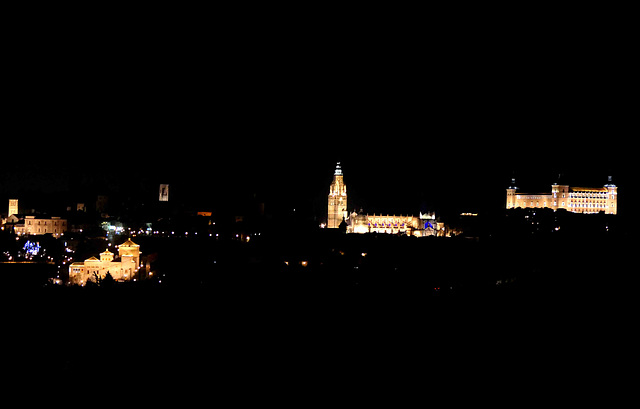

In 192 BC, the Romans conquered the area and founded the outpost Toletum. Due to its iron ore deposits, Toledo developed into an important settlement. Since the first barbarian invasions, the ancient walls were reinforced. In 411 the Alans and later the Visigoths conquered the city. Toledo was the capital of the Visigoths' empire from about 531 to 711.
The Moors conquered the place in 712. Toledo experienced its heyday during the period of Moorish rule as Ṭulayṭula during the Caliphate of Córdoba until its conquest by Alfonso VI in 1085, after a four-year siege. In 1088, only a few years after the conquest, Archbishop Bernard of Toledo obtained confirmation from Pope Urban II that Toledo should hold the "primatus in totis Hispaniarum regnis" (primacy in all the kingdoms of the Iberian dominions). The Archbishop of Toledo is still today the Primate of the Catholic Church of Spain.
In the 12th and 13th centuries, the Toledo school of translators translated ancient philosophical writings (Plato, Aristotle) that had been translated from Greek into Arabic, but also genuinely Arabic writings from the fields of astronomy, mathematics, Islamic religion and theology into Latin.
After the conquest by Alfonso VI, Toledo became the residence of the Kingdom of Castile in 1087 and remained the capital of Spain until 1561.
Deep in the night
The Moors conquered the place in 712. Toledo experienced its heyday during the period of Moorish rule as Ṭulayṭula during the Caliphate of Córdoba until its conquest by Alfonso VI in 1085, after a four-year siege. In 1088, only a few years after the conquest, Archbishop Bernard of Toledo obtained confirmation from Pope Urban II that Toledo should hold the "primatus in totis Hispaniarum regnis" (primacy in all the kingdoms of the Iberian dominions). The Archbishop of Toledo is still today the Primate of the Catholic Church of Spain.
In the 12th and 13th centuries, the Toledo school of translators translated ancient philosophical writings (Plato, Aristotle) that had been translated from Greek into Arabic, but also genuinely Arabic writings from the fields of astronomy, mathematics, Islamic religion and theology into Latin.
After the conquest by Alfonso VI, Toledo became the residence of the Kingdom of Castile in 1087 and remained the capital of Spain until 1561.
Deep in the night
Paolo Tanino has particularly liked this photo
- Keyboard shortcuts:
Jump to top
RSS feed- Latest comments - Subscribe to the comment feeds of this photo
- ipernity © 2007-2026
- Help & Contact
|
Club news
|
About ipernity
|
History |
ipernity Club & Prices |
Guide of good conduct
Donate | Group guidelines | Privacy policy | Terms of use | Statutes | In memoria -
Facebook
X

Sign-in to write a comment.