

Steyning - St Andrew and St Cuthman
Hardham - St Botolph
Ericeira, Portugal HBM
Arundel - Cathedral
Arundel - St Nicholas
Chichester - Chichester Cathedral
Bosham - Holy Trinity Church
East Meon - All Saints Church
Harting – St Mary and St Gabriel
Christchurch - Priory
Saint Eulalia Basilica.
Portchester - St Mary
Portchester - St Mary
Romsey - Abbey
Saint Eulalia Basilica.
Winchester - Cathedral
Temple of Mars (1st century BC).
Winchester - Cathedral
Aulnizeux
Breamore - St Mary
Stapleford - St Mary
Salisbury - Cathedral
Salisbury - Cathedral
Shoreham-by-Sea - St Nicolas Church
Shoreham-by-Sea - St Mary de Haura
Shoreham-by-Sea - St Mary de Haura
Bishopstone -St Andrews
Clayton - St John the Baptist
Clayton - St John the Baptist
Worth - St Nicholas Church
Worth - St Nicholas Church
Miranda do Douro, Portugal
Rochester - Rochester Cathedral
Church of Holy Mary (Concathedral).
Lugo - Catedral de Santa María
Austria - Kleinwalsertal/Riezlern, Mariä Opferung
Baroque style.
Ponferrada - Santo Tomás de las Ollas
Ponferrada - Basílica de la Encina
Pantón - San Miguel de Eiré
Pantón - San Fiz de Cangas
Saviano - Santo Estevo de Ribas de Miño
Chantada - Santa María de Camporramiro
Chantada - San Salvador de Asma
Rodeiro - Igrexa de San Vicente

Location
Lat, Lng:
You can copy the above to your favourite mapping app.
Address: unknown
You can copy the above to your favourite mapping app.
Address: unknown
Keywords
Authorizations, license
-
Visible by: Everyone -
All rights reserved
-
111 visits
Sompting - St Mary the Blessed Virgin
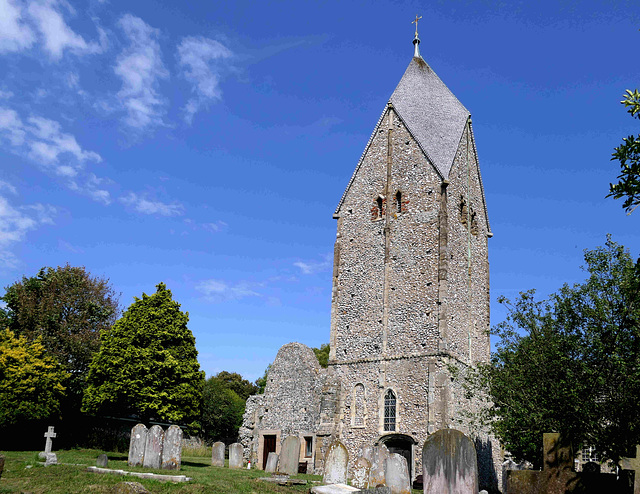

There was a church on the site of the present building by the early 11th century, and some elements remain from that era. William de Braose held it at the time of the Domesday survey, but in 1154 his grandson William de Braose, 3rd Lord of Bramber passed it to the Knights Templar, who made many structural changes. They widened the church by rebuilding the nave and chancel to the same width as the Saxon-era tower. In about 1180 they erected a large chapel effectively a separate church in its own right until the 19th century, when an arch linked it to the nave and made it a south transept. At the same time, they added a north transept with an aisle and two chapels.
After the Knights Templar were emasculated in 1307, Pope Clement V conveyed ownership of the church to the Knights Hospitaller in 1324. They built a porch on the south side and carried out work on the nave walls.
The church fell into decay during the 18th century. Repairs in the 1720s and 1760s were not enough, and two bells had to be sold to pay for proper repairs in 1791.
The tower is the most important feature of the church and is known as an exemplar of Saxon architecture—although its upper stage may have been renewed in early Norman times to an identical design. The spire, a design known as the Rhenish helm because of its prevalence in the Rhineland area of Germany, is unique in England.
After the Knights Templar were emasculated in 1307, Pope Clement V conveyed ownership of the church to the Knights Hospitaller in 1324. They built a porch on the south side and carried out work on the nave walls.
The church fell into decay during the 18th century. Repairs in the 1720s and 1760s were not enough, and two bells had to be sold to pay for proper repairs in 1791.
The tower is the most important feature of the church and is known as an exemplar of Saxon architecture—although its upper stage may have been renewed in early Norman times to an identical design. The spire, a design known as the Rhenish helm because of its prevalence in the Rhineland area of Germany, is unique in England.
Alexander Prolygin has particularly liked this photo
- Keyboard shortcuts:
Jump to top
RSS feed- Latest comments - Subscribe to the comment feeds of this photo
- ipernity © 2007-2026
- Help & Contact
|
Club news
|
About ipernity
|
History |
ipernity Club & Prices |
Guide of good conduct
Donate | Group guidelines | Privacy policy | Terms of use | Statutes | In memoria -
Facebook
X

Sign-in to write a comment.