

Cuenca - Catedral de Santa María y San Julián
Daroca - Santo Domingo
Daroca - San Miguel
Teruel - Torre de San Salvador
Teruel - Catedral de Teruel
Mora de Rubielos - Santa María
Valencia - Iglesia de los Santos Juanes
Almería - Catedral de Almería
Úbeda - Sacra Capilla del Salvador
Úbeda - Sacra Capilla del Salvador
Baeza - Catedral de Baeza
Baeza - Iglesia de la Santa Cruz
Baeza - Iglesia de la Santa Cruz
Úbeda - San Isidoro
Úbeda - Iglesia de San Pablo
Jaén - Catedral de la Asunción
Córdoba - San Nicolás de la Villa
Córdoba - Santo Domingo de Silos
Marchena - Santa María de la Mota
El Palmar de Troya - Basílica de Nuestra Madre del…
Jerez de la Frontera - San Dionisio Areopagita
Jerez de la Frontera - Catedral
Jerez de la Frontera - Iglesia de San Miguel
Palazuelos - Ermita de la Virgen de la Soledad
Carabias - Iglesia de San Salvador
Sigüenza - Catedral de Santa María
Guadalajara - Iglesia de los Remedios
Madrid - San Francisco el Grande
Madrid - San Francisco el Grande
Toledo - San Sebastián
Toledo - Catedral de Toledo
Toledo - El Cristo de la Luz
Toledo - El Cristo de la Luz
Segovia - San Lorenzo
Segovia - San Martín
Segovia - La Vera Cruz
Segovia - La Vera Cruz
Segovia - Catedral de Segovia
Segovia - La Santísima Trinidad
Avila - Ermita de Sonsoles
Ávila - Catedral de Cristo Salvador
Ávila - Ermita de San Segundo del Río Adaja
Ávila - San Andrés
Ávila - Santo Tomé el Viejo
Ávila - Basílica de San Vicente

Location
Lat, Lng:
You can copy the above to your favourite mapping app.
Address: unknown
You can copy the above to your favourite mapping app.
Address: unknown
See also...
Keywords
Authorizations, license
-
Visible by: Everyone -
All rights reserved
-
239 visits
Sigüenza - Catedral de Santa María
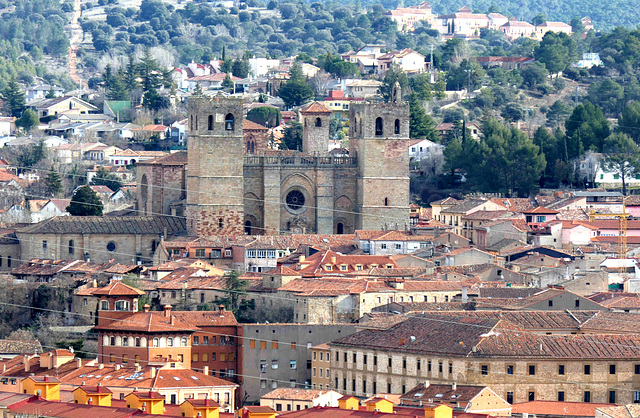

Pliny the Elder mentions Segontia in the 1st century AD in his work "Naturalis Historia" as a Celtiberian settlement. The area was taken by the Romans in the Numantine War (154-133 BC). After the end of the Western Roman Empire, the city was conquered by the Visigoths, who also founded the diocese of Sigüenza in 589. Taken over by the Moors around 712, the Christians reconquered the city in 1123. The construction of the cathedral began only a short time later, but it would take several centuries to complete. Today Sigüenza is a town with a population of about 4500.
The Visigoths built a small castle in the 5th century above the town. The Moors built a large fortified castle in the early 8th century. It was enclosed by a defensive wall providing an area known as the medina. In 1124, the castle was retaken by Bernard of Agen allowing Simón Girón de Cisneros to build an episcopal palace there. In the 15th century, the castle was strengthened by the bishops to protect it from attacks from Aragon and Navarre.
Construction of the cathedral began in 1124 after the expulsion of the Moors and the appointment of Bernardo of Agen as bishop. It was built on foundations previously occupied by a Visigothic church and then a Moorish mosque. The construction of the church lasted until the 15th century and in the 16th century it received Gothic elements - especially in the interior - and additions in the Renaissance style.
The western facade is characterized by the robust towers in the medieval style of a church fortress. The portals on the south and west sides are preserved in the Romanesque style but with later Baroque and Classical additions. The cathedral, is composed of a Latin cross plant, with three naves, transept and a large apse, surrounded by the ambulatory. It is 80 meters long by 31 meters in width.
The Visigoths built a small castle in the 5th century above the town. The Moors built a large fortified castle in the early 8th century. It was enclosed by a defensive wall providing an area known as the medina. In 1124, the castle was retaken by Bernard of Agen allowing Simón Girón de Cisneros to build an episcopal palace there. In the 15th century, the castle was strengthened by the bishops to protect it from attacks from Aragon and Navarre.
Construction of the cathedral began in 1124 after the expulsion of the Moors and the appointment of Bernardo of Agen as bishop. It was built on foundations previously occupied by a Visigothic church and then a Moorish mosque. The construction of the church lasted until the 15th century and in the 16th century it received Gothic elements - especially in the interior - and additions in the Renaissance style.
The western facade is characterized by the robust towers in the medieval style of a church fortress. The portals on the south and west sides are preserved in the Romanesque style but with later Baroque and Classical additions. The cathedral, is composed of a Latin cross plant, with three naves, transept and a large apse, surrounded by the ambulatory. It is 80 meters long by 31 meters in width.
kiiti has particularly liked this photo
- Keyboard shortcuts:
Jump to top
RSS feed- Latest comments - Subscribe to the comment feeds of this photo
- ipernity © 2007-2026
- Help & Contact
|
Club news
|
About ipernity
|
History |
ipernity Club & Prices |
Guide of good conduct
Donate | Group guidelines | Privacy policy | Terms of use | Statutes | In memoria -
Facebook
X

Sign-in to write a comment.