

Baroque interior of church.
Pulpit and gilded wood.
León - Catedral de León
León - Basílica de San Isidoro
Church of Mercy.
A view to west.
Palencia - Catedral de San Antolín
Palencia - San Miguel
Venta de Baños - San Juan de Baños
Venta de Baños - San Juan de Baños
Aranda de Duero - San Juan Bautista
Peñafiel - Convento de San Pablo
Valladolid - Santa María La Antigua
Valladolid - Santa María La Antigua
Valladolid - Iglesia de San Pablo
Church of Saint Paul Convent.
Mother Church of Portel.
Benavente - Santa María del Azogue
Benavente - San Juan del Mercado
El Campillo - San Pedro de la Nave
Zamora - San Cipriano
Saint Francis Church.
Church of Mercy.
Sahagún - San Lorenzo
Sahagún - San Lorenzo
Carrión de los Condes -Santa María del Camino
Church door.
New Saint Claire Convent (17th century).
Church and ruins of Old Saint Claire Convent (14th…
Carrión de los Condes - Iglesia de Santiago
Church of Saint Francis Convent.
Barrocal do Douro, Portugal
Frómista - San Martín
Burgos - San Gil
Burgos - Catedral de Burgos
Barrocal do Douro, Portugal
Barrocal do Douro, Portugal
Barrocal do Douro, Portugal
Miñón de Santibáñez - San Pedro
Miñón de Santibáñez - San Pedro
Church of Sotto Mayor Palace.
Italie Bellagio lac de Côme
Burgo de Osma - Catedral de Santa María de la Asun…
Almazán - Ermita de Jesus
Barrocal do Douro, Portugal HBM

Location
Lat, Lng:
You can copy the above to your favourite mapping app.
Address: unknown
You can copy the above to your favourite mapping app.
Address: unknown
See also...
Keywords
Authorizations, license
-
Visible by: Everyone -
All rights reserved
-
171 visits
León - Catedral de León
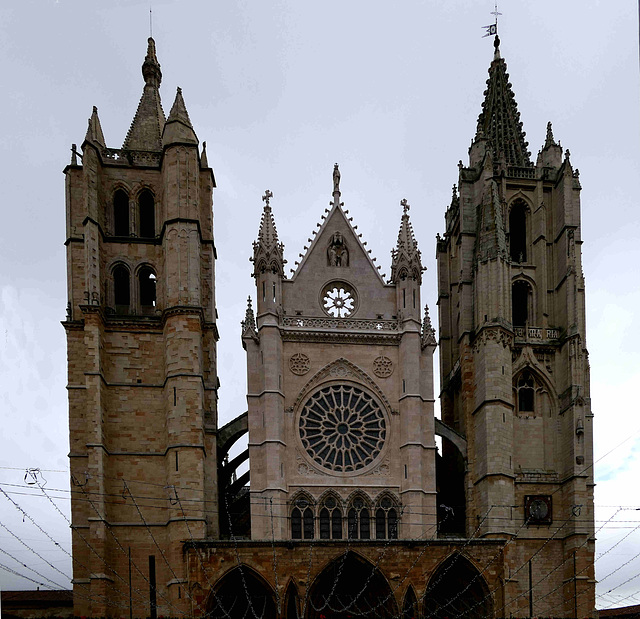

León was founded in 68 AD for a Roman legion from which they were supposed to pacify the rebellious mountain dwellers of Asturias and Cantabria. The name of the settlement that was then developed is based on a refined form of the Latin word "legio".
After the end of the Roman Empire, the city was conquered by the Visigoths and in 712 by the Moors. In 856, after the reconquest under King Ordoño I of Asturias, the city was repopulated. Ordoño II made León the capital of his kingdom of León in 914. Sacked by Almanzor in about 987, the city was reconstructed and repopulated by Alfonso V,
León was an important stop on the Way of St. James to Santiago de Compostela. Traders and artisans settled in the suburbs and had a strong influence on the development of the city from the 13th century onwards. In the early Middle Ages, the city became prosperous through the cattle trade. However, from the 16th century until the 19th century, the economy and population declined.
The main construction period of the cathedral was between 1255 and 1303.
The first architect was "Master Enrique", who had previously built the transept and nave of Burgos Cathedral between 1243 and 1260. "Master Enrique" directed the construction from 1255 to 1277, using Reims Cathedral as a model. The experience he gained in Burgos prompted him to take a risk, which paid off centuries later, as many openings later had to be bricked up for stability reasons. In the middle of the 19th century, the structure was on the verge of collapse and had to be completely restored. Reconstruction lasted from 1859 to 1901.
In 1302, the work was apparently stopped, probably for financial reasons. This may also be the reason for the comparatively short nave with only five bays, for the lack of a tower in the transept. The upper parts of the cathedral were not completed until 1439.
The five-part porch on the west façade was built in the mid to late 13th century. The design of this sophisticated three-portal complex was based on the most important model of the time, the transept portals of Chartres Cathedral.
After the end of the Roman Empire, the city was conquered by the Visigoths and in 712 by the Moors. In 856, after the reconquest under King Ordoño I of Asturias, the city was repopulated. Ordoño II made León the capital of his kingdom of León in 914. Sacked by Almanzor in about 987, the city was reconstructed and repopulated by Alfonso V,
León was an important stop on the Way of St. James to Santiago de Compostela. Traders and artisans settled in the suburbs and had a strong influence on the development of the city from the 13th century onwards. In the early Middle Ages, the city became prosperous through the cattle trade. However, from the 16th century until the 19th century, the economy and population declined.
The main construction period of the cathedral was between 1255 and 1303.
The first architect was "Master Enrique", who had previously built the transept and nave of Burgos Cathedral between 1243 and 1260. "Master Enrique" directed the construction from 1255 to 1277, using Reims Cathedral as a model. The experience he gained in Burgos prompted him to take a risk, which paid off centuries later, as many openings later had to be bricked up for stability reasons. In the middle of the 19th century, the structure was on the verge of collapse and had to be completely restored. Reconstruction lasted from 1859 to 1901.
In 1302, the work was apparently stopped, probably for financial reasons. This may also be the reason for the comparatively short nave with only five bays, for the lack of a tower in the transept. The upper parts of the cathedral were not completed until 1439.
The five-part porch on the west façade was built in the mid to late 13th century. The design of this sophisticated three-portal complex was based on the most important model of the time, the transept portals of Chartres Cathedral.
kiiti, SV1XV, Alexander Prolygin have particularly liked this photo
- Keyboard shortcuts:
Jump to top
RSS feed- Latest comments - Subscribe to the comment feeds of this photo
- ipernity © 2007-2026
- Help & Contact
|
Club news
|
About ipernity
|
History |
ipernity Club & Prices |
Guide of good conduct
Donate | Group guidelines | Privacy policy | Terms of use | Statutes | In memoria -
Facebook
X

Sign-in to write a comment.