

Ripoll - Monastery of Santa Maria
L'Espunyola - Sant Climent de l'Espunyola
Solsona - Catedral de Santa María
Solsona - Catedral de Santa María
La Seu d’Urgell - Cathedral of Santa Maria
La Seu d’Urgell - Cathedral of Santa Maria
La Seu d’Urgell - Cathedral of Santa Maria
Sant Miquel d’Engolasters
Pallerols del Cantó - Saint Roman
Pallerols del Cantó - Saint Roman
Tremp - Santa Maria de Valldeflors
Monzón - Santa María del Romeral
Casbas de Huesca - Ermita de Bascués
Biescas - San Juan de Busa
Fleurance - Saint-Laurent
Agen - Cathédrale Saint-Caprais d'Agen
Lisle-sur-Tarn - Notre-Dame de la Jonquière
Gaillac - Saint-Michel
Vienne - Cathedral St. Maurice
Lyon - Cathédrale Saint-Jean-Baptiste
Saint-Chef - St.Theudère
Moudon - Saint-Étienne
Moudon - Saint-Étienne
Girona - Sant Pere de Galligants
Marseille - Cathédrale Sainte-Marie-Majeure
Marseille - Notre-Dame de la Garde
Albenga - Duomo di Albenga
Albenga - Duomo di Albenga
Alba - Duomo di Alba
Torino - Basilica di Superga
Torino - Gran Madre di Dio
Aigle - Saint-Maurice d'Aigle
Biel/Bienne - Stadtkirche
Haguenau - Saint-Nicolas
Strasbourg - Cathédrale Notre-Dame
Strasbourg - Cathédrale Notre-Dame
Strasbourg - Saint-Thomas
Piacenza - Duomo
Fidenza - Cattedrale di San Donnino
Vernazza - Santa Margharita d`Antiochia
La Spezia - Cattedrale di Cristo Re
Pistoia - Battistero di San Giovanni in Corte
Signa - San Lorenzo
Florence - Battistero di San Giovanni
Florence - San Lorenzo

Location
Lat, Lng:
You can copy the above to your favourite mapping app.
Address: unknown
You can copy the above to your favourite mapping app.
Address: unknown
See also...
Keywords
Authorizations, license
-
Visible by: Everyone -
All rights reserved
-
137 visits
Ripoll - Monastery of Santa Maria
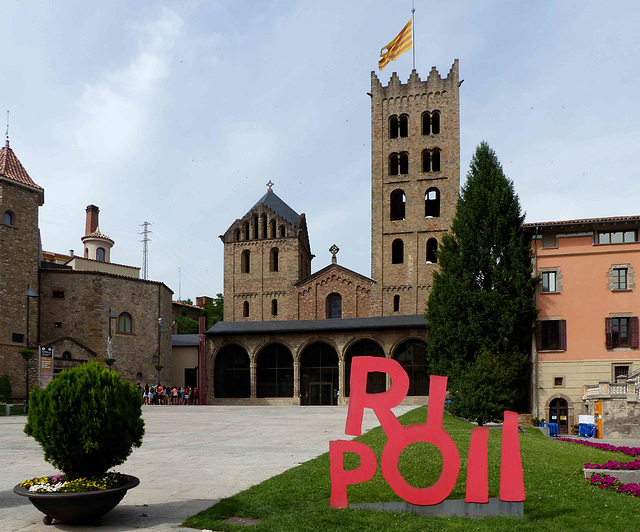

Wilfred the Hairy (aka Guifré el Pilós), whom we just "met" as the founder of the nearby monastery in Sant Joan de les Abadesses, where his daughter Emma of Barcelona was the first abbess, founded the Monastery of Santa Maria in Ripoll in 879. Here his son Radulf de Barcelona was abbot. This was not only Wilfred´s family business, he was very successful in the political power game of that time.
The first church was consecrated in 888, but as the monastery grew it was "reconsecrated" in 935, 977 and 1032. When Oliba de Besalú, as well a descendent of Wilfred, was abbot here (1008 - 1046), this was a cultural center. More than 250 books were on the shelves of the monastery´s library.
The church was the burial place for the Counts of Besalú and Barcelona. Still today many tombs can be found in the transept, including that one of Wilfred the Hairy.
The decline started within the 15th century. In 1428 it was severely damaged by an earthquake, the restoration was done in Gothic style.
The church got ruined during the first Carlist War, the library burnt down, and the last monks had left. In 1847 part of the cloister and soon after, the abbot´s palace got demolished.
The Bishop of Vic organized the rebuilding so that the church got consecrated again in 1893. The church of today is vastly a product of the reconstruction of the 19th century, but it may be "near" to the romanesque structure.
The cloister got reconstructed end of the 19th century as well, but as only a part of it had been demolished, it still contains a lot of the original structure.
The construction of the ground floor started in 1180 and it took until the early 15th century to complete it. The second-floor dates to the 15th and 16th centuries. Some of the capitals are sculptured by Jordi de Déu (aka Jordi Johan). Jordi de Déu (+1418), born on the island of Sicily, with greek roots, was sold as a slave to Catalan master carver Jaume Cascalls, who taught him sculpture.
-
I have been to Ripoll a couple of times, so I may add newer (like this) and older photos.
The first church was consecrated in 888, but as the monastery grew it was "reconsecrated" in 935, 977 and 1032. When Oliba de Besalú, as well a descendent of Wilfred, was abbot here (1008 - 1046), this was a cultural center. More than 250 books were on the shelves of the monastery´s library.
The church was the burial place for the Counts of Besalú and Barcelona. Still today many tombs can be found in the transept, including that one of Wilfred the Hairy.
The decline started within the 15th century. In 1428 it was severely damaged by an earthquake, the restoration was done in Gothic style.
The church got ruined during the first Carlist War, the library burnt down, and the last monks had left. In 1847 part of the cloister and soon after, the abbot´s palace got demolished.
The Bishop of Vic organized the rebuilding so that the church got consecrated again in 1893. The church of today is vastly a product of the reconstruction of the 19th century, but it may be "near" to the romanesque structure.
The cloister got reconstructed end of the 19th century as well, but as only a part of it had been demolished, it still contains a lot of the original structure.
The construction of the ground floor started in 1180 and it took until the early 15th century to complete it. The second-floor dates to the 15th and 16th centuries. Some of the capitals are sculptured by Jordi de Déu (aka Jordi Johan). Jordi de Déu (+1418), born on the island of Sicily, with greek roots, was sold as a slave to Catalan master carver Jaume Cascalls, who taught him sculpture.
-
I have been to Ripoll a couple of times, so I may add newer (like this) and older photos.
kiiti has particularly liked this photo
- Keyboard shortcuts:
Jump to top
RSS feed- Latest comments - Subscribe to the comment feeds of this photo
- ipernity © 2007-2026
- Help & Contact
|
Club news
|
About ipernity
|
History |
ipernity Club & Prices |
Guide of good conduct
Donate | Group guidelines | Privacy policy | Terms of use | Statutes | In memoria -
Facebook
X

Sign-in to write a comment.