

Marseille - Cathédrale Sainte-Marie-Majeure
Cordes sur Ciel
Albi
Orgue AUBERTIN église Saint Martin commune de VERT…
L'ossuaire du Beausset Vieux - Das Beinhaus von Le…
Fleurance - Saint-Laurent
Agen - Cathédrale Saint-Caprais d'Agen
Cathédrale Sainte Cécile Albi
Castelsarrasin - Saint Saveur
Castelsarrasin - Saint Saveur
Lisle-sur-Tarn - Notre-Dame de la Jonquière
Lisle-sur-Tarn - Notre-Dame de la Jonquière
Gaillac - Saint-Michel
Vienne - Abbaye de Saint-André-le-Bas
Ploulec h
Vienne - Cathedral St. Maurice
Lyon - Cathédrale Saint-Jean-Baptiste
Perros Guirec
Saint-Chef - St.Theudère
Orgue Sainte Anne Bordeaux
Besançon - Cathédrale Saint-Jean
Luxeuil les Bains - St. Pierre
Luxeuil les Bains - St. Pierre
Sainte Anne Intérieur - St. Anne Innenseite - Sain…
HBM - Notre Dame d'Allauch
HBM - Sainte Anne
Haguenau - Saint-Nicolas
Strasbourg - Cathédrale Notre-Dame
Fouras
Strasbourg - Cathédrale Notre-Dame
Strasbourg - Cathédrale Notre-Dame
Strasbourg - Saint-Thomas
Sélestat - Sainte-Foy
Sélestat - Saint-Georges
Affoux
EPERNAY
Pip - Le train des jouets en escale... - Der Spiel…
Pip - Notre-Dame-de-l'Assomption
HFF - Herse anti-terroriste - Antiterrorstriegel -…
Lieu de rendez-vous - Ort des Treffens - Meeting p…
Chapelle Saint-Roch - Kapelle Saint-Roch - Saint R…
Église Saint-Pierre-et-Notre-Dame-de-l'Assomption
Eglise St-Rémi et St-Front
Les Baux de Provence
Notre Dame de la Garde

Location
Lat, Lng:
You can copy the above to your favourite mapping app.
Address: unknown
You can copy the above to your favourite mapping app.
Address: unknown
See also...
Keywords
Authorizations, license
-
Visible by: Everyone -
All rights reserved
-
273 visits
Marseille - Notre-Dame de la Garde
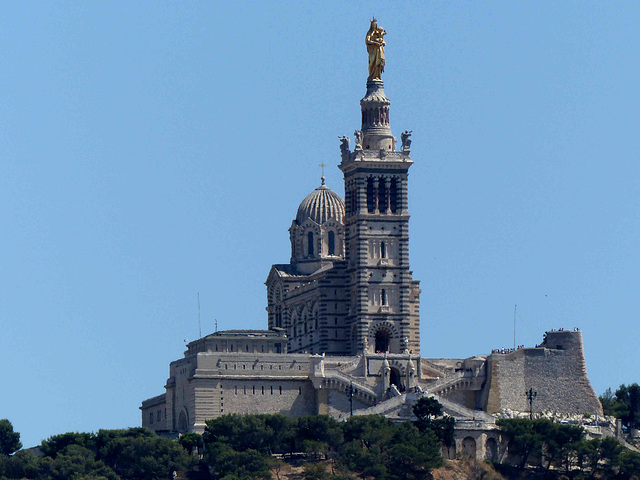

Marseille, today the second most populous city in France, was founded around 600 BC by Greek settlers. It was known to the ancient Greeks as Massalia.
There were always conflicts with the Celtic tribes that ruled Gaul. 125 BC Massalia summoned the troops of the Roman Empire for help against the attacks of Gallic tribes. During the course of the war, the entire territory of southern Gaul was annexed by the Romans as the province of Gallia Narbonensis. The city itself was able to retain its independence for several decades but in 49 BC it was finally conquered and integrated into the province of Narbonensis.
At the beginning of the 5th century AD, the monastery of Saint-Victor was founded, which was to become the residence of the bishops of Marseille from 750 to 960. In 481 Marseille fell to the Visigoths, 508 to the Ostrogoths and 536 to the Franks.
Destroyed by the Saracens, the city was rebuilt in the 10th century and placed under the Vicomtes de Marseille. For a few years, Marseille was an independent republic but when Charles of Anjou, brother of King Louis IX. of France, became Count of Provence, he submitted to Marseille.
In 1423 Alfonso V of Aragon conquered and devastated the city. René, Count of Provence, rebuilt it and after the death of his successor, Count Charles of Maine, it became part of the French crown in 1481.
A small chapel was built in 1214 on the highest natural point in Marseille, a 149 m high limestone cliff on the south side of the Old Port. The chapel was inside the fortifications around 1600, but remained accessible. The number of pilgrims steadily increased and the chapel was expanded several times.
During the French Revolution, the church lost its medieval miraculous image and all of its furnishings. In 1807 it was reopened for worship and gradually restored. Finally, in 1851, the rector of Notre Dame applied to Paris for permission to build a larger new building with a high spire on the site of the old church within the military complex. Approval was granted and the foundation stone was laid in 1853.
The construction of the new church had to be interrupted several times due to lack of funds. In 1861 the crypt was completed. When the upper church was solemnly consecrated in 1864, the bell tower was still unfinished. The manufacture and installation of the 11.20 m high statue of Mary on the spire, designed by Eugène-Louis Lequesne, was completed in 1870. Most people in Marseille call this church "La Bonne Mère".
There were always conflicts with the Celtic tribes that ruled Gaul. 125 BC Massalia summoned the troops of the Roman Empire for help against the attacks of Gallic tribes. During the course of the war, the entire territory of southern Gaul was annexed by the Romans as the province of Gallia Narbonensis. The city itself was able to retain its independence for several decades but in 49 BC it was finally conquered and integrated into the province of Narbonensis.
At the beginning of the 5th century AD, the monastery of Saint-Victor was founded, which was to become the residence of the bishops of Marseille from 750 to 960. In 481 Marseille fell to the Visigoths, 508 to the Ostrogoths and 536 to the Franks.
Destroyed by the Saracens, the city was rebuilt in the 10th century and placed under the Vicomtes de Marseille. For a few years, Marseille was an independent republic but when Charles of Anjou, brother of King Louis IX. of France, became Count of Provence, he submitted to Marseille.
In 1423 Alfonso V of Aragon conquered and devastated the city. René, Count of Provence, rebuilt it and after the death of his successor, Count Charles of Maine, it became part of the French crown in 1481.
A small chapel was built in 1214 on the highest natural point in Marseille, a 149 m high limestone cliff on the south side of the Old Port. The chapel was inside the fortifications around 1600, but remained accessible. The number of pilgrims steadily increased and the chapel was expanded several times.
During the French Revolution, the church lost its medieval miraculous image and all of its furnishings. In 1807 it was reopened for worship and gradually restored. Finally, in 1851, the rector of Notre Dame applied to Paris for permission to build a larger new building with a high spire on the site of the old church within the military complex. Approval was granted and the foundation stone was laid in 1853.
The construction of the new church had to be interrupted several times due to lack of funds. In 1861 the crypt was completed. When the upper church was solemnly consecrated in 1864, the bell tower was still unfinished. The manufacture and installation of the 11.20 m high statue of Mary on the spire, designed by Eugène-Louis Lequesne, was completed in 1870. Most people in Marseille call this church "La Bonne Mère".
Falk Preusche, Guydel, Alexander Prolygin have particularly liked this photo
- Keyboard shortcuts:
Jump to top
RSS feed- Latest comments - Subscribe to the comment feeds of this photo
- ipernity © 2007-2026
- Help & Contact
|
Club news
|
About ipernity
|
History |
ipernity Club & Prices |
Guide of good conduct
Donate | Group guidelines | Privacy policy | Terms of use | Statutes | In memoria -
Facebook
X

Sign-in to write a comment.