

Pistoia - Battistero di San Giovanni in Corte
La Spezia - Cattedrale di Cristo Re
Frankfurt - Paulskirche
Torino - Gran Madre di Dio
Torino - Basilica di Superga
Havelberg - St. Annen und Gertraudenkapelle
Манастир Добриловина.
Ottmarsheim >>>>>>>
Almazán - Ermita de Jesus
Moldova, Bălți, Sts. Emperors Constantine and Elen…
Segovia - La Vera Cruz
Romania, Library of St. John's from Neamț and Neam…
San Michele Arcangelo
Greece - Glyfada, Cathedral of Saints Constantine…
Córdoba - Santo Domingo de Silos
Alburquerque
Aveiro - Capela de São Bartolomeu
Ericeira, Portugal HBM
Ericeira, Portugal
Cambridge - Church of the Holy Sepulchre
Lucena - Iglesia de San Mateo
Lucena - Iglesia de San Mateo
Lucena - Iglesia de San Mateo
Todi - Santa María de la Consolación
Antrodoco - Santa Maria Extra Moenia
Antrodoco - Santa Maria Extra Moenia
Brindisi - San Giovanni al Sepolcro
Brindisi - San Giovanni al Sepolcro
Benevento - Santa Sofia
Ancarano - Madonna della Misericordia
Ascoli Piceno - Battistero di San Giovanni
Ascoli Piceno - Tempietto di S Emidio Rosso
Urbino - San Bernardino
Rimini - Tempietto di Sant'Antonio
Ravenna - Santa Maria del Suffragio
Ravenna - Chiesa di Santa Giustina
Bologna - Basilica del Sepolcro
Parma - Baptistery (PiP)
Crema - Santa Maria della Croce
Crema - Santa Maria della Croce
Venezia - La Maddalena
Torcello - Chiesa di Santa Fosca
Torcello - Chiesa di Santa Fosca
Torcello - Basilica di Santa Maria Assunta
Isola di San Michele - San Michele in Isola

Location
Lat, Lng:
You can copy the above to your favourite mapping app.
Address: unknown
You can copy the above to your favourite mapping app.
Address: unknown
See also...
Keywords
Authorizations, license
-
Visible by: Everyone -
All rights reserved
-
256 visits
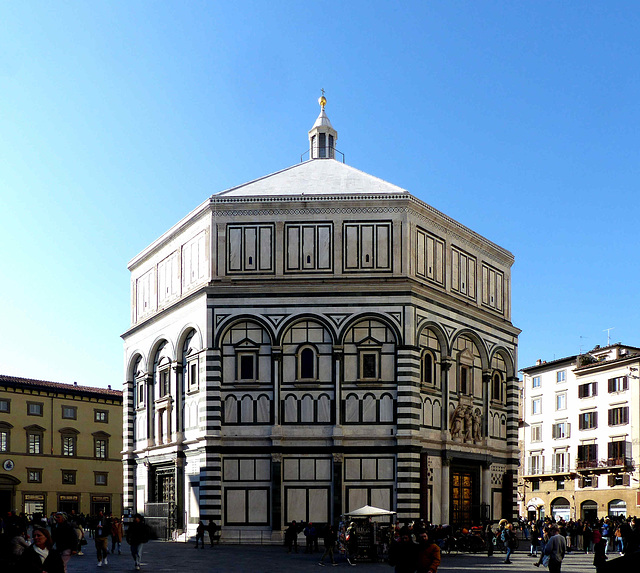
Florence - Battistero di San Giovanni

Florentina was established in Roman times as a settlement for veteran soldiers. The name had changed already when young Charlemagne conquered the town in 774. It became part of the Duchy of Tuscany, with Lucca as the capital. Around 1000 Margrave Hugo chose Florence as residency instead of Lucca. After the death of Matilda of Tuscany (1115), the Florentines formed a republic ruled by a council. The town prospered, despite a constant fight between the different factions and noble families.
In the 15th century, Florence was among the largest and wealthiest cities in Europe. This was when the Medici family entered the political scene. As a dynasty of art-loving, power-hungry bankers, they made Florence the birthplace of the Renaissance.
The Baptistery of San Giovanni is the baptistery of Florence Cathedral. The time of origin is disputed, the church was consecrated in the 11th century. The church stands on the foundations of a Roman building. The first reliable source dates from 897, when an ecclesia (church) dedicated to John the Baptist and facing the bishop's palace is mentioned.
Today's building dates from the 11th century at the earliest. The octagon had been a common shape for baptisteries for many centuries since early Christian times. The construction was finished in 1128. An octagonal lantern was added to the roof around 1150. It was enlarged with a rectangular entrance porch in 1202, leading into the original western entrance of the building, that in the 15th century became an apse, after the opening of the eastern door facing the western door of the cathedral by Lorenzo Ghiberti.
Between the fourteenth and sixteenth centuries, three bronze double doors were added, with bronze and marble statues above them.
In the 15th century, Florence was among the largest and wealthiest cities in Europe. This was when the Medici family entered the political scene. As a dynasty of art-loving, power-hungry bankers, they made Florence the birthplace of the Renaissance.
The Baptistery of San Giovanni is the baptistery of Florence Cathedral. The time of origin is disputed, the church was consecrated in the 11th century. The church stands on the foundations of a Roman building. The first reliable source dates from 897, when an ecclesia (church) dedicated to John the Baptist and facing the bishop's palace is mentioned.
Today's building dates from the 11th century at the earliest. The octagon had been a common shape for baptisteries for many centuries since early Christian times. The construction was finished in 1128. An octagonal lantern was added to the roof around 1150. It was enlarged with a rectangular entrance porch in 1202, leading into the original western entrance of the building, that in the 15th century became an apse, after the opening of the eastern door facing the western door of the cathedral by Lorenzo Ghiberti.
Between the fourteenth and sixteenth centuries, three bronze double doors were added, with bronze and marble statues above them.
Alexander Prolygin, Marco F. Delminho, kiiti and 2 other people have particularly liked this photo
- Keyboard shortcuts:
Jump to top
RSS feed- Latest comments - Subscribe to the comment feeds of this photo
- ipernity © 2007-2026
- Help & Contact
|
Club news
|
About ipernity
|
History |
ipernity Club & Prices |
Guide of good conduct
Donate | Group guidelines | Privacy policy | Terms of use | Statutes | In memoria -
Facebook
X

Sign-in to write a comment.