

Ascoli Piceno - Battistero di San Giovanni
Ancarano - Madonna della Misericordia
Benevento - Santa Sofia
Brindisi - San Giovanni al Sepolcro
Brindisi - San Giovanni al Sepolcro
Antrodoco - Santa Maria Extra Moenia
Antrodoco - Santa Maria Extra Moenia
Todi - Santa María de la Consolación
Florence - Battistero di San Giovanni
Pistoia - Battistero di San Giovanni in Corte
La Spezia - Cattedrale di Cristo Re
Frankfurt - Paulskirche
Torino - Gran Madre di Dio
Torino - Basilica di Superga
Havelberg - St. Annen und Gertraudenkapelle
Манастир Добриловина.
Ottmarsheim >>>>>>>
Almazán - Ermita de Jesus
Moldova, Bălți, Sts. Emperors Constantine and Elen…
Segovia - La Vera Cruz
Romania, Library of St. John's from Neamț and Neam…
San Michele Arcangelo
Greece - Glyfada, Cathedral of Saints Constantine…
Urbino - San Bernardino
Rimini - Tempietto di Sant'Antonio
Ravenna - Santa Maria del Suffragio
Ravenna - Chiesa di Santa Giustina
Bologna - Basilica del Sepolcro
Parma - Baptistery (PiP)
Crema - Santa Maria della Croce
Crema - Santa Maria della Croce
Venezia - La Maddalena
Torcello - Chiesa di Santa Fosca
Torcello - Chiesa di Santa Fosca
Torcello - Basilica di Santa Maria Assunta
Isola di San Michele - San Michele in Isola
Pumenengo - Santuario della Madonna della Rotonda
Pumenengo - Santuario della Madonna della Rotonda
Strzelno - Rotunda św. Prokopa
Strzelno - Rotunda św. Prokopa
Strzelno - Rotunda św. Prokopa
Strzelno - Rotunda św. Prokopa
Białystok - Bazylika św. Rocha
Saint Sebastian Chapel.
Ericeira, Portugal

Location
Lat, Lng:
You can copy the above to your favourite mapping app.
Address: unknown
You can copy the above to your favourite mapping app.
Address: unknown
See also...
Keywords
Authorizations, license
-
Visible by: Everyone -
All rights reserved
-
219 visits
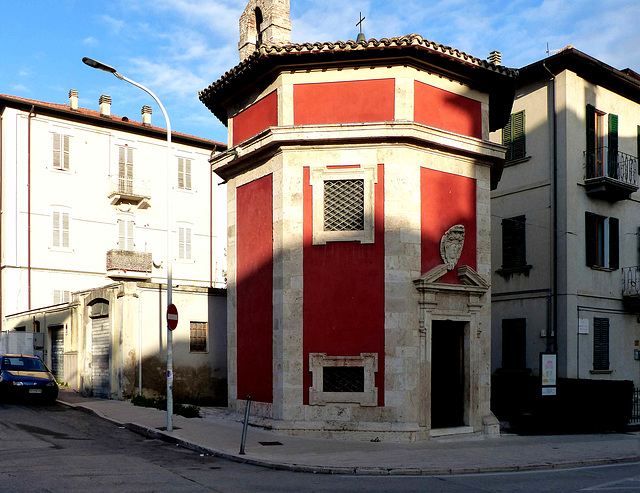
Ascoli Piceno - Tempietto di S Emidio Rosso

In 268 BC Ascoli became a Roman "civitas foederata" but after it had revolted against Rome, it was reconquered and destroyed by Pompeius Strabo in 89BC.
During the Middle Ages Ascoli was ravaged by the Ostrogoths and then by the Lombards. After nearly two centuries as part of the Lombard Duchy of Spoleto (593–789), Ascoli was ruled by the Franks but ultimately it was the bishops that gained influence and power over the city.
In 1189 a free republican municipality was established but it experienced the sacking and destruction by the imperial armies of Frederick II. Municipal freedoms got undermined by factional struggles between the most prominent families. The internal unrest between opposing factions did not cease, leading to decades of rebellions, massacres, raids, the growth of banditry and the decline of civil virtues. This unstable situation opened the way to foreign dictatorships, such as condottiero (mercenary) Galeotto Malatesta (14th century) who is driven out by a revolt and later on Francesco Sforza who established a cruel dictatorship (15th century) which was overthrown in 1482, even if Ascoli was forced to recognize the sovereignty of the Church.
The town was called "Ascoli" until 1862, when "Piceno" was added, evoking the Picenes, which lived between the 8th and 6th centuries BC. here.
The small octagonal chapel was built in 1633. According to tradition, the stone slab on which St. Emeidio was decapitated in 309 is conserved under the altar. The walls are red in memory of the Martyr's blood spilled here.
During the Middle Ages Ascoli was ravaged by the Ostrogoths and then by the Lombards. After nearly two centuries as part of the Lombard Duchy of Spoleto (593–789), Ascoli was ruled by the Franks but ultimately it was the bishops that gained influence and power over the city.
In 1189 a free republican municipality was established but it experienced the sacking and destruction by the imperial armies of Frederick II. Municipal freedoms got undermined by factional struggles between the most prominent families. The internal unrest between opposing factions did not cease, leading to decades of rebellions, massacres, raids, the growth of banditry and the decline of civil virtues. This unstable situation opened the way to foreign dictatorships, such as condottiero (mercenary) Galeotto Malatesta (14th century) who is driven out by a revolt and later on Francesco Sforza who established a cruel dictatorship (15th century) which was overthrown in 1482, even if Ascoli was forced to recognize the sovereignty of the Church.
The town was called "Ascoli" until 1862, when "Piceno" was added, evoking the Picenes, which lived between the 8th and 6th centuries BC. here.
The small octagonal chapel was built in 1633. According to tradition, the stone slab on which St. Emeidio was decapitated in 309 is conserved under the altar. The walls are red in memory of the Martyr's blood spilled here.
Marco F. Delminho, Boro, Paolo Tanino have particularly liked this photo
- Keyboard shortcuts:
Jump to top
RSS feed- Latest comments - Subscribe to the comment feeds of this photo
- ipernity © 2007-2026
- Help & Contact
|
Club news
|
About ipernity
|
History |
ipernity Club & Prices |
Guide of good conduct
Donate | Group guidelines | Privacy policy | Terms of use | Statutes | In memoria -
Facebook
X

Sign-in to write a comment.