

Rots - Saint-Ouen
Bayeux - Cathedral
Église Notre-Dame la Grande de Poitiers
Cerisy-la-Forêt - Abbey Saint-Vigor
Cerisy-la-Forêt - Abbey Saint-Vigor
La Barre-de-Semilly - Saint-Ébremond
Tollevast - Saint-Martin
Tamerville - Notre-Dame-de-l'Assomption
CAUDRY
CAUDRY
Barneville-Carteret - Saint-Germain
Lessay - Abbay Sainte-Trinité
Lessay - Abbay Sainte-Trinité
Portbail - Notre-Dame
Savigny - Notre-Dame
Léhon - Abbaye Saint-Magloire
Plouha - Chapelle de Kermaria-an-Iskuit
Plouha - Chapelle de Kermaria-an-Iskuit
Plouha - Chapelle de Kermaria-an-Iskuit
Perros-Guirec - Saint-Jacques
LYON
***
Église Notre-Dame la Grande de Poitiers
Caen - Abbaye aux Dames
Caen - Saint-Nicolas
Église Notre-Dame la Grande de Poitiers
Église Notre-Dame la Grande de Poitiers
Caen - Abbaye aux Hommes
Caen - Abbaye aux Hommes
Caen - Abbaye aux Hommes
Boscherville - Saint-Martin
Boscherville - Saint-Martin
Rouen - Cathedral
Gournay-en-Bray - Saint-Hildevert
Beauvais - Cathedral
Amiens - Cathedral
Amiens - Cathedral
Quimper, Cathédrale St Corentin
Quimper, Cathédrale St Corentin
GUERANDE
Cathédrale de REIMS
Locronan, église Saint-Ronan
Locronan, église Saint-Ronan
Cathédrale de REIMS
Cathédrale de REIMS

Location
Lat, Lng:
You can copy the above to your favourite mapping app.
Address: unknown
You can copy the above to your favourite mapping app.
Address: unknown
See also...
Keywords
Authorizations, license
-
Visible by: Everyone -
All rights reserved
-
345 visits
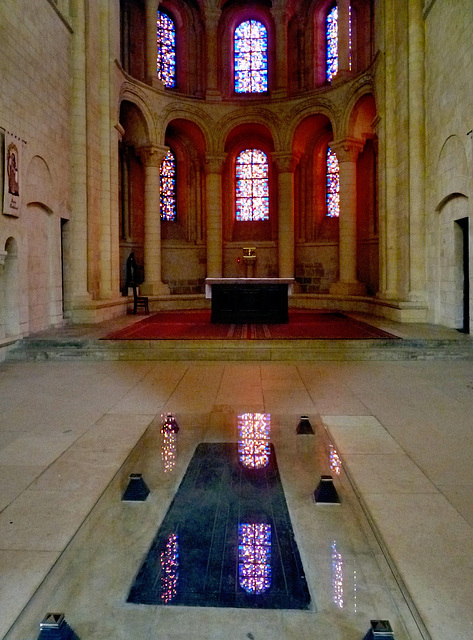
Caen - Abbaye aux Dames

Caen was a settlement already in Roman times, but prospered, when
William the Conqueror (aka "William the Bastard") built a castle here.
When William married Matilda of Flanders (~ 1051) a papal ban was issued
at the Council of Reims on the grounds of consanguinity. In 1059 Pope Nicholas awarded dispensation, after William and Matilda agreed to found
two monasteries as penance.
William founded the Abbey of Saint-Etienne (aka "Abbaye aux Hommes"),
Matilda founded with here husband´s support the Abbey Sainte-Trinité
(aka "Abbaye aux Dames"). The erection of both abbeys started in Caen
around 1060.
The community of nuns was suppressed by the French Revolution. In 1823
the local authorities transferred the ancient Hôtel-Dieu to the former
cloister for use as a hospital, and the canonesses regular established
themselves there. The canonesses continued to operate until 1908 when
the facility was transferred into a nursing home.
The former abbey church Sainte-Trinité now serves the parish.
Seen here is the grave of "Reine Mathilda", wife of William the Conqueror. Matilda was crowned Queen in 1068 and mother of nine kids, including two kings, William II and Henry I, and Cecilia, who was abbess of this monastery. Mathilda died in November 1083 and was buried here. Her husband died in 1087.
His grave is in the choir of Saint-Etienne, once the abbey-church of the Abbaye aux Hommes, less than a kilometer away.
Matilda´s tomb was vandalized during the Wars of Religions and later again during the French Revolution. Now the black slab, that marks the grave, is protected by safety glass.
William the Conqueror (aka "William the Bastard") built a castle here.
When William married Matilda of Flanders (~ 1051) a papal ban was issued
at the Council of Reims on the grounds of consanguinity. In 1059 Pope Nicholas awarded dispensation, after William and Matilda agreed to found
two monasteries as penance.
William founded the Abbey of Saint-Etienne (aka "Abbaye aux Hommes"),
Matilda founded with here husband´s support the Abbey Sainte-Trinité
(aka "Abbaye aux Dames"). The erection of both abbeys started in Caen
around 1060.
The community of nuns was suppressed by the French Revolution. In 1823
the local authorities transferred the ancient Hôtel-Dieu to the former
cloister for use as a hospital, and the canonesses regular established
themselves there. The canonesses continued to operate until 1908 when
the facility was transferred into a nursing home.
The former abbey church Sainte-Trinité now serves the parish.
Seen here is the grave of "Reine Mathilda", wife of William the Conqueror. Matilda was crowned Queen in 1068 and mother of nine kids, including two kings, William II and Henry I, and Cecilia, who was abbess of this monastery. Mathilda died in November 1083 and was buried here. Her husband died in 1087.
His grave is in the choir of Saint-Etienne, once the abbey-church of the Abbaye aux Hommes, less than a kilometer away.
Matilda´s tomb was vandalized during the Wars of Religions and later again during the French Revolution. Now the black slab, that marks the grave, is protected by safety glass.
- Keyboard shortcuts:
Jump to top
RSS feed- Latest comments - Subscribe to the comment feeds of this photo
- ipernity © 2007-2026
- Help & Contact
|
Club news
|
About ipernity
|
History |
ipernity Club & Prices |
Guide of good conduct
Donate | Group guidelines | Privacy policy | Terms of use | Statutes | In memoria -
Facebook
X

Sign-in to write a comment.