

mother feeds her fawn st bruno DSC 3261
Autumn colour CSC 3815
persistence of memory Time IMG 20171203 170438
novembers rose render2
squirrel 2 DSC 4051
CSC 0316
blue jay DSC 3932
toronto DSC 4054
sleds DSC 4088a
elephant IMG 20180218 084809
Roses march wing DSC 4255
icthy 2 ROM DSC 4340
bird fossil Confusciusorni dui DSC 4353
Dancing fossil Liaoxiornis delicatus 2
Montreal pissoir 20150805 125539
agate IMG 20180427 211336
trout lily may 6 2018 DSC 4495
Eastern eyed click beetle A DSC 4741
forillon day three south sector walk DSC 5112
Perce pine grosbeak MONT ST ANNESDSC 5495 x
Perce DSC 5248
iris versicolor v2 DSC 5765
Ile Bonaventure gannet DSC 5422
painted lady 2 sept 2017 st bruno DSC 3319
showy tick trefoil st bruno sept 2 2017 DSC 2990
the bridge st bruno DSC 2704
the blasted tree don valley toronto DSC 2903
sunglasses DSC 3051
more beer DSC 0394
folkestone 2017
Giant ichneumon megarhyssa-Aug 2017 DSC 2219
Giant ichneumon megarhyssa-Aug 2017 DSC 2242
meadowhawkDSC 1122
painted lady DSC 0763
CSC 0031
garden enoplog and the bee july 2017 DSC 0376
foxglove bees-eye-view V2 DSC 0393
Yamaska ragged robin-2 DSC 4787
CSC 5352
DSC 5384
toronto don monarch june 2017 DSC 5618
CSC 5949
CSC 5267
showy orchis galearis spectabilis st bruno 3 june…
water avens crop St Bruno 2017 05 27
See also...
Keywords
Authorizations, license
-
Visible by: Everyone -
All rights reserved
-
786 visits
Meloe, oil beetle, St Bruno, Oct 2017
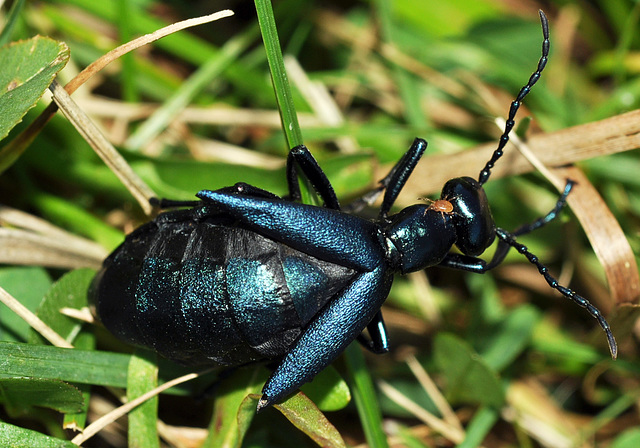

I don’t expect too many people to care for this one. First, it’s a beetle, second, it’s a black beetle. It is an oil beetle, (Genus Meloe, there are several species and they all look the same to me). When threatened they pump out a fluid from between their leg joints that contains cantharidin, a compound that is more than a little nasty. In small doses it is reputedly an aphrodisiac, the famous Spanish fly is based on cantharidin, but consume too much, (and by all accounts, a little is too much), and a grim, writhing, agonizing, death ensues. Their reproductive habits also tend toward the macabre. The female lays eggs in burrows. The first generation of larvae hatch, crawl up plant stalks to settle in flowers. Here they are picked up by bees. In fact, some oil beetles emit pheromones that attract male wild bees. The larvae climb aboard the bee. The male bee mates with a female bee, and the larval oil beetles are transferred to the female. One web-site referred to this transfer as 'six-legged venereal disease', which is a troubling comparison but apt. The female bee lays her eggs and stuffs the nest with pollen. Meanwhile, the oil beetle larvae having dropped off the mummy bee, set about to eat the pollen. Then they eat the larval bees. Then they make themselves scarce without so much as a thank you note.
Dave C, buonacoppi, William Sutherland, Nouchetdu38 and 8 other people have particularly liked this photo
- Keyboard shortcuts:
Jump to top
RSS feed- Latest comments - Subscribe to the comment feeds of this photo
- ipernity © 2007-2026
- Help & Contact
|
Club news
|
About ipernity
|
History |
ipernity Club & Prices |
Guide of good conduct
Donate | Group guidelines | Privacy policy | Terms of use | Statutes | In memoria -
Facebook
X

and what a superb macro !!!
P'TITES BEBÊTES EN MACRO.
Admired in : P'TITES BEBÊTES EN MACRO
Admired in:
www.ipernity.com/group/tolerance
Superb description.
Sign-in to write a comment.