

From Books Only for me excerpts

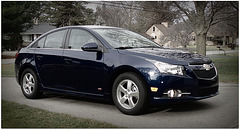
How much pleasure do you get from your car?
| |
|
|
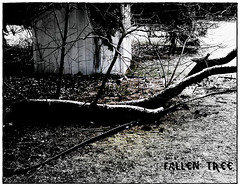
Memories
| |
|
|
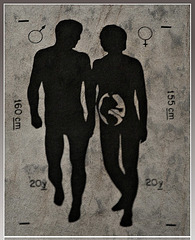
Diagram ~ Voyager Spacecraft Golden Record
| |
|
|
1977, Carl Sagan asked Toronto painter and radio producer Jon Lomberg how an artist might express the essence of human identity to an audience that had never seen humans. With fellow Cornell astrophysicist Frank Drake, Sagan had just been invited by NASA to devise something meaningful about humanity to accompany the twin Voyager spacecrafts, which would visit the outer planets and then continue on through interstellar space, possibly forever.
Writing ~ An Art of discovery
| |
|
|
|
Paper
| |
|
|

Which path to take
| |
|
|

Water - conspicious consumption
| |
|
|
Tree in its essential form
| |
|
|
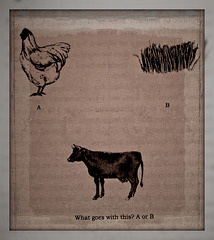
What goes with it A or B
| |
|
|
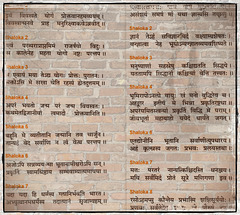
Samskrata ~ Sanskrit ~ संस्कृतम्
| |
|
|
Sanskrit, also spelled संस्कृतम् (saṃskṛtam), is an ancient language of India commonly seen as the grandmother of the Indo-European language family (even English!). Closely allied with Prakrit and Pali, Sanskrit is more exhaustive in both grammar and terms and has the most extensive collection of literature in the world, greatly surpassing its sister-languages Greek and Latin.
The Human Condition
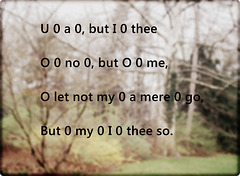
Cipher as a Code & a Zero
| |
|
You sigh for a cipher, but I sigh for thee
O sigh for no cipher, but O sigh for me.
O let not my sigh for a mere cipher go,
But sign for my sigh, for I sigh for thee so.

Cognitive study of Autumn colors
| |
|
|
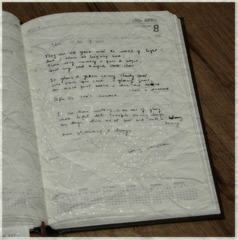
Fossil of Language
| |
|
|
Writing is a kind of fossil and so can tell us a little about the languages that have been recorded since it was invented. While it shares a lot with spoken language, including most of its words and much organizational structure, writing cannot be considered the bare bones of speech, for it is something else entirely. Writing is static, structured by the convent ions of punctuation and the use of space. The kinds of sentences that occur in writing bear only an indirect relationship to the more free-flowing and complex structures of speech. Writing has no additional channels for avoiding ambiguity, as speech has with intonation and gesture. And writing is only six thousand years old. ~ Page 5 [Introduction] "The First Word" ~ Christine Kenneally
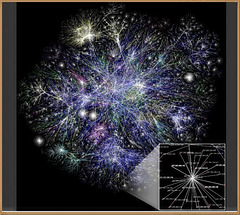
Internet map 1024.jpg Wikipedia
| |
|
|
In a 2005 speech, the CEO of Google, Eric Schmidt, for the first time offered an estimate of the size of the Internet in total bytes of memory.
He put the total at 5 million trillion bytes – or, based on the average size of the computer byte – about 50,000,000,000,000,000,000,000 (50 sex-trillion) bites. All of this memory, representing a sizeable portion of all human knowledge and memory, was stored virtually in more than 150 million websites, and physically in an estimated 75 million services located around the world. None of these numbers were accurate, other researchers added, and some might of off in either direction by a factor of five.
Of this total size of the Internet, Schmidt estimated that Google, by far the world’s leading search-engine company, had managed after seven years to index 200 trillion bytes (terabytes), or just .004 percent of the Net. Most of the rest, he admitted, was essentially terra incognita – a vast region of unexplored data that might never be fully known. At the current rate, Google would need 300 years to index the entire Internet – and that, Schmidt added, was only assuming the impossible: that the Net probably grew by several trillion bytes just during the course of Schmidt’s speech.
By 2010, these unimaginable contents of the Net were accessed by just short of 1 billion personal computers, nearly 700 million smart-phones (the total for 2011), and several hundred million other devices large and small, in the hands of estimated 2 billion users worldwide. Some of these users, mostly from the developed world, arrived in cyber-pace using powerful computers and handheld devices, linked via wire-less networks or broadband cable, and stored hundreds of gigabytes of memory of their own.
Others, newer to the Web and often from developing nations, had reached the Internet any way they could: dial-up modems, cell phones rented from corner stands, desktop computers stationed in classrooms and local libraries, Internet cafes of the kind long gone from the West. But they’d make it at last, and whether they were selling goods on eBay or following bloggers covering events their censored national media wouldn’t touch or taking online classes at distant universities they would never see, they were the first generation to have access to the world’s accumulated memory. And because of that, they inhabited a unique new reality that name of their ancestors had ever experienced. For the first time, these billions (and 2 billion more are expected to join this global conversation within the next decade) had access to almost everything every human has ever known. And it was at their fingertips. And it was as good as free. ~ Page 238/239
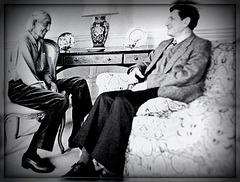
J.Krishnamurthi & physicist David Bohm ~ 1984
| |
|
|
en.wikipedia.org/wiki/David_Bohm
In the late 1970s, another physicist stepped up to the plate, bearing credentials that made Capra look like an undergrad by comparison. David Bohm had done his graduate work at Berkeley under Oppenheimer and taught at Princeton when Einstein was on campus. He was also influenced by his two-decade-long dialogue with J. Krishnamurthi. Bohm theorized that the domain we think of reality, with its separate objects and events, is actually enfolded within (and unfolds from) a realm of unbroken wholeness in which everything – all of matter and all of consciousness – is simultaneously connected to everything else. “The sphere of ordinary material life and sphere of mystical experience,” said Bohm, “have a certain shared order [that] will allow a fruitful relationship between them”
Bohm theory evoked a compelling image: the hologram, in which each piece of the whole is mirrored in every other piece. Another Vedic visual now came into use: Indra’s Net, a vast network of jewels, each of which reflects the image of all the others. Throughout the 1980s, as Reagan reigned in Washington, conversations about the “holographic universe” and the “holographic paradigm” ranged over a variety of disciplines. Many of the participants had been influenced by Eastern philosophy, and now their ideas were heard by the public. ~ Page 287/288 (American Veda – Philip Goldberg)
youtu.be/CvL4uNA4U-k?si=iNGcSVi9tarD40Zj
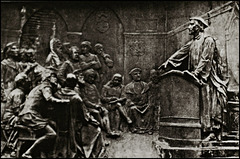
Giordano Bruno
| |
|
|
BrunoGiordano (1548-1600), an Italian wandering scholar, once a Dominican, starts from a Neo-Platonist position. The phenomena we see in the world are the effects of a world-soul which animates nature and makes it into a single organism. In Bruno’s thought God sometimes seems distant and unknowable; at other times God seems to be totally identified with the world of nature. In Bruno’s august but not wholly intelligible expression, God is the Nature which causes Nature which manifests itself in the Nature which is caused by Nature.
The world of nature, for Bruno, is infinite, with no edge, surface, or limit. In this boundless space there are many scholar systems; our sun is just one star among others, and no one star can be called the centre of the universe, since all position is relative. Our earth enjoys no unique privilege; for all we know intelligent life is present elsewhere in the universe. Solar systems rise, glow, and perish, pulsating moments in the life of the single organism whole soul is the world-soul. The universe is built up of atoms, physical and spiritual; each human being is a conscious, immortal atom, mirroring in itself the entire universe.
Bruno’s opinions, unsurprisingly, did not find favour with the Church. He was passed from one Inquisition to an other, and, having refused to recant, was burnt in Rome in 1600. His theories anticipate, in an exciting way, scientific discoveries of later ages and speculations which remain popular with scientists at the present day. But that is what they are, speculations; so far as we know he devoted no time to observation or experiment ~ page 199
Jump to top
RSS feed- Latest items - Subscribe to the latest items added to this album
- ipernity © 2007-2026
- Help & Contact
|
Club news
|
About ipernity
|
History |
ipernity Club & Prices |
Guide of good conduct
Donate | Group guidelines | Privacy policy | Terms of use | Statutes | In memoria -
Facebook
X
