

Greece on the ruins
Sujatha and Gauthama Buddha
Monsoon day
Creeper
Thanks giving
In coming Light
Car street
Adolf Hitler in Nuremberg
Night
Jiffy
Rain - Fall
Foggy Autumn Morning
Neighbourhood morning
Home
Foggy morning
Sutter Av.
Fog
Rasputin
IMG 9836
Stupa
President Obama
Shiva dancing the Cosmic Dance of destruction and…
Purandara Dasa
If it is Wednesday
Wet
Umbrellas
On the wall
Pompey's Piller
Summer
Mousy seat
Kundun
Helen
Dandalion / Taraxacum officinale.
Reflection
ಕವಿ ಮನೆ / Poet's House
Beauty
Window view
Resilence
Type script 1989

See also...
Keywords
Authorizations, license
-
Visible by: Everyone -
All rights reserved
-
7 visits
- Keyboard shortcuts:
Jump to top
RSS feed- Latest comments - Subscribe to the comment feeds of this photo
- ipernity © 2007-2026
- Help & Contact
|
Club news
|
About ipernity
|
History |
ipernity Club & Prices |
Guide of good conduct
Donate | Group guidelines | Privacy policy | Terms of use | Statutes | In memoria -
Facebook
X

There is a Romano-Celtic solid bronze votive in the form of the helmeted head of Minerva (1st century CE, 1.5″, 3.8 cm tall). Intensely stylized, she wears a high crested helmet decorated on either side with dolphins. Her hair falls in locks at the perimeter of her helmet. Her facial detail, including her wide eyes, broad nose and tightly closed lips, is strongly preserved. She wears an ornamental breastplate that ironically mirrors her own expression. This figure is an example of bronze votive Roman art as influenced by the native Celts of Britain. The eyes, and particularly the breastplate, are predominately Celtic in design.
One of the unique features of this example is the breastplate which mirrors the goddess’ serious facial expression. Also, the sculpting of the helmet is zoomorphically styled with the dolphin heads. There are three similarly-sized bronze Minerva busts on display in the British Museum. This particular example is in my own collection.
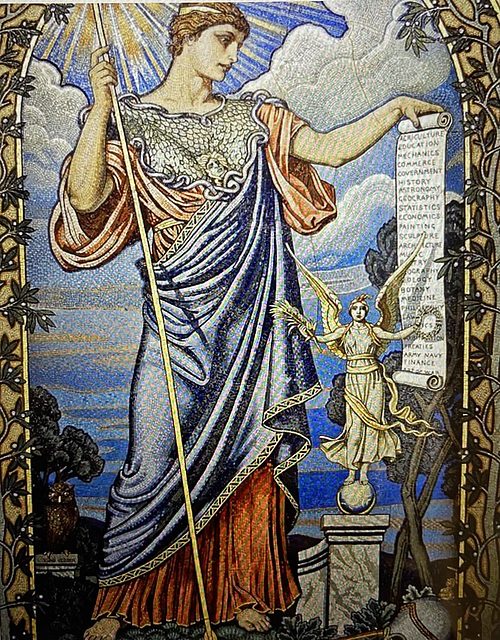
Minerva was the Roman goddess of war, wisdom and the crafts. In Britain at the turn of the 1st millennium CE, Minerva was depicted throughout Celtic Britain in both purely Roman fashion and in the more abstract Celtic style as illustrated above. But in Bath, at the temple of Aquae Sulis she becomes ‘fully equated with a Celtic goddess, Sulis’. (1)Sulis was a local goddess of healing who ruled over the remarkable hot spring beside the river Avon near Bath (Aquae Sulis). She was not only a water deity, but her name Sulis is obviously linked with the sun, probably related to the heat of the waters. Thus she represents two of the elements, water and fire. Her association with Minerva may have related with the craft of healing. Miranda Green says,
The shrine of Sulis Minerva at Bath provides a superb example of the conflation and hybridization of Roman and Celtic religious beliefs and practices. On epigraphic dedications to the goddess where both Celtic and Roman names are mentioned, that of the indigenous goddess, Sulis, is always put first, thereby emphasizing that she was the patroness of the spring and that her cult was long standing.
Perhaps the most famous image from Aqua Sulis is the masculine Medusa head on the main temple pediment. This is a most remarkable image relating the classical Greek myth of Perseus and the Gorgon with the Celtic goddess Sulis and, by inference, the Roman goddess Minerva. The Celtic influence in this image has transformed the female gorgon into a male, bearded face. The locks of hair can represent not only waves of the sea, but also rays of the sun, again linking both fire and water to the sacred spring. Snakes in the beard leave little doubt of the Medusa relationship. Wings on each side of the head suggest a relation with air and the stone of the figure with earth. Thus this single Celtic image combines the four elements – earth, air, fire and water – in a composite whole which hearkens from the Celts through the Romans to the Greeks and, as a predecessor to the future Greenman.
Minerva (1st century CE, 1.5″, 3.8 cm tall). Intensely stylized, she wears a high crested helmet decorated on either side with dolphins. Her hair falls in locks at the perimeter of her helmet. Her facial detail, including her wide eyes, broad nose and tightly closed lips, is strongly preserved. She wears an ornamental breastplate that ironically mirrors her own expression. This figure is an example of bronze votive Roman art as influenced by the native Celts of Britain. The eyes, and particularly the breastplate, are predominately Celtic in design.
One of the unique features of this example is the breastplate which mirrors the goddess’ serious facial expression. Also, the sculpting of the helmet is zoomorphically styled with the dolphin heads. There are three similarly-sized bronze Minerva busts on display in the British Museum. This particular example is in my own collection.
Minerva was the Roman goddess of war, wisdom and the crafts. In Britain at the turn of the 1st millennium CE, Minerva was depicted throughout Celtic Britain in both purely Roman fashion and in the more abstract Celtic style as illustrated above. But in Bath, at the temple of Aquae Sulis she becomes ‘fully equated with a Celtic goddess, Sulis’. (1)Sulis was a local goddess of healing who ruled over the remarkable hot spring beside the river Avon near Bath (Aquae Sulis). She was not only a water deity, but her name Sulis is obviously linked with the sun, probably related to the heat of the waters. Thus she represents two of the elements, water and fire. Her association with Minerva may have related with the craft of healing. Miranda Green says,
Sign-in to write a comment.