

For the Chipmunk in My Yard
First snow of the season
First snow of the season
First snow
First snow of the season
First snow of the season
Changing seaons
His first Winter day
Olive Bread
Snow flakes
Cardinal
Atom with consciousness
Abondoned
Hosmar House
A classic home of yore
Once upon a time
The Little red squirrel
Neighbour's yard
Tourist Train
Lalbagh
Got it
Autumn beauty
Halloween
Halloween
Last of the season
Sunrise in a French door
Autumn light in a thicket
Red squirrel and Autumn leaves
Leaves
Leaves
See also...
Keywords
Authorizations, license
-
Visible by: Everyone -
All rights reserved
- Photo replaced on 20 Mar 2020
-
18 visits
Chipmunk
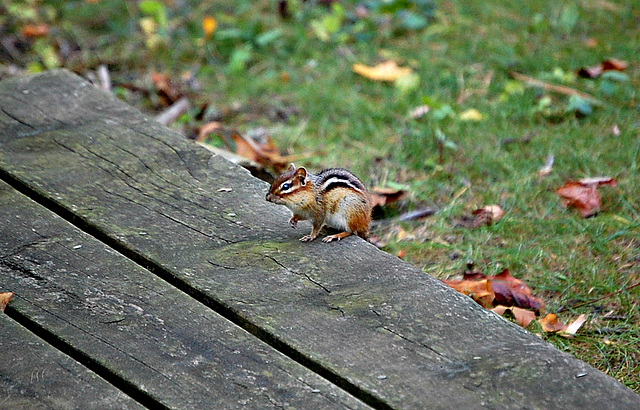

Chipmunks are versatile and can be found in a variety of habitats. Their main habitats are deciduous forests, forest edges and areas of thick brush. They may also be found in meadows, fields and along fence lines. They also frequent bird feeders, gardens, and nut producing trees. Ideal chipmunk habitat will have abundant food supply, cover, and adequate den sites.
Den sites are not usually a problem as chipmunks can burrow into the ground or use holes in hollow trees, logs and stone walls. They will also use spaces under buildings and in houses.
Chipmunks build complex burrow systems with dens, tunnels, and food storage areas often over ten feet in length and three feet in depth. The dens usually have two levels. The upper level is where the chipmunk sleeps and is lined with grass and leaves. The lower level is used for food storage.
Eastern chipmunks are not true hibernators as they are unable to build up a large enough fat reserve to sleep uninterruptedly through the winter. Instead, they wake periodically throughout the winter, usually on warmer days, to feed on stored food or forage above ground.
Chipmunks are generally solitary animals except during the breeding season. They are most active during the day, especially mid-morning and mid-afternoon. Chipmunks are territorial and will aggressively defend their burrow entrance. They vocally threaten and will even chase away intruders approaching their territory.
Den sites are not usually a problem as chipmunks can burrow into the ground or use holes in hollow trees, logs and stone walls. They will also use spaces under buildings and in houses.
Chipmunks build complex burrow systems with dens, tunnels, and food storage areas often over ten feet in length and three feet in depth. The dens usually have two levels. The upper level is where the chipmunk sleeps and is lined with grass and leaves. The lower level is used for food storage.
Eastern chipmunks are not true hibernators as they are unable to build up a large enough fat reserve to sleep uninterruptedly through the winter. Instead, they wake periodically throughout the winter, usually on warmer days, to feed on stored food or forage above ground.
Chipmunks are generally solitary animals except during the breeding season. They are most active during the day, especially mid-morning and mid-afternoon. Chipmunks are territorial and will aggressively defend their burrow entrance. They vocally threaten and will even chase away intruders approaching their territory.
- Keyboard shortcuts:
Jump to top
RSS feed- Latest comments - Subscribe to the comment feeds of this photo
- ipernity © 2007-2026
- Help & Contact
|
Club news
|
About ipernity
|
History |
ipernity Club & Prices |
Guide of good conduct
Donate | Group guidelines | Privacy policy | Terms of use | Statutes | In memoria -
Facebook
X

Sign-in to write a comment.