

Spring
Happy Birthday
F-word
Halloween party
The Bottle
Bla bla bla
You know what they're writing about
Subframing
Light bulbs
Traditions
Ended
From behind
Worm's eye view
Behind on schedule
Prickly
Abstract
Colour
Early sunday morning
Rainbow Road
Flames
Geometry
To know or to know knot
Healing powers
Repeating patterns
Kitsch
BW1
Slowly Burning
Inversion
Out of the blue
After the rain
Beachball
Paperclip SOOC
Shadows
A place you love
S-curve
Metal
Hello Mother
White on white
Glasses
Mermaid
Easter Egg
Spring
ThatOld55
Art
Feathers
1/1000 • f/7.1 • 200.0 mm • ISO 100 •
Canon EOS 6D
EF70-200mm f/2.8L IS USM
See also...
Authorizations, license
-
Visible by: Everyone -
All rights reserved
-
847 visits
Transition
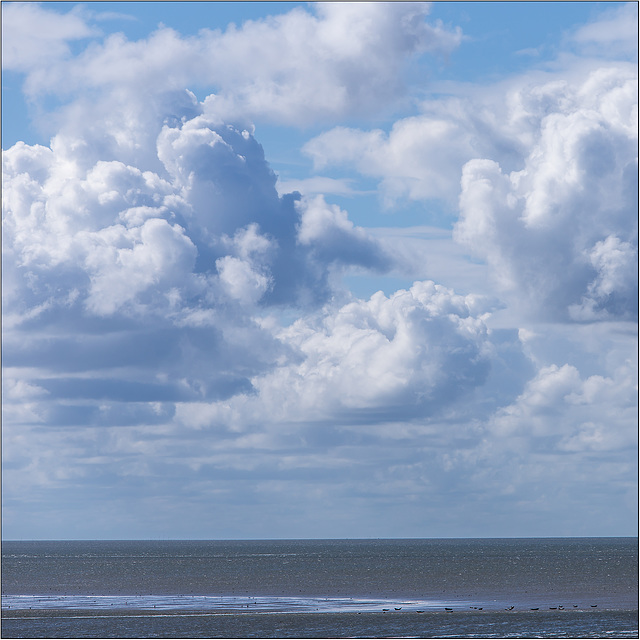

The Sunday Challenge = Transition
-------------------------------------------------
An excellent example of constant transition is the Wadden Sea (Dutch: Waddenzee, German: Wattenmeer), an intertidal zone in the southeastern part of the North Sea. It lies between the coast of northwestern continental Europe and the range of Frisian Islands, forming a shallow body of water with tidal flats and wetlands. It is rich in biological diversity
The Wadden Sea is famous for its rich flora and fauna, especially birds. Wadden Sea is an important habitat for two species of seals, harbor and grey seals. In 2009 it is inscribed on UNESCO's World Heritage List.
You can see numerous birds and seals on the mud flats in this image. Try the larger view.
The word wad is Dutch for "mud flat". The area is typified by extensive tidal mud flats, deeper tidal trenches (tidal creeks) and the islands that are contained within this, a region continually contested by land and sea.
The islands are marked by dunes and wide, sandy beaches towards the North Sea and a low, tidal coast towards the Wadden Sea. The impact of waves and currents, carrying away sediments, is slowly changing the layout of the islands. Some islands have moved eastwards through the centuries, having lost land on one side and grown on the other.
-------------------------------------------------
An excellent example of constant transition is the Wadden Sea (Dutch: Waddenzee, German: Wattenmeer), an intertidal zone in the southeastern part of the North Sea. It lies between the coast of northwestern continental Europe and the range of Frisian Islands, forming a shallow body of water with tidal flats and wetlands. It is rich in biological diversity
The Wadden Sea is famous for its rich flora and fauna, especially birds. Wadden Sea is an important habitat for two species of seals, harbor and grey seals. In 2009 it is inscribed on UNESCO's World Heritage List.
You can see numerous birds and seals on the mud flats in this image. Try the larger view.
The word wad is Dutch for "mud flat". The area is typified by extensive tidal mud flats, deeper tidal trenches (tidal creeks) and the islands that are contained within this, a region continually contested by land and sea.
The islands are marked by dunes and wide, sandy beaches towards the North Sea and a low, tidal coast towards the Wadden Sea. The impact of waves and currents, carrying away sediments, is slowly changing the layout of the islands. Some islands have moved eastwards through the centuries, having lost land on one side and grown on the other.
buonacoppi, Marta Wojtkowska, , Don Sutherland and 13 other people have particularly liked this photo
- Keyboard shortcuts:
Jump to top
RSS feed- Latest comments - Subscribe to the comment feeds of this photo
- ipernity © 2007-2026
- Help & Contact
|
Club news
|
About ipernity
|
History |
ipernity Club & Prices |
Guide of good conduct
Donate | Group guidelines | Privacy policy | Terms of use | Statutes | In memoria -
Facebook
X

Sign-in to write a comment.