


Greece - Ελλάδα - Griekenland

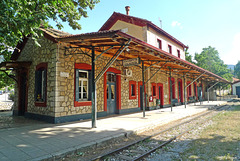
Greece - Kalavryta, Odontotos
| |
|
|
|
The Odontotos rack railway runs between Diakopto on the coast of the Corinthian Bay and Kalavryta on a height of almost 750 meters. It follows the Vouraikos river over bridges and through tunnels.
The construction of the network started in 1889 and it was inaugurated on 10 March 1896. It has a length of just more than 22 kilometers. With a gauge of 0,75 meter the Odontotos is one of the narrowest in the world.
The railway has some characteristic stations. The main image shows the Kalavryta railway station and PiP1 the Mega Spileo station.
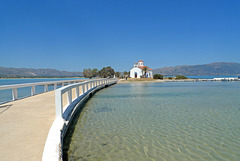
Greece - Elafonisos, Agios Spyridon
| |
|
|
|
The Saint Spyridion church was built by the first inhabitants of the island. They came from Mani, one of the The Agios Spyridon church ( Αγίου Σπυρίδωνα ) - located at the entrance of the port of Elafonisos - is the landmark of the little island. The church is built on a rocky island with cedar trees and is connected with the main island by a bridge.
The church was built by the first inhabitants of the island. They came from Mani, one of the three peninsulas which extend from the Peloponnese, around the year of 1858. The church was renovated in 1962. The iconostasis is made of stones from Malta and decorated with remarkable icons.
The church is the only historical holy monument on Elafonisos.
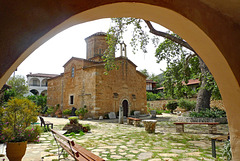
Greece - Astros, Loukous Monastery
| |
|
|
|
The Loukous Monastery ( Ιερά Μονή Λουκούς ) is probably built on the site of an early Christian church of the 5th century AD. The current catholicon - was rebuilt on its remains in 1117 - is a domed church of the composite four columned. It is decorated with fine wall paintings and its floor is paved with coloured marble slabs. The iconostasis is decorated with portable icons dated to the 17th century. ( Just a pity we were not allowed to take pictures inside the church )
Today the monastery is one of the most important Byzantine monuments in Arcadia. The most possible etymology of the name of the monastery is from the Latin word “Lucus”, which means “Holy Forest”. The monastery was male until 1946 which after turned into a female one.
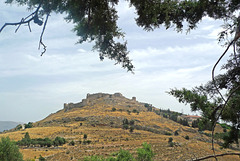
Greece - Argos, Larissa Castle
| |
|
|
|
Larissa Castle ( Κάστρο Λάρισα ) - the ancient and medieval acropolis of the city of Argos - is located on the top of the Larissa hill on a height of 289 meters above the city of Argos. The first inhabitants of the area were the Pelasgians - pre-Hellenic people inhabiting parts of Greece - and the names "Argos" and "Larissa" are pelasgian. The meaning of the first was “valley” and of the latter “acropolis”.
Τhe castle was created in the 6th century B.C. but there was a fortification there since prehistoric times and the epoch of the Pelasgians. The medieval castle was first built by the Byzantines in the 10th century. During the Byzantine period, the fortress was of strategic importance. In 1203, it came under the control of the archon of Nafplio. In 1212 it was captured by Othon de la Roche, the Bourgoundian Duke of Athens, and was controlled by the Franks until 1388.
Between 1394 and 1463 it was occupied by the Venetians. In 1463 it was captured by the Turks and remained under their control until 1822, interrupted during 1686-1715, when Larissa came under the control of the Venetians. The site was liberated by the Greeks in 1822 during the Greek War of Independence. .
Greece - Nafplion, Church of Panagia
| |
|
|
|
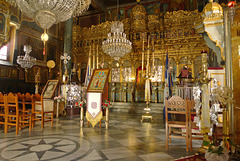
The Church of Panagia ( Ιερός Ναός Παναγίας ) – consecrated to the Presentation of the Virgin Mary - is one of the oldest and most beautiful churches of Nafplion. The original temple, dating back to the 15th century was smaller and belonged to the Orthodox Church. Around 1700, during the second Venetian domination, the church took its current form, a three-aisled basilica. A further addition is the church-porch, while the bell tower dates added in 1907.
The Church of Panagia has a beautiful wood-carved temple of Ionian style inside, created in the 19th century. The pulpit and the episcopal throne of the church are of a similar style. Its frescoes are impressive.
Greece - Apidea, olive tree
| |
|
|
|
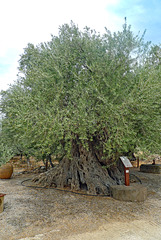
This over-aged olive tree has known Byzantine despots, Frankish and Venetian rulers, Ottoman conquerors and lived through the Greek Revolution. It survived wars, fires and looting and is now a remarkable "monumental olive tree". Although the passage of time has chiselled its wooden body, giving it reliefs, it has remained intact and has continued to bear its precious fruits.
This particular olive tree belongs to the variety of Myrtolias, which is mainly cultivated in Greece. It is located at an altitude of 260 meters. This variety is mainly used for the production of very high quality olive oil and is resistant to cold and dryness. The trunk base circumference is more than 14 meters and the tree is 8 meters high.
Comparing the data of some other olive trees in Greece, the Apidea olive tree is probably in its second millennium or has already passed it. A sign next to the tree tells it is more than 2.000 years old.
Greece - Agios Nikolaos Geopark
| |
|
|
|
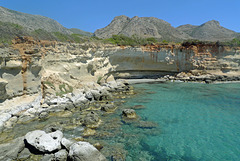
Earthquakes, volcanic activity and geological disturbances led to the fossilisation of the area’s paleoflora millions of years ago. More specifically, a series of geological events at the coastal area, close to Cape Maleas, caused the palm forest that existed in the area to sink. Organic matter of trees, plants and mollusks was replaced by solutions of silicon and calcium over a process that lasted centuries.
The coastline of Lakonia’s south where fossils have been preserved is large and offers a superb view. It includes fossilised root knots a metre deep, roots, trunks and shellfish
Nowadays, the area is a geological museum with an extensive history. The petrified palm forest of the coastal zone of Agios Nikolaos is included to the Atlas of Geological Monuments of the Aegean.
Greece - Lagia, Church of the Assumption
| |
|
|
|
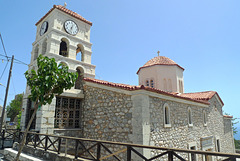
Lagia is a village in southeast Mani with some stone mansions and a Greek Orthodox Church on the main square. The Church of the Assumption ( Εκκλησία Κοίμησεως της Θεοτόκου ) is built on a slope. Through the door in the tower one will reach a kind of balcony, which gives a view on the beautiful frescoes on the walls and ceiling. A staircase leads to the ground floor of this remarkable village church.
The church was constructed about 200 years ago with the full participation of local men and women, with building materials gathered from the surrounding mountains.
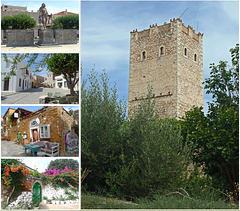
Greece - Areopoli
| |
|
|
|
The town of Areopoli is built at the foot of the Elias Mountain at an altitude of 250 meters. According to tradition, the name Areopoli is attributed to the god of war Ares. The village used to be called Tsimova before being renamed to Areopoli in 1912.
Like the rest of the Mani settlements, Areopolis is known for its major contribution in the Greek War of Independence against the Ottoman Empire. The Greek War of Independence started in Areopolis on March 17, 1821 by Petros Pierrakos, also known as Petros Mavromichalis, the last bey of Mani.
Nowadays Areopoli is a popular holiday destination offering many sights like stone houses, churches, imposing traditional Mani towers and cobblestoned streets. At the central square of the village “Platia Athanaton” one will come across the statue of Petrompeis Mavromichalis, the famous chieftain and offspring of the Mavromichali family. Areopoli is also starting point for a Mani Peninsula-visit.
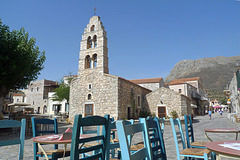
Greece - Areopoli, Church of Agios Charalambos & P…
| |
|
|
|
One of the must see sights in Areopoli is the dual church of Agios Charalambos and Panagia. The church - located in the centre of the town - offers frescoes dating back to 1869. It has an interesting stepped belfry with stone reliefs.
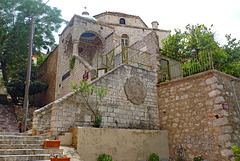
Greece - Nafplion, Church of the Transfiguration o…
| |
|
|
|
The history of the Church of the Transfiguration of the Saviour - also knowns as Frankoklisia - probably began during the time of the Frankish occupation of Nafplio, when the church must have been used as a convent for Franciscan nuns. Shortly before the outbreak of the Greek revolutionin 1821, when Nafplio was still under Turkish control, the widow of the Aga-Pasha converted it into a mosque, as a memorial to her husband.
In 1839, with the mediation of King Otto (the first king of the modern Greek state), the Municipality of Nafplio granted the mosque to the Catholic Church, for the ecclesiastical needs of the approximately three hundred Greek and foreign Catholics - mainly the Bavarian soldiers who belonged to the king's entourage. After repairs, the church was officially opened in 1840.
The church has been in continuous operation from 1839 to the present day.
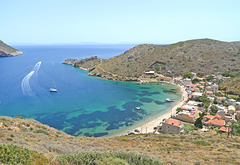
Greece - Porto Kagio
| |
|
|
|
The picturesque village of Porto Kagio is located in a small bay nearby the southernmost tip of the Mani Peninsula, where the landscape is presented by high barren hills and indented coast with bays. It is the southernmost natural port of mainland Greece. The tiny village is far from civilization, making it peaceful and quiet. Right in front there is a small pebbly beach with crystal-clear waters.
The village has always been a very important port. It was already mentioned in the 2nd century AD, when it was known as Psammathous. The modern name comes from the Venetian “Porto Quaglio” and the French (Frankish) “Port des Cailles” (Quail Port).
Porto Kagio was the base of the pirate fleet of Lambros Katsonis. Lambros Katsonis sailed from port to port, looting Ottoman boats and trying to get the Greeks to start a revolution. During World War II, it was the place from which a significant number of British soldiers escaped to Egypt.
Greece - Vathia
| |
|
|
|
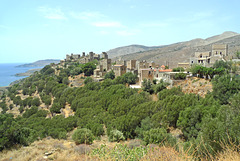
Vathia - or Vatheia - is a traditional village in the southernmost tip of the Mani peninsula on the Peloponnese. The village was built from the mid 16th century. In the 19th century the village had about 300 inhabitants, who were mainly farmers and the olive harvest was their main occupation. At the beginning of the 20th century the inhabitants left the village due to poverty and at the end of the eighties of the last century there were hardly any people living there.
Nowadays Vathia - often called a ghost town - is almost completely uninhabited. It has about 90 typical tower houses with the typical architecture of the Mani; most of them are empty and partly dilapidated, but in the meantime some have been renovated.
The tower houses in Vathia are built like fortresses with two or three floors. The people, at one time, fiercely guarded their land and livelihoods, either from foreign invaders or rival families. The fortress-like houses provided the ideal opportunity to keep a lookout in the case of a potential invasion. The head of each household was considered to be a ‘mini warlord’, who had the interests of the family at the center of his concerns. The fierceness of the people, the rugged terrain and the strategic location of the tower houses helped keep Mani (and Vathia) free from invaders and it even maintained its independence from the Ottoman Empire..
Vathia is built on a hill top in the middle of an impressive landscape with beautiful sea views. It is located halfway between Areopoli and Cape Tenaro.
Greece - Kefalari, Zoodochos Pigi Church
| |
|
|
|
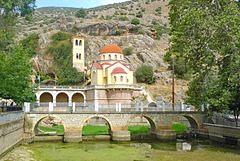
Kefalari (nearby the town of Argos) is a well-known pilgrimage site for the Greek Orthodox people, due to the Zoodochos Pigi Church. The first church, built in 1634, was possibly the place where the miraculous image of the Holy Virgin was found.
The church was destroyed in 1918 after an explosion in the German ammunition depots. That first church was called “Panagia Kefalariotissa”, meaning “Holy Virgin of Kefalari”. Half of the church was inside a cave. The explosion was survived only by the picture of the Holy Virgin and the altar.
The people of Argos wanted to rebuild the church, and aided by the Greek immigrants of Argos in America, collected enough money to do it. In 1924, the new church was opened. In 1955 the bell tower of the church was built. In front of the church is a small pond, created by the waters of Erysinos.
Greece - Valtaki, Dimitrios shipwreck
| |
|
|
|
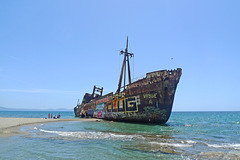
Rusty Dimitrios shipwreck is an imposing cargo ship that has been abandoned on Valtaki beach since 1981. It is believed that this ship was used for transporting illegal cigarettes between Turkey and Italy, however many refer to this ship as a ghost ship, of which the origins remain unknown.
Greece - Nafplion, Palamidi fortress
| |
|
|
|
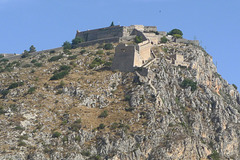
Palamidi fortress is one of the most important and best-preserved castles in Greece, a beautiful example of Venetian architecture of the 18th century. It is located located on a 216 meters high hill above the city of Nafplion.
The hill at which the castle is located was named after Palamidis, the hero of Homer’s Epics. The fortress was a very large and ambitious project, but was finished within a relatively short period from 1711 until 1714. It is a typical baroque fortress based on the plans of a Venetian engineer. In 1715, just one year after its completion, it was occupied by the Turks. During the Greek War of Independence - in 1822 - Palamidi was captured by the Greeks.
The fortress commands an impressive The view from the fortress over Nafplion, the Argolic Gulf and the surrounfing county are just stunning
Greece - Astros, Loukous aqueduct
| |
|
|
|
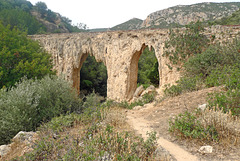
Nearby the Loukos monastery stands an old aqueduct bridge crossing a small ravine. The Roman aqueduct carried water from a spring located about one and half kilometer to the northwest. Its purpose was to supply water to the nearby villa of Herodes Atticus, one of the richest and most important Greeks at the time.
The aqueduct was built during the second century, when Greece was under Roman rule. The water was rich in dissolved minerals and nowadays the brickwork of the aqueduct is completely covered with lime sinter.
Greece - Messini, Agios Ioannis
| |
|
|
|
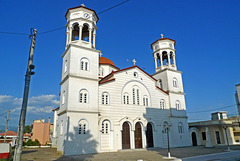
The Agios Ioannis church (Holy Metropolitan Church of St. John the Baptist of Messina) is the metropolitan church of the city of Messini.
In 1986 during devastating earthquakes the church was badly damaged and eventually demolished. Today, a new large church with two large bell towers has been erected. The new church was built in the form of the previous one with some changes such as the dome, the second bell tower and the removal of the porch. The inauguration of the new church was held on October 17, 1993.
Jump to top
RSS feed- Latest items - Subscribe to the latest items added to this album
- ipernity © 2007-2026
- Help & Contact
|
Club news
|
About ipernity
|
History |
ipernity Club & Prices |
Guide of good conduct
Donate | Group guidelines | Privacy policy | Terms of use | Statutes | In memoria -
Facebook
X
