


Italia - Italy - Italië

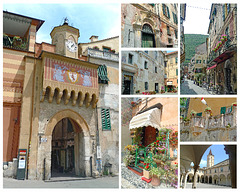
Italy - Finalborgo
| |
|
|
|
Finalborgo is a small walled town not far from the Mediterranean Sea. The name derives from “Burgum Finarii”, border land (for fines) to the times of the Romans and administrative center of the marquisate of the Del Carretto family between the 14th and the 16th century. The origin of the village dates back to the end of the 12th century, to the epoch of the marquis Enrico The Guercio. Recent important archaeological discoveries, however, date back its foundation to some centuries before.
With the walls, the different city-gates and the semicircular towers which interrupted to treat the walls Finalborgo retains the characteristics of a fortified village in its 15th-century structure, rear to the destruction resulting from the war with Genoa (1448). The 15th-century and Renaissance palaces, altered during the period of Spanish domination, embellish the urban fabric.
Nowadays Finalborgo is considered being one of the most beautiful villages in Italy due to its history, places to visit and natural beauty. The town belongs to il borghi pui bella d'Italia (the most beautiful villages in Italy).
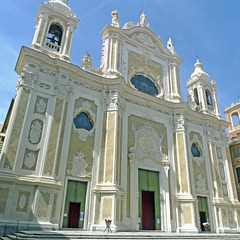
Italy - Finale Ligure, Basilica di S. Giovanni Bat…
| |
|
|
|
The Basilica di S. Giovanni Battista (Basilica of Saint John the Baptist) is located in the center of Finale Ligure. It is considered being one of the most beautiful Baroque churches in the region. The construction of the church started in 1619; fifty-five years the church was inaugurated.
The design is usually attributed to Gian Lorenzo Bernini, but most probably designed by local architects, who did work in Bernini's style. The façade, rich in artistic emblems and stained-glass windows, is the work of a local architect and was completed in 1762. The dome of the basilica has a height of 24 meters.
The interior is characterized by a great harmony and simplicity of proportions. The central nave is separated from the two aisles by two rows of paired columns. Twelve very rich chapels - decorated with architectural motifs - are situated in the two aisles. The high altar - built in 1767 - is inlaid with polychrome marbles.
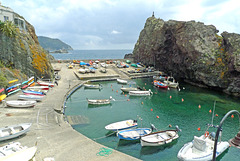
Italy - Framura
| |
|
|
|
Framura is on the official list of Italy’s prettiest towns ( Borghi più Belli d’Italia ). The old town is actually made up of four tiny villages clinging to a hillside, one above the other. At sea level is the pretty little harbour, or Porticciolo . The harbour is full of colourful boats and has a bar for a lunch, drink or aperitivo.
We visited Framura from Levanto - where we stayed a couple of days - by a short bike trip. The biking/walking path runs through an old restored railway tunnel and is as flat as can be. It offers a couple of snatches of views of the beautiful coast of the Mediterranean Sea.
Levanto has a number of bicycle rental companies. However, we were able to use the free bicycles of our hotel (Oasi Hotel).
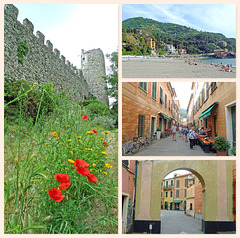
Italy - Levanto
| |
|
|
|
Levanto - about 5.600 inhabitants - is a coastal town, located along the Italian Riviera between Genua and La Spezia. The town is bordering - and a good starting point for exploring - the well known villages of Cinque Terre. It is sharing with them large areas of the National Park and the Protected Marine Reserve.
Levanto has a historical center, nowadays completely pedestrian. The town still has a medieval feel due to the presence of the old castle dating from the 1200', the old city wall and bell tower. Levanto also has many churches, which include the Chiesa di Sant’Andrea from 1222 and the San Nicolo and San Siro churches, which date back to the 11th century. Among these things, Levanto is home to a UNESCO-listed 13th-century loggia, a rare example of late medieval architecture that survives intact up to the present.
The town and its medieval villages are nestled amidst a wide valley of olive groves, vineyards and Mediterranean maquis. The valley opens up in sandy or pebbly beaches.
Levanto was the first stop on our journey through Liguria. We did sleep in a nice hotel - Oasi Hotel - close to the centre of the town with also very friendly staff.
Italy - Levanto, Chiesa di Sant’Andrea
| |
|
|
|
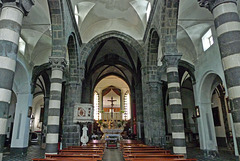
The year of construction of the Romanesque Chiesa di Sant’Andrea (Church of St. Andrew) is not exactly known. Certainly the church is mentioned several times in 13th-century documents, including one dated “1222”, the year of the hypothetical start of work on the building of the church.
On the other hand, it is certain, from the references on the façade and on the first pillar on the right, that the church was consecrated on 20 May 1463, after the new enlargement works which started in 1450. The slender columns of the nave pick up the decorative motif of alternating bands already, also present on the façade.
Its actual look is due to the restorations made between the end of the 19th century and the first decades of the 20th century. The façade is covered by a marble facing with alternating bands of white Carrara marble and green serpentinite, a decorative motif typical of Genoese Gothic architecture. The remarkable has a magnificent rose window.
The interior of the church offers several works of art, an 18th-century main altar and a red marble baptismal font.
We came across the Chiesa di Sant’Andrea during a city walk. We found it on a leaflet from the local tourist information office, although the route was not very clear at some points.

Italy - Monterosso al Mare
| |
|
|
|
The Cinque Terre is a string of five old fishing villages perched high on the rugged coastline of the east end of the Italian Riviera in Liguria. Until recently they were linked only by mule tracks and accessible only by rail or water. Nowadays Cinque Terre is a UNESCO Heritage Site. It's also one of the most sought-after travel destinations in all of Italy. The five villages are no longer the isolated hamlets they once were, but there’s still a feeling of authenticity, with few roads and perfectly preserved architecture.
Monterosso al Mare - the most populated village of Cinque Terre - is divided into two parts, divided by a pedestrian tunnel. To the west the residential; area with a long sandy beach, railway station, hotels and restaurants. To the east the old town with a small harbour and beach and the typical tower-houses painted with bright colours and narrow medieval alleys.
A first settlement is mentioned in the 9th century. Shortly after the year 1000, the inhabitants began to descend into the natural inlet and the small town began to increase in number and was protected by town walls. In 1545 the village was the victim of a terrible raid by Barbary pirates led by the Ottoman corsair Dragut. With the arrival of Napoleon, Monterosso followed the vicissitudes of French domination and the birth of the Kingdom of Italy.
Monterosso al Mare was the last village in Cinque Terre we visited. To be honest it was the least exciting of the five villages. It feels more like an "average" summer resort with its long beach and several hotels.
Italy - Monterosso al Mare, Chiesa di San Giovanni…
| |
|
|
|
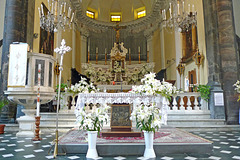
The current parish church Chiesa di San Giovanni Battista (Church of San Juan Bautista) was built between the year 1244 and 1307. It was remodeled in the Baroque period and more recently between 1963 and 1964. The facade , which dates from 1307, is made of alternating vestments of white marble and dark green serpentine. The central rose window in white marble is a splendid example of ornate Gothic. The lace-like ornamentation shows from the central button, eighteen smooth and twisted columns.
The interior structure has a basilica plan and a division of three naves and for its characteristics, represents a pure Genoese Gothic style. The altar greater and the masonry wood , were commissioned in 1734.
The Chiesa di San Giovanni Battista is one of the oldest churches in Cinque Terre.
Italy - Manarola
| |
|
|
|
The Cinque Terre is a string of five old fishing villages perched high on the rugged coastline of the east end of the Italian Riviera in Liguria. Until recently they were linked only by mule tracks and accessible only by rail or water. Nowadays Cinque Terre is a UNESCO Heritage Site. It's also one of the most sought-after travel destinations in all of Italy. The five villages are no longer the isolated hamlets they once were, but there’s still a feeling of authenticity, with few roads and perfectly preserved architecture.
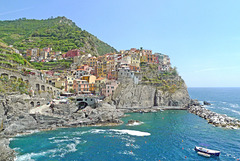
Manarola, the second village of the Cinque Terre coming from La Spezia is one of the most picturesque villages, made up of the characteristic perched and colorful tower-houses that overlook the alleys and the main street, where boats are on dry land, which creates an extra attractive image.
Manarola develops around the main road that retraces the course of the Groppo stream, which is now covered and no longer visible. Numerous alleyways and stone alleys branch off from the main street, to reach the sides of the promontory and the houses higher up on the rock that reaches up to 70 meters above the Mediterranean Sea. The main road ends at a tiny harbour.
Manarola was first mentioned in the second half of the 13th century. Passed under the dominion of Genoa, the town experienced a progressive development, becoming one of the major producers of oil and wine.
Italy - Noli
| |
|
|
|
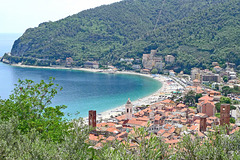
Noli - probably founded by the ancient Greeks - is located along a beautiful Ligurian bay, and borders Bergeggi to the east and Capo Noli to the west. The location of the village was an important factor in trade and Noli flourished. It was the capital of the Maritime Republic of the same name between 1193 and 1797, when it celebrated its heyday. Noli played an important role in the defence of the Ligurian coast against attacks.
The historic centre of Noli has a maze of small narrow streets surrounded by medieval towers and colourful houses. The most interesting buildings are dating back to the 13th century; among them the Torre del Comune, the Palazzo del Comune (town hall) and the cathedral. The town is surrounded by steep hills and one can enjoy beautiful views over the roofs of the village. For instance from the old Castello di Monte Ursino (main image).
Noli belongs to il borghi pui bella d'Italia (the most beautiful villages in Italy).
Italy - Noli, Cattedrale di San Pietro
| |
|
|
|
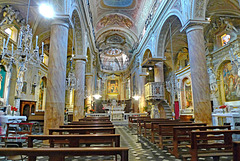
The Baroque style Cattedrale di SanPietro (Cathedral of San Pietro) dates back to the 13th century, but in the first version it was a small chapel named after San Pietro. After being chosen as the cathedral of the town diocese in 1572, it was renovated and enlarged, as it looks like nowadays; but some signs of the original building are still visible on the facade and on the right side of the church.
The main treasure inside the cathedral is a Roman sarcophagus in polychrome marble known as “Sant'Eugenio's Ark”, because it was used as the patron saint's relics. The current aspect of this sarcophagus is the result of some restorations made between the 15th and the 16th centuries. Also noteworthy are the bishop's chair in carved walnut wood , the pulpit and a processional case in polychrome wood.
Italy - Pavia Cathedral
| |
|
|
|
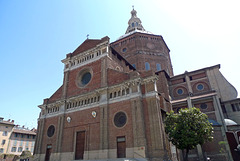
The history of the Cattedrale di Santo Stefano e Santa Maria Assunta dates back to 1488, when its construction began on the site of two pre-existing Romanesque, "twin" cathedrals. From this date onwards many people contributed to the design of the cathedral, including Leonardo Da Vinci who visited Pavia during the early stages of the cathedral's construction. The church was not fully completed until the 1930s, more than 400 years after the first stone was laid.
The plan of the Pavia Cathedral is a Greek cross, with three naves flanked by semi-circular chapels. The central nave is twice as wide as those on the side; it is about 30 metres high and divided by two galleries. The dome has an octagonal plan and is the fourth largest in Italy with a height of 97 metres and a span of 34 metres.
The Cathedral of Pavia is the most important Renaissance building of the city, recognizable by its impressive octagonal masonry dome.
Italy - Pietra Ligure, Basilica di San Nicolò
| |
|
|
|
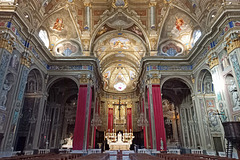
The Basilica di San Nicolò - dedicated to St Nicholas of Bari - is located at the central square in the historic centre of Pietra Ligure.
In the 18th century, construction of a new church began, in order to thank St Nicholas for the plague miracle. The building of the basilica - replacing an earlier church - started in 1750 and lasted 41 years. The church was blessed - although still unfinished - in 1791. The construction was finally completed after the rule of Napoleon. . In 1814, three heavy bells arrived by sea ready to be hoisted onto the bell tower. In 1863 a second bell tower was finished.
Although the Baroque-Renaissance façade is simple and almost monochrome, entering the basilica one has the idea of being immersed in a work of art. The interior is truly a marvel for the eyes: the walls and ceiling are entirely decorated with religious motifs and scenes, and in the upper band of the walls, near the ceiling fresco, there is a series of niches and columns created using the 'trompe d'oeil' painting technique. The 16th century wooden choir and pulpit come from the Marseille Cathedral. The true marvel of the basilica is the immense and beautiful vault, 27.25 meters long and 23.50 meters wide.
Italia - Pontebba, Santa Maria Maggiore
| |
|
|
|
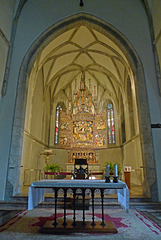
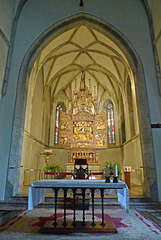
The historically most important church in the area is the parish church of Santa Maria Maggiore in Pontebba. The little chapel - most probably from the 12th century – was rebuilt in gothic styli in 1504 by architect Johann Komauer. A number of changes and additions had been made over the years. The present church - originally San Antonio Chapel - was built in 1697.
The highlight of the church is its famous ‘Flügelaltar’ (winged altarpiece). This wonderful wooden altar dates back till 1517, with carved, painted and gilded parts. The altar reproduces the incoronation of the Virgin Mary in the central scene and on the side doors at the front, evangelic scenes. The winged altarpiece has a height of 7,50 meters.
Italia - Pontebba, Santa Maria Maggiore
| |
|
|
|
The historically most important church in the area is the parish church of Santa Maria Maggiore in Pontebba. The little chapel - most probably from the 12th century – was rebuilt in gothic styli in 1504 by architect Johann Komauer. A number of changes and additions had been made over the years. The present church - originally San Antonio Chapel - was built in 1697.
The highlight of the church is its famous ‘Flügelaltar’ (winged altarpiece). This wonderful wooden altar dates back till 1517, with carved, painted and gilded parts. The altar reproduces the incoronation of the Virgin Mary in the central scene and on the side doors at the front, evangelic scenes. The winged altarpiece has a height of 7,50 meters.
Italy - Portofino
| |
|
|
|
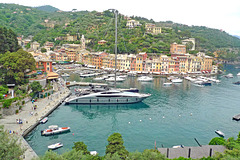
The coastal town of Portofino is located in the heart of the Italian Riviera with a tranquil crescent harbour with a hill of olive groves and small vineyards in its background. The harbour cradled by a piazza which in turn is rimmed by pastel coloured houses. Portofino is one of the most iconic Mediterranean places. As one of the most renowned tourist resorts in the world the town attracts thousands of travelers, including artists, politicians and celebrities of international level.
Portofino’s birth is dating back to the Roman era, when it was known by the name Portus Delphini (Dolphin’s Harbour). The Benedictines established a monastery in the 1400s, only to abandon it in the 1500s after repeated raids by pirates. The building remained an empty ruin until the 1800s, when a titled European family restored it as a summer villa. In the 1850s, British aristocrats began making Portofino popular, believing that relics of St. George, England’s patron saint, rested in the parish church.
Only 500 people live in Portofino: fishing families, shop owners, people with hotels or restaurants and a few who work in Genoa.
During our visit, we climbed to the viewpoint next to the Church of St. George. Unfortunately, the view of the picturesque harbour was spoilt by some ugly large yachts.
Italy - Portofino, Chiesa del Divo Martino
| |
|
|
|
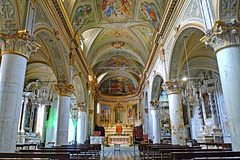
Chiesa del Divo Martino (St. Martin Church) - the parish church of Portofino - is dedicated to Saint Martin of Tours. This striped church most likely dates back to the period between the 10th and 12th centuries. It is thought that it was built in Romanic-Lombard style, as a replacement for a primitive chapel located on the pier of Portofino.
The consecration of the Chiesa del Divo Martino took place in 1548, on the occasion of the chest found under the main altar with relics of the Holy martyrs Dorothea, Cassiano and Vincenzo.
Subsequently, it will be restored time and time again, and the current building is the result of the 19th century changes. The main facade is decorated with simple decorative elements and the window is a medallion that is located above the main entrance. On the right side of the building there is a square bell tower.
The bright interior is decorated with beautiful frescoes, huge chandeliers and massive columns connected by arched openings.
This church came on my bucket list after I saw a photo by Stephan Fey on Ipernity.
Italy - South Tyrol, Reschensee and Piz Lad
| |
|
|
|
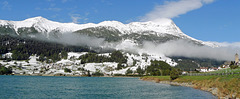
Reschensee (Lake Reschen) is an artificial lake in South Tyrol. It is located in the triangle between Italy, Austria and Switzerland, a couple of km’s from the Reschen Pass on the border of Austria.
Reschensee is an artificial lake, which unifies two natural lakes (Reschensee and Mittersee). Construction of the dam started in 1940 and took ten years. The lake submerged a couple of villages. The landmark of the reschensee is the steeple of the former 14th century village church of Graun (see PiP).
On the right hand side of the mountain range you see the Piz Lad, a 2808 meter high peak nearby the so called “Dreiländerecke” (Corner of three countries).
Italy - Rochetta Nervina
| |
|
|
|
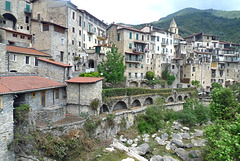
Archaeological findings testify that the area where Rocchetta stands today has been continuously inhabited since Roman times. During medieval times it was a place through which pilgrims passed on their way from Lower Piedmont through the Nervia Valley: many of the religious buildings in the area served as hospices.
Politically it belonged to an important strategic area called the “County of Nice”. The history Rochetta Nervina is one of a borderland, constantly harassed by fighting and raids between its inhabitants and its neighbours, particularly the Dorias of Dolceacqua .
Today Rocchetta Nervina - with less than 300 inhabitants - still has its medieval appearance, located on the banks of the river Barbaira. The little village is well known for its pools of water (laghetti di Rochetta) in that river (PiP3).
Jump to top
RSS feed- Latest items - Subscribe to the latest items added to this album
- ipernity © 2007-2026
- Help & Contact
|
Club news
|
About ipernity
|
History |
ipernity Club & Prices |
Guide of good conduct
Donate | Group guidelines | Privacy policy | Terms of use | Statutes | In memoria -
Facebook
X
