
Jaap van 't Veen's photos

België - Antwerpen, Rubenshuis
| |
|
|
|
Peter Paul Rubens is one of Antwerp's most famous residents. He lived and worked here for much of his life. When he returned to Antwerp from Italy in 1608, he had a house on Vaartstraat (now Wapper) renovated two years later. He designed the Rubenshuis (Rubens House) and studio himself, modelled on the Renaissance palaces in Italy.
In 1937, the city of Antwerp purchased the property. Shortly after the Second World War, it was officially opened as a museum. The Baroque garden has been reconstructed as much as possible to its original state and contains more than 17,000 plants.

België - Antwerpen, Vlaeykensgang
| |
|
|
|
The Vlaeykensgang is a picturesque courtyard dating back to 1591. In the past, the poorest inhabitants of the city lived here, together with the shoemakers. They were responsible for ringing the alarm bell of the nearby cathedral. In the 1960s, there were plans to demolish this medieval street, until antique dealer Axel Vervoordt bought the Vlaeykensgang and had it restored.
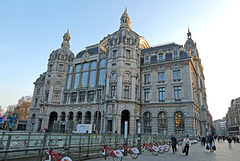
België - Antwerpen Centraal
| |
|
|
|
Antwerpen-Centraal (Antwerp Central) is the name of the main railway station in Antwerp. The original building was constructed between 1895 and 1905; it replaced the wooden train station from the mid 19th century.
The stone clad terminus buildings were designed by architect L. Delacenserie. It has a huge dome above the waiting room and eight smaller towers of which six were demolished during the 1950s. Fortunately they were reconstructed in 2009 together with several ornaments, including large lion statues. The rich interior is lavishly decorated with more than twenty different kinds of marble and stone.
Antwerpen-Centraal has been voted one of the most beautiful railway stations in the world on several occasions, including by Newsweek, Mashable and The Telegraph.
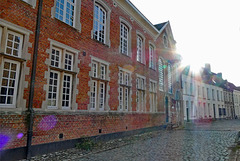
België - Lier, Begijnhof
| |
|
|
|
The Begijnhof (Beguinage) was founded in 1258 and formed a separate parish. The beguinage is spread over 11 narrow streets and counts 95 houses. The front doors of the houses bear the name of a saint or a biblical scene. Some façades have panels depicting the Stations of the Cross. The current buildings date mainly from the 17th century.
The beguinage is like a village in the middle of the city, surrounded by brick walls and accessible through four gates. At the centre of the beguinage stands the baroque Sint-Margaretakerk (St Margaret's Church). Construction started in the 17th century, and it was not until a century later that the upper part of the façade and the bell tower were completed.
The Beguinage was restored in the 1990s and was recognised as a UNESCO World Heritage Site in 1998.
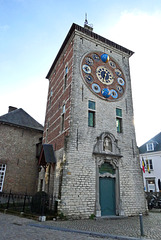
België - Lier, Zimmertoren
| |
|
|
|
The former Cornelius tower - dating back to the 14th century - was part of the old city fortifications. It was transformed into the Zimmertoren (Zimmer Tower) in 1930. Clockmaker and astronomer Louis Zimmer donated the Jubilee Clock to the town of Lier in honour of Belgium's 100th anniversary.
The Jubilee Clock on the front of the tower captivates everyone who pays a visit. The clock shows time indications on all continents, phases of the moon, times of tides and many other periodic phenomena.
Nowadays the Zimmertoren is without a doubt the most famous landmark in Lier.

België - Lier
| |
|
|
|
Lier is a town with 38,000 inhabitants located at the confluence of the Grote Nete and Kleine Nete rivers. The Binnennete, a closed section of the Kleine Nete, runs through the town centre. No wonder Lier is known as the “Netestad”.
Lier has a rich history and was already inhabited in Roman times. In the Middle Ages, it was an important trading town and a member of the Hanseatic League. Today, Lier is best known for its picturesque town centre with its charming squares, narrow streets and historic buildings.
The inhabitants of Lier are also known as “schapenkoppen” (sheep heads). This nickname comes from a legend in which Duke John II wanted to thank the inhabitants for their contribution to the battle against Mechelen in the 14th century. As a reward, the city council could choose between a university or a cattle market. The council chose the cattle market (the university came a little later in Leuven). The duke is said to have remarked, “Oh, those “schapenkoppen” , in response to this choice.

Season's Greetings
| |
|
|
|
Prettige Kerstdagen en een goed en gezond 2026.
Merry Christmas and a Happy Healthy 2026.
Frohe Weihnachten und ein Gutes, Gesundes 2026.
Joyeux Noël et bonne et heureuse année 2026.
Feliz Navidad y un próspero y saludable 2026.
Buon Natale e un felice e sano 2026.
Feliz Natal e um próspero e saudável 2026.

Nederland - Bunnik, Kromme Rijn
| |
|
|
|
The river Kromme Rijn (Crooked Rhine) flows from Wijk bij Duurstede to Utrecht and is 28 kilometres long. The river with its amny bends is the artery of Utrecht and supplies water to the Oudegracht and the canals. Normally, seven cubic metres of water per second pass through Amelisweerd estate (Bunnik). When it rains heavily, this can increase to as much as twelve cubic metres. Rainwater then flows from the Utrechtse Heuvelrug (Utrecht Hill Ridge) to the Kromme Rijn via various ditches.
Until 1930, the Kromme Rijn was the main transport artery for goods and people between Wijk bij Duurstede and Utrecht. Where the provincial road now runs, there was previously only a muddy cart track. The boats were pulled by people. Until 1870, the journey between Wijk bij Duurstede and Utrecht took about six hours.

Nederland - Spakenburg, Oude Haven
| |
|
|
|
The Oude Haven (Old Harbour) is Spakenburg’s soul. The harbour dates back to the 15th century. Ot was built for the botters , wooden boats used by fishermen when fishing was a way to earn a living.
After the construction of the Afsluitdijk , the saltwater Zuiderzee was dammed off and became a freshwater lake. This put an end to the fishing industry. The harbour no longer served the same function and became a marina.
Around 1975 more and more people started buying up the old botters and refurbishing them for recreational purposes. Nowadays about twenty of these old vessels can be admired in the Oude Haven .

Nederland - Baarn, Kasteel Groeneveld
| |
|
|
|
Kasteel Groeneveld (Groeneveld Castle) in Baarn is an 18th-century country estate and one of the finest examples of a country house from that era. Since the 17th century, regents and merchants from Dutch cities came to their country houses to enjoy the good life.
The ‘castle’ was built in 1703 by Marcus Mamuchet and is considered being one of the finest examples of a country house from the Rococo style period. It was built in the tradition of 17th- and 18th-century estates that were intended as summer houses for wealthy city dwellers, mainly from Amsterdam. Groeneveld was probably built on the foundations of a farmstead. Initially, the house consisted only of the central part of the main building and the two outbuildings: coach house and orangery. The side wings date from around 1760.
Kasteel Groeneveld was privately owned until 1940. Nowadays it is owned and managed by Staatsbosbeheer (a Dutch governmental organization for forestry and the management of nature reserves

Nederland - Botanische Tuinen Universiteit Utrecht
| |
|
|
|
The Botanische Tuinen Universiteit Utrecht (Utrecht University Botanic Gardens) is the largest academic botanical garden - with a size of about 100.000m² - in the Netherlands. The garden is located on Utrecht Science Park and surrounded by (modern) buildings of the university.
The botanic garden has a spectacular setting including a large rock garden built on the bunkers of an old fort. It has a collection of around 10.000 plant species.
The Botanic Gardens originate back to 1639, when the first botanical garden for medicinal purposes was founded in the city centre of Utrecht. In 1963 it came to the current location at Fort Hoofddijk , once part of the New Dutch Waterline. Between 1964 and 1974, over 2.100 tons of Ardennes rock created one of Europe’s largest rock gardens on and around the fort.

Nederland - Utrecht, Fort Hoofddijk
| |
|
|
|
Fort Hoofddijk (also called Werk aan de Hoofddijk ) is part of the New Dutch Waterline. This line runs from Muiden to the Biesbosch and was intended to protect the cities of Amsterdam, The Hague, Rotterdam and Utrecht against enemies from the east by flooding large areas of land.
When Fort Hoofddijk was completed in 1879, it had 12 cannons and was garrisoned by approximately 100 soldiers. The fort was never used in a war, partly due to the development of aircraft that could fly over the line. Five buildings were originally constructed within the fort moat, four of which still remain today: three depots and a large bombproof barracks.
Today, Fort Hoofddijk is located in the middle of the Botanical Gardens and the buildings are used by Utrecht University.

Nederland - Bunnik, Huis Rhijnauwen
| |
|
|
|
Around the year 1200, Rhijnauwen Castle (a real fortress with a moat and a drawbridge) stood on the site of Huis Rhijnauwen (Manor Rhijnauwen). The castle was destroyed by the French in 1672. The current building was built around 1830. In 1919, the estate was purchased by the municipality of Utrecht from its last private owner.
Huis Rhijnauwen - located on the right bank of the river Kromme Rijn - has been used as a youth hostel since 1933, making it the oldest in the Netherlands.
Nederland - Renswoude, Koepelkerk
| |
|
|
|
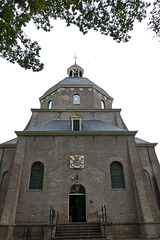
April 1638, Johan van Reede, Lord of Renswoude, submitted a request to the States of Utrecht to have his own church and minister. Permission was quickly granted and on 11 November 1638, the first minister was confirmed. In August 1639, the first stone of the Koepelkerk (Domed Church) was laid. Construction lasted until 1641. There's no real evidence for it, but the design is usually attributed to well known Dutch architect Jacob van Campen.
The square facade stone shows the coats of arms of Van Reede-Van Eede and is adorned with the Danish Order of the Elephant. The coats of arms painted on the ceiling of the dome are those of the donors who financially supported the construction of the church. Below them are twelve royal coats of arms.
Until 1922 the church was the property of the lords of Renswoude, after which it was handed to the reformed community of Renswoude. The Koeplkerk is a Dutch national monument.

Nederland - Bunnik, Landhuis Oud Amelisweerd
| |
|
|
|
Landhuis Oud Amelisweerd (Manor Oud Amelisweerd) was built in 1770 as a summer residence commissioned by Gerard Godard Taets van Amerongen. He had a bridge built over the river Kromme Rijn and transformed the estate into the park we see today.
Because the country house has never been intensively inhabited, many original elements have been preserved.The layout, floors, doors and ceilings have remained unchanged since 1770. This originality, together with the 18th and 19th century Chinese and Dutch wallpaper that is still present, makes Oud Amelisweerd unique.
In later history, the country house had various owners, including King Louis Napoleon Bonaparte, the Bosch van Drakestein family and, from 1951, the municipality of Utrecht. Today - being a National Monument - it houses a museum with exhibitions on art, science and history.
Nederland - Slot Zeist
| |
|
|
|
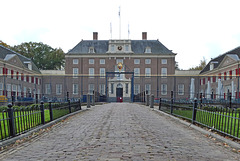
Slot Zeist (Castle Zeist) was built between 1677 and 1686 on behalf of Willem Adriaan van Nassau, grandson of Willem van Oranje. The building was designed by architect Jacobus Roman, who also designed Paleis Het Loo in Apeldoorn. The interior was mainly designed by the Huguenot Daniël Marot. His largely preserved wall and ceiling paintings are reminiscent of French Baroque.
In 1745, Slot Zeist was purchased by the merchant Cornelis Schellinger. In 1746, he donated part of it to the Moravian Brethren community, which would serve as their headquarters in the Netherlands.
In 1924, the castle was purchased by the municipality of Zeist. The castle was renovated in 1969 and restored to its original Baroque style, using authentic demolition material from other Baroque buildings.
Nederland - Kasteel Renswoude
| |
|
|
|
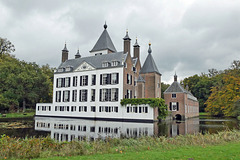
Kasteel Renswoude (Renswoude Castle), formerly called Borchwal , is a castle and knight's manor and estate nearby the village of Renswoude. The first house probably dates from the late 14th century. Perhaps the name refers to a borgwal (circular rampart) that surrounded the castle.
During the Dutch 'Golden Age' - in 1654 – the original house was demolished by order of Johan van Reede and replaced by the current country house in Dutch-classicist style. It was probably built on the medieval foundations. The castle has a special design, which gives it a double appearance. The white plastered back gives the building a real country-house appearance, while the front with its towers is more reminiscent of a castle. The facade of the main building is dominated by the large tower in the middle with a corner tower protruding on either side.
Nederland - Doorn, Nationaal Bomenmuseum Gimborn
| |
|
|
|
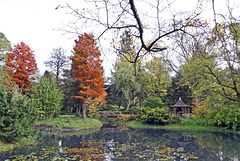
Nationaal Bomenmuseum Gimborn (National Tree Museum Gimborn) is the largest arboretum in the Netherlands. The park-like landscape is criss-crossed with winding paths, a large heath garden, unique vistas and an enormous tree house. The ponds are fed by clear seepage water from the Utrechtse Heuvelrug (Utrecht Hill Ridge).
Covering 29 hectares, it houses a world-famous collection of 3.000 species of trees and shrubs from all over the world. German ink manufacturer Max von Gimborn started it as a private collection of conifers and ericaceous plants in 1924.
