


Birds of Alberta 10


04 Jun 2015
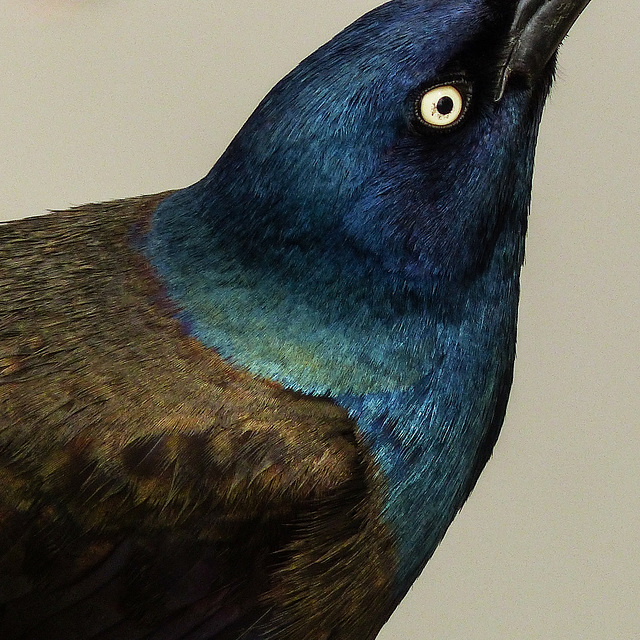
When black isn't really black
This photo was an accident, but I thought it was still too pretty to delete : ) I was taking photos of this gorgeous Common Grackle, when it disappeared from sight and then suddenly popped up much closer than I was expecting. I cropped the sides of the photo to make it square, but other than that, this is how the photo was taken : ) Though these birds seem to be unpopular, I love to see them and try and capture their iridescent beauty. They appear to be a black bird, but when the sun catches them, they come alive with colour.
"Common Grackles are blackbirds that look like they've been slightly stretched. They're taller and longer tailed than a typical blackbird, with a longer, more tapered bill and glossy-iridescent bodies. Grackles walk around lawns and fields on their long legs or gather in noisy groups high in trees, typically evergreens. They eat many crops (notably corn) and nearly anything else as well, including garbage. In flight their long tails trail behind them, sometimes folded down the middle into a shallow V shape." From AllABoutBirds.
www.allaboutbirds.org/guide/Common_Grackle/id
animals.nationalgeographic.com/animals/birding/common-gra...
Two days ago, on 4 June 2015, it was a dry day, though a thunderstorm was forecast. After grey skies and rain the previous couple of days, I felt like going for a drive. Started at a wetland in SW Calgary, where I saw the usual Lesser Scaup and Redheads. The male Redhead did not like any of the other ducks around him and would chase away each one in turn. Quite the bully! Also managed to get a few more shots of a Common Grackle, including this one, though they move fast and seemingly constantly.
From there, I drove some of my usual backroads SW of the city. The clouds were building up quite dramatically, and I stopped at one wetland where they were reflected quite beautifully. I didn't see all that many birds, but was content to get a few chances to photograph a pair of Mountain Bluebirds, Tree Swallows, an Eastern Kingbird, and a Savannah Sparrow. No Wilson's Snipe this time, though I thought I had one on a distant fence post. Turned out to be a Mourning Dove - only the second time I've ever seen one on a fence post. Also saw a Swainson's Hawk which flew and landed on a high power pole near where the Bluebirds and Tree Swallows were nesting. The Tree Swallows, in true fashion, were causing the Bluebirds enough stress by flying and landing just a foot or two away from the Bluebirds' nesting box. The male Bluebird did such a great job of chasing away its rather beautiful, iridescent neighbours - which I also enjoy photographing. So, a short trip, but one that I always enjoy, especially each spring.
06 Jun 2015
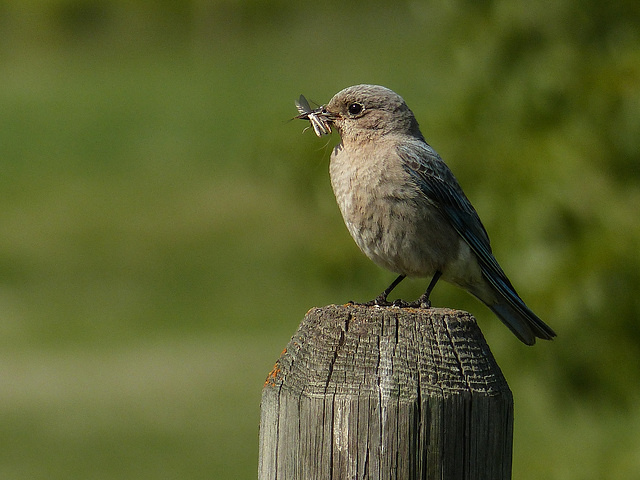
Collecting supper for her babies
Yesterday afternoon, 6 June 2015, my place was beginning to get uncomfortably warm inside. That meant I needed air-conditioning and the only place to find it was in my car. So, off I went along the backroads SW of the city. I wasn't expecting to see anything different, but there were certain birds that I was certain I would see - birds that I really enjoy photographing. I really do need to drive somewhere different, but this drive is just a fairly short drive and fits nicely into an afternoon or early evening.
The "usual" included Mountain Bluebirds, and this female obliged, bringing a mouthful of insects for her babies. Dad seems to bring the larger, heavier insects, especially Grasshoppers, while Mom tends to choose lighter, more delicate ones. Funny how the nearby Tree Swallows will sometimes "tease" their Bluebird neighbours by flying and landing very near the Bluebird nesting box. Out of nowhere, the brilliant flash of blue of the male flies at top speed to chase the Tree Swallows away. Yesterday, I noticed the female Bluebird landed just a couple of feet from the Tree Swallow nesting box and just sat there with a Swallow on either side of her. No idea why she did this, as it annoyed the Swallows, and of course she was chased away.
Other sightings on my drive included the usual Tree Swallows, Red-winged Blackbirds, Black Terns, a pair of Cinnamon Teal glowing in the bright sunlight, a distant Coot feeding her little ones, a Pied-billed Grebe who was annoying an adult Coot who kept racing across the top of the water to chase the Grebe further away. My final sighting was a Coyote in a field of Dandelions. By the time I had pulled over and raised my camera, it was already heading off in the opposite direction, stopping once to look back as Coyotes tend to do.
I almost forgot to mention the highlight of my drive! Not far from home, I noticed a Canada Goose in the distance, standing in the grass right at the edge of the road. I thought it might just step out in front of me, so I stopped in my lane on this fairly busy road and turned on my hazard flashers. Sure enough, it did exactly what I was suspecting - and it was followed by its family of half a dozen or so goslings walking in a very disciplined single file, with Mom/Dad bringing up the rear. Fortunately, the cars coming behind me in the other lane also slowed down and stopped till everyone was safely to the other side. May sound silly, but I find it such an amazing, humbling experience when this happens : )
In Bluebirds, the blue colour is produced by the structure of the feather - there is no blue pigment. "Tiny air pockets in the barbs of feathers can scatter incoming light, resulting in a specific, non-iridescent color. Blue colors in feathers are almost always produced in this manner. Examples include the blue feathers of Bluebirds, Indigo Buntings, Blue Jay's and Steller's Jays."
www.allaboutbirds.org/guide/Mountain_Bluebird/id
www.jstor.org/discover/pgs/index?id=10.2307/4077277&i...
07 Jun 2015
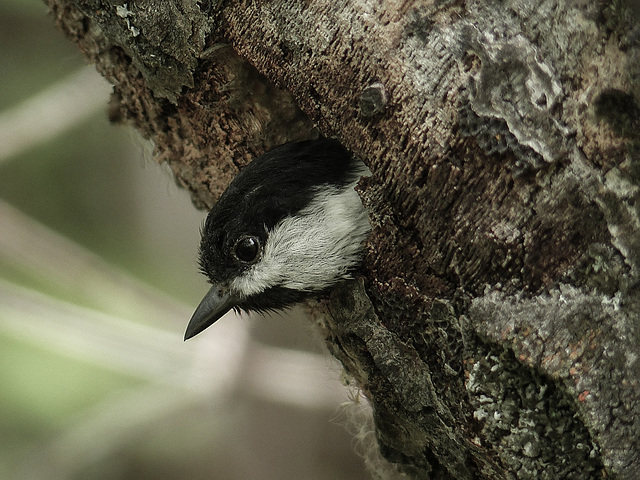
Well, hello, little Chickadee
Yesterday, 7 June 2015, was a hot day – way too hot for my liking. Today, the forecast is for 30C this afternoon. I wasn’t keen on the idea of being out in the sun for three hours, but neither could I have stayed in my place one more minute - it feels like an oven!
Decided to join birding friends for a walk at the west end of South Glenmore Park and we had a lovely, leisurely walk, stopping often to look at, or listen to, a variety of birds. I think my favourites were a pair of colourful American Goldfinch. It was also fun to see this little Black-capped Chickadee looking out from its nest cavity. Will add Janet and Bernie’s bird list below, for my own memory.
There were quite a few species of wildflower as well. I so rarely go on a walk, so I tend to miss many of the wildflowers.
Thanks for such an enjoyable afternoon, both of you! A stop afterwards at the Good Earth café was so much appreciated, too.
1. Great Blue Heron - 1
2. Canada Goose - 40
3. Mallard - 5
4. Gadwall - 2
5. Swainson's Hawk - 1
6. Franklin's Gull - 30+
7. Woodpecker sp. likely Sapsucker - 1
8. Olive-sided Flycatcher -1
9. Least Flycatcher - 12
10. Red-eyed Vireo - 2
11. Black-billed Magpie - 1
12. American Crow - 4
13. Common Raven - 1
14. Tree Swallow - 4
15. Black-capped Chickadee - 2 @nest site.
16. House Wren - 11
17. American Robin - 6
18. Cedar Waxwing - 6
19. Yellow Warbler - 10
20. Chipping Sparrow - 1
21. Clay-coloured Sparrow - 4
22. Baltimore Oriole - 1
23. Red-winged Blackbird - 3
24. Brown-headed Cowbird - 3
25. House Finch - 3
26. American Goldfinch - 5
27. House Sparrow - 2
Least Chipmunk - 1
Muskrat - 1
Yellow Swallowtail Butterfly - 10+
Blue Azure - 1
Alpine sp. Butterfly - 15+
Janet & Bernie
07 Jun 2015
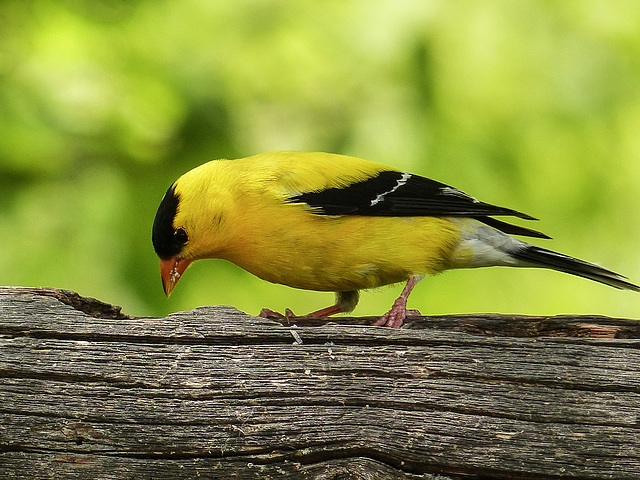
A lovely splash of colour
Something tells me that Flickr may just have uploaded my three photos today in the wrong order - again! This Goldfinch shot is supposed to be my main photo, i.e. the very last photo that I posted today. It shows in the correct order when I look at my photostream.
Yesterday, 7 June 2015, was a hot day – way too hot for my liking. I was not keen on the idea of being out in the sun for three hours, but neither could I have stayed in my place one more minute - it feels like an oven! Today, the forecast is for 30C this afternoon (later: it's up to 32C!).
Decided to join birding friends for a walk at the west end of South Glenmore Park and we had a lovely, leisurely walk, stopping often to look at, or listen to, a variety of birds. I think my favourites were a pair of colourful American Goldfinch (male seen in this photo). It was also fun to see a little Black-capped Chickadee looking out from its nest cavity. There were quite a few species of wildflower as well. Will add Janet and Bernie’s bird list below, for my own memory. Thanks for such an enjoyable afternoon, both of you! A stop afterwards at the Good Earth café was so much appreciated, too.
1. Great Blue Heron - 1
2. Canada Goose - 40
3. Mallard - 5
4. Gadwall - 2
5. Swainson's Hawk - 1
6. Franklin's Gull - 30+
7. Woodpecker sp. likely Sapsucker - 1
8. Olive-sided Flycatcher -1
9. Least Flycatcher - 12
10. Red-eyed Vireo - 2
11. Black-billed Magpie - 1
12. American Crow - 4
13. Common Raven - 1
14. Tree Swallow - 4
15. Black-capped Chickadee - 2 @nest site.
16. House Wren - 11
17. American Robin - 6
18. Cedar Waxwing - 6
19. Yellow Warbler - 10
20. Chipping Sparrow - 1
21. Clay-coloured Sparrow - 4
22. Baltimore Oriole - 1
23. Red-winged Blackbird - 3
24. Brown-headed Cowbird - 3
25. House Finch - 3
26. American Goldfinch - 5
27. House Sparrow - 2
Least Chipmunk - 1
Muskrat - 1
Yellow Swallowtail Butterfly - 10+
Blue Azure - 1
Alpine sp. Butterfly - 15+
07 Jun 2015
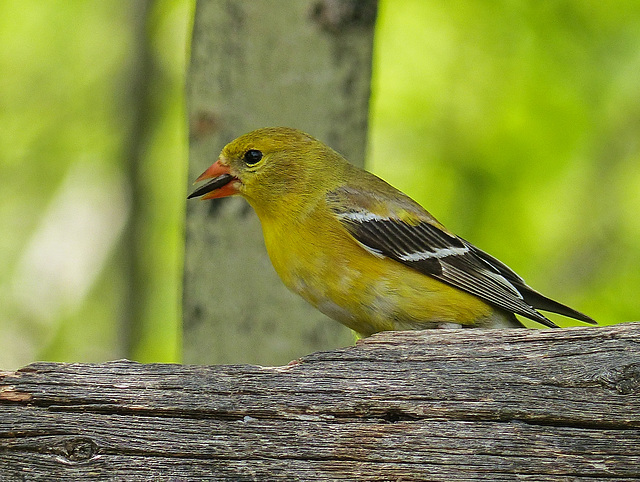
American Goldfinch female with Sunflower seed
A couple of days ago, 7 June 2015, it was a hot day – way too hot for my liking. I was not keen on the idea of being out in the sun for three hours, but neither could I have stayed in my place one more minute - it feels like an oven! Yesterday, it got up to 32C in the afternoon.
Decided to join birding friends for a walk at the west end of South Glenmore Park and we had a lovely, leisurely walk, stopping often to look at, or listen to, a variety of birds. I think my favourites were a pair of colourful American Goldfinch (female seen in this photo). It was also fun to see a little Black-capped Chickadee looking out from its nest cavity.
There were quite a few species of wildflower as well. I so rarely go on a walk, so I tend to miss many of the wildflowers.
Will add Janet and Bernie’s bird list below, for my own memory. Thanks for such an enjoyable afternoon, both of you! A stop afterwards at the Good Earth café was so much appreciated, too.
1. Great Blue Heron - 1
2. Canada Goose - 40
3. Mallard - 5
4. Gadwall - 2
5. Swainson's Hawk - 1
6. Franklin's Gull - 30+
7. Woodpecker sp. likely Sapsucker - 1
8. Olive-sided Flycatcher -1
9. Least Flycatcher - 12
10. Red-eyed Vireo - 2
11. Black-billed Magpie - 1
12. American Crow - 4
13. Common Raven - 1
14. Tree Swallow - 4
15. Black-capped Chickadee - 2 @nest site.
16. House Wren - 11
17. American Robin - 6
18. Cedar Waxwing - 6
19. Yellow Warbler - 10
20. Chipping Sparrow - 1
21. Clay-coloured Sparrow - 4
22. Baltimore Oriole - 1
23. Red-winged Blackbird - 3
24. Brown-headed Cowbird - 3
25. House Finch - 3
26. American Goldfinch - 5
27. House Sparrow - 2
Least Chipmunk - 1
Muskrat - 1
Yellow Swallowtail Butterfly - 10+
Blue Azure - 1
Alpine sp. Butterfly - 15+
"This handsome little finch, the state bird of New Jersey, Iowa, and Washington, is welcome and common at feeders, where it takes primarily sunflower and nyjer. Goldfinches often flock with Pine Siskins and Common Redpolls. Spring males are brilliant yellow and shiny black with a bit of white. Females and all winter birds are more dull but identifiable by their conical bill; pointed, notched tail; wingbars; and lack of streaking. During molts they look bizarrely patchy." From AllAboutBirds.
www.allaboutbirds.org/guide/American_Goldfinch/id
26 Apr 2015
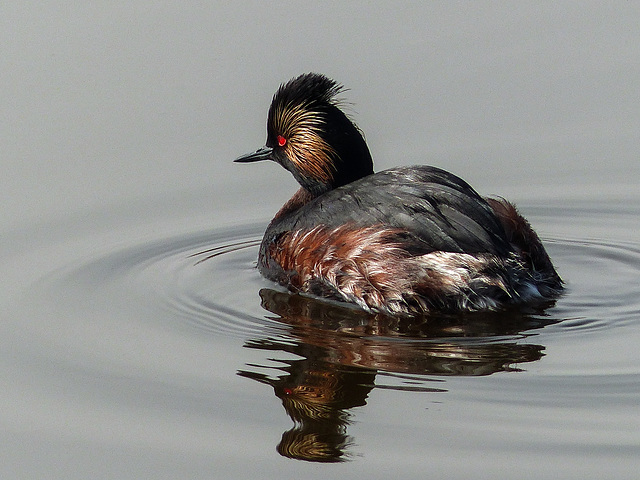
Eared Grebe / Podiceps nigricollis
Cornell Lab of Ornithology has released a new Bird Photo ID program, called Merlin Bird Photo ID. I tried it with a photo of a Mountain Bluebird and a female Red-winged Blackbird and was impressed that it identified both birds accurately. So far, it works for 400 North American birds. Apparently, it does not work on tablets or mobile devices at this time. For best results, use a computer with a recent version of Chrome or Safari. Give it a try!
merlin.allaboutbirds.org/photo-id/?utm_source=Cornell+Lab...
On 26 April 2015, I spent the day with a fair-sized group of friends, at Frank Lake. The weather was beautiful and, for once, not windy. Frank Lake and the surrounding area is one of my favourite places to spend a day or half a day.
On a trip like this one, there are a lot of the birds that I don't see, as I don't use binoculars. Also, my interest is not to see as many species as possible, but to hopefully come across a few birds close enough to photograph. Fortunately, at the bird blind/hide, a pair of Eared Grebes was within camera range. Every once in a while, they stayed still for a few seconds before continuing their constant swimming and diving. The light was such that, much of the time, you couldn't tell that they had red eyes - and really it's the eyes (and the golden "ear" feathers) that add so much beauty to these birds. The eyes always make me think of red buttons : ) This Grebe is the most abundant Grebe in the world, and it occurs on every continent except Australia and Antarctica.
www.allaboutbirds.org/guide/Eared_Grebe/id
en.wikipedia.org/wiki/Black-necked_grebe
I will add the final list of the 51 species seen, complied by our Leader, Tony Timmons. Probably not of much interest to most people, but it does help my memory. Many thanks, as always, Tony, for a very successful and most enjoyable day! Really appreciate your giving up a precious weekend day to take us out there.
"The birds put on a spectacular show for the 19 participants on the Frank Lake trip today. We tallied 51 species. (Anne's note: on this trip one year ago, we found 53 species.)
Expected species were present in pretty good numbers; most noteworthy being American Avocet (200+) and White-faced Ibis (120). Thousands of ducks were on the Lake.
Thanks to Dan Parliament and Al Borgardt for scoping birds and sharing sightings with the group.
Before the start of the trip, Rose Painter spotted two Long-billed Curlew near Blackie. Later in the day, we searched for the birds without success.
Eared Grebe 250
Western Grebe 20
Double-crested Cormorant 25
Black-crowned Night Heron 1
White-faced Ibis 120
Canada Goose
Swan sp. 12
Gadwall
American Wigeon
Mallard
Blue-winged Teal
Cinnamon Teal
Green-winged Teal
Northern Shoveler
Northern Pintail
Canvasback
Redhead
Ring-necked Duck
Lesser Scaup
Bufflehead
Common Goldeneye
Hooded Merganser 2 f.
Ruddy Duck
Northern Harrier 3
Swainson's Hawk 3
Gray Partridge 4
American Coot
Killdeer 5
Black-necked Stilt 10
American Avocet 200+
Greater Yellowlegs 5
Lesser Yellowlegs 17
Franklin's Gull 1000
Bonaparte's Gull 10
Ring-billed Gull 5
California Gull 20
Rock Pigeon
Great Horned Owl ( 3 ad. + 3 owlets )
Black-billed Magpie
American Crow
Common Raven
Tree Swallow 60
Bank Swallow 1
Marsh Wren 4
American Robin
European Starling
Red-winged Blackbird
Western Meadowlark 5
Yellow-headed Blackbird
Brewer's Blackbird 1
House Sparrow
Tony Timmons"

10 Jun 2015
Neighbours of the feathered kind
Yesterday evening, 10 June 2015, was only what I would call a "magical" evening! Normally, I never go out in the evening - usually just too tired and there are all sorts of things needing to be done on my computer. However, having driven SW of the city the previous day and noticing a baby Mountain Bluebird poking its head out of its nesting box, I knew that any time now that it and its siblings would be suddenly gone. It wouldn't surprise me if they fledge today, which means that another drive will have to be done to check. I have been out far more than usual the past 10 days or so and actually look forward to a day when I don't end up doing the drive.
It was early evening when I left home yesterday, after a volunteer shift and a haircut. Really, I was just going to check on the Bluebirds and was not expecting to see all that much else.That's how the evening started, but as the evening progressed, the world seemed to come alive with bird song and activity. It has been a long, long time since I've experienced that.
Though my trip was mainly just to check on the Bluebirds, I was also lucky to see an American Robin sitting on a barbed-wire fence just a couple of feet away from a brilliant blue male Bluebird. Talk about colour! They were way down the road, so I was only able to get a very distant shot. Also saw a number of Snipe that I love photographing.
When I reached the point where I was going to turn around and head for home, I saw yet another Snipe perched on a fence. Just a few feet from it, on the same fence, was a beautiful Swainson's Hawk! After posing for a while, both birds took off, with the Hawk in hot pursuit of the Snipe. I couldn't see how the chase ended, but hopefully the world is not missing a Snipe today.
Closer to home, I suddenly spotted a beautiful female Moose at a small wetland, right before I turned on to the main highway. Not sure if it's because I took my first photos of her from inside the car, across the passenger seat, but most were blurry. Eventually, she left and started walking along the road away from the highway. I crawled along, watching her way in the distance. She kept walking from side to side of the road and then stopped to lick some salt off the road, bending her front knees in what looked a very awkward move : )
Driving back to the highway, I stopped to watch three or four young White-tailed Deer having fun at the wetland. One would occasionally stamp one of its front legs in the water and then bound away a few feet. Funny to watch and so good to see it playing so happily.
So, it was quite the evening, to say the least! I drove all the way home with a big smile on my face. And now I have to dash and get ready to meet a few birding friends for a morning walk.
09 Jun 2015
Almost time to fledge
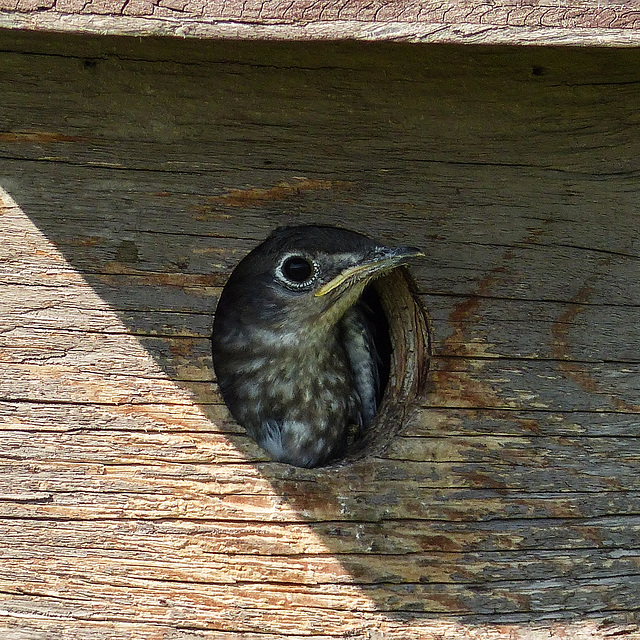
Two days ago, on 9 June 2015, I went for a drive SW of the city, along my "usual" backroads. I had been watching a pair of Mountain Bluebirds and, while waiting for them to make an appearance again, I suddenly noticed two little beaks push through the hole in the nesting box. A few seconds later, this baby Bluebird poked its head through the hole and took a look at the big, big world beyond its cozy little nest. Such a cute little thing!
I have only ever once seen baby Bluebirds that have fledged and that was a number of years ago, when I happened to spot them down on the ground, in the grasses. Usually, they are there one day and then gone the next and I don't see them again till the next year. Yesterday, I did the drive again and was happy to see that the little family had not yet left. Maybe today will be the day, which means that I know I will do the drive again : ) As usual, I noticed flashes of blue near quite a few nest boxes.
In Bluebirds, the blue colour is produced by the structure of the feather - there is no blue pigment. "Tiny air pockets in the barbs of feathers can scatter incoming light, resulting in a specific, non-iridescent color. Blue colors in feathers are almost always produced in this manner. Examples include the blue feathers of Bluebirds, Indigo Buntings, Blue Jay's and Steller's Jays."
www.allaboutbirds.org/guide/Mountain_Bluebird/id
www.jstor.org/discover/pgs/index?id=10.2307/4077277&i...
11 Jun 2015
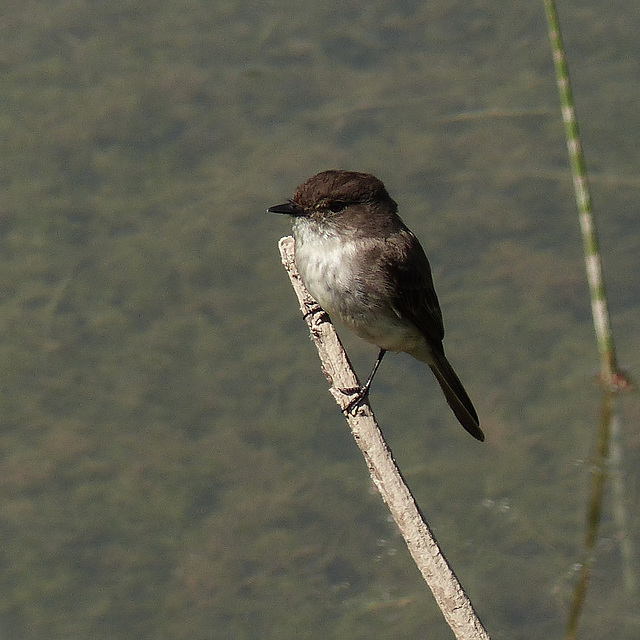
Eastern Phoebe / Sayornis phoebe
Last night, I got the dreaded Blue Screen on my computer, so in a panic, I knew I just had to start backing up almost the last year's worth of photos! Will have to spend time the next few days continuing with this chore.
Yesterday morning, 11 June 2015, I joined a group of friends for a walk in Weaselhead, hoping to see three species of Hummingbird - Calliope, Rufous and Ruby-throated. The Calliope (5 of them) gave us the closest (but still distant) views, while the other two were very distant. It never fails to amaze me that these three species are all found in Weaselhead.
As usual at this time of year, it was good to see the huge number of Cliff Swallows, swarming like a cloud of large insects around the metal bridge over the river. In flight, they catch insects and fly back to their mud nests, that are built under the bridge, to feed their babies. It amazes me how each bird knows which is its own nest - they all look alike.
Another bird (a pair) that was good to see was the little Eastern Phoebe, back at the same location where it has been at least the last few years. This photo is the closest one I've been able to get, taken when the bird flew to a piece of driftwood in the water.
"One of our most familiar eastern flycatchers, the Eastern Phoebe’s raspy “phoebe” call is a frequent sound around yards and farms in spring and summer. These brown-and-white songbirds sit upright and wag their tails from prominent, low perches. They typically place their mud-and-grass nests in protected nooks on bridges, barns, and houses, which adds to the species’ familiarity to humans. Hardy birds, Eastern Phoebes winter farther north than most other flycatchers and are one of the earliest returning migrants in spring." From AllAboutBirds.
www.allaboutbirds.org/guide/eastern_phoebe/id
en.wikipedia.org/wiki/Eastern_phoebe
The group divided into two for this walk and the following is the combined list of species seen. As usual, I didn't see all the listed birds, but was happy especially to see the three Hummingbird species.
Mallard-2
Great Blue Heron-1
Swainson’s Hawk-2, 1 captured juv. BBMagpie.
Merlin-1, captured a Cliff Swallow.
Spotted Sandpiper-1
Franklin’s Gull-50
Ruby-throated Hummingbird-2
Rufous Hummingbird-1
Calliope Hummingbird-5
Northern Flicker-4
Olive-sided Flycatcher-1.
Eastern Phoebe-2
Black-billed Magpie-6
American Crow-4
Common Raven-1+
Tree Swallow-12
Cliff Swallow-249
Black-capped Chickadee-3
White-breasted Nuthatch-2
House Wren-6
American Robin-5
Gray Catbird-6
Cedar Waxwing-12
Yellow Warbler-10
Spotted Towhee-1 heard.
Clay-colored Sparrow-12
White-throated Sparrow-6
Common Grackle-1
Brown-headed Cowbird-6
House Finch-2
American Goldfinch-2
Red Squirrel-3
Muskrat-1
Jump to top
RSS feed- Latest items - Subscribe to the latest items added to this album
- ipernity © 2007-2026
- Help & Contact
|
Club news
|
About ipernity
|
History |
ipernity Club & Prices |
Guide of good conduct
Donate | Group guidelines | Privacy policy | Terms of use | Statutes | In memoria -
Facebook
X
