


Wild animals of Alberta 3


10 Jun 2015
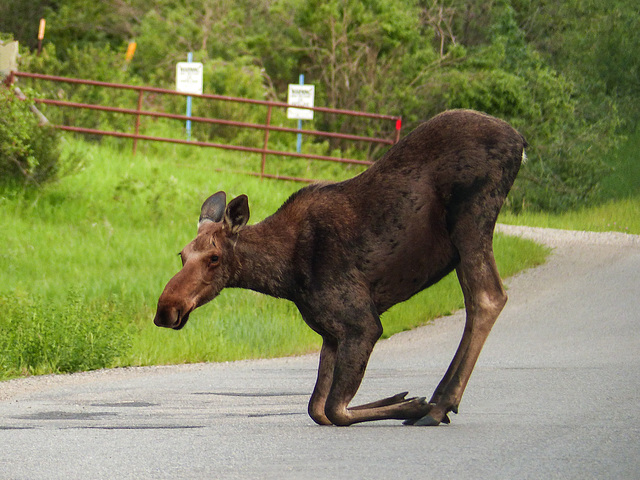
Moose kneeling to lick salt from the road
Wednesday, 10 June 2015, was only what I would call a "magical" evening! Normally, I never go out in the evening - usually just too tired and there are all sorts of things needing to be done on my computer. However, having driven SW of the city the previous day and noticing a baby Mountain Bluebird poking its head out of its nesting box, I knew that any time now that it and its siblings would be suddenly gone. Since then, I have been back one time and a Tree Swallow poked its head out of the Bluebird nesting box, letting me know that this Bluebird family had fledged and moved away.
It was early evening when I left home on 10 June, after a volunteer shift and a haircut. Really, I was just going to check on the Bluebirds and was not expecting to see all that much else.That's how the evening started, but as the evening progressed, the world seemed to come alive with bird song and activity. It has been a long, long time since I've experienced that, if ever.
Though my trip was mainly just to check on the Bluebirds, I was also lucky to see an American Robin sitting on a barbed-wire fence just a couple of feet away from a brilliant blue male Bluebird. Talk about colour! They were way down the road, so I was only able to get a very distant shot. Also saw a number of Snipe that I love photographing.
When I reached the point where I was going to turn around and head for home, I saw yet another Snipe perched on a fence. Just a few feet from it, on the same fence, was a beautiful Swainson's Hawk! After posing for a while, both birds took off, with the Hawk in hot pursuit of the Snipe. I couldn't see how the chase ended, but hopefully the world is not missing a Snipe.
Closer to home, I suddenly spotted a beautiful female Moose (seen in this photo) at a small wetland, right before I turned on to the main highway. Not sure if it's because I took my first photos (not this one) of her from inside the car, across the passenger seat, but most were blurry. Eventually, she left and started walking along the road away from the highway. I crawled along, watching her way in the distance. She kept walking from side to side of the road and then stopped to lick some salt off the road, bending her front legs to kneel in what looked a very awkward move : ) When she had walked further down the road, I stopped my car and turned on the hazard flashing lights, as she wasn't too obvious in the shadows from the trees at the edge of the road. I can see how easily a collision can happen! Fortunately, only one car came along, from behind my car, and the guy slowed down and was smiling. Took a while, but eventually the huge, majestic animal leapt over a barbed-wire fence and sauntered off into the trees.
Driving back to the highway, I stopped to watch three or four young White-tailed Deer having fun at the same wetland. One of them was standing in the water and would occasionally stamp one of its front legs to make a splash and then bound away a few feet. Funny to watch and so good to see it playing so happily.
So, it was quite the evening, to say the least! I drove all the way home with a big smile on my face.
10 Jun 2015
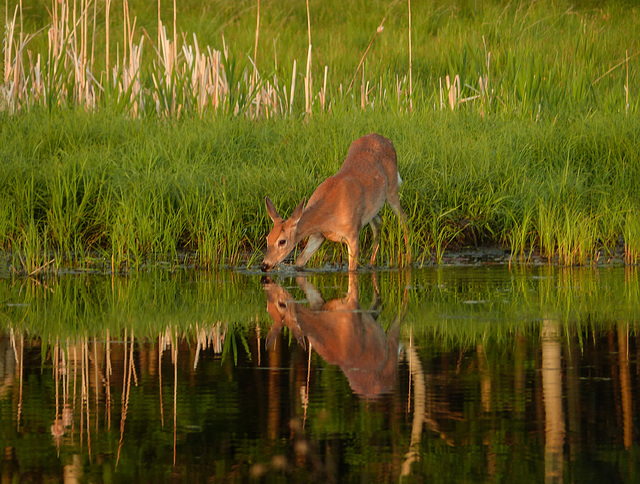
Peace and late evening sun
Don't ask me why I centred the deer in this photo! I do try not to do that, except when I crop a photo to square. Maybe I had planned to crop the photo, as it was taken from quite a distance, leaving the deer more to one side. Oh, well : )
The evening of 10 June 2015, was only what I would call a "magical"! Normally, I tend not to go out in the evening - usually just too tired and there are all sorts of things needing to be done on my computer. However, having driven SW of the city the previous day and noticing a baby Mountain Bluebird poking its head out of its nesting box, I knew that any time now, it and its siblings would be suddenly gone. I have been back more recently and found a Tree Swallow looking out from the Bluebirds' nesting box.
It was early evening when I left home on 10 June, after a volunteer shift and a haircut. Really, I was just going to check on the Bluebirds and was not expecting to see all that much else.That's how the evening started, but as the evening progressed, the world seemed to come alive with bird song and activity. It has been a long, long time since I've experienced that, if ever.
Though my trip was mainly just to check on the Bluebirds, I was also lucky to see an American Robin sitting on a barbed-wire fence just a couple of feet away from a brilliant blue male Bluebird. Talk about colour! They were way down the road, so I was only able to get a very distant shot. Also saw a number of Snipe that I love to photograph.
When I reached the point where I was going to turn around and head for home, I saw yet another Snipe perched on a fence. Just a few feet from it, on the same fence rail, was a beautiful Swainson's Hawk! After posing for a while, both birds took off, with the Hawk in hot pursuit of the Snipe. I couldn't see how the chase ended, but hopefully the world is not missing a Snipe today.
Closer to home, I suddenly spotted a beautiful female Moose at a small wetland, right before I turned on to the main highway. Not sure if it's because I took my first photos of her from inside the car, across the passenger seat, but most were blurry. Eventually, she left and started walking along the road away from the highway. I crawled along, watching her way in the distance. She kept walking from side to side of the road and then stopped to lick some salt off the road, bending her front legs to kneel in what looked a very awkward move : )
Driving back to the highway, I stopped to watch three or four young White-tailed Deer having fun at the wetland. This one would occasionally stamp one of its front legs in the water and then bound away a few feet. Funny to watch and so good to see it playing so happily.
So, it was quite the evening, to say the least! I drove all the way home with a big smile on my face.
19 Jun 2015
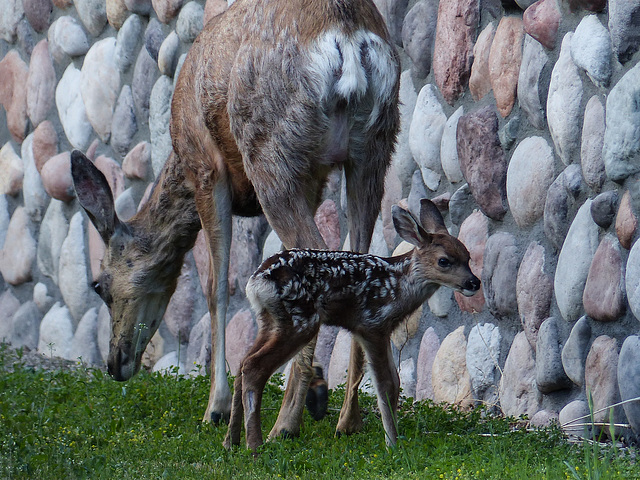
Very young Mule deer
On the first day of three spent in Waterton Lakes National Park, my friends and I came across this beautiful sight along one of the roads in the small town of Waterton. This tiny baby Mule Deer could barely stand and kept falling down. It was trying to nurse - amazingly, its mother eventually lay down to make nursing easier for her new little one.
"With its merging landforms, connected ecoregions and its mild, moist, windy climate, Waterton Lakes National Park is an amazing meeting place for an abundant and diverse collection of vegetation.
Despite it's small size (505 sq km) Waterton is graced with over 1000 species of vascular plants . Over half of Alberta's plant species are found in this tiny place. The park's four ecoregions - foothills parkland, montane, subalpine and alpine - embrace forty-five vegetation communities. Sixteen of these are considered significant because they are rare or fragile and threatened.
Waterton also has an unusually high number of rare plants - over 175 are provincially rare (e.g. mountain lady's-slipper, pygmy poppy, mountain hollyhock), and over twenty of these are found only in the Waterton area (e.g. western wakerobin, Lewis' mock-orange, white-veined wintergreen). Over 50 species are rare in Canada (e.g. Bolander's quillwort, Lyall's scorpionweed, Brewer's monkeyflower.)" From Parks Canada website.
www.pc.gc.ca/eng/pn-np/ab/waterton/natcul/natcul1/f.aspx
I was so lucky to be invited to join friends Sandy and Heide on a three-day trip to Waterton Lakes National Park, from 19-21 (inclusive) June 2015. We met up with other members of the Alberta Native Plant Council for their annual Botany Alberta weekend. Most people who attended stayed at the Crooked Creek Campground, a 5.6 km drive east of the Waterton Park Gate on Highway 5, but my friends and I stayed at the Crandell Mountain Lodge on the edge of Waterton town. The ANPC people had a list of particular rare species that they hoped to find, and they were very successful.
Our stay down south overlapped the annual Waterton Wildflower Festival, but we came across very few people on our various drives and hikes. Needless to say, I was extremely fortunate to spend three days with people who are very knowledgeable about plants and many other things. This meant that I got to see many wildflower species, including several that were new to me, such as the gorgeous Mariposa Lily. It was one of the flowers that was on my mental Wish List - and there were hundreds of them to be seen! I had also never seen the spectacular Bear Grass and I was so thrilled that there were still several plants in bloom. Absolutely made my day!
Our two main hikes of the weekend were the Bertha Lake Trail as far as the Bertha Falls (on 20 June), and the Crandell Lake Trail (on 21 June). Makes me smile when a described "short, easy hike" in a book or on the Internet turns into a full day of exploration along the trail, taking hours to reach the destination, though returning to the cars in a much shorter time.
The wind made photographing plants a real challenge, including the beautiful Mariposa Lilies in the meadow along the Hay Barn road. Though I took plenty of photos, I wasn't sure that I would end up with any that were sharp enough. Trying to catch a quick shot when a flower is blowing in and out of the viewfinder is not easy! Unfortunately, I'm no longer able to get down and take macro shots (my lens needs to be about 4" away from the subject), so my photos have to be telemacro.
I've just been trying to find a list of plant species in Waterton Park, but have so far been out of luck. I do have the book, "Wildflowers of Waterton Park" by Jacinthe Lavoie and Ian Wilson, which has an Index of Plant names, but I was hoping to find a list that I could print out.
It's going to take me ages to type descriptions for the various photos I'll slowly be posting, and I will no doubt keep adding new bits and pieces over time. There is just so much information I want to add. Also, my photos of quite a few of the plants will be posted for the use of ANPC members and are, unfortunately, really poor images. Need them added to my Waterton Lakes album, so please bear with me : ) Luckily, you don't even need to look at them.
Thank you so much, Sandy and Heide, for a great three-day trip in such spectacular scenery, surrounded by amazing nature. The wildflowers were top priority, but I was so happy to see insects, scenery and even a bit of wildlife that included a very distant female Grizzly with a cub from last year and two Black Bears, one of which was along the Crandell Lake trail at the same time we were there.
Thanks, too, Sandy, for doing all the driving - so much appreciated by Heide and myself! Also have to thank you both for being so thoughtful as far as my limitations go (lol, I can move much better than I was expecting today!) and for your patience in allowing me to take lots of photos! Heide, you'll be glad to know that I have a bottle of water sitting by my computer - thanks for all the reminders to keep hydrated while hiking. Two other people to mention - Arnold, it was so good to see you at the meeting place. Been a long time since our paths crossed. Jerry (from Calgary), good to bump into you in Waterton, and thanks so much for telling us about various sightings and even taking us to several of the locations, despite the fact that you had just returned from a major mountain hike that day. Loved seeing the distant Loon lying in the grass at the edge of one of the wetlands.
Great trip, great company! How lucky I am.
20 Jun 2015
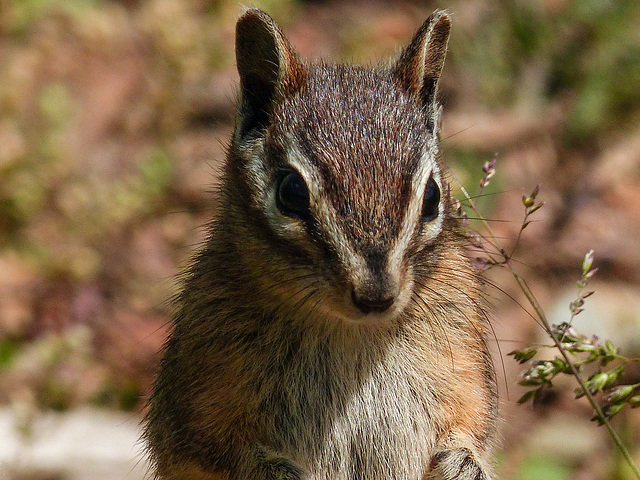
Least Chipmunk / Tamias minimus
Our temperature this afternoon (27 June 2015) is supposed to get up to 32C (will actually feel like 34C) and the same is forecast for tomorrow. Much, much too hot for me, especially with no air-conditioning.
This little female Least Chipmunk was busy feeding along the Bertha Lake Trail (as far as Bertha Falls) in Waterton Lakes National Park, on 20 June 2015. Not the best lighting, but I think she's still cute.
"The Least Chipmunk has two whitish and three dark stripes on each side of the face, and four light and five dark stripes down its back. The overall colour is a greyish brown, but may be quite rust-coloured during the mid-summer months. The smallest of the western Chipmunks, the Least's head and body measures only 93-114mm (3.65 to 4.5 inches) with a bushy tail almost equally as long, which, when running, is held straight up. This fast-moving and agile mammal is strictly diurnal, spending most of its time in a frenzied search for food, much of which it stores for winter." From the old www.weaselhead.org" ; website.
en.wikipedia.org/wiki/Least_chipmunk
I was so lucky to be invited to join friends Sandy and Heide on a three-day trip to Waterton Lakes National Park, from 19-21 (inclusive) June 2015. We met up with other members of the Alberta Native Plant Council for their annual Botany Alberta weekend. Most people who attended stayed at the Crooked Creek Campground, a 5.6 km drive east of the Waterton Park Gate on Highway 5, but my friends and I stayed at the Crandell Mountain Lodge on the edge of Waterton town. The ANPC people had a list of species that they hoped to find, and they were very successful.
Our stay down south overlapped the annual Waterton Wildflower Festival, but we came across very few people on our various drives and hikes. Needless to say, I was extremely fortunate to spend three days with people who are very knowledgeable about plants and many other things. This meant that I got to see many wildflower species, including several that were new to me, such as the gorgeous Mariposa Lily. It was one of the flowers that was on my Wish List - and there were hundreds of them to be seen! I had also never seen the spectacular Bear Grass and I was so thrilled that there were still several plants in bloom. Absolutely made my day!
Our two main hikes of the weekend were the Bertha Lake Trail as far as the Bertha Falls (on 20 June), and the Crandell Lake Trail (on 21 June). Makes me smile when a described "short, easy hike" in a book or on the Internet turns into a full day of exploration along the trail, taking hours to reach the destination, though returning to the cars in a much shorter time. Our walks/hikes are very slow-paced with endless stops to look at/for plants and to take photos. This makes it possible for me to go along.
Crandell Lake from the Crandell Campground trailhead:
Return distance 4.0 km (2.4 miles), elevation gain 150 metres (492'), hiking time 1.5 hours (we took all day!).
Bertha Falls from the townsite trailhead:
Return distance 5.6 km (3.4 miles), elevation gain 150 metres (492'), hiking time 1.5 hours (again, we took all day). For me, this hike felt much further than it was!
The wind made photographing plants a real challenge, including the beautiful Mariposa Lilies in the meadow along the Hay Barn road. Trying to catch a quick shot when a flower is blowing in and out of the viewfinder is not easy! Unfortunately, I'm no longer able to get down and take macro shots (my lens needs to be about 4" away from the subject), so my photos have to be telemacro.
I've been trying to find an online list of plant species in Waterton Park, but have so far been out of luck. I do have the book, "Wildflowers of Waterton Park" by Jacinthe Lavoie and Ian Wilson, which has an Index of Plant names, but I was hoping to find a list that I could print out.
It's going to take me ages to type descriptions for the various photos I'll slowly be posting, and I will no doubt keep adding new bits and pieces over time. There is just so much information I want to add, but my descriptions are already way too long. Also, my photos of quite a few of the plants will be posted for the use of ANPC members and are, unfortunately, really poor images. Need them added to my Waterton Lakes album, so please bear with me : ) Luckily, you don't even need to look at them.
20 Jun 2015
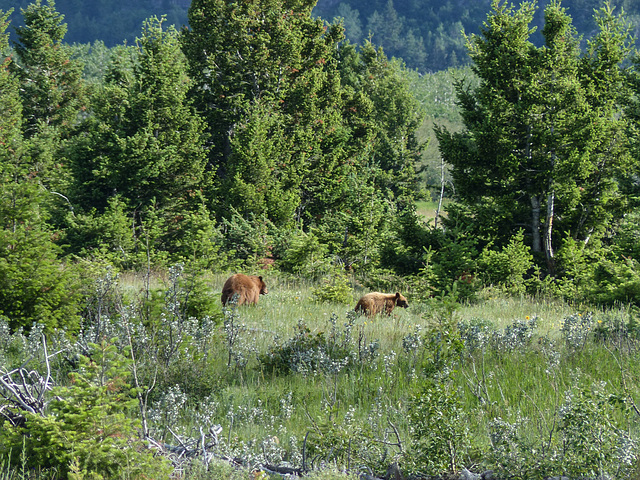
Grizzly Bear with last year's cub
Definitely a very distant shot, lol, but I wanted to add it to my Waterton Lakes National Park album. We were on our way to meet other members of the Alberta Native Plant Council in the early evening of 20 June 2015, when we saw that quite a few cars had stopped on a bridge along Highway 5. Yes, we did what most people do, we pulled over and took a look, as there was most likely a bear to be seen. Well, this Grizzly and a cub from last year were barely visible in the far, far distance. Tried a shot or two and, in this one, you can actually tell what the animals are. Such a thrill, especially as I think I've only ever seen a Grizzly (and a cub from the previous year) on one other occasion - by Kananaskis Lakes in Kananaskis, and at very close quarters! Any other bears that I have seen were Black Bears. Also, this was a botany trip, so anything else seen was a bonus : ) We saw four bears in total. A Black Bear crossed the road ahead of our car in the dark on the first evening (no photo). A second Black Bear was near the trailhead for Crandell Lake Trail - was passing though the forest, gave us one quick glance, strode across the path and disappeared into the trees. Not interested in us at all. The other two bears were the two Grizzlies in this photo. Amazing to watch as they hung out in the meadow, looking for food.
I was so lucky to be invited to join friends Sandy and Heide on a three-day trip to Waterton Lakes National Park, from 19-21 (inclusive) June 2015. We met up with other members of the Alberta Native Plant Council for their annual Botany Alberta weekend. Most people who attended stayed at the Crooked Creek Campground, a 5.6 km drive east of the Waterton Park Gate on Highway 5, but my friends and I stayed at the Crandell Mountain Lodge on the edge of Waterton town. The ANPC people had a list of species that they hoped to find, and they were very successful.
Our stay down south overlapped the annual Waterton Wildflower Festival, but we came across very few people on our various drives and hikes. I was expecting everywhere to be packed. Needless to say, I was extremely fortunate to spend three days with people who are specialists and very knowledgeable about plants, and many other things. This meant that I got to see many wildflower species, including several that were new to me, such as the gorgeous Mariposa Lily. It was one of the flowers that was on my Wish List - and there were hundreds of them to be seen! I had also never seen the spectacular Bear Grass and I was so thrilled that there were still several plants in bloom. Absolutely made my day!
Our two main hikes of the weekend were the Bertha Lake Trail as far as the Bertha Falls (on 20 June), and the Crandell Lake Trail (on 21 June). Makes me smile when a described "short, easy hike" in a book or on the Internet turns into a full day of exploration along the trail, taking hours to reach the destination, though returning to the cars in a much shorter time. Our walks/hikes are very slow-paced with endless stops to look at/for plants and to take photos. This makes it possible for me to go along.
Crandell Lake from the Crandell Campground trailhead:
Return distance 4.0 km (2.4 miles), elevation gain 150 metres (492'), hiking time 1.5 hours (we took all day!).
Bertha Falls from the townsite trailhead:
Return distance 5.6 km (3.4 miles), elevation gain 150 metres (492'), hiking time 1.5 hours (again, we took all day). For me, this hike felt much further than it was!
The wind made photographing plants a real challenge, including the beautiful Mariposa Lilies in the meadow along the Hay Barn road. Trying to catch a quick shot when a flower is blowing in and out of the viewfinder is not easy! Unfortunately, I'm no longer able to get down and take macro shots (my lens needs to be about 4" away from the subject), so my photos have to be telemacro.
I've been trying to find an online list of plant species in Waterton Park, but have so far been out of luck. I do have the book, "Wildflowers of Waterton Park" by Jacinthe Lavoie and Ian Wilson, which has an Index of Plant names, but I was hoping to find a list that I could print out.
It's going to take me ages to type descriptions for the various photos I'll slowly be posting, and I will no doubt keep adding new bits and pieces over time. There is just so much information I want to add, but my descriptions are already way too long. Also, my photos of quite a few of the plants will be posted for the use of ANPC members and are, unfortunately, really poor images. Need them added to my Waterton Lakes album, so please bear with me : ) Luckily, you don't even need to look at them.
21 Jun 2015
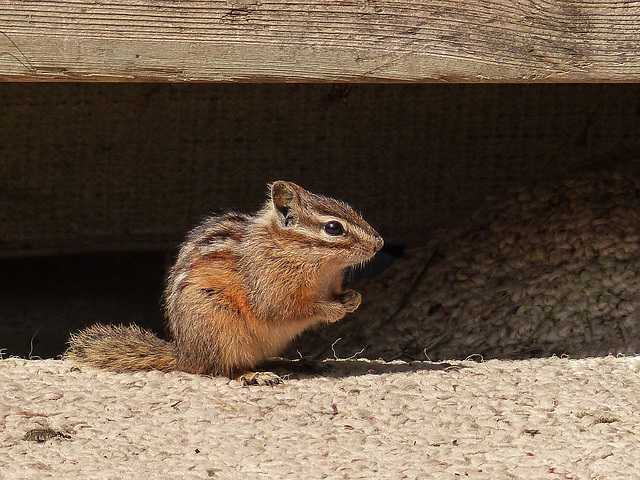
I'm hiding - she can't see me
This photo of a little Least Chipmunk was taken on 21 June 2015, when some of us walked to a campground to find an outhouse before starting on a hike along the Crandell Lake Trail, in Waterton Lakes National Park. The least chipmunk (Tamias minimus) is the smallest species of chipmunk, and the most widespread in North America.
en.wikipedia.org/wiki/Least_chipmunk
I was so lucky to be invited to join friends Sandy and Heide on a three-day trip to Waterton Lakes National Park, from 19-21 (inclusive) June 2015. We met up with other members of the Alberta Native Plant Council for their annual Botany Alberta weekend. Most people who attended stayed at the Crooked Creek Campground, a 5.6 km drive east of the Waterton Park Gate on Highway 5, but my friends and I stayed at the Crandell Mountain Lodge on the edge of Waterton town. The ANPC people had a list of species that they hoped to find, and they were very successful.
Our stay down south overlapped the annual Waterton Wildflower Festival, but we came across very few people on our various drives and hikes. Needless to say, I was extremely fortunate to spend three days with people who are very knowledgeable about plants (and other things). This meant that I got to see many wildflower species, including several that were new to me, such as the gorgeous Mariposa Lily. It was one of the flowers that was on my Wish List - and there were hundreds of them to be seen! I had also never seen the spectacular Bear Grass and I was so thrilled that there were still several plants in bloom. Absolutely made my day!
Our two main hikes of the weekend were the Bertha Lake Trail as far as the Bertha Falls (on 20 June), and the Crandell Lake Trail (on 21 June). Makes me smile when a described "short, easy hike" in a book or on the Internet turns into a full day of exploration along the trail, taking hours to reach the destination, though returning to the cars in a much shorter time. Our walks/hikes are very slow-paced with endless stops to look at/for plants and to take photos. This makes it possible for me to go along.
Crandell Lake from the Crandell Campground trailhead:
Return distance 4.0 km (2.4 miles), elevation gain 150 metres (492'), hiking time 1.5 hours (we took all day!).
Bertha Falls from the townsite trailhead:
Return distance 5.6 km (3.4 miles), elevation gain 150 metres (492'), hiking time 1.5 hours (again, we took all day). For me, this hike felt much further than it was!
The wind made photographing plants a real challenge, including the beautiful Mariposa Lilies in the meadow along the Hay Barn road. Though I took plenty of photos, I wasn't sure that I would end up with any that were sharp enough. Trying to catch a quick shot when a flower is blowing in and out of the viewfinder is not easy! Unfortunately, I'm no longer able to get down and take macro shots (my lens needs to be about 4" away from the subject), so my photos have to be telemacro.
I've been trying to find a list of plant species in Waterton Park, but have so far been out of luck. I do have the book, "Wildflowers of Waterton Park" by Jacinthe Lavoie and Ian Wilson, which has an Index of Plant names, but I was hoping to find a list that I could print out.
19 Jun 2015
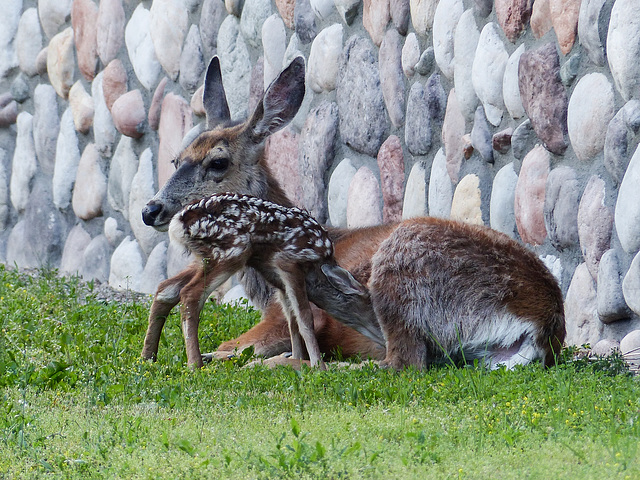
Mule Deer, Mom and baby
On the first day of three spent in Waterton Lakes National Park, my friends and I came across this beautiful sight along one of the roads in the small town of Waterton. This tiny baby Mule Deer could barely stand and kept falling down. It was trying to nurse - amazingly, its mother eventually lay down to make nursing easier for her new little one.
"With its merging landforms, connected ecoregions and its mild, moist, windy climate, Waterton Lakes National Park is an amazing meeting place for an abundant and diverse collection of vegetation.
Despite it's small size (505 sq km) Waterton is graced with over 1000 species of vascular plants . Over half of Alberta's plant species are found in this tiny place. The park's four ecoregions - foothills parkland, montane, subalpine and alpine - embrace forty-five vegetation communities. Sixteen of these are considered significant because they are rare or fragile and threatened.
Waterton also has an unusually high number of rare plants - over 175 are provincially rare (e.g. mountain lady's-slipper, pygmy poppy, mountain hollyhock), and over twenty of these are found only in the Waterton area (e.g. western wakerobin, Lewis' mock-orange, white-veined wintergreen). Over 50 species are rare in Canada (e.g. Bolander's quillwort, Lyall's scorpionweed, Brewer's monkeyflower.)" From Parks Canada website.
www.pc.gc.ca/eng/pn-np/ab/waterton/natcul/natcul1/f.aspx
I was so lucky to be invited to join friends Sandy and Heide on a three-day trip to Waterton Lakes National Park, from 19-21 (inclusive) June 2015. We met up with other members of the Alberta Native Plant Council for their annual Botany Alberta weekend. Most people who attended stayed at the Crooked Creek Campground, a 5.6 km drive east of the Waterton Park Gate on Highway 5, but my friends and I stayed at the Crandell Mountain Lodge on the edge of Waterton town. The ANPC people had a list of particular rare species that they hoped to find, and they were very successful.
Our stay down south overlapped the annual Waterton Wildflower Festival, but we came across very few people on our various drives and hikes. Needless to say, I was extremely fortunate to spend three days with people who are very knowledgeable about plants and many other things. This meant that I got to see many wildflower species, including several that were new to me, such as the gorgeous Mariposa Lily. It was one of the flowers that was on my mental Wish List - and there were hundreds of them to be seen! I had also never seen the white Mountain Lady's Slipper or the spectacular Bear Grass and I was so thrilled that there were still several of the latter plants in bloom. Absolutely made my day!
Our two main hikes of the weekend were the Bertha Lake Trail as far as the Bertha Falls (on 20 June), and the Crandell Lake Trail (on 21 June). Makes me smile when a described "short, easy hike" in a book or on the Internet turns into a full day of exploration along the trail, taking hours to reach the destination, though returning to the cars in a much shorter time.
The wind made photographing some of the plants a real challenge, including the beautiful Mariposa Lilies in the meadow along the Hay Barn road. Though I took plenty of photos, I wasn't sure that I would end up with any that were sharp enough. Trying to catch a quick shot when a flower is blowing in and out of the viewfinder is not easy! Unfortunately, I'm no longer able to get down and take macro shots (my lens needs to be about 4" away from the subject), so my photos have to be telemacro.
Thank you so much, Sandy and Heide, for a great three-day trip in such spectacular scenery, surrounded by amazing nature. The wildflowers were top priority, but I was so happy to see insects, scenery and even a bit of wildlife that included a very distant female Grizzly with a cub from last year and two Black Bears, one of which was along the Crandell Lake trail at the same time we were there.
Thanks, too, Sandy, for doing all the driving - so much appreciated by Heide and myself! Also have to thank you both for being so thoughtful as far as my limitations go (lol, I can move much better than I was expecting today!) and for your patience in allowing me to take lots of photos! Heide, you'll be glad to know that I have a bottle of water sitting by my computer - thanks for all the reminders to keep hydrated while hiking. Two other people to mention - Arnold, it was so good to see you at the meeting place. Been a long time since our paths crossed. Jerry (from Calgary), good to bump into you in Waterton, and thanks so much for telling us about various sightings and even taking us to several of the locations, despite the fact that you had just returned from a major mountain hike that day. Loved seeing the distant (nesting) Loon lying in the grass at the edge of one of the wetlands.
Great trip, great company! How lucky I am.
19 Jul 2015
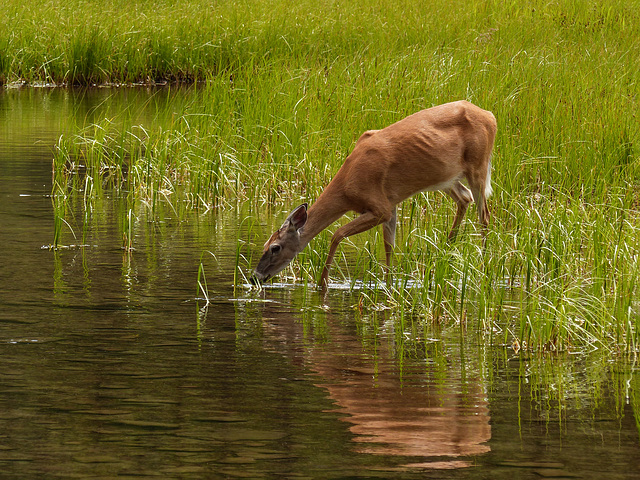
White-tailed Deer at Akamina Lake, Waterton
To have the chance to visit Waterton Lakes National Park in June was such an absolute treat, but to be able to visit this beautiful region again one month later was just incredible. I think I've only ever been maybe five or so times in the 37 years that I've lived here, so you can imagine my delight to get two chances in one year!! Actually, I signed up for the July trip a while ago and, though there were some aspects of the three-day trip that I wasn't particularly keen on, I knew this was a wonderful chance to go down south. Then, some time later, friend Sandy asked if I wanted to go down to Waterton in June for the Botany Alberta weekend. So, lucky, lucky me!!
Just got back home two evenings ago from this second visit, 17-19 July 2015. Again, wonderful to be surrounded by such magnificent scenery, go on a few pleasantly slow walks with plenty of time to look for, and photograph, wildflowers, insects, and a few birds. Lots of great company with people I already knew and lots of new faces, too. The trip was organized by Nature Calgary. Everyone was free to go wherever they wanted each day, but for the two nights, we stayed at the very basic Canyon Church Camp, off the Red Rock Parkway. Dorm-style cabins (about which I will say nothing, lol!), but they do have showers and even flush toilets at the camp. We were fed so well - lots of variety and good food. We were given two breakfasts and two suppers, plus a packed lunch for the two days. Our thanks go out to the lady (can't remember her name, sorry) who cooked and prepared these meals for us! They were so much enjoyed and greatly appreciated!
Our first day, which included the drive from Calgary, it rained all day long. Thankfully, the remaining two days were beautiful and sunny, and appreciated even more because of the first rainy day. The first day, we drove around Waterton town, calling in at Cameron Falls and then driving to Red Rock Canyon. We did the short walk along both sides of the canyon, in the rain, so it was pretty much useless as far as taking photos was concerned. I was happy to see a Swainson's Thrush, the first time I had seen one close.
Cameron Lake is a beautiful lake and I love the small jetty and the colourful canoes lined up. Our walk took us along the right hand side of the lake, through the forest.
One of my favourite plants that we saw was Water Hemlock - though I had seen it before, I had never seen it this close and in such detail. The bees and other insects love it, too, with several insects on many of the flower heads. This attractive plant is one of the most deadly poisonous plants in North America. Two other plants that I was thrilled to see were Pink Monkeyflower and Yellow Monkeyflower. I had never seen these wildflowers before. Pearly Everlasting, False Helebore, Fringed Grass-of-Parnassus, Foam Flower, and Thimbleberry were just a few of the other plants we found. We were amazed at how many orchids there were - everywhere. Later on the second day, we called in at Red Rock Canyon again and, because it was absolutely packed with people, we decided to do the nearby Blakiston Falls Trail. Along this trail, I was thrilled to see a few Pinedrops plants in flower - I had only ever seen them once before (at Cypress Hills), and they were in seed. Thanks so much, Debbie, for the heads-up about these plants that you had found earlier! We also saw a couple of Prince's Pine plants along this trail - a first for me. They look rather like Pink Pyrola, so could easily be overlooked.
Later, in the evening on this day, Andrew Hart took us to look at a wetland for Sandhill Cranes. He knew they can be seen there and, with the help of a spotting scope, he found a total of 5 seen from two lookouts. Barely visible with the naked eye, they were so far away. I just managed to get a 48x zoomed shot that was kind of fit to post : ) Andrew had also timed it so that we could drive along Chief Mountain Parkway afterwards, stop at the lookout and watch the sunset over the mountain peaks.
The following morning, our last, some of us visited Cameron Lake again and then walked along the very short Akamina Lake trail (only 1 km) that starts from the Cameron Lake parking lot. A beautiful little trail, where we found two Bear Grass plants still in flower, but well past their prime. Also watched a rather thin deer making her way along the edge of the lake. A lovely walk to end our stay in Waterton Lakes National Park. Thanks so much, Darlene, for letting us do this, knowing that we needed to start driving north to Calgary. Thank you SO much, too, for driving three of us to and from Calgary and around the park some of the time, too. To say that we appreciated it is a huge understatement!! Our thanks, too, to Andrew for organizing this trip so brilliantly! A great time was had by all.
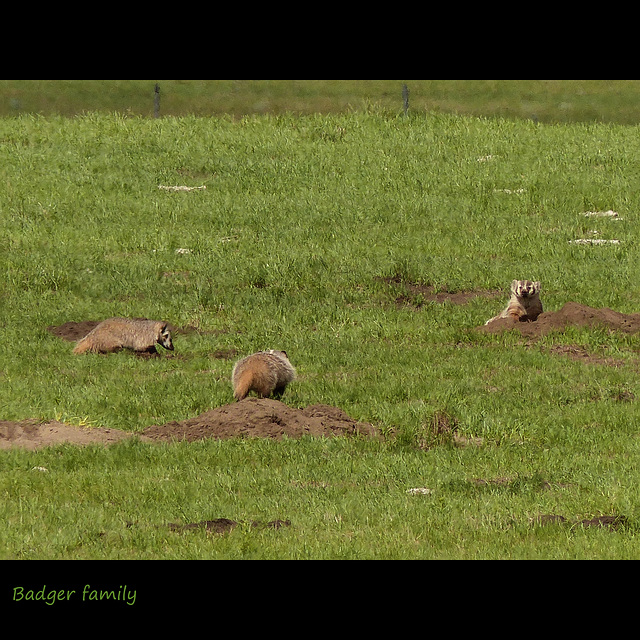
Three out of four ain't bad
Yesterday, 26 July 2015, 22 of us drove out to Marsland Basin, E of Calgary. Part of this beautiful wetland belongs to our friend, Lyn, and her partner - they have a house and yard that overlooks the wetland. This was the second time that I had visited the area, the first being on 28 June 2015. Each time, we have to sign a small guestbook. Also, everyone who can, is asked to please submit a list of species seen to eBird. The birds on the water are very distant, so you need binoculars (which I don't have) and even better, a spotting scope. Really, they are too far away for photos, though I can get a distant shot with my point-and-shoot camera set at 48x zoom and then cropped. Like last time, I took a long look over the lake and then wandered round Lyn's property, this time finding a mushroom or two, a beautiful moth, a Thistle or two, their two donkeys, a House Wren, an Eastern Kingbird, a Mourning Dove, and a family of Western Kingbirds (that were just about impossible to see as they flitted in amongst the high branches.
The highlight of the visit for many of us was seeing a very, very distant family of American Badgers that were in a neighbour's field (so, private land), digging for prey (probably the nearby Richardson's Ground Squirrels). There are four family members, though some of us only saw three. I think I have only ever seen a Badger three times before in 37 years, the last one being on 11 June 2012, on one of Don Stiles' annual Mountain Bluebird outings. This photo was taken: Focal Length (35mm format) - 1200 mm.
The General Status of the American Badger in Alberta is Sensitive. More detailed Status is "Data Deficient" - not enough current information to determine its status.
en.wikipedia.org/wiki/American_badger
A report from 2002:
esrd.alberta.ca/fish-wildlife/species-at-risk/species-at-...
After our visit to the Marsland Basin, friends Dorothy and Stephen drove two of us back to Calgary again, travelling the roads slowly so that we could see a number of perched Swainson's Hawks, and a Meadowlark with mouth full of insects to feed to her babies. Thanks so much, Stephen, for the safe ride there and back. As always, hugely appreciated!
I will add the list of 53 bird species seen, compiled by our leader, Bob Lefebvre, mainly to jog my own memory. Thanks so much, Bob for arranging this visit for us!
Canada Goose 29
Gadwall 11
American Wigeon 1
Mallard 25
Blue-winged Teal 60
Cinnamon Teal 6
Northern Shoveler 8
Northern Pintail 3
Green-winged Teal 2
Bufflehead 1
Common Goldeneye 1
Hooded Merganser 2
Ruddy Duck 2
Eared Grebe 3
Double-crested Cormorant 1
White-faced Ibis 16
Swainson's Hawk 4
Red-tailed Hawk 2
Black-necked Stilt 8
American Avocet 15
Killdeer 35
Spotted Sandpiper 1
Greater Yellowlegs 12
Willet 1
Lesser Yellowlegs 30
Marbled Godwit 1
Stilt Sandpiper 1
Least Sandpiper 5
Long-billed Dowitcher 80
Wilson's Phalarope 55
Bonaparte's Gull 40
Franklin's Gull 60
Ring-billed Gull 30
Forster's Tern 1
Mourning Dove 3
Northern Flicker 4
Western Kingbird 10
Eastern Kingbird 8
Black-billed Magpie 2
Tree Swallow 2
Barn Swallow 1
House Wren 5
American Robin 5
European Starling 40
Cedar Waxwing 1
Common Yellowthroat 3 One male feeding a recently fledged Brown-headed Cowbird.
Yellow Warbler 1
Clay-colored Sparrow 1
Savannah Sparrow 6
Red-winged Blackbird 45
Yellow-headed Blackbird 2
Brown-headed Cowbird 2 Two juveniles. One being fed by a male Common Yellowthroat.
House Sparrow 80
Muskrat -1
Richardson's Ground Squirrel - 100+
American Badger - 4
Coyote - 4
View this checklist online at ebird.org/ebird/view/checklist?subID=S24392576
Bob Lefebvre
Jump to top
RSS feed- Latest items - Subscribe to the latest items added to this album
- ipernity © 2007-2026
- Help & Contact
|
Club news
|
About ipernity
|
History |
ipernity Club & Prices |
Guide of good conduct
Donate | Group guidelines | Privacy policy | Terms of use | Statutes | In memoria -
Facebook
X
