


Moose


26 Oct 2016
1 favorite
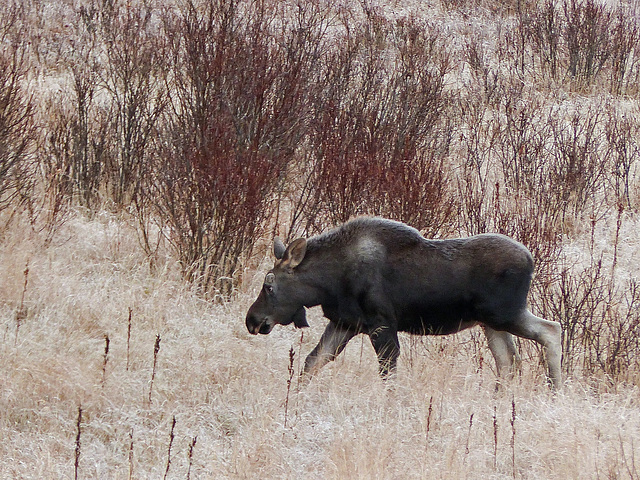
One of four Moose seen yesterday
I was out on another day trip yesterday, 26 October 2016, and just ran out of time this morning to add two of my descriptions. Usually, I don't have three long day outings within five days, except during the Christmas Bird Counts, and it really tired me out, and I'm still dragging my heels late this evening, even more so as I was out on a birding walk along the Bow River south of Lafarge area with friends this morning.
Yesterday was a great day, most enjoyable, spent with friends, Shirley and Anne. We had a very early start, 7:00 am, and drove west of the city to start with, driving to the far end of Elbow Falls Trail (Highway 66). While at Elbow Falls, we saw a pair of American Dippers flying from rock to rock. They were vocalizing, too, which I had never heard before.
Though there seemed to be very few birds to be seen all day, we were so lucky to see a total of four Moose - two at each of two different locations SW of the city. This photo shows one of the two that we saw first. They were moving in and out of all the bushes, but I was able to get a shot or two when they were out in the open. It is always nice to see a Moose, and to see four in one day was a real treat. The second two were fairly young ones.
From Elbow Falls Trail, we drove down through the Millarville area and finally ended up east of High River. We found one of the Great Horned Owls that everyone had been following earlier in the year, along with a nearby little American Tree Sparrow. We did see a few Hawks, including a Rough-legged Hawk on a hay bale and very dark morph Hawk later in the day.
A great day, ladies - thank you so much for inviting me along and thanks so much, Shirley, for driving! Greatly appreciated.
26 Oct 2016
1 favorite
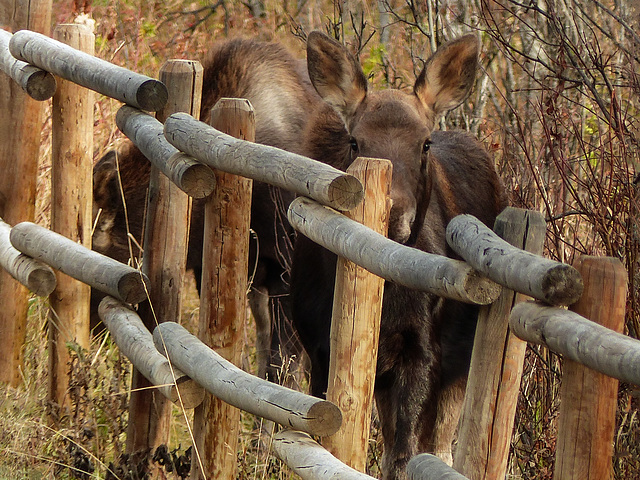
02 Two young Moose
Usually, I don't have three long day outings within five days, except during the Christmas Bird Counts, but three days ago, I was lucky enough to go with friends, Shirley and Anne, for a day's outing SW and SE of the city.
We had a very early start, 7:00 am, and drove west of the city to start with, driving to the far end of Elbow Falls Trail (Highway 66). While at Elbow Falls, we saw a pair of American Dippers flying from rock to rock. They were vocalizing, too, which I had never heard before.
Though there seemed to be very few birds to be seen all day, we were so lucky to see a total of four Moose - two at each of two different locations SW of the city. It is always nice to see a Moose, and to see four in one day was a real treat. The two animals in this photo were fairly young ones who were eating the bushes along a country road. Our presence didn't seem to bother them at all. Unfortunately, the fence made it impossible to get any decent shots.
From Elbow Falls Trail, we drove down through the Millarville area and finally ended up east of High River. We found one of the Great Horned Owls that everyone had been following earlier in the year, along with a nearby little American Tree Sparrow. We did see a few Hawks, including a Rough-legged Hawk on a hay bale and a very dark morph Hawk later in the day.
A great day, ladies - thank you so much for inviting me along and thanks so much, Shirley, for driving! Greatly appreciated. So glad we didn't have today's weather instead!
26 Oct 2016
2 favorites
5 comments
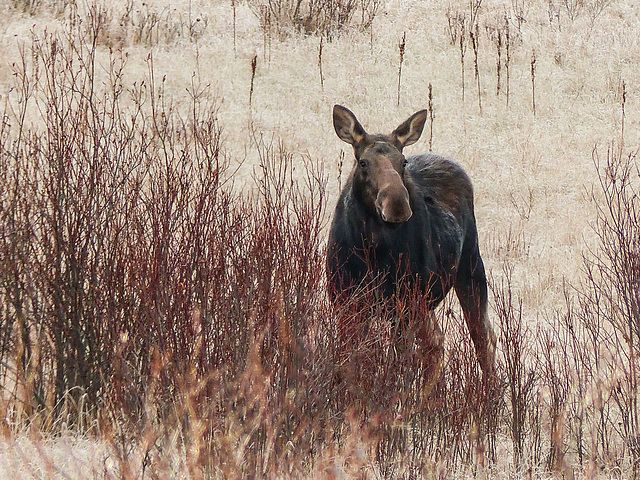
Eye contact with a very distant Moose
GOOD LUCK, AMERICA!! GOOD LUCK, WORLD!!
Today is THE day - voting for the next U.S. President. May the BEST person win.
-----------------------------------------------------------------------------------------------
What crazy weather we are having here in Calgary - it's already 10C this morning and it is forecast to soar to 20C this afternoon! Insane weather for 8 November. As warm as many of our days this past, rainy summer.
On 26 October 2016, I went on a day trip with friends, Shirley and Anne. We had a very early start, 7:00 am, and drove west of the city to start with, driving to the far end of Elbow Falls Trail (Highway 66). While at Elbow Falls, we saw a pair of American Dippers flying from rock to rock. They were vocalizing, too, which I had never heard before.
Though there seemed to be very few birds to be seen all day, we were so lucky to see a total of four Moose - two at each of two different locations SW of the city. This photo shows one of the two that we saw first. They were moving in and out of all the bushes, but I was able to get a shot or two when they were out in the open. It is always nice to see a Moose, and to see four in one day was a real treat. The second two were fairly young ones.
From Elbow Falls Trail, we drove down through the Millarville area and finally ended up east of High River. We found one of the Great Horned Owls that everyone had been following earlier in the year, along with a nearby little American Tree Sparrow. We did see a few Hawks, including a Rough-legged Hawk on a hay bale and very dark morph Hawk later in the day.
A great day, ladies - thank you so much for inviting me along and thanks so much, Shirley, for driving! Greatly appreciated.
29 Nov 2016
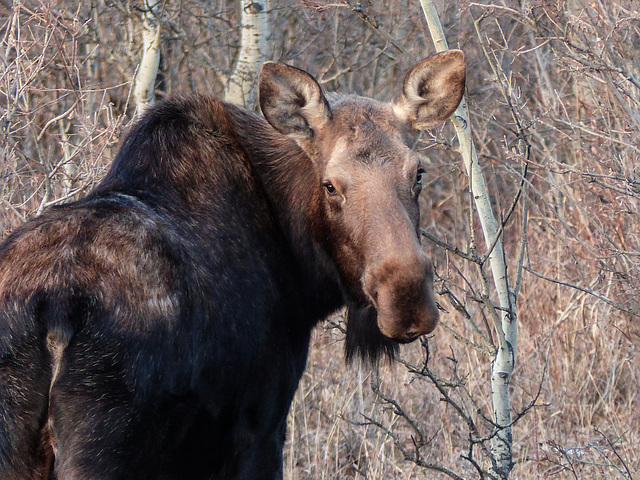
Curious Moose
Wow, it's just before noon and only 10 new photos showing from my Contacts.
This morning, 1 December 2016, the temperature is -2C and it's snowing heavily. Early yesterday evening, I went food shopping, as snow was forecast for today, and it was snowing lightly then, too. That was the first time I had driven my 'new' car in snow - the other times, I had simply stayed home and waited for the snow to melt : ) Unfortunately, I have an appointment to get to in a short while.
Two days ago, on 29 November 2016, I was fortunate enough to have a third trip into the mountains to look for and photograph wonderful White-tailed Ptarmigan. Friend, Shirley, had been out there before, but just missed seeing them. She asked if I wanted to go with her, and I jumped at the chance. I knew several other people who were planning to go, so felt a little more confident that we would probably be able to find these birds.
We left the city and travelled south via Turner Valley, but came back to the city via Barrier Lake and Highway 1. While driving out to Highway 40 in the morning, we stopped to watch this beautiful female Moose along the road from Turner Valley. She was quite a distance from the road, and turned to look at us, even taking a couple of steps towards us. After a short while, she decided that we just weren't all that interesting or a threat, and continued into the trees. Later, we stopped to watch a couple of Bighorn Sheep on Highway 40. Other than that, there was no sign of other wildlife other than many tracks left in the snow.
“The moose (North America) or Eurasian elk (Europe), Alces alces, is the largest extant species in the deer family. Moose are distinguished by the palmate antlers of the males; other members of the family have antlers with adendritic ("twig-like") configuration. Moose typically inhabit boreal and mixed deciduous forests of the Northern Hemisphere in temperate to subarctic climates. Moose used to have a much wider range but hunting and other human activities greatly reduced it over the years. Moose have been reintroduced to some of their former habitats. Currently, most moose are found in Canada, Alaska, Scandinavia and Russia. Their diet consists of both terrestrial and aquatic vegetation. The most common moose predators are wolves, bears, and humans. Unlike most other deer species, moose are solitary animals and do not form herds. Although generally slow-moving and sedentary, moose can become aggressive and move surprisingly quickly if angered or startled. Their mating season in the autumn can lead to spectacular fights between males competing for a female.
The moose is a herbivore and is capable of consuming many types of plant or fruit. The average adult moose needs to consume 9,770 kcal (40.9 MJ) per day to maintain its body weight. Much of a moose's energy is derived from terrestrial vegetation, mainly consisting of forbs and other non-grasses, and fresh shoots from trees such as willow and birch. These plants are rather low in sodium, and moose generally need to consume a good quantity of aquatic plants. While much lower in energy, these plants provide the moose with its sodium requirements, and as much as half of their diet usually consists of aquatic plant life. In winter, moose are often drawn to roadways, to lick salt that is used as a snow and ice melter. A typical moose, weighing 360 kg (790 lb), can eat up to 32 kg (71 lb) of food per day.” From Wikipedia.
en.wikipedia.org/wiki/Moose
When we finally reached our destination, we were thrilled to hear from several other people that Ptarmigan were being seen. So, find them, we did - but, oh, what we had to go through in order to see them! Unlike the other two times I had been, on 22nd and 23rd November, this time the birds were not near the main road area but, instead, were first spotted way across the valley, low down on the mountainside. A few years ago, I had done a short walk along this valley in deep, deep snow and vowed I would never be so foolish to do it again. You need snowshoes and, even then, the going is difficult. Of course, I don't have snowshoes, nor did a few of my friends.
When I heard that some people ahead of us had seen a few of the birds closer than the mountainside, I decided I would at least start 'walking' and see how far I got. The first short distance through the snow was flat, but then we had to climb upwards through knee deep snow. I almost had to give up, but thanks to friend, Tony, who basically dragged me up a couple of the most difficult parts, I was able to plough my way to where the closest Ptarmigan were. A few other helping hands, too, made this climb possible.
Several of the birds were in the sunshine, either resting or taking a few short steps. These birds almost looked as if they had a small light under their body, lighting up the lowest feathers and making the bird glow. So different compared to seeing and photographing them on a cloudy, gloomy day.
Eventually, it was time to head back down and along to the cars, repeating the difficult process of 'step and plunge' through the snow. It felt so good to finally reach the car!
From today (1 December) onward, the north and south winter gates will be closed across Highway 40, so these birds will be left in peace for the rest of the winter, until 14 or 15 June 2017. All the wildlife in the area will be free of human presence while they have their young ones in the spring.
Thanks so much for a great day, Shirley! I'm so glad you were finally able to see a few of these beautiful Ptarmigan in their winter white. It was very unfortunate that at least one person was not able to do the difficult walk and so will have to wait till next fall to hopefully get a 'lifer'. Most people I know have/had never seen this species when white, so I'm feeling extremely lucky! Of course, even if one doesn't find the Ptarmigan, the scenery alone is just breathtaking.
26 Oct 2016
5 favorites
2 comments
Two's company
I'm only posting one photo this morning.
On 26 October 2016, I went on a day trip with friends, Shirley and Anne. We had a very early start, 7:00 am, and drove west of the city to start with, driving to the far end of Elbow Falls Trail (Highway 66). While at Elbow Falls, we saw a pair of American Dippers flying from rock to rock. They were vocalizing, too, which I had never heard before.
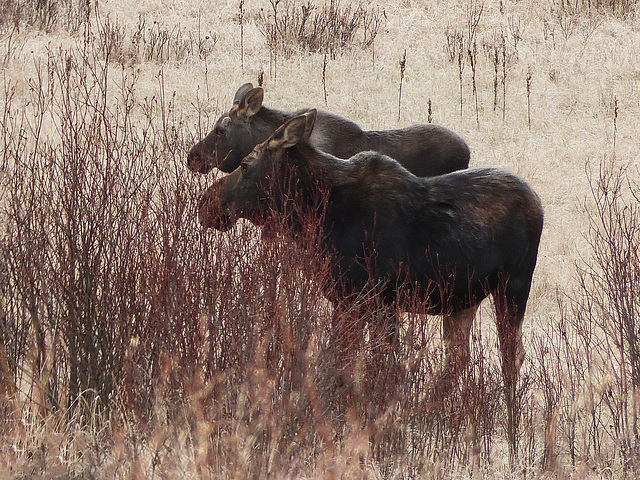
Though there seemed to be very few birds to be seen all day, we were so lucky to see a total of four Moose - two at each of two different locations SW of the city. This photo shows the two that we saw first. They were moving in and out of all the bushes, but I was able to get a shot or two when they were at least partly out in the open. It is always nice to see a Moose, and to see four in one day was a real treat. The second two were fairly young ones.
“The moose (North America) or Eurasian elk (Europe), Alces alces, is the largest extant species in the deer family. Moose are distinguished by the palmate antlers of the males; other members of the family have antlers with adendritic ("twig-like") configuration. Moose typically inhabit boreal and mixed deciduous forests of the Northern Hemisphere in temperate to subarctic climates. Moose used to have a much wider range but hunting and other human activities greatly reduced it over the years. Moose have been reintroduced to some of their former habitats. Currently, most moose are found in Canada, Alaska, Scandinavia and Russia. Their diet consists of both terrestrial and aquatic vegetation. The most common moose predators are wolves, bears, and humans. Unlike most other deer species, moose are solitary animals and do not form herds. Although generally slow-moving and sedentary, moose can become aggressive and move surprisingly quickly if angered or startled. Their mating season in the autumn can lead to spectacular fights between males competing for a female.
The moose is a herbivore and is capable of consuming many types of plant or fruit. The average adult moose needs to consume 9,770 kcal (40.9 MJ) per day to maintain its body weight. Much of a moose's energy is derived from terrestrial vegetation, mainly consisting of forbs and other non-grasses, and fresh shoots from trees such as willow and birch. These plants are rather low in sodium, and moose generally need to consume a good quantity of aquatic plants. While much lower in energy, these plants provide the moose with its sodium requirements, and as much as half of their diet usually consists of aquatic plant life. In winter, moose are often drawn to roadways, to lick salt that is used as a snow and ice melter. A typical moose, weighing 360 kg (790 lb), can eat up to 32 kg (71 lb) of food per day.” From Wikipedia.
en.wikipedia.org/wiki/Moose
From Elbow Falls Trail, we drove down through the Millarville area and finally ended up east of High River. We found one of the Great Horned Owls that everyone had been following earlier in the year, along with a nearby little American Tree Sparrow. We did see a few Hawks, including a Rough-legged Hawk on a hay bale and a very dark morph Hawk later in the day.
A great day, ladies - thank you so much for inviting me along and thanks so much, Shirley, for driving! Greatly appreciated.
29 Nov 2016
A sweet encounter
On 29 November 2016, I was fortunate enough to have a third trip into the mountains to look for and photograph these wonderful White-tailed Ptarmigan. Friend, Shirley, had been out there before, but just missed seeing them. She asked if I wanted to go with her, and I jumped at the chance. I knew several other people who were planning to go, so felt a little more confident that we would probably be able to find these birds.
Find them, we did - but, oh, what we had to go through in order to see them! Unlike the other two times I had been, on 22nd and 23rd November, this time the birds were not near the main road area but, instead, were first spotted way across the valley, low down on the mountainside. A few years ago, I had done a short walk along this valley in deep, deep snow and vowed I would never be so foolish to do it again. You need snowshoes and, even then, the going is difficult. Of course, I don't have snowshoes, nor did a few of my friends.
When I heard that some people ahead of us had seen a few of the birds closer than the mountainside, I decided I would at least start 'walking' and see how far I got. The first short distance through the snow was flat, but then we had to climb upwards through knee deep snow. I almost had to give up, but thanks to friend, Tony, who basically dragged me up some of the most difficult parts, I was able to plough my way to where the closest Ptarmigan were. A few other helping hands, too, made this climb possible.
Several of the birds were in the sunshine for a while, either resting or taking a few short steps. So different compared to seeing and photographing them on a cloudy, gloomy day.
These birds tend to walk around in just a small area for a while, feeding on the buds of the low Willow bushes, and then the group lies down, some of them burrowing till just the head and neck are visible, or some will burrow till they disappear completely under the snow. Every now and then, you can hear the little sounds they make. After resting, they repeat the feeding process and then rest again. As you can imagine, from a distance, a turn of the head so that a bird is looking away from you, all that remains is something that looks like one of the many lumps of snow everywhere.
"The smallest grouse in North America, the White-tailed Ptarmigan inhabits alpine regions from Alaska to New Mexico. It has numerous adaptations to its severe habitat, including feathered toes, highly cryptic plumage, and an energy-conserving daily regime." From AllAboutBirds.
www.allaboutbirds.org/guide/White-tailed_Ptarmigan/id
"The white-tailed ptarmigan (Lagopus leucura), also known as the snow quail, is the smallest bird in the grouse family. It is a permanent resident of high altitudes on or above the tree line and is native to Alaska and the mountainous parts of Canada and the western United States. It has also been introduced into the Sierra Nevada in California, the Wallowa Mountains in Oregon and the Uinta Mountains in Utah. Its plumage is cryptic and varies at different times of the year. In the summer it is speckled in gray, brown and white whereas in winter it is wholly white. At all times of year the wings, belly and tail are white. The white-tailed ptarmigan has a diet of buds, leaves, flowers and seeds. The nest is a simple depression in the ground in which up to eight eggs are laid. After hatching, the chicks soon leave the nest. At first they eat insects but later move on to an adult diet, their mother using vocalisations to help them find suitable plant food. The population seems to be stable and the IUCN lists this species as being of "Least Concern". From Wikipedia.
en.wikipedia.org/wiki/White-tailed_ptarmigan
Eventually, it was time to head back down and along to the cars, repeating the difficult process of 'step and plunge' through the snow. It felt so good to finally reach the car!
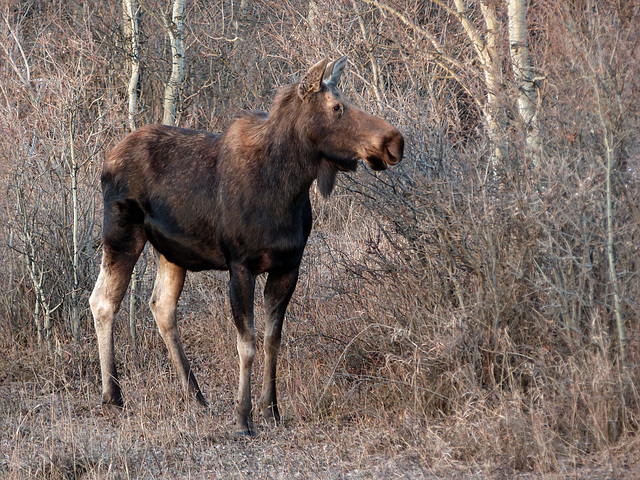
Shirley and I had left the city and travelled south via Turner Valley, but came back to the city via Barrier Lake and Highway 1. While driving out to Highway 40 in the morning, we stopped to watch this beautiful female Moose along the road from Turner Valley. She was quite a distance from the road, and turned to look at us, even taking a couple of steps towards us. After a short while, she decided that we just weren't all that interesting or a threat, and continued into the trees. Later, we stopped to watch a couple of Bighorn Sheep on Highway 40. Other than that, there was no sign of other wildlife other than many tracks left in the snow.
“The moose (North America) or Eurasian elk (Europe), Alces alces, is the largest extant species in the deer family. Moose are distinguished by the palmate antlers of the males; other members of the family have antlers with adendritic ("twig-like") configuration. Moose typically inhabit boreal and mixed deciduous forests of the Northern Hemisphere in temperate to subarctic climates. Moose used to have a much wider range but hunting and other human activities greatly reduced it over the years. Moose have been reintroduced to some of their former habitats. Currently, most moose are found in Canada, Alaska, Scandinavia and Russia. Their diet consists of both terrestrial and aquatic vegetation. The most common moose predators are wolves, bears, and humans. Unlike most other deer species, moose are solitary animals and do not form herds. Although generally slow-moving and sedentary, moose can become aggressive and move surprisingly quickly if angered or startled. Their mating season in the autumn can lead to spectacular fights between males competing for a female.
The moose is a herbivore and is capable of consuming many types of plant or fruit. The average adult moose needs to consume 9,770 kcal (40.9 MJ) per day to maintain its body weight. Much of a moose's energy is derived from terrestrial vegetation, mainly consisting of forbs and other non-grasses, and fresh shoots from trees such as willow and birch. These plants are rather low in sodium, and moose generally need to consume a good quantity of aquatic plants. While much lower in energy, these plants provide the moose with its sodium requirements, and as much as half of their diet usually consists of aquatic plant life. In winter, moose are often drawn to roadways, to lick salt that is used as a snow and ice melter. A typical moose, weighing 360 kg (790 lb), can eat up to 32 kg (71 lb) of food per day.” From Wikipedia.
en.wikipedia.org/wiki/Moose</a
07 Dec 2014
2 favorites
2 comments
Moose from the archives
Just posting two photos again today, 13 January 2017, both grabbed from my archives. I finally got out to run a few important errands yesterday, after being home for 7 or 8 days. Our deep-freeze is finally breaking and tomorrow is forecast to get up to -1C!
What a day I had with friends on 7 December 2014, in an absolute winter wonderland! We set off about 7:45 a.m. (still dark) and drove westwards to the Kananaskis area of our majestic mountains. Early in the drive, the sunrise turned the still distant mountains pink - this is always such an amazing sight to see. There was very low cloud lingering in some places, too, which I always love to see.
Once we had reached Kananaskis, we drove the area of Highway 40 that was still open (the rest of this highway is closed during the winter months) and also the Smith-Dorrien road. There had been a recent snowfall and the trees were still covered in snow, which turned everywhere into a winter wonderland. There was no wind and the temperatures hovered a few degrees around 0C. Sunshine, a few clouds, and fun company made it such a great day!
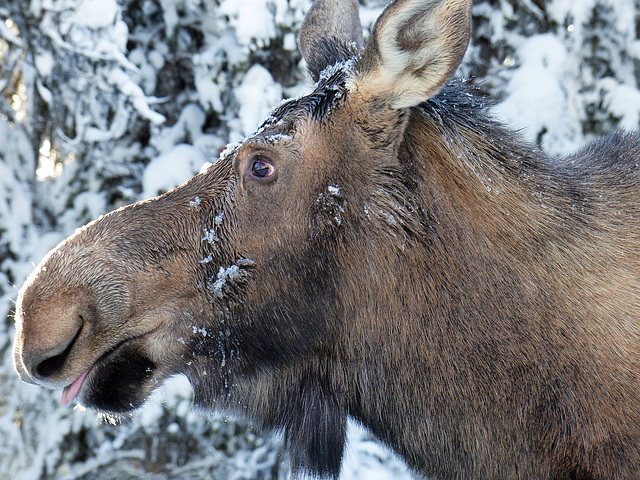
My friends had been hoping for a long time to be able to show me a winter Moose, and on this day they did really well, finding the beautiful female seen in this photo and, at another location, a youngish male with antlers that looked rather like two little twigs sticking out of the sides of his head. The size of both these wild animals was huge! You can stop the car some distance away from them, but if they are busy licking off the salt and minerals from any car in sight, they sometimes might eventually come close. All this female was interested in was doing this very thing : ) She would occasionally stop, straighten up and look and listen - usually this would be because she had heard or seen people snow-shoeing or cross-country skiing on a nearby trail through the forest. The rest of the time, she licked and licked and licked some more - the slurping sound could be heard from quite some distance :) At one point, she bent both front knees to kneel, so that she could reach the lower part of a vehicle. Lol, she did a fine job of cleaning headlights till they shone. Impressive and rather amusing at the same time. Free car wash, anyone?? I should add that caution must always be kept in mind and respect given to an animal - any wildlife can be unpredictable.
Most of the time, this female was in the shade, as in this photo, which made taking photos a bit of a challenge. What a difference in the colour of her coat when she occasionally moved into the sun.
We saw this female first, then the youngish male, and then we saw the female a second time, later. After feeding on dead leaves and tiny twigs from under the deep snow, she then lay down in the snow at the edge of some trees - the first time I had ever seen a Moose lying down. Such a peaceful scene - no one else was around either.
I always feel so privileged when I witness any kind of wildlife, especially so when you get the chance to watch a while and learn the behaviour of the animal or bird you are lucky enough to see. Of course, just being in such spectacular scenery and being able to photograph the mountains is more than enough for me.
“The moose (North America) or Eurasian elk (Europe), Alces alces, is the largest extant species in the deer family. Moose are distinguished by the palmate antlers of the males; other members of the family have antlers with adendritic ("twig-like") configuration. Moose typically inhabit boreal and mixed deciduous forests of the Northern Hemisphere in temperate to subarctic climates. Moose used to have a much wider range but hunting and other human activities greatly reduced it over the years. Moose have been reintroduced to some of their former habitats. Currently, most moose are found in Canada, Alaska, Scandinavia and Russia. Their diet consists of both terrestrial and aquatic vegetation. The most common moose predators are wolves, bears, and humans. Unlike most other deer species, moose are solitary animals and do not form herds. Although generally slow-moving and sedentary, moose can become aggressive and move surprisingly quickly if angered or startled. Their mating season in the autumn can lead to spectacular fights between males competing for a female.
The moose is a herbivore and is capable of consuming many types of plant or fruit. The average adult moose needs to consume 9,770 kcal (40.9 MJ) per day to maintain its body weight. Much of a moose's energy is derived from terrestrial vegetation, mainly consisting of forbs and other non-grasses, and fresh shoots from trees such as willow and birch. These plants are rather low in sodium, and moose generally need to consume a good quantity of aquatic plants. While much lower in energy, these plants provide the moose with its sodium requirements, and as much as half of their diet usually consists of aquatic plant life. In winter, moose are often drawn to roadways, to lick salt that is used as a snow and ice melter. A typical moose, weighing 360 kg (790 lb), can eat up to 32 kg (71 lb) of food per day.” From Wikipedia.
en.wikipedia.org/wiki/Moose
07 Dec 2014
1 favorite
Moose in the mountains
What a day I had with friends on 7 December 2014, in an absolute winter wonderland! We set off about 7:45 a.m. (still dark) and drove westwards to the Kananaskis area of our majestic mountains. Early in the drive, the sunrise turned the still distant mountains pink - this is always such an amazing sight to see. There was very low cloud lingering in some places, too, which I always love to see.
Once we had reached Kananaskis, we drove the area of Highway 40 that was still open (the rest of this highway is closed during the winter months) and also the Smith-Dorrien road. There had been a recent snowfall and the trees were still covered in snow, which turned everywhere into a winter wonderland. There was no wind and the temperatures hovered a few degrees around 0C. Sunshine, a few clouds, and fun company made it such a great day!
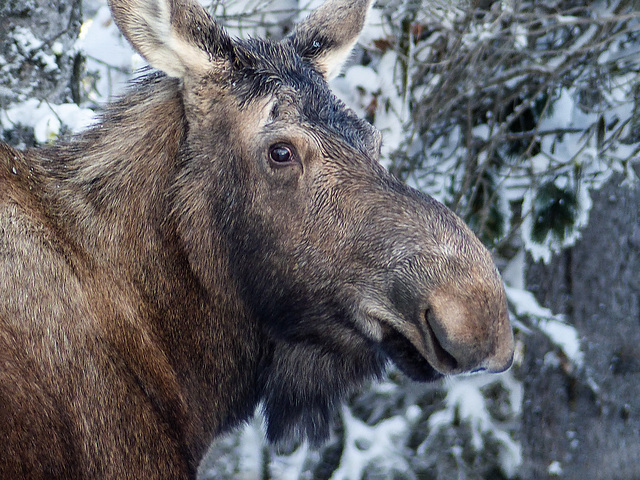
My friends had been hoping for a long time to be able to show me a winter Moose, and on this day they did really well, finding the beautiful female seen in this photo and, at another location, a youngish male with antlers that looked rather like two little twigs sticking out of the sides of his head. The size of both these wild animals was huge! You can stop the car some distance away from them, but if they are busy licking off the salt and minerals from any car in sight, they sometimes might eventually come close. All this female was interested in was doing this very thing : ) She would occasionally stop, straighten up and look and listen - usually this would be because she had heard or seen people snow-shoeing or cross-country skiing on a nearby trail through the forest. The rest of the time, she licked and licked and licked some more - the slurping sound could be heard from quite some distance :) At one point, she bent both front knees to kneel, so that she could reach the lower part of a vehicle. Lol, she did a fine job of cleaning headlights till they shone. Impressive and rather amusing at the same time. Free car wash, anyone?? I should add that caution must always be kept in mind and respect given to an animal - any wildlife can be unpredictable. The EXIF data for this image is Focal Length (35mm format) - 1080 mm. Unfortunately, it's not as sharp as it could have been.
Most of the time, this female was in the shade, as in this photo, which made taking photos a bit of a challenge. What a difference in the colour of her coat when she occasionally moved into the sun.
We saw this female first, then the youngish male, and then we saw the female a second time, later. After feeding on dead leaves and tiny twigs from under the deep snow, she then lay down in the snow at the edge of some trees - the first time I had ever seen a Moose lying down. Such a peaceful scene - no one else was around either.
I always feel so privileged when I witness any kind of wildlife, especially so when you get the chance to watch a while and learn the behaviour of the animal or bird you are lucky enough to see. Of course, just being in such spectacular scenery and being able to photograph the mountains is more than enough for me.
“The moose (North America) or Eurasian elk (Europe), Alces alces, is the largest extant species in the deer family. Moose are distinguished by the palmate antlers of the males; other members of the family have antlers with adendritic ("twig-like") configuration. Moose typically inhabit boreal and mixed deciduous forests of the Northern Hemisphere in temperate to subarctic climates. Moose used to have a much wider range but hunting and other human activities greatly reduced it over the years. Moose have been reintroduced to some of their former habitats. Currently, most moose are found in Canada, Alaska, Scandinavia and Russia. Their diet consists of both terrestrial and aquatic vegetation. The most common moose predators are wolves, bears, and humans. Unlike most other deer species, moose are solitary animals and do not form herds. Although generally slow-moving and sedentary, moose can become aggressive and move surprisingly quickly if angered or startled. Their mating season in the autumn can lead to spectacular fights between males competing for a female.
The moose is a herbivore and is capable of consuming many types of plant or fruit. The average adult moose needs to consume 9,770 kcal (40.9 MJ) per day to maintain its body weight. Much of a moose's energy is derived from terrestrial vegetation, mainly consisting of forbs and other non-grasses, and fresh shoots from trees such as willow and birch. These plants are rather low in sodium, and moose generally need to consume a good quantity of aquatic plants. While much lower in energy, these plants provide the moose with its sodium requirements, and as much as half of their diet usually consists of aquatic plant life. In winter, moose are often drawn to roadways, to lick salt that is used as a snow and ice melter. A typical moose, weighing 360 kg (790 lb), can eat up to 32 kg (71 lb) of food per day.” From Wikipedia.
en.wikipedia.org/wiki/Moose
19 Dec 2017
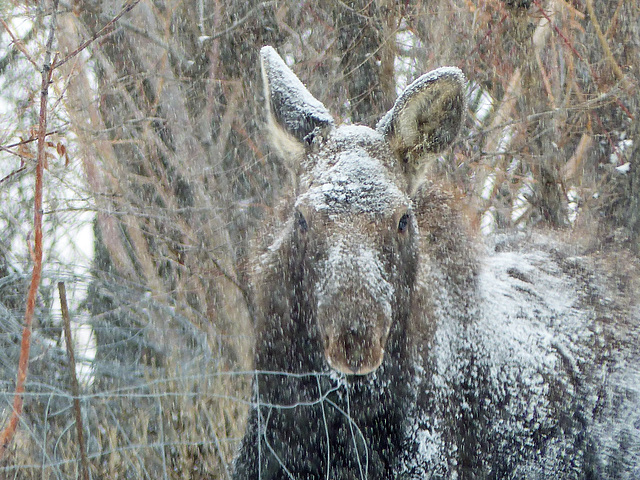
Unexpected, and very welcome, Moose
Yesterday, 19 December 2017, was the annual Audubon Christmas Bird Count for High River, a town to the south of Calgary. I am adding the report by Gus Yaki, the leader of our small group of 7, travelling in two cars. What Gus did not add, because he did not stay for the delicious Potluck supper after the Count, is that the forecast snow (Snowfall Warning in effect) arrived in full force in the evening and the drive back to Calgary was most unpleasant. Looks like there could be about 10" of the white stuff on top of my fence today. Thanks so much, Lorrie and John, for being so kind and picking me up in the early morning and driving me all day long, and then dropping me off for the Potluck and returning to collect me ready for the three of us to return to Calgary. Appreciated more than I can say! Thanks, also, to Greg Wagner for organizing the Count, as usual - great job! Last, but not least, many thanks to those who organized and prepared such a wonderful feast for us all to thoroughly enjoy at the end of the day! I left home around 7:00 am and arrived home about 8:15 pm, finally getting to bed at 2:00 am and eventually waking up at noon today! Was I tired after yesterday's full day!
One exciting sighting was a beautiful female Moose, maybe two years old! This was the first sighting ever of a Moose in the SE quadrant of the High River Count circle. From a distance, she was barely noticeable through the falling snow.
Common Redpolls were enjoyed at some feeders. They gave me the first opportunity to take photos this season. Much as I prefer photos without feeders, I am very glad for this chance. They are such dainty little birds, and fast-moving. It always looks like a feeding frenzy when they are at the feeders.
This red barn was on the last property that we visited, at the end of the day. I have happy memories of photographing the cutest group of farm cats at this barn during the Christmas Bird Count on 16 December 2014.
"High River CBC, SE Quadrant, including Frank Lake. 0800-1545, Tue, 19 Dec2017. Light overcast, light snow beginning at 1100. N Wind 10kph, -07 to -06°C. Ground bare initially, 3 cm at end. Little Bow River, mostly open.
Mallard-500
Northern Shoveler-1 f.
Northern Pintail-2
Common Goldeneye-3
Gray Partridge-8
Bald Eagle-1 ad, on Frank Lake
Prairie Falcon-1
Rock Pigeon-56
Great Horned Owl-6
Snowy Owl-1
Blue Jay-4
Black-billed Magpie-17
Common Raven-4
Song Sparrow-1
Snow Bunting-150
Common Redpoll-790
House Sparrow-202
Ring-necked Pheasant tracks by observation blind.
Gord Fraser, on W side of Little Bow, just N of 594 Av, had 40 Gray Partridges this a.m.
Coyote-4
Skunk track by observation blind
Meadow Vole-1
Mule Deer-6
Moose-1 f.
Participants:
Km by Car- 58
Km on foot -5
Total km - 63
Time by car – 2 hrs
Time on foot-5 hrs
Total party hours-7 hrs"
Jump to top
RSS feed- Latest items - Subscribe to the latest items added to this album
- ipernity © 2007-2025
- Help & Contact
|
Club news
|
About ipernity
|
History |
ipernity Club & Prices |
Guide of good conduct
Donate | Group guidelines | Privacy policy | Terms of use | Statutes | In memoria -
Facebook
X
