


Fish Creek Park 5

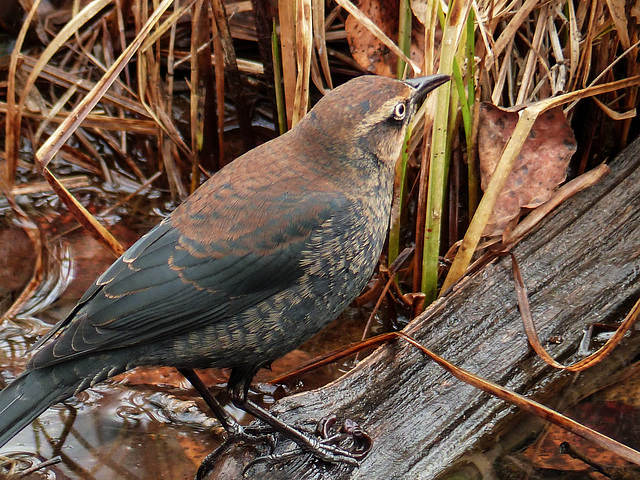

07 Nov 2014
Rusty Blackbird
In the early afternoon of 7 November 2014, I drove over to the east end of Fish Creek Park and was lucky enough to see two of these beautiful Rusty Blackbirds. IUCN Status: Vulnerable. I very rarely see these birds, so I’m always glad when I do see one. It was interesting to watch this one pick up and then toss aside endless leaves to check underneath them for food. Eventually, it did find a big, fat, juicy water worm of some kind, and ate it. As you can see from the photo, this bird is camouflaged quite well in those surroundings.
“The Rusty Blackbird is one of North America’s most rapidly declining species. The population has plunged an estimated 85-99 percent over the past forty years and scientists are completely puzzled as to what is the cause. They are relatively uncommon denizens of wooded swamps, breeding in the boreal forest and wintering in the eastern U.S. In winter, they travel in small flocks and are identified by their distinctive rusty feather edges and pallid yellow eyes.” From AllAboutBirds.
www.allaboutbirds.org/guide/rusty_blackbird/id
en.wikipedia.org/wiki/Rusty_blackbird
rustyblackbird.org/
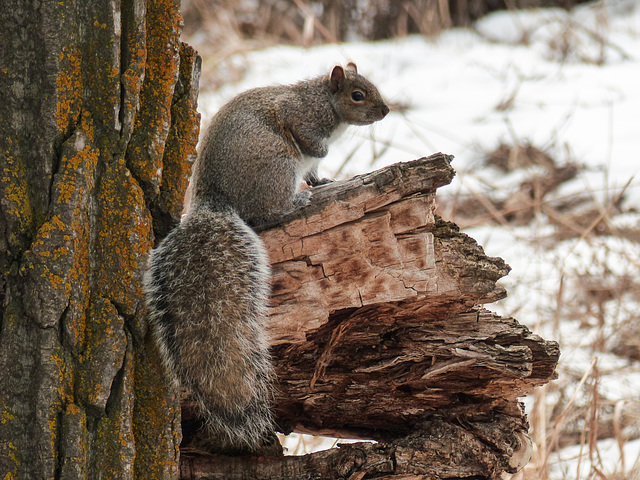
23 Nov 2014
1 favorite
1 comment
Bushy-tailed
It felt a little strange to see this Eastern Grey Squirrel sitting on the log that I’ve photographed the Long-tailed Weasel standing in. Can’t remember if there were two or three Eastern Greys in the same area a few days ago, on 23 November 2014, one of them a black form. The Squirrel in this photo had such a beautiful, bushy tail.
“The Eastern Grey Squirrels come in two main colour varieties or morphs, black and grey, and there are a few with shades of reds or even yellows in their pelage. A new-born litter may contain individuals of all colours. In the east, due to predatory pressure, grey individuals have a better chance of avoiding detection in grey-barked trees while black ones survive best when in stands of black-barked Black Oak or Black Walnut trees. In Calgary, litters seem to be evenly divided between grey and black. In winter, black individuals appear to be more numerous, particularly during cold days; perhaps their black fur absorbs more radiant heat, allowing them to be more active than their grey brothers or sisters.”From talkaboutwildlife.ca.
“Like many members of the family Sciuridae, the eastern gray squirrel is a scatter-hoarder; it hoards food in numerous small caches for later recovery. Some caches are quite temporary, especially those made near the site of a sudden abundance of food which can be retrieved within hours or days for reburial in a more secure site. Others are more permanent and are not retrieved until months later. Each squirrel is estimated to make several thousand caches each season. The squirrels have very accurate spatial memory for the locations of these caches, and use distant and nearby landmarks to retrieve them. Smell is used once the squirrel is within a few inches of the cache.” From Wikipedia.
en.wikipedia.org/wiki/Eastern_gray_squirrel
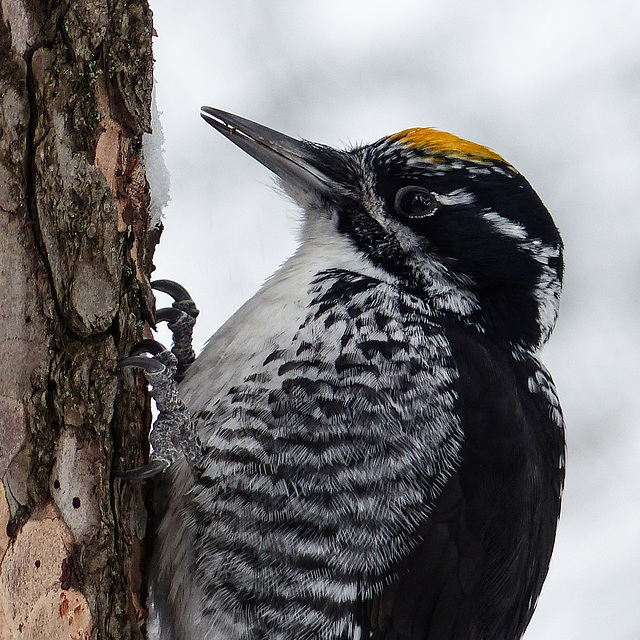
01 Dec 2014
1 favorite
2 comments
American Three-toed Woodpecker
Taken yesterday early afternoon (1 December 2014) in Fish Creek Park. After calling in at Votier’s Flats just before noon, I then drove over to Bebo Grove to see if there was any sign of the Barred Owl – no there wasn't and two other people had looked and been unsuccessful. I did see this male American Three-toed Woodpecker, though, which is always a treat, especially as it is rare in Alberta..
This photo shows a tree that has had bits of its bark removed, leaving the orange-coloured wood exposed. The Woodpecker wants to get to the larvae that are beneath the bark, so the bark has to be removed. Some trees are almost completely orange, so much bark has been peeled away by a Woodpecker. In winter, when there is snow on the ground, you can see the pieces of bark lying around the base of the tree, on top of the snow, if a Woodpecker has been at work very recently.
"The American Three-toed Woodpecker is found in boreal forests and montane coniferous forests across North America. Because of its choice of habitat, it is infrequently seen by most people." From AllAboutBirds.
www.allaboutbirds.org/guide/American_Three-toed_Woodpecke...
en.wikipedia.org/wiki/American_three-toed_woodpecker
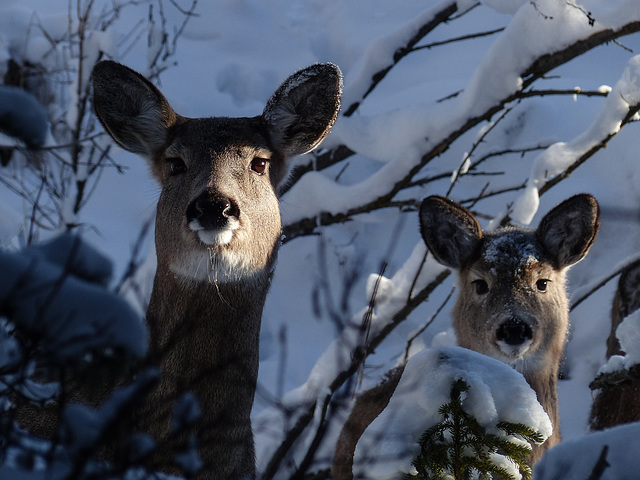
02 Dec 2014
Watching us watching them
When I was on a walk at Votier's Flats, Fish Creek Park, with friends yesterday, the person in front of me asked if I'd seen any deer that morning. Immediately after he had asked, someone spotted this little family of White-tailed Deer. The doe had two youngsters with her (yearlings?) and they were quite a distance away, peering at us through a gap in the trees. The sun was right on the doe's face - couldn't have been luckier. Such a brief encounter, but magical.
After this walk in a winter wonderland, I drove to a different part of Fish Creek Park - Bebo Grove - to see if there was any sign of the Barred Owl. No luck this time, either. Also wanted to hurry up and reach the first 100 km of driving on my new snow tires so that I could get the lugnuts (?) tightened. I didn't want to do a "long" drive outside the city till that had been done. Now all I have to do is wait till the road conditions have improved. I started off on just a very short drive SW of the city three (?) days ago and had to turn back because the roads were so bad, both main road and the side roads.
en.wikipedia.org/wiki/White-tailed_deer

02 Dec 2014
Rare (in Alberta) American Three-toed Woodpecker
Two days ago (1 December 2014), I called in at Votier’s Flats (in Fish Creek Park) just before noon, and then I drove over to Bebo Grove to see if there was any sign of the Barred Owl – no, there wasn't, and two other people had looked and been unsuccessful. I did see a male American Three-toed Woodpecker, though, which is always a treat, especially as it is rare in Alberta.
Yesterday was almost a repeat of the previous day, except that I went on a birding walk at Votier's Flats, hoping that someone would be able to find the Black-backed Woodpecker that had been seen. We were out of luck, unfortunately - I have seen one before, though.
After the walk, I again went over to Bebo Grove. No sign of the Barred Owl, but after a lot of searching, I happened to spot this female American Three-toed Woodpecker, presumably the mate of the male Woodpecker I had seen the previous day (photo posted yesterday).
Like yesterday's photo, this one also shows a tree that has had bits of its bark removed, leaving the orange-coloured wood exposed. The Woodpecker wants to get to the larvae that are in tunnels beneath the bark, so the bark has to be removed. See the tongue in action, lol! Some trees are almost completely orange, so much bark has been peeled away by a Woodpecker. In winter, when there is snow on the ground, you can see the pieces of bark lying around the base of the tree, on top of the snow, if a Woodpecker has been at work very recently. I think the tiny specks in this photo were from snow falling off one of the very high branches just as I was taking this photo.
"The American Three-toed Woodpecker is found in boreal forests and montane coniferous forests across North America. Because of its choice of habitat, it is infrequently seen by most people." From AllAboutBirds.
www.allaboutbirds.org/guide/American_Three-toed_Woodpecke...
en.wikipedia.org/wiki/American_three-toed_woodpecker
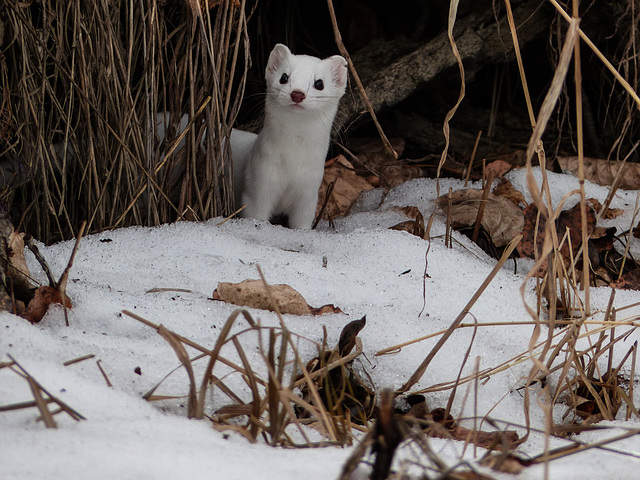
24 Nov 2014
1 favorite
Yes, it's the little white guy again
Just over a week ago, on 24 November 2014, I called in at Fish Creek Park to see if there was any sign of the Long-tailed Weasel. It did come out, but for maybe five minutes total, running around at top speed. I managed to get three or four shots, including this one, but that was all. Not the best composition, but usually there is no time to compose - you just point and click rapidly and hope that one photo will come out OK.
Since then, I’ve called in maybe three or four times recently, but there has been no sign of the Weasel and no tracks in the snow. I wonder if s/he is tucked down in its den, surrounded by all the many dead Meadow Voles that we have seen it catch recently. Weasels line their nests/dens with the fur from the animals they kill. Hopefully, it has not provided the nearby Great Horned Owl pair with a supper or two!
"Counting its tail, a large Long-tailed Weasel male, the largest of the three species in Canada, stretches nearly half a metre (20 in) in length, yet can slip into a hole just 3 cm (1.25 in) across. This enables it to enter small rodent tunnels used by mice and voles. In summer, it enters ground squirrels burrows in search of its favourite food. Average males measure 406 mm (16 in), their tail is 135 mm (5.25) long and they weigh 225 g (12.6 oz). Males are approximately 25 per cent larger than females, which on average weigh only 102 g (5.7 oz).
When winter approaches, within 30 days it grows a coat of white, giving it perfect camouflage against the snow -- all except for the tip of its tail, which stays black. A hungry predator, such as a hawk or owl, aims for that black tip, enabling the weasel to escape. Towards spring, between late February and April, in only 25 days, it reverses the process, acquiring the cinnamon-brown topcoat it will use all summer. This includes brown feet, unlike the other two species which retain white feet. The underside is usually buff-coloured." (Taken from the old weaselhead.org website).
“The long-tailed weasel mates in July–August, with implantation of the fertilized egg on the uterine wall being delayed until about March. The gestation period lasts 10 months, with actual embryonic development taking place only during the last four weeks of this period, an adaptation to timing births for spring, when small mammals are abundant. Litter size generally consists of 5–8 kits, which are born in April–May.” From Wikipedia.
en.wikipedia.org/wiki/Long-tailed_weasel
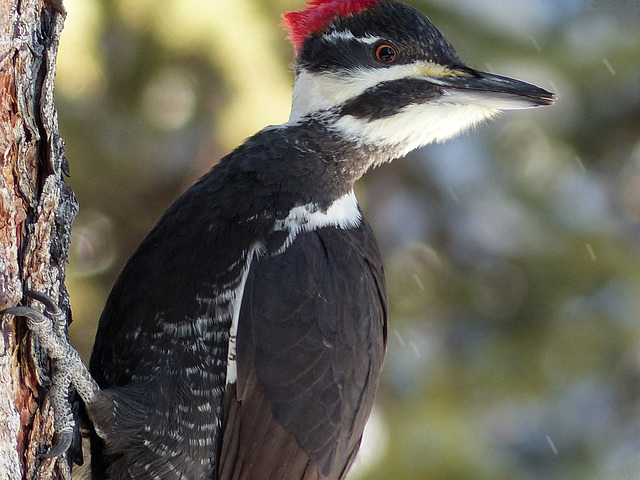
04 Dec 2014
She won't have a headache tonight ....
“Pileated woodpeckers, the largest woodpeckers in North America, hammer their heads into trees with a force of 15 mph, 20 times a second. So how do their heads not turn to mush? Thick muscles, sponge-like bones, and a third eyelid keep bird brains intact. "If you get hit hard in the head, you can break blood vessels behind the eye or traumatize nerves behind eye," said University of California Davis ophthalmologist Ivan Schwab. ‘Seeing patients in car accidents and knowing what woodpeckers do made me wonder why these injuries don't happen in woodpeckers.’
Last fall, Schwab was honored with an Ig Nobel award, the irreverent version of the Nobel Prize, for his research on how woodpeckers avoid headaches, published in the British Journal of Ophthalmology.
Along with their straight-as-an-arrow strikes at the tree, which safeguards against head trauma, birds' bodies are designed to absorb the impact. One millisecond before a strike comes across the bill, dense muscles in the neck contract, and the bird closes its thick inner eyelid. Some of the force radiates down the neck muscles and protects the skull from a full blow. A compressible bone in the skull offers cushion, too. Meanwhile, the bird's closed eyelid shields the eye from any pieces of wood bouncing off the tree and holds the eyeball in place. The eyelid acts like a seat belt and keeps the eye from literally popping out of the head," Schwab told LiveScience. "Otherwise, acceleration would tear the retina." The outside portion of the eye itself is firm, filled with blood to support the retina from being jostled around.
Bird brains also remain rigid during head banging. Injuries to the human head make our brains bounce back and forth in the cerebral spinal fluid, bathing the organ, but woodpeckers have virtually none of this fluid. While scientists can't be certain that woodpeckers don't get headaches, Schwab pointed out that the birds are at least very tolerant of headaches.” From Science on NBC News, 1 August 2007.
www.nbcnews.com/id/16531772/ns/technology_and_science-sci...
Photo was taken yesterday, 4 December 2014, when I went for a short walk in Fish Creek Park. This week, I’ve been trying to do several short walks to see if it makes any difference at all to the level of pain in my back. The weather has been beautiful this week, too – we all know that it is going to change back to “winter” before too long. Also, a short time in the park can (if you are lucky!) be simply amazing.
I happened to come across this female Pileated Woodpecker near the base of a tree. Almost impossible to get a sharp photo because she just didn’t stop banging her head against the tree. She caught me off guard when she suddenly turned her head around – too bad I missed part of her beautiful red crest. So many photos to be deleted, ha. While I was trying to catch one split second when the action actually slowed down, a much smaller bird flew over my head and landed on the same tree, about 4’ higher. Couldn’t believe my eyes when I saw that it was a male Black-backed Woodpecker (rare in Alberta, just like the two American Three-toed Woodpeckers that I saw in a different part of the park, on two different days this week). Talk about being lucky!
Later: ha, returned to the same area this afternoon, thinking it would be nice to try and get some better shots. Well, there was no sign of either species today - in fact, very few birds of any kind. I did see a pair of Hairy Woodpeckers high up on two of the tallest trees, and there were a few Chickadees. Yesterday, when I was trying to focus on the Pileated, a couple of times a Chickadee flew inside my lens hood. Could almost hear, and most definitely could imagine, those tiny, sharp claws scraping against the camera lens.

20 Nov 2014
A quick peek through the fence
On 20 November 2014, I went on a birding walk with friends in the morning. The weather had been reasonably mild recently, with sunshine and blue skies, perfect for a leisurely walk. Ten days later, our weather changed, and snow returned along with brutally cold temperatures again.
After the walk, I paid another visit to where the Long-tailed Weasel could sometimes be seen. Various friends were there, too, and we were treated to a few good photo opps, including with some of the eight or so Meadow Voles it caught while we were there. Some days you are lucky, and others you are not! This shot is just a quick one, to show the kind of terrain where this Weasel hangs out. It is an amazing hunter, moving so rapidly over the uneven, snowy ground with tangles of dead plants and fallen logs. A few times, it ran up the embankment, through the metal fence and then back down again. I didn’t try cropping this image, as I know the quality is not the best for doing so.
"Counting its tail, a large Long-tailed Weasel male, the largest of the three species in Canada, stretches nearly half a metre (20 in) in length, yet can slip into a hole just 3 cm (1.25 in) across. This enables it to enter small rodent tunnels used by mice and voles. In summer, it enters ground squirrels burrows in search of its favourite food. Average males measure 406 mm (16 in), their tail is 135 mm (5.25) long and they weigh 225 g (12.6 oz). Males are approximately 25 per cent larger than females, which on average weigh only 102 g (5.7 oz).
When winter approaches, within 30 days it grows a coat of white, giving it perfect camouflage against the snow -- all except for the tip of its tail, which stays black. A hungry predator, such as a hawk or owl, aims for that black tip, enabling the weasel to escape. Towards spring, between late February and April, in only 25 days, it reverses the process, acquiring the cinnamon-brown topcoat it will use all summer. This includes brown feet, unlike the other two species which retain white feet. The underside is usually buff-coloured." (Taken from the old weaselhead.org website).
en.wikipedia.org/wiki/Long-tailed_weasel
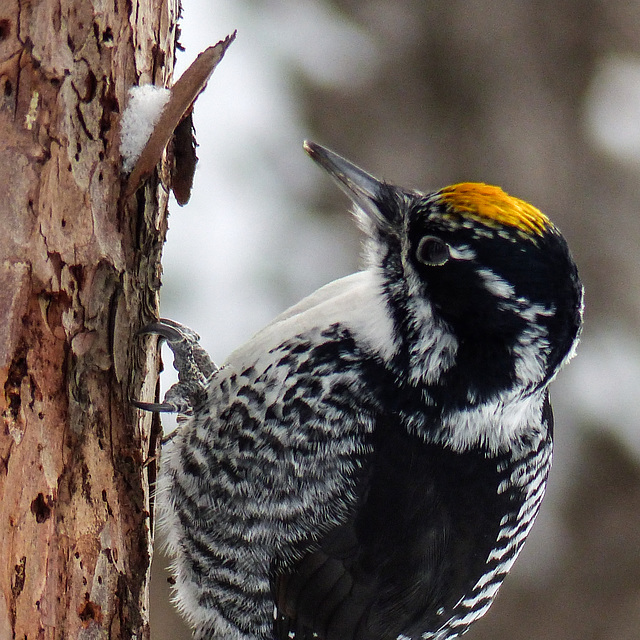
01 Dec 2014
American Three-toed Woodpecker male
Taken five days ago (1 December 2014) in Fish Creek Park. After calling in at Votier’s Flats just before noon, I then drove over to Bebo Grove to see if there was any sign of the Barred Owl – no there wasn't and two other people had looked and been unsuccessful. I did see this male American Three-toed Woodpecker, though, which is always a treat, especially as it is rare species in Alberta. I love the bright yellow feathers that only the males have.
This photo shows a tree that has had a lot of its bark removed, leaving the orange-coloured wood exposed. The Woodpecker wants to get to the larvae that are beneath the bark, so the bark has to be removed. Some trees are almost completely orange, so much bark has been peeled away by a Woodpecker. In winter, when there is snow on the ground, you can see the small pieces of bark lying around the base of the tree, on top of the snow, if a Woodpecker has been at work very recently. Unfortunately, this photo is not as sharp as I wish it had been.
"The American Three-toed Woodpecker is found in boreal forests and montane coniferous forests across North America. Because of its choice of habitat, it is infrequently seen by most people." From AllAboutBirds.
www.allaboutbirds.org/guide/American_Three-toed_Woodpecke...
en.wikipedia.org/wiki/American_three-toed_woodpecker
Jump to top
RSS feed- Latest items - Subscribe to the latest items added to this album
- ipernity © 2007-2026
- Help & Contact
|
Club news
|
About ipernity
|
History |
ipernity Club & Prices |
Guide of good conduct
Donate | Group guidelines | Privacy policy | Terms of use | Statutes | In memoria -
Facebook
X
