


Red Rock Coulee, Alberta


20 Sep 2013
1 favorite
1 comment
Concretions at Red Rock Coulee
Another landscape photo taken at Red Rock Coulee in SE Alberta. We left Calgary on Monday morning, 20 September 2013, and had to reach Elkwater in the Cypress Hills (not that far from the Saskatchewan border), several hours' drive away, where we were going to stay in a little rustic cabin for three nights. On the way there, we stopped at Red Rock Coulee, which is just 56 kms (35 mi) southwest of Medicine Hat. Actually, this particular photo was taken on Monday, 23 September 2013, when we called in again, this time walking down the hillside and into one of the coulees. While my friends searched for Lichens, I wandered around, taking photos of the scenery and anything else I came across. While we were down there, the sky had filled with some rather nice clouds, which I appreciated. However, the extremely high winds were not pleasant at all, to say the least! In fact, strong winds were everywhere in many parts of SE Alberta. I was expecting a lot of my photos to be very blurry, as I could barely keep my balance or hold my camera. Amazingly, most seem to be OK to use, from the very quick look I've taken so far. This is Rattlesnake territory, too, but fortunately we didn't come across any, thank goodness! At least, not here, but one was seen (not by me!) at the Pinhorn Grazing Lease, when we were monitoring the Yucca plants.
"The main feature of this natural landscape is the huge red boulders; some measuring 2.5 m across. They are scattered over a relatively small distance. Bedrock is close to the surface in this area, covered by only a thin layer of soil. Water erosion has carved the landscape over time and a badlands topography has formed in places. The bands of colour visible in the exposed bedrock are made of dark gray shales, greenish and gray sandstones, bentonitic clays and thin bands of ironstone.
The most striking features of this landscape are the round reddish boulders. These are sandstone concretions and at up to 2.5 m in diameter, they are among the largest in the world. The boulders were formed in prehistoric seas as layers of sand, calcite and iron oxide collected around a nucleus formed by shells, leaves or bones. The concretions grew larger as the circulating waters deposited more layers. The reddish colour comes from iron oxide." From Wikipedia.
en.wikipedia.org/wiki/Red_Rock_Coulee
23 Sep 2013
1 favorite
2 comments
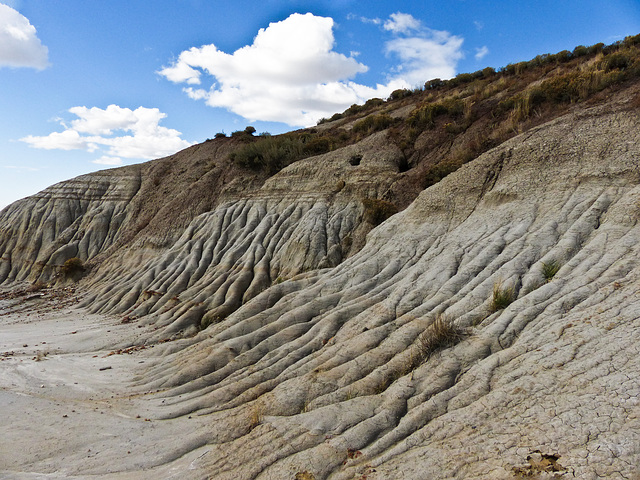
Erosion at Red Rock Coulee
Another landscape photo taken at Red Rock Coulee in SE Alberta. We left Calgary on Monday morning, 20 September 2013, and had to reach Elkwater in the Cypress Hills (not that far from the Saskatchewan border), several hours' drive away, where we were going to stay in a little rustic cabin for three nights. On the way there, we stopped at Red Rock Coulee, which is just 56 kms (35 mi) southwest of Medicine Hat. Actually, this particular photo was taken on Monday, 23 September 2013, when we called in again, this time walking down the hillside and into one of the coulees. While my friends searched for Lichens, I wandered around, taking photos of the scenery and anything else I came across. These eroded, layered hills are similar to some of those seen in places like Drumheller and DInosaur Provincial Park. The extremely high winds were not pleasant at all, to say the least! In fact, strong winds were everywhere in many parts of SE Alberta. I was expecting a lot of my photos to be very blurry, as I could barely keep my balance or hold my camera. Amazingly, most seem to be OK to use, from the very quick look I've taken so far. This is Rattlesnake territory, too, but fortunately we didn't come across any, thank goodness! At least, not here, but one was seen (not by me!) at the Pinhorn Grazing Lease, when we were monitoring the Yucca plants.
"The main feature of this natural landscape is the huge red boulders; some measuring 2.5 m across. They are scattered over a relatively small distance. Bedrock is close to the surface in this area, covered by only a thin layer of soil. Water erosion has carved the landscape over time and a badlands topography has formed in places. The bands of colour visible in the exposed bedrock are made of dark gray shales, greenish and gray sandstones, bentonitic clays and thin bands of ironstone.
The most striking features of this landscape are the round reddish boulders. These are sandstone concretions and at up to 2.5 m in diameter, they are among the largest in the world. The boulders were formed in prehistoric seas as layers of sand, calcite and iron oxide collected around a nucleus formed by shells, leaves or bones. The concretions grew larger as the circulating waters deposited more layers. The reddish colour comes from iron oxide." From Wikipedia.
en.wikipedia.org/wiki/Red_Rock_Coulee
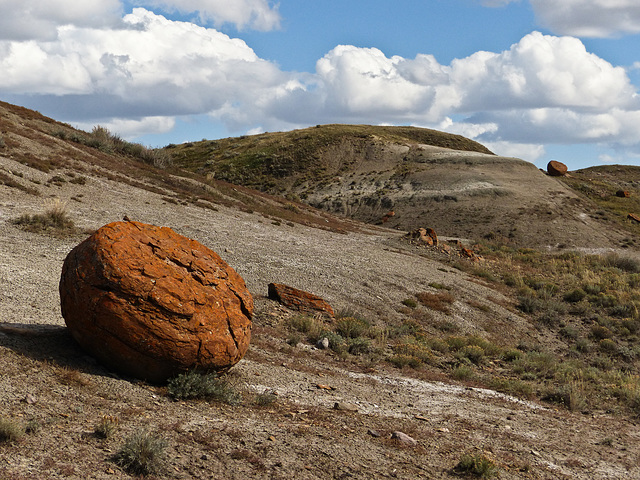
Uniqueness
Another landscape photo taken at Red Rock Coulee in SE Alberta. We left Calgary on Monday morning, 20 September 2013, and had to reach Elkwater in the Cypress Hills (not that far from the Saskatchewan border), several hours' drive away, where we were going to stay in a little rustic cabin for three nights. On the way there, we stopped at Red Rock Coulee, which is just 56 kms (35 mi) southwest of Medicine Hat. Actually, this particular photo was taken on Monday, 23 September 2013, when we called in again, this time walking down the hillside and into one of the coulees. While my friends searched for Lichens, I wandered around, taking photos of the scenery and anything else I came across. While we were down there, the sky had filled with some rather nice clouds, which I appreciated. However, the extremely high winds were not pleasant at all, to say the least! In fact, strong winds were everywhere in many parts of SE Alberta. I was expecting a lot of my photos to be blurry, as I could barely keep my balance or hold my camera. Amazingly, most seem to be OK, from the very quick look I've taken so far. This is Rattlesnake territory, too, but fortunately we didn't come across any, thank goodness! At least, not here, but one was seen (not by me!) at the Pinhorn Grazing Lease, when we were monitoring the Yucca plants.
"The main feature of this natural landscape is the huge red boulders; some measuring 2.5 m across. They are scattered over a relatively small distance. Bedrock is close to the surface in this area, covered by only a thin layer of soil. Water erosion has carved the landscape over time and a badlands topography has formed in places. The bands of colour visible in the exposed bedrock are made of dark gray shales, greenish and gray sandstones, bentonitic clays and thin bands of ironstone.
The most striking features of this landscape are the round reddish boulders. These are sandstone concretions and at up to 2.5 m in diameter, they are among the largest in the world. The boulders were formed in prehistoric seas as layers of sand, calcite and iron oxide collected around a nucleus formed by shells, leaves or bones. The concretions grew larger as the circulating waters deposited more layers. The reddish colour comes from iron oxide." From Wikipedia.
en.wikipedia.org/wiki/Red_Rock_Coulee
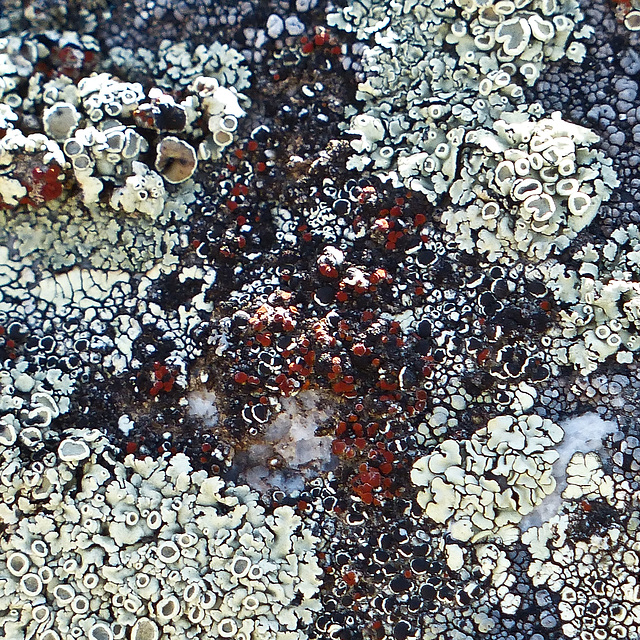
Lichens at Red Rock Coulee
A photo I needed to add to my SE Alberta trip album. Wish I was able to ID Lichens, but eventually I will be able to get the names from the two friends I went with on the road trip. I know the red Lichen proved to be of interest to them. I wonder how many people take a closer look at the splashes of colour on rocks - lichens really are quite fascinating and beautiful : ) Taken on 23 September 2013, down one of the coulees at Red Rock Coulee.
ID, thanks to Janet Marsh and Sandra Davis: Parasite Caloplaca epithallina on crust lichen & Rhizoplaca melanophthalma.
Oh, what a treat!
Got home around 7:45 p.m. yesterday evening (Monday, 23 September 2013) from an amazing four day (three night) road trip down to SE Alberta with two friends. Our furthest destination was Elkwater in the Cypress Hills, but we did a lot of driving all over the SE part of the province. All new territory to me, so I was extremely lucky to get this chance. Both friends had been to this area before, but wanted to go back to see if they could add any new species of Lichen to those already on various lists for each area, and to simply explore this beautiful section on Alberta. Always exciting to see some new things, not to mention all new scenery for me : ) Was really concerned before we went, though, as I had been on antibiotics (which, normally, I never take) for the previous nine days and they were making me feel nauseous and generally sick, and I wasn't sure how I was going to manage the trip. Had to forget the last day of pills, as apart from the nausea, another side-effect was reddening of the skin, and my poor legs looked like they had suffered burns! Think they have also affected my eyes, too, which is really troubling. So thankful I still managed! What I would have missed!
We left Calgary on Monday morning, 20 September 2013, and had to reach Elkwater in the Cypress Hills (not that far from the Saskatchewan border), several hours' drive away, where we were going to stay in a little rustic cabin for three nights. On the way there, we stopped at Red Rock Coulee, which is just 56 kms (35 mi) southwest of Medicine Hat, and you can see just a tiny bit in my photo above. Actually, this particular photo was taken yesterday, Monday 23 September 2013, when we called in again, this time walking down the hillside and into one of the coulees. While my friends searched for Lichens, I wandered around, taking photos of the scenery and anything else I came across. While we were down there, the sky had filled with some rather nice clouds, which I appreciated. However, the extremely high winds were not pleasant at all, to say the least! In fact, strong winds were everywhere in many parts of SE Alberta. I was expecting a lot of my photos to be blurry, as I could barely keep my balance or hold my camera. Amazingly, most seem to be OK, from the very quick look I've taken so far. This is Rattlesnake territory, too, but fortunately we didn't come across any!
"The main feature of this natural landscape is the huge red boulders; some measuring 2.5 m across. They are scattered over a relatively small distance. Bedrock is close to the surface in this area, covered by only a thin layer of soil. Water erosion has carved the landscape over time and a badlands topography has formed in places. The bands of colour visible in the exposed bedrock are made of dark gray shales, greenish and gray sandstones, bentonitic clays and thin bands of ironstone.
The most striking features of this landscape are the round reddish boulders. These are sandstone concretions and at up to 2.5 m in diameter, they are among the largest in the world. The boulders were formed in prehistoric seas as layers of sand, calcite and iron oxide collected around a nucleus formed by shells, leaves or bones. The concretions grew larger as the circulating waters deposited more layers. The reddish colour comes from iron oxide." From Wikipedia.
en.wikipedia.org/wiki/Red_Rock_Coulee
www.flickr.com/photos/annkelliott/9916309166
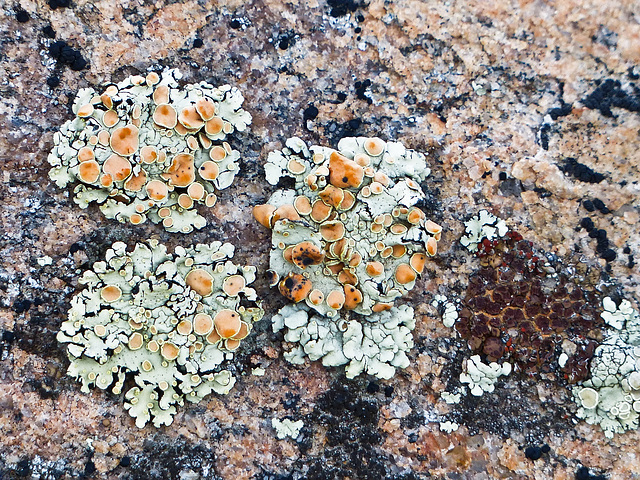
One of my favourite Lichens
I know practically nothing about Lichens, but I did recognize this pale green and orange one. I always enjoy seeing this species and it's fun to photograph (though not in the extremely powerful winds that were blowing the whole time we were at Red Rock Coulee, and elsewhere, in SE Alberta). Taken on Monday, 23 September 2013, when we called in at this location for a second time, this time climbing down into one of the coulees, on the final day of our four-day road trip. Comparing to other photos, I wonder if this is Rhizoplaca chrysoleuca? I don't know what the black and the dark brown Lichens are.
ID, thanks to specialist Janet Marsh: Rhizoplaca chrysoleuca.

20 Sep 2013
1 favorite
1 comment
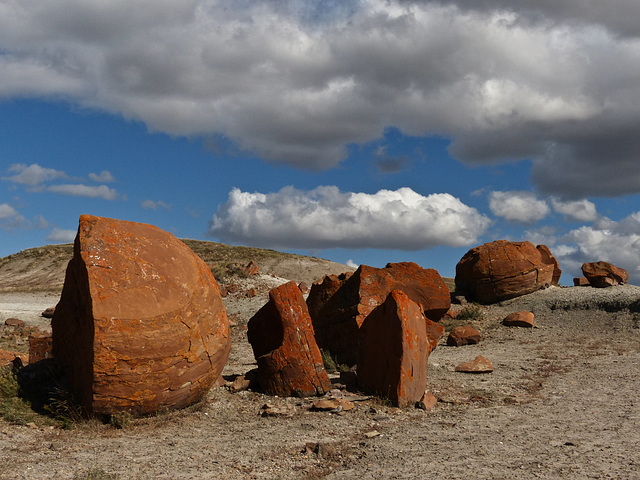
The split
Another landscape photo taken at Red Rock Coulee in SE Alberta. We left Calgary on Monday morning, 20 September 2013, and had to reach Elkwater in the Cypress Hills (not that far from the Saskatchewan border), several hours' drive away, where we were going to stay in a little rustic cabin for three nights. On the way there, we stopped at Red Rock Coulee, which is just 56 kms (35 mi) southwest of Medicine Hat. Some of the huge red concretions had split in half, like the one in this image. This is Rattlesnake territory, too, but fortunately we didn't come across any, thank goodness! At least, not here, but one was seen (not by me!) at the Pinhorn Grazing Lease, when we were monitoring the Yucca plants.
"The main feature of this natural landscape is the huge red boulders; some measuring 2.5 m across. They are scattered over a relatively small distance. Bedrock is close to the surface in this area, covered by only a thin layer of soil. Water erosion has carved the landscape over time and a badlands topography has formed in places. The bands of colour visible in the exposed bedrock are made of dark gray shales, greenish and gray sandstones, bentonitic clays and thin bands of ironstone.
The most striking features of this landscape are the round reddish boulders. These are sandstone concretions and at up to 2.5 m in diameter, they are among the largest in the world. The boulders were formed in prehistoric seas as layers of sand, calcite and iron oxide collected around a nucleus formed by shells, leaves or bones. The concretions grew larger as the circulating waters deposited more layers. The reddish colour comes from iron oxide." From Wikipedia.
en.wikipedia.org/wiki/Red_Rock_Coulee
20 Sep 2013
4 favorites
1 comment
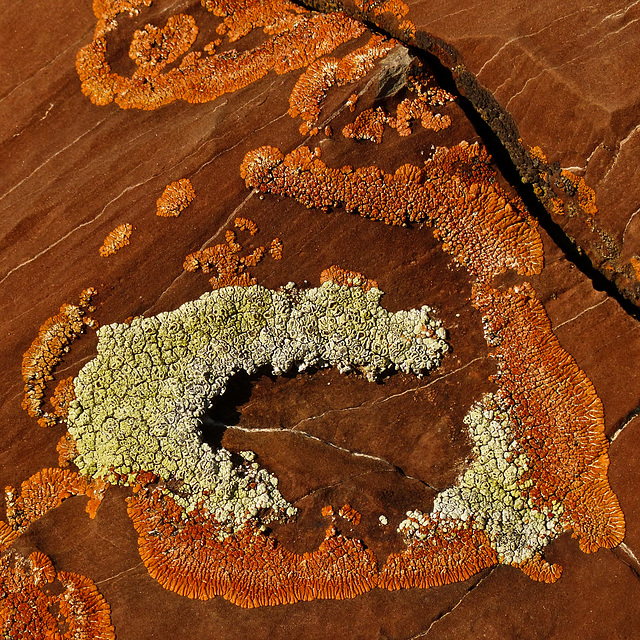
Lichens on Red Rock Coulee boulder
The Lichens that were growing on the huge, red rock concretions at Red Rock Coulee, in Southern Alberta, were just so beautiful. No doubt just common ones, but they were huge and colourful. Is the orange lichen Xanthoria elegans? Taken on 20 September 2013, the first day of a four-day trip with a couple of friends, travelling as far as Cypress Hills, where we stayed in a rustic cabin for three nights. We called in at Red Rock Coulee again on our way home to Calgary, but that time we climbed down into one of the coulees to look for mosses and lichens - and anything else of interest and beauty.
23 Sep 2013
1 favorite
1 comment
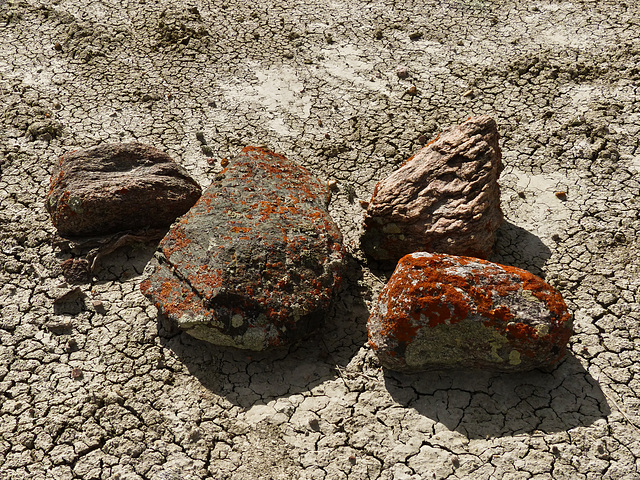
Small rocks, Red Rock Coulee
I had another image that I took at Red Rock Coulee all ready to upload this evening, but after many attempts, I had to give up. Took forever to upload each time and then it told me that it hadn't worked. So, I grabbed another shot from the same folder. I loved Red Rock Coulee, in Southern Alberta. A couple of friends and I visited this location twice during our 4-day trip last September (2012), and on the second visit, we climbed down into one of the coulees. Such a dry area - and Rattlesnake country! - with mud cracks and rocks scattered all over the place. Taken on 23 September 2013.
Jump to top
RSS feed- Latest items - Subscribe to the latest items added to this album
- ipernity © 2007-2026
- Help & Contact
|
Club news
|
About ipernity
|
History |
ipernity Club & Prices |
Guide of good conduct
Donate | Group guidelines | Privacy policy | Terms of use | Statutes | In memoria -
Facebook
X
