


US holiday, September 2012

I had an absolutely amazing week away with my friends from England, Linda and Tony. We left Calgary early on 11 September 2012 and returned late on 17 September 2012. Believe it or not, this was only my second holiday in about 30 years! Some of you may remember that when my Brother in England died almost two years ago, several of my long-time friends who lived in the same city stepped forward a…
(read more)
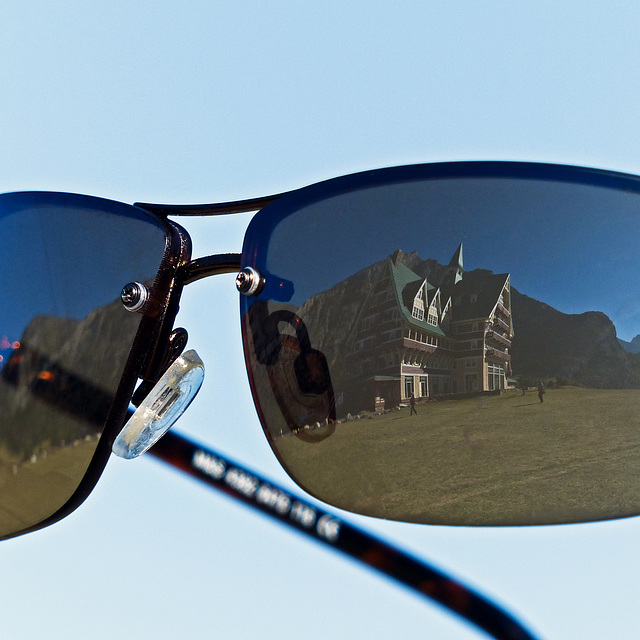

Quick reflection reaction
Lol, when I was down in Waterton National Park on the final day of a week's holiday with friends, Linda and Tony from England, I happened to notice that Tony had a lovely reflection of the old Prince of Wales hotel in his sunglasses. Before I had finished raising my camera to take a zoomed in shot, Tony had removed his glasses at top speed to avoid having his photo taken - not as fast as I would have removed mine, though, I can tell you!. Had to take this shot instead : )
"Built in 1926-27 during one of Waterton’s windiest and snowiest winters, the Prince of Wales Hotel is the park's most recognized landmark.
During its construction the extreme weather conditions and poor access created many problems for contractors Douglas Oland and James Scott, from Cardston, Alberta.
On December 10 1926 hurricane-force winds (estimated at 145 km/hr) blew each of the hotel's wings about 7.5 cm off their foundation. The men managed to winch the sections back in line. Three months later winds reached speeds of over 129 km/hr, again pushing the building off its foundation. This time Oland feared structural damage if they tried to pull back the now fully-framed building so he decided to leave it slightly out of plume.
The hotel is named after Edward, Prince of Wales who later became King Edward VIII, and, like its namesake, it has a colourful history. If its Douglas fir pillars could talk they would tell you a tale of American imagination and money, built with Canadian grit and patience.
Today, many people recognize the Prince of Wales as a railway hotel, but few realize it was built by the Great Northern of United States ... and not the Canadian Pacific.
In February 1993 the Historic Sites and Monuments Board approved the Prince of Wales' designation as a National Historic Site, recognizing its architectural style (rustic design tradition, with peaked roofs, gables, balconies and timber-frame interior that give it an appearance of a giant alpine chalet) and its contribution to tourism in the mountains. On July 23 1995 a commemorative plaque ceremony was held at the hotel." From Parks Canada.
www.pc.gc.ca/pn-np/ab/waterton/natcul/natcul4.aspx
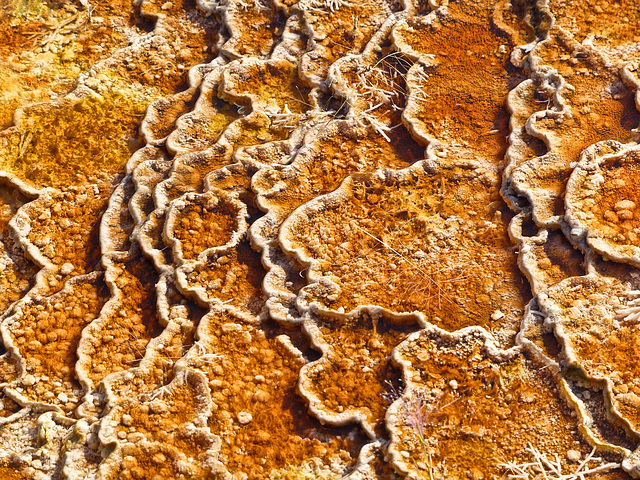
Patterns, Mammoth Hot Springs
So many beautiful patterns and textures are created around the various springs at Mammoth Hot Springs and other hot spring/geyser locations within Yellowstone National Park. This shot was taken from the boardwalk, looking over the railing, near the Main Terrace at Mammoth Hot Springs, on 12 September 2012.
"Mammoth Hot Springs is a large complex of hot springs on a hill of travertine in Yellowstone National Park ... It was created over thousands of years as hot water from the spring cooled and deposited calcium carbonate (over two tons flow into Mammoth each day in a solution). Although these springs lie outside the caldera boundary, their energy has been attributed to the same magmatic system that fuels other Yellowstone geothermal areas... A caldera is a cauldron-like volcanic feature usually formed by the collapse of land following a volcanic eruption. They are sometimes confused with volcanic craters."
en.wikipedia.org/wiki/Mammoth_Hot_Springs
For a diagram of the Hot Springs layout:
en.wikipedia.org/wiki/File:MammothHotSprings.JPG
Map of Yellowstone National Park:
hfc.nps.gov/carto/PDF/YELLmap2.pdf
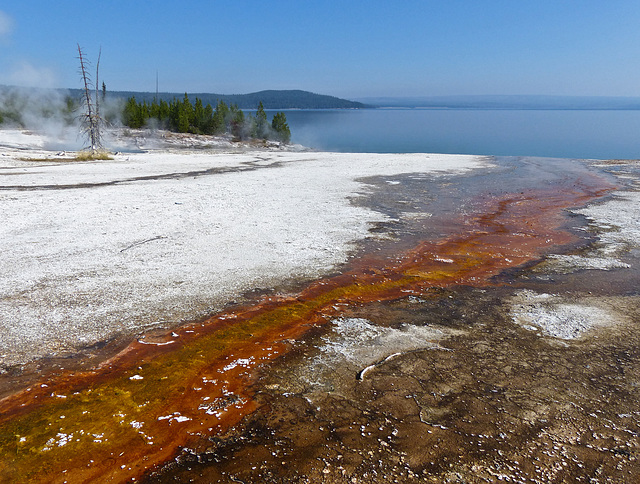
Flowing into Yellowstone Lake
I really liked this particular area of hot springs in Yellowstone National Park, West Thumb Geyser Basin, as it was interesting to see how some of them were actually just off-shore, in Yellowstone Lake itself. My image shows one of the springs flowing into the lake, over the colourful deposits and growths. Taken between Big Cone and Black Pool. From this spot, we were happy to see two (or was it three?) beautiful Bald Eagles in the dead trees at the edge of the Basin. Somehow, I just wasn't expecting to see these majestic raptors in a place like this.
I hope you're not getting TOO fed up of hot spring photos, especially as I still have a lot more to go through!
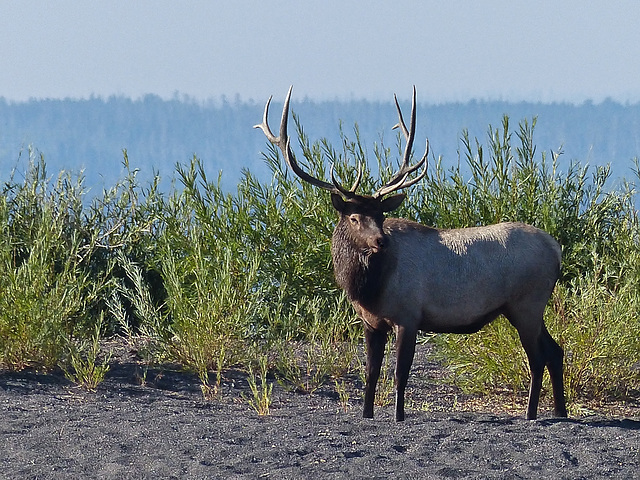
King of the lake
On two mornings, we were lucky enough to see several beautiful Elk on this narrow strip of land rising out of Yellowstone Lake, Wyoming, US. This stag was the only male, along with his females. Taken on 13 September 2012, the third day of a week away in Yellowstone and Grand Teton National Parks. There was a lot of haze in the park from forest fires.
"Elk (Cervus elaphus) are the most abundant large mammal found in Yellowstone; paleontological evidence confirms their continuous presence for at least 1,000 years. Yellowstone National Park was established in 1872, when market hunting of all large grazing animals was rampant. Not until after 1886, when the U.S. Army was called in to protect the park and wildlife slaughter was brought under control, did the large animals increase in number.
More than 30,000 elk from 7-8 different herds summer in Yellowstone and approximately 15,000 to 22,000 winter in the park."
www.nps.gov/yell/naturescience/elk.htm
What a performance with uploading my images this morning. Ended up having to use the old uploader - but even that wouldn't load the last photo. I've been trying for about an hour now.
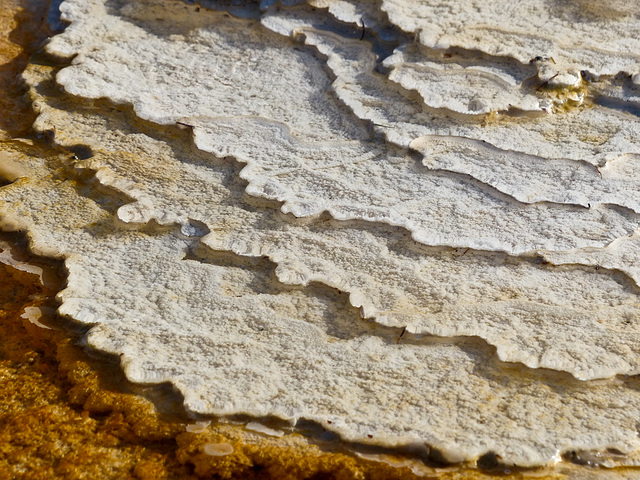
Delicate layers
One of the many patterns that have been formed around the hot springs at Mammoth Hot Springs, Yellowstone National Park, Wyoming, US. These were such beautiful, thin, delicate layers.
"Mammoth Hot Springs is a large complex of hot springs on a hill of travertine in Yellowstone National Park ... It was created over thousands of years as hot water from the spring cooled and deposited calcium carbonate (over two tons flow into Mammoth each day in a solution). Although these springs lie outside the caldera boundary, their energy has been attributed to the same magmatic system that fuels other Yellowstone geothermal areas... A caldera is a cauldron-like volcanic feature usually formed by the collapse of land following a volcanic eruption. They are sometimes confused with volcanic craters."
en.wikipedia.org/wiki/Mammoth_Hot_Springs
For a diagram of the Hot Springs layout:
en.wikipedia.org/wiki/File:MammothHotSprings.JPG
Map of Yellowstone National Park:
hfc.nps.gov/carto/PDF/YELLmap2.pdf
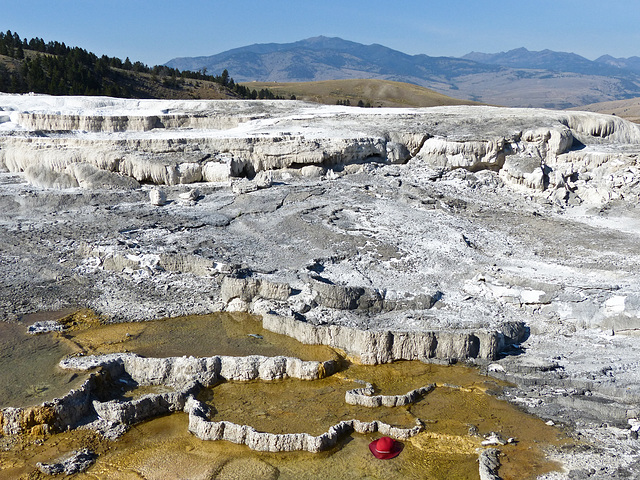
The Red Hat
Judging by the rather nice hat, I am guessing that it was blown rather than thrown! Couldn't resist taking a shot, as it added a small splash of colour to a rather colourless landscape. Taken at Mammoth Hot Springs, Yellowstone National Park, Wyoming, US, on 12 September 2012.
I visited Mammoth Hot Springs and the rest of Yellowstone National Park 32 years ago, when my kids were very young. Loved Mammoth Hot Springs, so was thrilled to get the chance to see this fascinating area again.
"Mammoth Hot Springs is a large complex of hot springs on a hill of travertine in Yellowstone National Park ... It was created over thousands of years as hot water from the spring cooled and deposited calcium carbonate (over two tons flow into Mammoth each day in a solution). Although these springs lie outside the caldera boundary, their energy has been attributed to the same magmatic system that fuels other Yellowstone geothermal areas... A caldera is a cauldron-like volcanic feature usually formed by the collapse of land following a volcanic eruption. They are sometimes confused with volcanic craters."
en.wikipedia.org/wiki/Mammoth_Hot_Springs
For a diagram of the Hot Springs layout:
en.wikipedia.org/wiki/File:MammothHotSprings.JPG
Map of Yellowstone National Park:
hfc.nps.gov/carto/PDF/YELLmap2.pdf
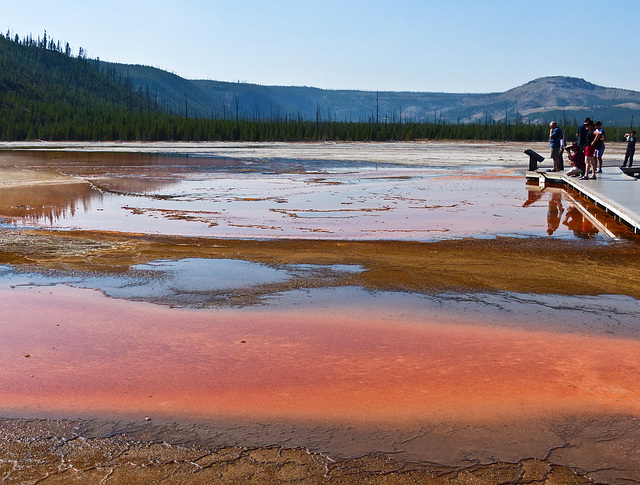
Looking in awe
How we (friends from England, Linda and Tony, and myself) enjoyed ourselves at this wonderful hot springs location in Yellowstone National Park on 13 September 2012! The colours and patterns were spectacular.
'"The Grand Prismatic Spring in Yellowstone National Park is the largest hot spring in the United States, and the third largest in the world, after Frying Pan Lake in New Zealand and Boiling Lake in Dominica. It is located in the Midway Geyser Basin.
Grand Prismatic Spring was noted by geologists working in the Hayden Geological Survey of 1871, and named by them for its striking coloration. Its colors include blue, green, yellow, orange, red and brown, and recall the rainbow disperson of white light by an optical prism.
The vivid colors in the spring are the result of pigmented bacteria in the microbial mats that grow around the edges of the mineral-rich water. The bacteria produce colors ranging from green to red; the amount of color in the microbial mats depends on the ratio of chlorophyll to carotenoids and on the temperature of the water which favors one bacterium over another. In the summer, the mats tend to be orange and red, whereas in the winter the mats are usually dark green. The center of the pool is sterile due to extreme heat.... The spring is approximately 250 by 300 feet (80 by 90 m) in size and is 160 feet (50 m) deep. The spring discharges an estimated 560 US gallons (2,100 L) of 160 °F (70 °C) water per minute." From Wikipedia.
en.wikipedia.org/wiki/Grand_Prismatic_Spring
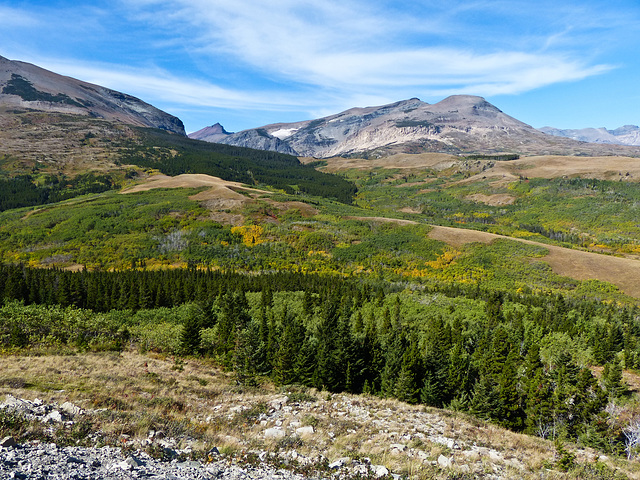
17 Sep 2012
Glacier National Park, Montana, US
I had forgotten what a beautiful place Glacier National Park is until I got the chance to travel though it, with friends, Linda and Tony, from England, mid-September. It had been 32 years since I had been there once before. A wonderful mix of mountain peaks and ridges along with rolling hills. Taken on 17 September 2012, the last day of our week's holiday, on our way from Kalispell to Calgary via Glacier National Park and adjoining Waterton Lakes National Park..
Grand Prismatic Spring, Yellowstone National Park
Congratulations to Americans, everywhere! That was a pretty tense evening yesterday, waiting to see if President Obama would be elected to serve another four years, or if the US would have a brand new President. Actually, I knew the result before anyone else, lol! How? Because I fell asleep in front of the TV part way through the evening and had a great dream in which I watched Michelle Obama reacting with joy at the announcement that her husband had won, ha, ha. I woke with a start, maybe 30 seconds before the very final predictions were announced on TV, saying that Obama was in.
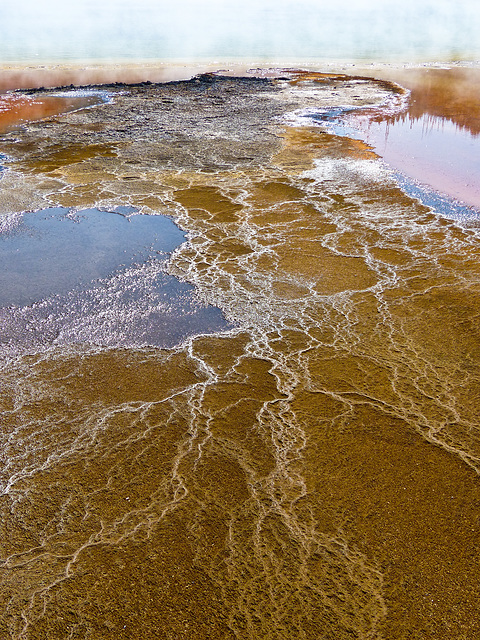
Another view of the beautiful patterns and formations around the Grand Prismatic Spring, Yellowstone National Park, Wyoming, US. You can see the steam rising from the huge spring at the top of the image. In some places, the colours were more vibrant and orange, as in my photo below. I think the photo in the comment box is perhaps my favourite photo from around the Grand Prismatic Spring.
"The Grand Prismatic Spring in Yellowstone National Park is the largest hot spring in the United States, and the third largest in the world, after Frying Pan Lake in New Zealand and Boiling Lake in Dominica. It is located in the Midway Geyser Basin.
Grand Prismatic Spring was noted by geologists working in the Hayden Geological Survey of 1871, and named by them for its striking coloration. Its colors include blue, green, yellow, orange, red and brown, and recall the rainbow disperson of white light by an optical prism.
The vivid colors in the spring are the result of pigmented bacteria in the microbial mats that grow around the edges of the mineral-rich water. The bacteria produce colors ranging from green to red; the amount of color in the microbial mats depends on the ratio of chlorophyll to carotenoids and on the temperature of the water which favors one bacterium over another. In the summer, the mats tend to be orange and red, whereas in the winter the mats are usually dark green. The center of the pool is sterile due to extreme heat.... The spring is approximately 250 by 300 feet (80 by 90 m) in size and is 160 feet (50 m) deep. The spring discharges an estimated 560 US gallons (2,100 L) of 160 °F (70 °C) water per minute." From Wikipedia.
en.wikipedia.org/wiki/Grand_Prismatic_Spring
Jump to top
RSS feed- Latest items - Subscribe to the latest items added to this album
- ipernity © 2007-2026
- Help & Contact
|
Club news
|
About ipernity
|
History |
ipernity Club & Prices |
Guide of good conduct
Donate | Group guidelines | Privacy policy | Terms of use | Statutes | In memoria -
Facebook
X
