


Mountain Bluebird


10 Jun 2015
1 favorite
Blue and banded
Wednesday, 10 June 2015, was only what I would call a "magical" evening! Normally, I never go out in the evening - usually just too tired and there are all sorts of things needing to be done on my computer. However, having driven SW of the city the previous day and noticing a baby Mountain Bluebird poking its head out of its nesting box, I knew that any time now that it and its siblings would be suddenly gone. Since then, I have been back one time and a Tree Swallow poked its head out of the Bluebird nesting box, letting me know that this Bluebird family had fledged and moved away. The male Bluebird seen in this photo was taken at a different location the same evening.
In Bluebirds, the blue colour is produced by the structure of the feather - there is no blue pigment. "Tiny air pockets in the barbs of feathers can scatter incoming light, resulting in a specific, non-iridescent color. Blue colors in feathers are almost always produced in this manner. Examples include the blue feathers of Bluebirds, Indigo Buntings, Blue Jay's and Steller's Jays."
www.allaboutbirds.org/guide/Mountain_Bluebird/id
www.jstor.org/discover/pgs/index?id=10.2307/4077277&i...
It was early evening when I left home on 10 June, after a volunteer shift and a haircut. Really, I was just going to check on the Bluebirds and was not expecting to see all that much else.That's how the evening started, but as the evening progressed, the world seemed to come alive with bird song and activity. It has been a long, long time since I've experienced that, if ever.
Though my trip was mainly just to check on the Bluebirds, I was also lucky to see an American Robin sitting on a barbed-wire fence just a couple of feet away from a brilliant blue male Bluebird (not this one). Talk about colour! They were way down the road, so I was only able to get a very distant shot. Also saw a number of Snipe that I love photographing.
When I reached the point where I was going to turn around and head for home, I saw yet another Snipe perched on a fence. Just a few feet from it, on the same fence, was a beautiful Swainson's Hawk! After posing for a while, both birds took off, with the Hawk in hot pursuit of the Snipe. I couldn't see how the chase ended, but hopefully the world is not missing a Snipe.
Closer to home, I suddenly spotted a beautiful female Moose at a small wetland, right before I turned on to the main highway. Not sure if it's because I took my first photos (including this one) of her from inside the car, across the passenger seat, but most were blurry. Eventually, she left and started walking along the road away from the highway. I crawled along, watching her way in the distance. She kept walking from side to side of the road and then stopped to lick some salt off the road, bending her front legs to kneel in what looked a very awkward move : ) At this point, I stopped my car and turned on the hazard flashing lights, as she wasn't too obvious in the shadows from the trees at the edge of the road. I can see how easily a collision can happen! Fortunately, only one car came along, from behind my car, and the guy slowed down and was smiling. Took a while, but eventually the huge, majestic animal leapt over a barbed-wire fence and sauntered off into the trees.
Driving back to the highway, I stopped to watch three or four young White-tailed Deer having fun at the same wetland. One of them was standing in the water and would occasionally stamp one of its front legs to make a splash and then bound away a few feet. Funny to watch and so good to see it playing so happily.
So, it was quite the evening, to say the least! I drove all the way home with a big smile on my face.
29 Jun 2015
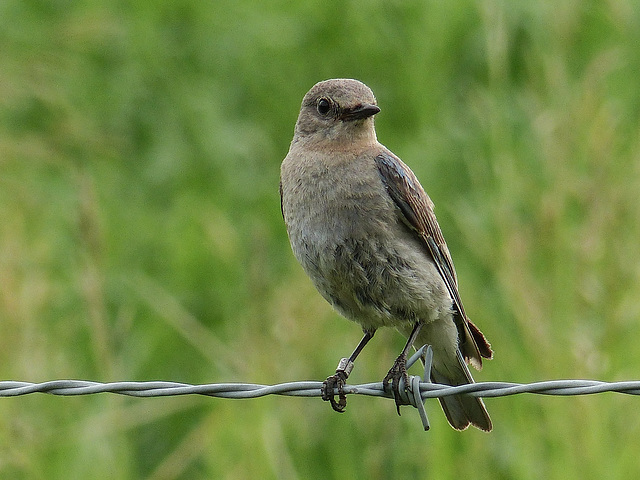
Mountain Bluebird female
Yesterday evening, 29 June 2015, a small group of us met at 6:30 pm and went SW of the city with Don Stiles, who has been a dedicated Mountain Bluebird Monitor for something like 38 years! It was around 10:00 pm when I arrived home. I told the group that I would post three of the photos I took, on Flickr today. The light was not good for photos, at least not with my camera, and the later it got and the light faded, the worse they turned out. The last couple of weeks, I’ve noticed that many of my photos are not turning out how I would have expected. There seems to be a somewhat green cast on some of them, along with being grainy. I always dread the year and a half mark with any camera I buy – that is when a few things start not working the same.
This drive is an annual trip along Don’s Bluebird Route. We get the chance to see Mountain Bluebirds, Tree Swallows and Wrens nesting in various wooden nesting boxes along the country roads. Some boxes have eggs in the nest, others have tiny babies all packed tightly together. One of the boxes had a female Tree Swallow adult in it, too, and, as it hadn't been banded before, Don demonstrated how he carefully puts a metal band around the tiny leg.
At the one particular Bluebird box, Mom and Dad were waiting nearby, insects in their beaks ready to feed their babies as soon as we had finished. They are such good parents.
Along the route, we saw a few other birds and animals, including a pair of beautiful American Goldfinches, various Blackbirds and a few ducks. We were lucky to see several Elk, too, that were wild – not sure if I can rescue one of the photos I took of them, but will try later.
Many thanks, as always, Don, for letting us come along with you. It is an evening I look forward to every year, and I could tell how much everyone enjoyed themselves yesterday!
In Bluebirds, the blue colour is produced by the structure of the feather - there is no blue pigment. "Tiny air pockets in the barbs of feathers can scatter incoming light, resulting in a specific, non-iridescent color. Blue colors in feathers are almost always produced in this manner. Examples include the blue feathers of Bluebirds, Indigo Buntings, Blue Jay's and Steller's Jays."
www.allaboutbirds.org/guide/Mountain_Bluebird/id
www.jstor.org/discover/pgs/index?id=10.2307/4077277&i...
For anyone who might wonder if a baby bird is handled, will its parents pick up my scent and abandon it? The answer below is from the Cornell Lab of Ornithology:
A. It's a myth that parent birds will abandon young that have been touched by humans—most birds have a poor sense of smell, and birds in general identify their young using the same cues we humans do—appearance and sound. It's perfectly safe to pick up a fallen nestling and put it back in the nest, or to carry a fledgling out of danger and place it in a tree or shrub." Same would apply to bird banding.
NO BIRD OR WILD ANIMAL SHOULD EVER BE KEPT AS A PET!
29 Jun 2015
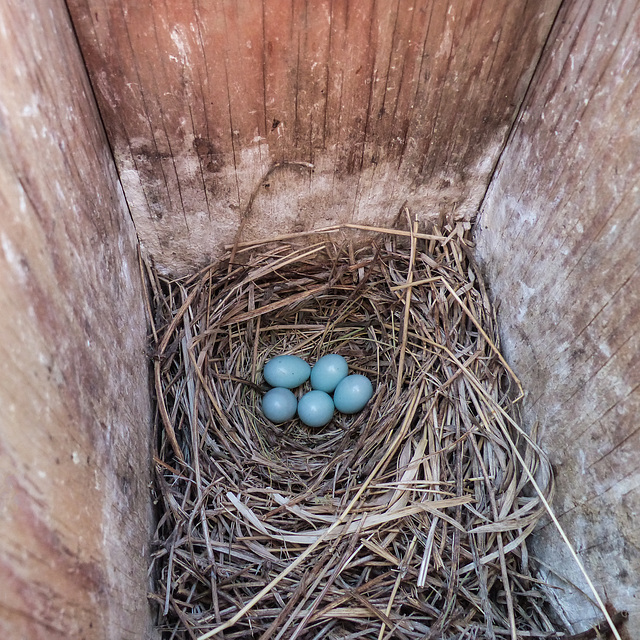
Mountain Bluebird nest with eggs
Yesterday evening, 29 June 2015, a small group of us met at 6:30 pm and went SW of the city with Don Stiles, who has been a dedicated Mountain Bluebird Monitor for something like 38 years! It was around 10:00 pm when I arrived home. I told the group that I would post three of the photos I took, on Flickr today. The light was not good for photos, at least not with my camera, and the later it got and the light faded, the worse they turned out. The last couple of weeks, I’ve noticed that many of my photos are not turning out how I would have expected. There seems to be a somewhat green cast on some of them, along with being grainy. I always dread the year and a half mark with any camera I buy – that is when a few things start not working the same.
This drive is an annual trip along Don’s Bluebird Route. We get the chance to see Mountain Bluebirds, Tree Swallows and Wrens nesting in various wooden nesting boxes along the country roads. Some boxes have eggs in the nest, others have tiny babies all packed tightly together. One of the boxes had a female Tree Swallow adult in it, too, and, as it hadn't been banded before, Don demonstrated how he carefully puts a metal band around the tiny leg.
At the one particular Bluebird box, Mom and Dad were waiting nearby, insects in their beaks ready to feed their babies as soon as we had finished. They are such good parents.
Along the route, we saw a few other birds and animals, including a pair of beautiful American Goldfinches, various Blackbirds and a few ducks. We were lucky to see several Elk, too, that were wild – not sure if I can rescue one of the photos I took of them, but will try later.
Many thanks, as always, Don, for letting us come along with you. It is an evening I look forward to every year, and I could tell how much everyone enjoyed themselves yesterday!
In Bluebirds, the blue colour is produced by the structure of the feather - there is no blue pigment. "Tiny air pockets in the barbs of feathers can scatter incoming light, resulting in a specific, non-iridescent color. Blue colors in feathers are almost always produced in this manner. Examples include the blue feathers of Bluebirds, Indigo Buntings, Blue Jay's and Steller's Jays."
www.allaboutbirds.org/guide/Mountain_Bluebird/id
www.jstor.org/discover/pgs/index?id=10.2307/4077277&i...
For anyone who might wonder if a baby bird is handled, will its parents pick up my scent and abandon it? The answer below is from the Cornell Lab of Ornithology:
A. It's a myth that parent birds will abandon young that have been touched by humans—most birds have a poor sense of smell, and birds in general identify their young using the same cues we humans do—appearance and sound. It's perfectly safe to pick up a fallen nestling and put it back in the nest, or to carry a fledgling out of danger and place it in a tree or shrub." Same would apply to bird banding.
NO BIRD OR WILD ANIMAL SHOULD EVER BE KEPT AS A PET!
29 Jun 2015
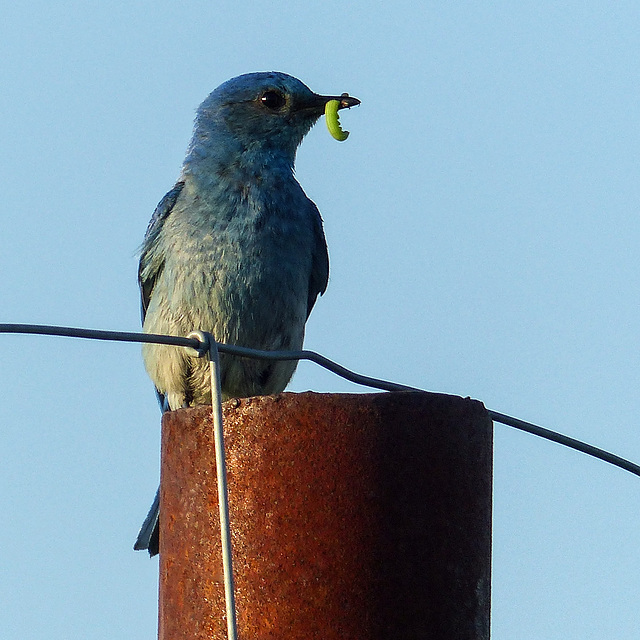
Mountain Bluebird male
Yesterday evening, 29 June 2015, a small group of us met at 6:30 pm and went SW of the city with Don Stiles, who has been a dedicated Mountain Bluebird Monitor for something like 38 years! It was around 10:00 pm when I arrived home. I told the group that I would post three of the photos I took, on Flickr today. The light was not good for photos, at least not with my camera, and the later it got and the light faded, the worse they turned out. The last couple of weeks, I’ve noticed that many of my photos are not turning out how I would have expected. There seems to be a somewhat green cast on some of them, along with being grainy. I always dread the year and a half mark with any camera I buy – that is when a few things start not working the same.
This drive is an annual trip along Don’s Bluebird Route. We get the chance to see Mountain Bluebirds, Tree Swallows and Wrens nesting in various wooden nesting boxes along the country roads. Some boxes have eggs in the nest, others have tiny babies all packed tightly together. One of the boxes had a female Tree Swallow adult in it, too, and, as it hadn't been banded before, Don demonstrated how he carefully puts a metal band around the tiny leg.
At the one particular Bluebird box, Mom and Dad were waiting nearby, insects in their beaks ready to feed their babies as soon as we had finished. They are such good parents.
Along the route, we saw a few other birds and animals, including a pair of beautiful American Goldfinches, various Blackbirds and a few ducks. We were lucky to see several Elk, too, that were wild – not sure if I can rescue one of the photos I took of them, but will try later.
Many thanks, as always, Don, for letting us come along with you. It is an evening I look forward to every year, and I could tell how much everyone enjoyed themselves yesterday!
In Bluebirds, the blue colour is produced by the structure of the feather - there is no blue pigment. "Tiny air pockets in the barbs of feathers can scatter incoming light, resulting in a specific, non-iridescent color. Blue colors in feathers are almost always produced in this manner. Examples include the blue feathers of Bluebirds, Indigo Buntings, Blue Jay's and Steller's Jays."
www.allaboutbirds.org/guide/Mountain_Bluebird/id
www.jstor.org/discover/pgs/index?id=10.2307/4077277&i...
For anyone who might wonder if a baby bird is handled, will its parents pick up my scent and abandon it? The answer below is from the Cornell Lab of Ornithology:
A. It's a myth that parent birds will abandon young that have been touched by humans—most birds have a poor sense of smell, and birds in general identify their young using the same cues we humans do—appearance and sound. It's perfectly safe to pick up a fallen nestling and put it back in the nest, or to carry a fledgling out of danger and place it in a tree or shrub." Same would apply to bird banding.
NO BIRD OR WILD ANIMAL SHOULD EVER BE KEPT AS A PET!
Maybe I should add that, of course, only a person monitoring Bluebirds should ever open a nesting box.
10 Jun 2015
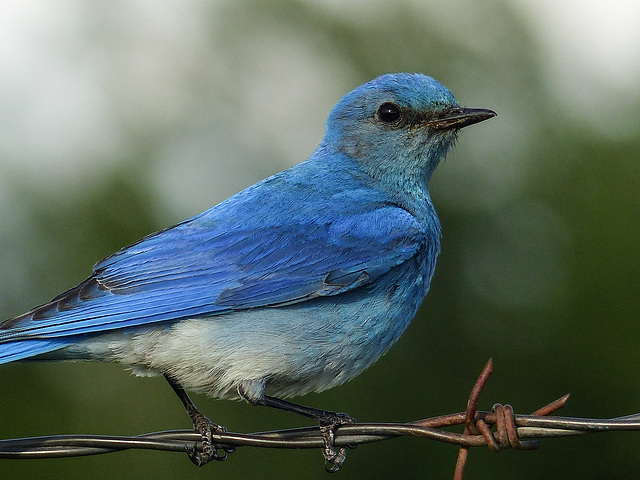
Bluebird of happiness
Sometimes, a quick, close shot ends up missing a bit of the tail of a bird, but I still like the photo : ) The evening of 10 June 2015, was only what I would call a "magical"! Normally, I tend not to go out in the evening - usually just too tired and there are all sorts of things needing to be done on my computer. However, having driven SW of the city the previous day and noticing a baby Mountain Bluebird poking its head out of its nesting box, I knew that any time now, it and its siblings would be suddenly gone. I have been back more recently and found a Tree Swallow looking out from the Bluebirds' nesting box.
It was early evening when I left home on 10 June, after a volunteer shift and a haircut. Really, I was just going to check on the Bluebirds and was not expecting to see all that much else. That's how the evening started, but as the evening progressed, the world seemed to come alive with bird song and activity. It has been a long, long time since I've experienced that, if ever.
Though my trip was mainly just to check on the Bluebirds, I was also lucky to see an American Robin sitting on a barbed-wire fence just a couple of feet away from a brilliant blue male Bluebird. Talk about colour! They were way down the road, so I was only able to get a very distant shot. Also saw a number of Snipe that I love to photograph.
When I reached the point where I was going to turn around and head for home, I saw yet another Snipe perched on a fence. Just a few feet from it, on the same fence rail, was a beautiful Swainson's Hawk! After posing for a while, both birds took off, with the Hawk in hot pursuit of the Snipe. I couldn't see how the chase ended, but hopefully the Snipe escaped.
Closer to home, I suddenly spotted a beautiful female Moose at a small wetland, right before I turned on to the main highway. Not sure if it's because I took my first photos of her from inside the car, across the passenger seat, but most were blurry. Eventually, she left and started walking along the road away from the highway. I crawled along, watching her way in the distance. She kept walking from side to side of the road and then stopped to lick some salt off the road, bending her front legs to kneel in what looked a very awkward move : )
Driving back to the highway, I stopped to watch three or four young White-tailed Deer having fun at the wetland. One of them would occasionally stamp one of its front legs in the water and then bound away a few feet. Funny to watch and so good to see it playing so happily.
So, it was quite the evening, to say the least! I drove all the way home with a big smile on my face.
In Bluebirds, the blue colour is produced by the structure of the feather - there is no blue pigment. "Tiny air pockets in the barbs of feathers can scatter incoming light, resulting in a specific, non-iridescent color. Blue colors in feathers are almost always produced in this manner. Examples include the blue feathers of Bluebirds, Indigo Buntings, Blue Jay's and Steller's Jays."
www.allaboutbirds.org/guide/Mountain_Bluebird/id
www.jstor.org/discover/pgs/index?id=10.2307/4077277&i...
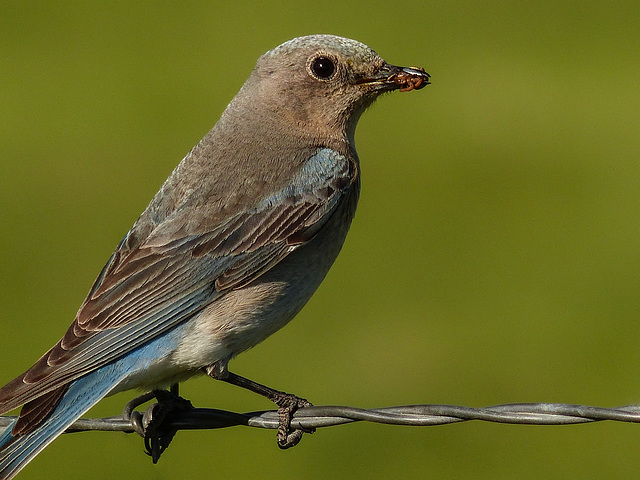
12 Jun 2013
From the archives
I really didn't feel like finding photos or editing them last night, but noticed this one that was ready to post. I have so many Mountain Bluebird photos on my computer, so try to slip one in every once in a while : )
That day, 12 June 2013, this pair of Bluebirds, seen SW of the city, let me take many photos of them, with and without food collected for their babies. Not sure if this female has a small spider in her bill. I found it fascinating to see the different kinds of insects that they caught, and each time they returned with something new, they would perch on the barbed-wire fence near the nesting box and give me a few wonderful poses.
In Bluebirds, the blue colour is produced by the structure of the feather - there is no blue pigment. "Tiny air pockets in the barbs of feathers can scatter incoming light, resulting in a specific, non-iridescent color. Blue colors in feathers are almost always produced in this manner. Examples include the blue feathers of Bluebirds, Indigo Buntings, Blue Jay's and Steller's Jays."
www.allaboutbirds.org/guide/Mountain_Bluebird/id
www.jstor.org/discover/pgs/index?id=10.2307/4077277&i...
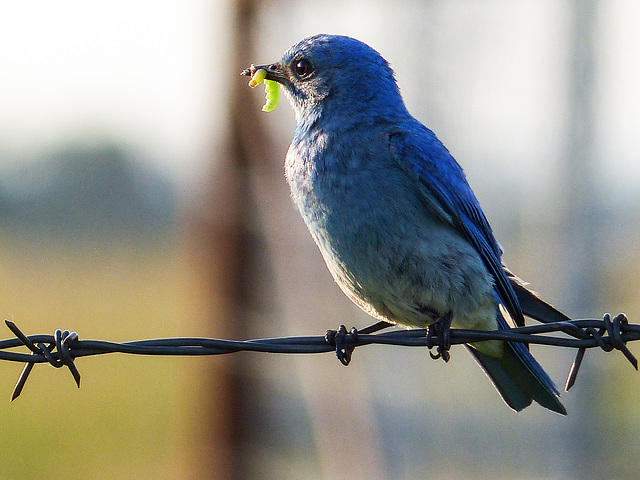
29 Jun 2015
Four more months to wait
On 29 June 2015, a small group of us met at 6:30 pm and went SW of the city with Don Stiles, who has been a dedicated Mountain Bluebird Monitor for something like 38 years! It was around 10:00 pm when I finally arrived home. The light was not good for photos, at least not with my camera, and of course, the later it got and the light faded, the worse they turned out.
This drive is an annual trip along Don’s Bluebird Route. We get the chance to see Mountain Bluebirds, Tree Swallows and Wrens nesting in various wooden nesting boxes along the country roads. Some boxes have eggs in the nest, others have tiny babies all packed tightly together. One of the boxes had a female Tree Swallow adult in it, too, and, as it hadn't been banded before, Don demonstrated how he carefully puts a metal band around the tiny leg/foot.
At the one particular Bluebird box, Mom and Dad were waiting nearby, insects in their beaks ready to feed their babies as soon as we had finished. They are such good parents.
Along the route, we saw a few other birds and animals, including a pair of beautiful American Goldfinches, various Blackbirds and a few ducks. We were lucky to see several Elk, too, that were wild.
Many thanks, as always, Don, for letting us come along with you. It is an evening I look forward to every year, and I could tell how much everyone enjoyed themselves.
In Bluebirds, the blue colour is produced by the structure of the feather - there is no blue pigment. "Tiny air pockets in the barbs of feathers can scatter incoming light, resulting in a specific, non-iridescent color. Blue colors in feathers are almost always produced in this manner. Examples include the blue feathers of Bluebirds, Indigo Buntings, Blue Jay's and Steller's Jays."
www.allaboutbirds.org/guide/Mountain_Bluebird/id
www.jstor.org/discover/pgs/index?id=10.2307/4077277&i...
For anyone who might wonder if a baby bird is handled, will its parents pick up my scent and abandon it? The answer below is from the Cornell Lab of Ornithology:
A. It's a myth that parent birds will abandon young that have been touched by humans—most birds have a poor sense of smell, and birds in general identify their young using the same cues we humans do—appearance and sound. It's perfectly safe to pick up a fallen nestling and put it back in the nest, or to carry a fledgling out of danger and place it in a tree or shrub." Same would apply to bird banding.
NO BIRD OR WILD ANIMAL SHOULD EVER BE KEPT AS A PET!
Maybe I should add that, of course, only a person monitoring Bluebirds should ever open a nesting box.
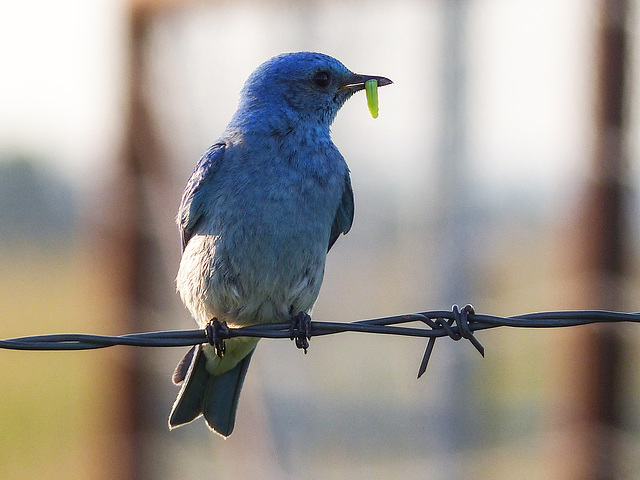
29 Jun 2015
A snack for his babies
On 29 June 2015, a small group of us met at 6:30 pm and went SW of the city with Don Stiles, who has been a dedicated Mountain Bluebird Monitor for something like 38 years! It was around 10:00 pm when I finally arrived home. The light was not good for photos, at least not with my camera, and of course, the later it got and the light faded, the worse they turned out.
This drive is an annual trip along Don’s Bluebird Route. We get the chance to see Mountain Bluebirds, Tree Swallows and Wrens nesting in various wooden nesting boxes along the country roads. Some boxes have eggs in the nest, others have tiny babies all packed tightly together. One of the boxes had a female Tree Swallow adult in it, too, and, as it hadn't been banded before, Don demonstrated how he carefully puts a metal band around the tiny leg/foot.
At the one particular Bluebird box, Mom and Dad were waiting nearby, insects in their beaks ready to feed their babies as soon as we had finished. They are such good parents.
Along the route, we saw a few other birds and animals, including a pair of beautiful American Goldfinches, various Blackbirds and a few ducks. We were lucky to see several Elk, too, that were wild.
Many thanks, as always, Don, for letting us come along with you. It is an evening I look forward to every year, and I could tell how much everyone enjoyed themselves.
In Bluebirds, the blue colour is produced by the structure of the feather - there is no blue pigment. "Tiny air pockets in the barbs of feathers can scatter incoming light, resulting in a specific, non-iridescent color. Blue colors in feathers are almost always produced in this manner. Examples include the blue feathers of Bluebirds, Indigo Buntings, Blue Jay's and Steller's Jays."
www.allaboutbirds.org/guide/Mountain_Bluebird/id
www.jstor.org/discover/pgs/index?id=10.2307/4077277&i...
For anyone who might wonder if a baby bird is handled, will its parents pick up my scent and abandon it? The answer below is from the Cornell Lab of Ornithology:
A. It's a myth that parent birds will abandon young that have been touched by humans—most birds have a poor sense of smell, and birds in general identify their young using the same cues we humans do—appearance and sound. It's perfectly safe to pick up a fallen nestling and put it back in the nest, or to carry a fledgling out of danger and place it in a tree or shrub." Same would apply to bird banding.
NO BIRD OR WILD ANIMAL SHOULD EVER BE KEPT AS A PET!
Maybe I should add that, of course, only a person monitoring Bluebirds should ever open a nesting box.
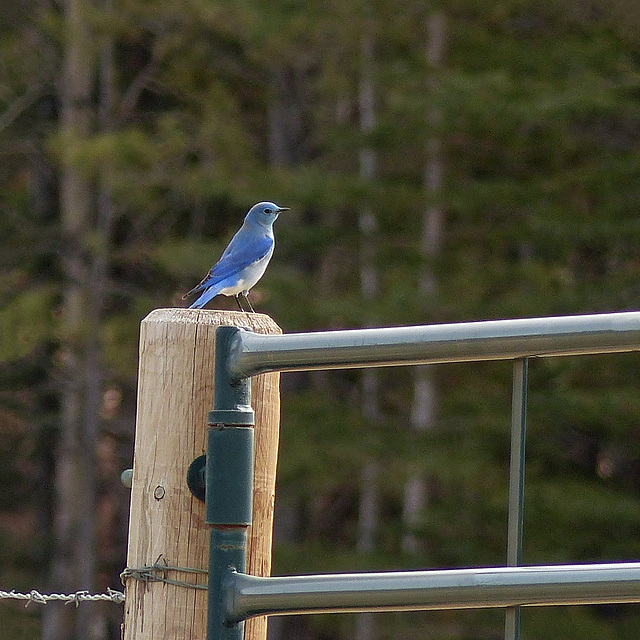
20 Mar 2016
One of the first of the season
After a long day out at Frank Lake on Saturday and then checking the upcoming weather forecast, yesterday, 20 March 2016, looked like it was going to be the only decent day of the coming week. Of course, we all know that weather forecasts can change. So, my alarm clocks were all set ridiculously early, though I still left home a bit later than I had intended, and I took myself NW of the city again to see if I could see an owl. Just a handful of friends were there and we got a few moments of great views of one of the Great Grays. The rest of the time, I did see an owl fly off into the trees a couple of times, but the time was spent waiting and chatting with my friends. Patience .....
While we were waiting, someone spotted this beautiful male Mountain Bluebird way down the road. Posting the only distant photo I got, just for the record. I am pretty sure I had caught a quick glimpse of another Bluebird on my drive to my destination. Also, I seem to remember catching a quick sight of another one recently, but can't for the life of me remember where or when. It's always such a treat to see a Bluebird, especially the very first of the season. That flash of bright blue is breathtaking. Thankfully, I do have many much closer shots in my Mountain Bluebird album : )
In Bluebirds, the blue colour is produced by the structure of the feather - there is no blue pigment. "Tiny air pockets in the barbs of feathers can scatter incoming light, resulting in a specific, non-iridescent color. Blue colors in feathers are almost always produced in this manner. Examples include the blue feathers of Bluebirds, Indigo Buntings, Blue Jay's and Steller's Jays."
www.allaboutbirds.org/guide/Mountain_Bluebird/id
www.jstor.org/discover/pgs/index?id=10.2307/4077277&i...
Jump to top
RSS feed- Latest items - Subscribe to the latest items added to this album
- ipernity © 2007-2026
- Help & Contact
|
Club news
|
About ipernity
|
History |
ipernity Club & Prices |
Guide of good conduct
Donate | Group guidelines | Privacy policy | Terms of use | Statutes | In memoria -
Facebook
X
