


Canon SX60


30 Jun 2018
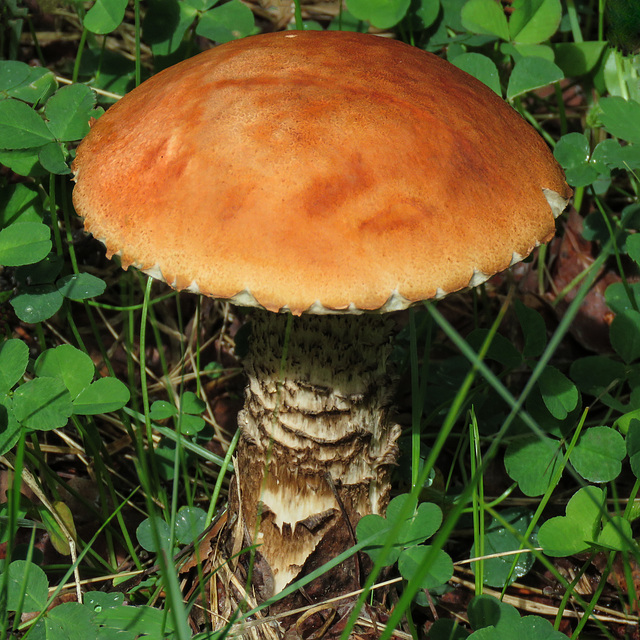
Aspen bolete
Friends and I had such a great day the day before yesterday, 30 June 2018, travelling westward into the mountains for a bio-blitz on the 40 acres of land belonging to such a delightful family - the Cartwrights. Tonight, I decided to edit and post the remaining photos that are really just record shots, in one go, completing my documentation of this most enjoyable trip. That means that I can go back and edit and post photos from other recent trips and bio-blitzes, as I have fallen way behind.
There were about a dozen family members who were there to join us on our bio-blitz, which was great. Each of the adult brothers and sisters live elsewhere, but share this precious land and return whenever they want some good old nature therapy and family time - even weddings! After spending a few hours strolling through their forest and exploring their wetland, I can completely understand why they love returning to this precious spot. Not only are all these siblings such friendly, welcoming people, the family has also generously placed this huge area into a trust, to make sure that it is forever left the way it is. "Property acquired by parents 50 years ago (1968?). An easement was placed on the land preventing any family member from disposing of their 'share', thus disallowing the fragmentation of this biologically rich area." Information from Gus Yaki.
Coffee and baked goodies were waiting for us on arrival - what a treat! Later in the walk, more coffee and goodies were waiting at a spot just before a long, wooden boardwalk. When I say boardwalk, I mean it was just one plank wide, with water and bog on either side. I do not have good balance and I immediately regretted attempting this, ha. Every single, tiny, slow step was taken with great care, I can assure you, and I was amazed that I didn't fall in.
Two of the younger members of the family have made a documentary about conservation in Southern Alberta. This is one of two short films to be shown by CPAWS on 4 July at Cardell Theatre in Calgary. They will be followed by a panel discussion with local experts and conservationists. Tickets have to be reserved.
www.eventbrite.ca/e/documentary-double-feature-with-cpaws...
It is always puzzling to me how our Naturalist leader meets so many people who live on ranches or acreages. It was a very different story two days ago, when we learned that he had offered a free bio-blitz (mind you, our bio-blitzes are always free!) at a Silent Auction : ) This family had won this "prize", and we couldn't have asked for a more appreciative group of family members to offer our help to. As always, the landowners 'win' by being given a very detailed list of every plant, etc. that is growing on their land. We also 'win' because we get to meet so many great people and see so many places that we would otherwise never get the chance to see.
26 Jun 2018
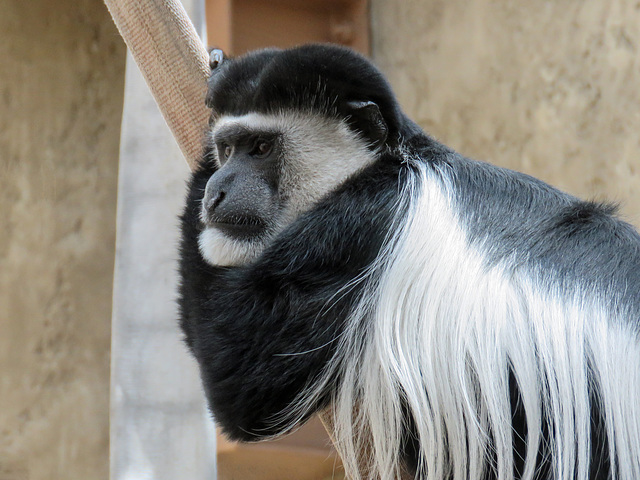
Colobus monkey - such a poser
Independence Day, 4th July! Thinking of our neighbours to the south and Americans around the world on this special day. A special thought to all those who serve to protect the American people.
"Independence Day, also referred to as the Fourth of July or July Fourth, is a federal holiday in the United States commemorating the adoption of the Declaration of Independence on July 4, 1776. The Continental Congress declared that the thirteen American colonies regarded themselves as a new nation, the United States of America, and were no longer part of the British Empire. The Congress actually voted to declare independence two days earlier, on July 2." From Wikipedia.
----------------------------------------------------------------------------------------
"At one time the colobus was hunted excessively for its beautiful fur, leading to its extermination in some areas. Its skin has been used to make dance costumes, hats and capes. Today, the greatest threat to its continued existence comes from loss of habitat as forests are cut down." From www.awf.org/content/wildlife/detail/colobusmonkey .
The last time I visited the Calgary Zoo was on 6 October 2015. I used to go fairly often, but my usual parking lot and Zoo entrance then closed for the winter. Since then, road construction and bridge replacement have been going on, but has now been completed. The drive to the north entrance of the Zoo is definitely out of my driving comfort zone, so I had been waiting for this day for a long time. June 26th 2018 was THE day - for me and for half the people in the city!! It was packed! I had decided to go before schools close for the summer. However, I suspect some schools had end-of-term Zoo visits on this day. Also, when I checked the weather forecast, rain was in the forecast for the next six days, so I knew i needed to go straight away.
My visit only covered about half the Zoo, as I usually spend a lot of time in the Conservatory, enjoying the plants and tropical butterflies. My daughter had taken a photo of a gigantic lily pad, Victoria Water Lily / Victoria amazonica, and I really wanted to see it. There were three or four of these in a tiny pool. I love the pattern on the underside of the upturned edge of each lily pad, I didn't see a huge variety of butterfly species that day, but there were enough to keep me happily clicking. They vary from day to day, as new butterflies emerge from their chrysalises..
My intention had not been to visit the newly arrived Panda family, as I was sure there would be an extremely long line-up. However, I was able to just walk in, which was great. How lucky we are to have these four amazing animals visit our Zoo. They were in an inside enclosure, full of plants - and Bamboo, of course. I'm not sure how many hours a day these animals sleep, but two of the three that could be seen slept for part of the time I was there. Had to smile at the very uncomfortable positions in which they slept. Part of the enclosure has glass, which made it almost impossible to get photos without the reflections of the crowds of people.
The Bactrian Camel had recently given birth to a baby - such a cute little thing. No sign of the Red Pandas when I passed their enclosure. One of the birds I love to see - though these birds tend to hide! - is the amazing Himalayan Monal. The male, especially, takes my breath away each time I see it.
A few hours well spent happily clicking. Hopefully, it won't be almost three years before my next visit, though the west entrance does close each winter. It felt so good to once again be back in a place full of colour and interest.
26 Jun 2018
3 favorites
4 comments
Always a treat to see
Independence Day, Fourth of July! Thinking of our neighbours to the south and Americans around the world on this special day. A special thought to all those who serve to protect the American people.
"Independence Day, also referred to as the Fourth of July or July Fourth, is a federal holiday in the United States commemorating the adoption of the Declaration of Independence on July 4, 1776. The Continental Congress declared that the thirteen American colonies regarded themselves as a new nation, the United States of America, and were no longer part of the British Empire. The Congress actually voted to declare independence two days earlier, on July 2." From Wikipedia.
----------------------------------------------------------------------------------------
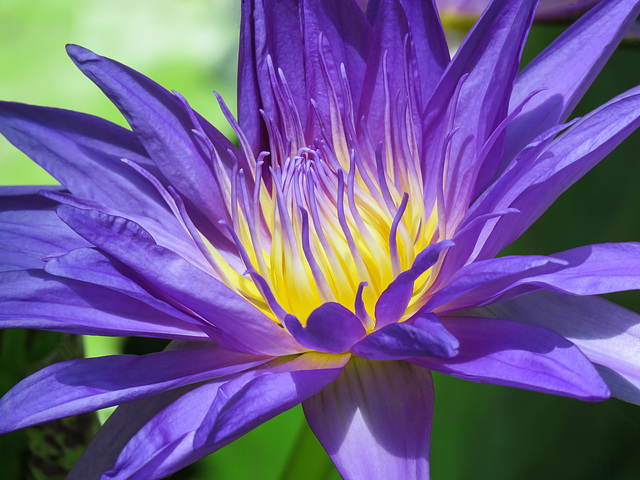
This beautiful Water Lily was growing in the ENMAX Conservatory at the Calgary Zoo, on 26 June 2018. Each time I go to the Zoo, I always hope that at least one of these beautiful Water Lilies will be in bloom.
en.wikipedia.org/wiki/Nymphaeaceae
The last time I visited the Calgary Zoo was on 6 October 2015. I used to go fairly often, but my usual parking lot and Zoo entrance then closed for the winter. Since then, road construction and bridge replacement have been going on, but has now been completed. The drive to the north entrance of the Zoo is definitely out of my driving comfort zone, so I had been waiting for this day for a long time. June 26th 2018 was THE day - for me and for half the people in the city!! It was packed! I had decided to go before schools close for the summer. However, I suspect some schools had end-of-term Zoo visits on this day. Also, when I checked the weather forecast, rain was in the forecast for the next six days, so I knew i needed to go straight away.
My visit only covered about half the Zoo, as I usually spend a lot of time in the Conservatory, enjoying the plants and tropical butterflies. My daughter had taken a photo of a gigantic lily pad, Victoria Water Lily / Victoria amazonica, and I really wanted to see it. There were three or four of these in a tiny pool. I love the pattern on the underside of the upturned edge of each lily pad, I didn't see a huge variety of butterfly species that day, but there were enough to keep me happily clicking. They vary from day to day, as new butterflies emerge from their chrysalises..
My intention had not been to visit the newly arrived Panda family, as I was sure there would be an extremely long line-up. However, I was able to just walk in, which was great. How lucky we are to have these four amazing animals visit our Zoo. They were in an inside enclosure, full of plants - and Bamboo, of course. I'm not sure how many hours a day these animals sleep, but two of the three that could be seen slept for part of the time I was there. Had to smile at the very uncomfortable positions in which they slept. Part of the enclosure has glass, which made it almost impossible to get photos without the reflections of the crowds of people.
The Bactrian Camel had recently given birth to a baby - such a cute little thing. No sign of the Red Pandas when I passed their enclosure. One of the birds I love to see - though these birds tend to hide! - is the amazing Himalayan Monal. The male, especially, takes my breath away each time I see it.
A few hours well spent happily clicking. Hopefully, it won't be almost three years before my next visit, though the west entrance does close each winter. It felt so good to once again be back in a place full of colour and interest.
23 Jun 2018
3 favorites
5 comments
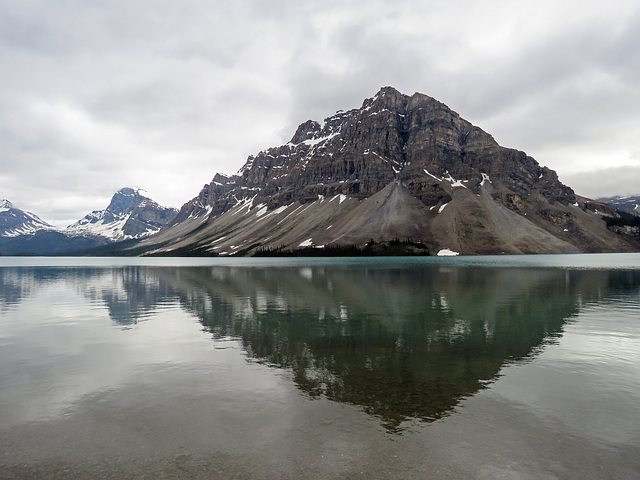
Reflected peaks
On 23 June 2018, I had the wonderful chance to return to two of my favourite places in the mountains - Bow Lake and Peyto Lake. This was thanks to the annual Bus Trip for Nature Calgary, with each year being to a different location in Alberta. These two Lakes are too far for me to drive (roughly two and a half hours), but mainly because they are way out of my driving comfort zone. I think I have only ever been to Peyto Lake twice before, the first time being something like 38 years ago, and the second time being in August 2013. Almost 40 years ago, I fell in love with Bow Lake, my absolute favourite place. I have been lucky enough to visit it a handful of times in recent years.
Unfortunately, we couldn't capture the beautiful, really deep turquoise colour that Peyto lake is so well known for. Too many low clouds and an overcast, damp day, but you can still see the beauty of this lake and its gorgeous surroundings. The forecast that I had seen for this whole area had been for snow-rain showers, with a high temperature of 12C and a low of 1C. Though the day started off with rain, we were lucky that we only had a few raindrops while we were out walking. It was really dreary weather, though, which was not good as far as photography was concerned.
Our first stop was at Peyto Lake, where we walked the short distance to the wooden Lookout deck. From there, we hiked a loop through the forest, finding a few wildflowers and some beautiful Orange Peel Fungus. On the way back to the Lookout, you really need to be very careful to take a path that leads back to the correct parking lot! The last few people took the wrong path and ended up waiting for a bus that never came for them. So easily done. They were eventually found, but after a long delay.
"Peyto Lake (pea-toe) is a glacier-fed lake located in Banff National Park in the Canadian Rockies. The lake itself is easily accessed from the Icefields Parkway. It was named for Ebenezer William Peyto, an early trail guide and trapper in the Banff area. The lake is formed in a valley of the Waputik Range, between Caldron Peak, Peyto Peak and Mount Jimmy Simpson, at an elevation of 1,860 m (6,100 ft). During the summer, significant amounts of glacial rock flour flow into the lake, and these suspended rock particles give the lake a bright, turquoise color. Because of its bright color, photos of the lake often appear in illustrated books, and area around the lake is a popular sightseeing spot for tourists in the park. The lake is best seen from Bow Summit, the highest point on the Icefield Parkway. The lake is fed by the Peyto Creek, which drains water from the Caldron Lake and Peyto Glacier (part of the Wapta Icefield), and flows into the Mistaya River."
wikimapia.org/655560/Peyto-lake
From Peyto Lake, we drove to the nearby Bow Lake, which just takes my breath away. I had told a couple of friends how beautiful it is, but that the best kind of day to visit is a sunny day with absolutely calm lake water so that reflections are seen. Well, that was definitely not the kind of day we had, but one makes the best of what one gets. We spent time there, walking part way along the edge of the lake, looking for any bird and wildflower species, and simply soaking up the amazing beauty of our surroundings.
www.travelalberta.com/ca/listings/bow-lake-1997/
On the way back to Calgary, we were very lucky to notice a handful of cars that had pulled over on the side of the road. This always makes one wonder if a bear has been sighted. Sure enough, our bus driver slowed down and stopped for a short while to allow us to take a few photos. After a few minutes, I heard our organizer tell someone (or more than one person) to stop using flash, as it was stressing out the bear. Tell me, just WHY would anyone think it was OK to use flash on a wild animal that was just a few feet away from our bus!!! An animal that was busy feeding on dandelions and had been taking no notice of us. So maddening when photographers don't have respect for wildlife and just don't think! I happened to be sitting on the 'wrong' side of the bus and had two or three rows of people who were sitting or standing up, all trying to get their shots in between the people in front of them. So, my photos are not good, but serve as a record of having had the privilege of seeing such a beautiful creature.
A final, short stop on the way home was near Castle Mountain, which is a very impressive sight. It also has an interesting history, which I will add when I eventually post a photo taken there.
Many thanks, Penny, for organizing our trip to such perfect places! I know a huge amount of work goes into making all the plans - thanks, too, to John for helping out with this. A very successful and most enjoyable outing. Shirley and Pam - I greatly appreciated your driving to meeting places here in the city!
07 Jul 2018
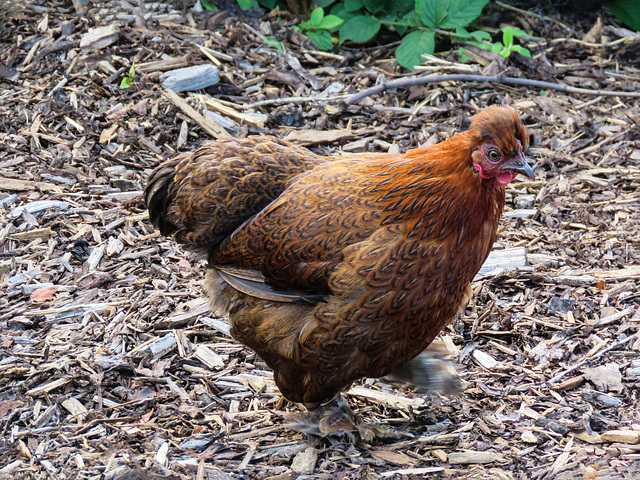
Momma hen at the Ellis Bird Farm
Tomorrow morning, I have yet another very early morning (alarm to be set for 4:45 am). In order to avoid a rush, I thought I would post tomorrow's photos this evening.
Friends and I had a bit of fun trying to get photos of an active young chicken and its mother (seen in this photo). I ended up having to delete almost all my photos, as either the head or the body was blurry. The previous image shows the youngster - a cute little thing.
Just over two years ago, on 4 June 2016, I had the chance to visit somewhere that I had longed to go to for years - the Ellis Bird Farm. This was thanks to the annual Nature Calgary Bus Trip, which goes to a different location each year. Then, yesterday, 7 July 2018, I got the chance to visit this unique place again, thanks to Jackie and Brenda, who organized a trip for a group of about 13 (?) friends/birders/photographers.
The drive from Calgary to the Ellis Bird Farm took us about two hours. When we arrived, we were greeted by a long line of bird nest boxes along the fence line. Within the farm area, there were even more nest boxes - everywhere! People send them from all over the province, even from overseas. I believe the Farm has the largest collection of outdoor boxes in the world - 300+!
Myrna Pearman, who has been "at the helm of Ellis Bird Farm for the past 30 years", knew we were coming and we were treated to a very special viewing of Purple Martins at various stages, from eggs to adult, To do this, she lowered some of the Purple Martin condominiums and let us peer inside. After a short talk about the Farm, we explored every corner, taking a break for lunch, sitting outside, at the Cafe. A few of us had reserved a table, which is a good idea, as the Farm can get very busy with visitors.
The main attraction at the Farm are the beautiful Purple Martins, uncommon in Alberta, though there are so many other things to see, as well. Purple Martins are very social birds, who apparently like people too, and nest in condominium-style nest boxes. They spend "most of the year in the Amazon rainforest in Brazil and come up to Alberta just long enough to raise a family."
"Ellis Bird Farm made science history on Tuesday May 31 2016 (?) when University of Manitoba Grad Student, Alisha Ritchie, and her EBF team (Cheyenne Knight, Claudia Lipski and Myrna Pearman) retrapped a very special yearling Purple Martin. This bird had been retrofitted with a light level geolocator last season, as a nestling, and is the first songbird EVER(!) to be tracked on its first migration. The bird had evaded several attempts to trap it, so it has been named Houdini."
Information about their Purple Martin Geolocator Program:
www.ellisbirdfarm.ca/purple-martin-geolocators.html
""Ellis Bird Farm is both a non-profit company and a working farm. It was established in 1982 to carry on the legacy of Lacombe-area conservationists, Charlie and Winnie Ellis, when their farm was purchased by Union Carbide Canada Ltd. At the time, Charlie and Winnie operated one of the largest bluebird trails in Canada and had established their farmstead as a haven for wildlife.
The Ellis family of Parkenham, Ontario, came west in 1886 to settle on a ranch near Calgary. Their son John, then a teenager, was married in 1894 to Agnes Clark who had come west from Ontario in 1888 to teach school. They lived near Calgary until 1906 when they moved with their family of four children to a quarter section homestead in the Joffre district. In 1907 they built a two-storey frame house and subsequently enlarged the farm by the purchase of an additional five quarters.
After John and Agnes passed away in the early 1950s, two of their children, Charlie and Winnie, took over the farm operations. And about this same time, Charlie began a project that was to dominate the rest of his life; he set out his first nesting box for the Mountain Bluebirds." From Ellis Bird Farm website.
www.ellisbirdfarm.ca/
Many thanks to Shirley, for driving the four of us to and from the Farm. Thank you for picking me up, Pam, to get me over to the meeting place. Beautiful weather and great company made for a super day. Have to say, too, that it was great to get away from the city, where the Calgary Stampede is in full swing.
09 Jul 2018
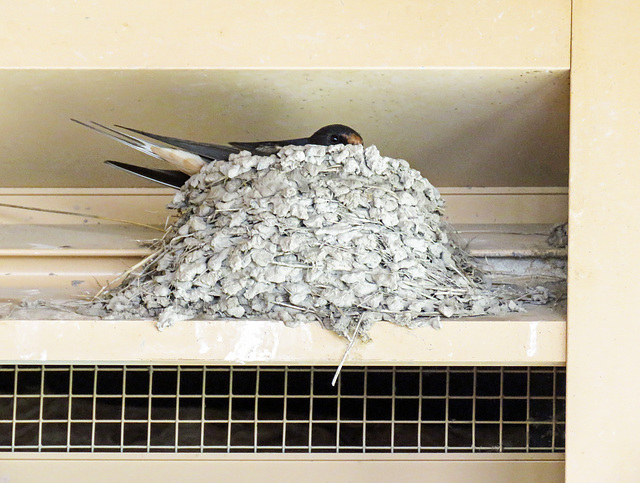
Barn Swallow on nest
"Barn Swallow pairs explore a number of potential nesting spots, flying up and hovering to investigate a location, then moving to another site before narrowing their choice. Preferred sites include eaves, rafters, and cross beams of barns, sheds and stables, as well as the undersides of bridges, wharfs, and culverts. They may also use nests from previous years, but avoid those infested heavily with mites or other parasites.
Both male and female build the nest cup using mud. They collect mud in their bills and often mix it with grass stems to make pellets. They first construct a small shelf to sit on, then build up the nest’s sides. If built against a wall or other vertical surface the result is a semicircular, half-cup shape. Nests built on top of a beam or other horizontal surface form a complete cup about 3 inches across at the rim and 2 inches deep. The birds line the cup first with grass, then feathers, and in colonies may steal nest-lining materials from neighboring nests. When reusing nests, Barn Swallows clean out old feathers and add new mud to the nest’s rim." From AllAboutBirds.
www.allaboutbirds.org/guide/Barn_Swallow/lifehistory#nesting
Yesterday, 9 July 2018, I went for a trip to Kananaskis with friends Shirley and Pam. This was planned as a bear hunt - but not a single bear was to be seen : ) As usual, when it comes to wildlife, it's all about timing. You can be lucky or unlucky, and I guess yesterday was not our lucky day, at least not as far as bears were concerned.
We left the city at 7:00 am to give ourselves the best chance. Within just a matter of minutes, we came upon a Great Blue Heron and a couple of Black-crowned Night-Herons, which was wonderful. Couldn't get good photos of them, just shots for the record. Our day was certainly starting off well.
We travelled to Kananaskis via Highway 1, but returned to the city along the south portion of Highway 40. When I go to Kananaskis on my own (only about three times so far), I only go south to Highway 40, never on Highway 1. I believe it takes about the same time to drive either way.
No sign of a bear, anywhere, but of course, we were surrounded by spectacular scenery all day. We had great weather, with a high of about 27C. There was haze over the mountains.
One of our stops was at Peninsular, at Lower Kananaskis Lake. Such a peaceful spot, with just a handful of people fishing and several people in canoes or kayaks. The main thing we saw there was a Golden-mantled Ground Squirrel (not the one posted today) down on the rocks.
Another place we wanted to get to was the area where the Pikas can be seen. For the first while, we began to think that we were going to be out of luck. Fortunately, one little Pika did eventually show itself and we were able to get a few photos. When I don't get photos that I'm quite happy with, it is a huge incentive to drive myself out there for another chance. While we were there, we did see a little Golden-mantled Ground Squirrel, who was happily munching on Yellow Columbine flowers. Surprisingly, no Mountain Sheep were to be seen, here or anywhere else on this day.
A final stopping place was on the way home along Highway 40. We had forgotten that this place is closed on Mondays. I remember last year, when I drove out there myself, I had been banking on buying a sandwich for my lunch and for getting gas for my car. However, we did see at least two tiny Hummingbirds there, nesting Barn Swallows, and several interesting moths that I had never seen before, including a One Eyed Sphinx Moth.
So, all together, an interesting, fun day spent in good company. We are so very lucky to live within reach of such a breathtaking area!
09 Jul 2018
2 favorites
1 comment
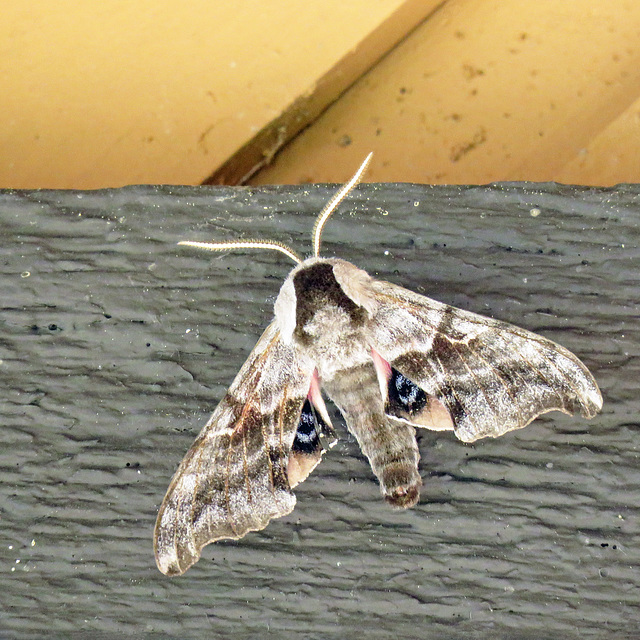
One Eyed Sphinx Moth / Smerinthus cerisyi
Hope I have the correct ID for this rather beautiful, large Moth. If anyone sees this image and is able to confirm or correct the ID, that would be so much appreciated.
Yesterday, 9 July 2018, I went for a trip to Kananaskis with friends Shirley and Pam. This was planned as a bear hunt - but not a single bear was to be seen : ) As usual, when it comes to wildlife, it's all about timing. You can be lucky or unlucky, and I guess yesterday was not our lucky day, at least not as far as bears were concerned.
We left the city at 7:00 am to give ourselves the best chance. Within just a matter of minutes, we came upon a Great Blue Heron and a couple of Black-crowned Night-Herons, which was wonderful. Couldn't get good photos of them, just shots for the record. Our day was certainly starting off well.
We travelled to Kananaskis via Highway 1, but returned to the city along the south portion of Highway 40. When I go to Kananaskis on my own (only about three times so far), I only go south to Highway 40, never on Highway 1. I believe it takes about the same time to drive either way.
No sign of a bear, anywhere, but of course, we were surrounded by spectacular scenery all day. We had great weather, with a high of about 27C. There was haze over the mountains.
One of our stops was at Peninsular, at Lower Kananaskis Lake. Such a peaceful spot, with just a handful of people fishing and several people in canoes or kayaks. The main thing we saw there was a Golden-mantled Ground Squirrel (not the one posted today) down on the rocks.
Another place we wanted to get to was the area where the Pikas can be seen. For the first while, we began to think that we were going to be out of luck. Fortunately, one little Pika did eventually show itself and we were able to get a few photos. When I don't get photos that I'm quite happy with, it is a huge incentive to drive myself out there for another chance. While we were there, we did see a little Golden-mantled Ground Squirrel, who was happily munching on Yellow Columbine flowers. Surprisingly, no Mountain Sheep were to be seen, here or anywhere else on this day.
A final stopping place was on the way home along Highway 40. We had forgotten that this place is closed on Mondays. I remember last year, when I drove out there myself, I had been banking on buying a sandwich for my lunch and for getting gas for my car. However, we did see at least two tiny Hummingbirds there, nesting Barn Swallows, and several interesting moths that I had never seen before, including this One Eyed Sphinx Moth.
So, all together, an interesting, fun day spent in good company. We are so very lucky to live within reach of such a breathtaking area!
09 Jul 2018
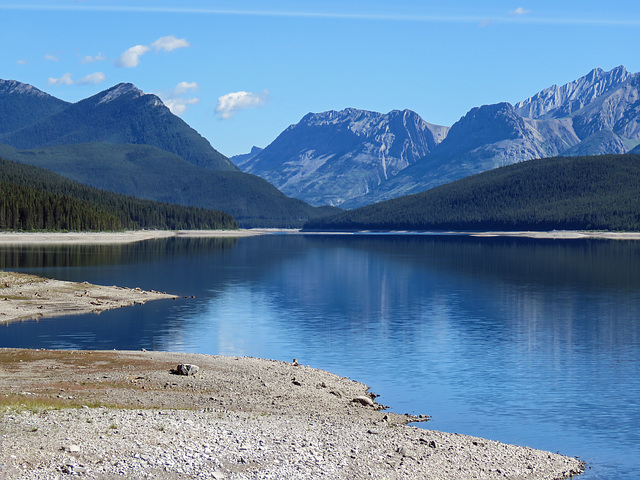
Peninsular, Kananaskis
Yesterday, 9 July 2018, I went for a trip to Kananaskis with friends Shirley and Pam. This was planned as a bear hunt - but not a single bear was to be seen : ) As usual, when it comes to wildlife, it's all about timing. You can be lucky or unlucky, and I guess yesterday was not our lucky day, at least not as far as bears were concerned.
We left the city at 7:00 am to give ourselves the best chance. Within just a matter of minutes, we came upon a Great Blue Heron and a couple of Black-crowned Night-Herons, which was wonderful. Couldn't get good photos of them, just shots for the record. Our day was certainly starting off well.
We travelled to Kananaskis via Highway 1, but returned to the city along the south portion of Highway 40. When I go to Kananaskis on my own (only about three times so far), I only go south to Highway 40, never on Highway 1. I believe it takes about the same time to drive either way.
No sign of a bear, anywhere, but of course, we were surrounded by spectacular scenery all day. We had great weather, with a high of about 27C. You can't tell too well in this photo, but the original version showed the haze that was over the mountains.
One of our stops was at Peninsular, at Lower Kananaskis Lake. Such a peaceful spot, with just a handful of people fishing and several people in canoes or kayaks. The main thing we saw there was a Golden-mantled Ground Squirrel (not the one posted today) down on the rocks.
Another place we wanted to get to was the area where the Pikas can be seen. For the first while, we began to think that we were going to be out of luck. Fortunately, one little Pika did eventually show itself and we were able to get a few photos. When I don't get photos that I'm quite happy with, it is a huge incentive to drive myself out there for another chance. While we were there, we did see a little Golden-mantled Ground Squirrel, who was happily munching on Yellow Columbine flowers. Surprisingly, no Mountain Sheep were to be seen, here or anywhere else on this day.
A final stopping place was on the way home along Highway 40. We had forgotten that this place is closed on Mondays. I remember last year, when I drove out there myself, I had been banking on buying a sandwich for my lunch and for getting gas for my car. However, we did see at least two tiny Hummingbirds there, Barn Swallows, and several interesting moths that I had never seen before, including a One Eyed Sphinx Moth (photo posted this morning).
So, all together, an interesting, fun day spent in good company. We are so very lucky to live within reach of such a breathtaking area!
07 Jul 2018
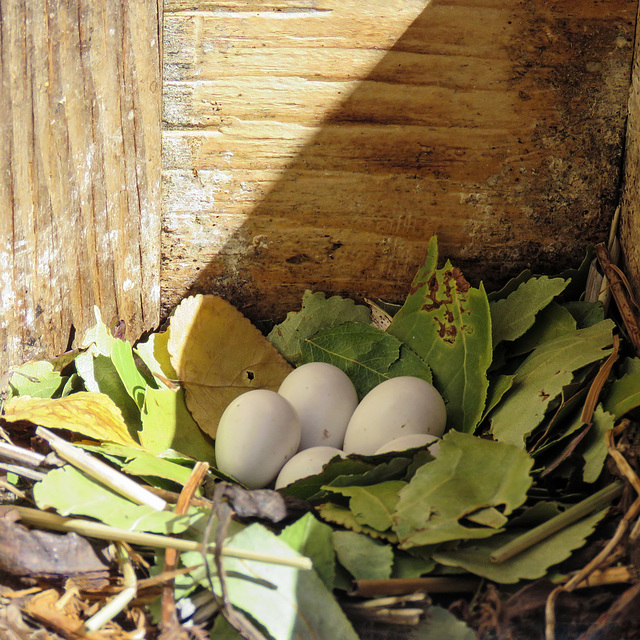
Purple Martin nest and eggs
Too many people standing around this lowered Purple Martin condominium nest box left me unable to get a closer photo of these tiny babies. Most people seemed to want their camera just inches away, blocking the view. Just as I was hoping to get a shot, down came the lid! Luckily, I got this shot from the far end of the box, giving me one shot for the record.
Just over a year ago, on 4 June 2016, I had the chance to visit somewhere that I had longed to go to for years - the Ellis Bird Farm. This was thanks to the annual Nature Calgary Bus Trip, which goes to a different location each year. Then, yesterday, 7 July 2018, I got the chance to visit this unique place again, thanks to Jackie and Brenda, who organized a trip for a group of about 13 (?) friends/birders/photographers.
The drive from Calgary to the Ellis Bird Farm took us about two hours. When we arrived, we were greeted by a long line of bird nest boxes along the fence line. Within the farm area, there were even more nest boxes - everywhere! People send them from all over the province, even from overseas. I believe the Farm has the largest collection of outdoor boxes in the world - 300+!
Myrna Pearman, who has been "at the helm of Ellis Bird Farm for the past 30 years", knew we were coming and we were treated to a very special viewing of Purple Martins at various stages, from eggs to adult, To do this, she lowered some of the Purple Martin condominiums and let us peer inside. After a short talk about the Farm, we explored every corner, taking a break for lunch, sitting outside, at the Cafe. A few of us had reserved a table, which is a good idea, as the Farm can get very busy with visitors.
The main attraction at the Farm are the beautiful Purple Martins, uncommon in Alberta, though there are so many other things to see, as well. Purple Martins are very social birds, who apparently like people too, and nest in condominium-style nest boxes. They spend "most of the year in the Amazon rainforest in Brazil and come up to Alberta just long enough to raise a family."
"Ellis Bird Farm made science history on Tuesday May 31 2016 (?) when University of Manitoba Grad Student, Alisha Ritchie, and her EBF team (Cheyenne Knight, Claudia Lipski and Myrna Pearman) retrapped a very special yearling Purple Martin. This bird had been retrofitted with a light level geolocator last season, as a nestling, and is the first songbird EVER(!) to be tracked on its first migration. The bird had evaded several attempts to trap it, so it has been named Houdini."
Information about their Purple Martin Geolocator Program:
www.ellisbirdfarm.ca/purple-martin-geolocators.html
""Ellis Bird Farm is both a non-profit company and a working farm. It was established in 1982 to carry on the legacy of Lacombe-area conservationists, Charlie and Winnie Ellis, when their farm was purchased by Union Carbide Canada Ltd. At the time, Charlie and Winnie operated one of the largest bluebird trails in Canada and had established their farmstead as a haven for wildlife.
The Ellis family of Parkenham, Ontario, came west in 1886 to settle on a ranch near Calgary. Their son John, then a teenager, was married in 1894 to Agnes Clark who had come west from Ontario in 1888 to teach school. They lived near Calgary until 1906 when they moved with their family of four children to a quarter section homestead in the Joffre district. In 1907 they built a two-storey frame house and subsequently enlarged the farm by the purchase of an additional five quarters.
After John and Agnes passed away in the early 1950s, two of their children, Charlie and Winnie, took over the farm operations. And about this same time, Charlie began a project that was to dominate the rest of his life; he set out his first nesting box for the Mountain Bluebirds." From Ellis Bird Farm website.
www.ellisbirdfarm.ca/
Many thanks to Shirley, for driving the four of us to and from the Farm. Thank you for picking me up, Pam, to get me over to the meeting place. Beautiful weather and great company made for a super day. Have to say, too, that it was great to get away from the city, where the Calgary Stampede is in full swing.
Jump to top
RSS feed- Latest items - Subscribe to the latest items added to this album
- ipernity © 2007-2026
- Help & Contact
|
Club news
|
About ipernity
|
History |
ipernity Club & Prices |
Guide of good conduct
Donate | Group guidelines | Privacy policy | Terms of use | Statutes | In memoria -
Facebook
X
