

Push!
The colours of fall
Our beautiful foothills on an overcast day
Yellow-rumped Warbler
Strap/Coral Club / Clavariadelphus ligula
Juvenile White-throated Sparrow / Zonotrichia albi…
Juvenile Red-tailed Hawk / Buteo jamaicensis
Three insect species on a single flower
Autumn berries
Yesterday's find
Merlin
Chinook arch over Calgary
Rusty Gilled Polypore / Gloeophyllum sepiarium
Spruce Grouse, adult female
A fine network of cells - maybe Arcyria obvelata?
False Dandelion / Agoseris glauca
The long hike down the mountain
Puffballs on Plateau Mountain
Looking towards top of Plateau Mountain
Merlin on the hunt
Bighorn Sheep on Plateau Mountain, 2012
Periglacial feature, Plateau Mountain
Spruce Sawyer
Barn Owl / Tyto alba
Across the river
A use for old shoes
Tea, anyone?
Helmeted Guineafowl / Numida meleagris
Reindeer lichen
Look into my eyes
Fungus on a log
Highbush cranberry / Viburnum opulus var. american…
Eye contact
Growing amongst the mosses
Bunchberry Meadows, Nature Conservancy of Canada
Merlin
Eyelash fungi
Cladonia lichen
Happy find at Bunchberry Meadows Conservation Area
Lichen at Bunchberry Meadows Conservation Area
Bunchberry Meadows, Nature Conservancy
Bluebird memories
Lichen at Rock Glacier
The arrival of fall
Long-eared Owl
Keywords
Authorizations, license
-
Visible by: Everyone -
All rights reserved
-
291 visits
American Kestrel, Falco sparverius
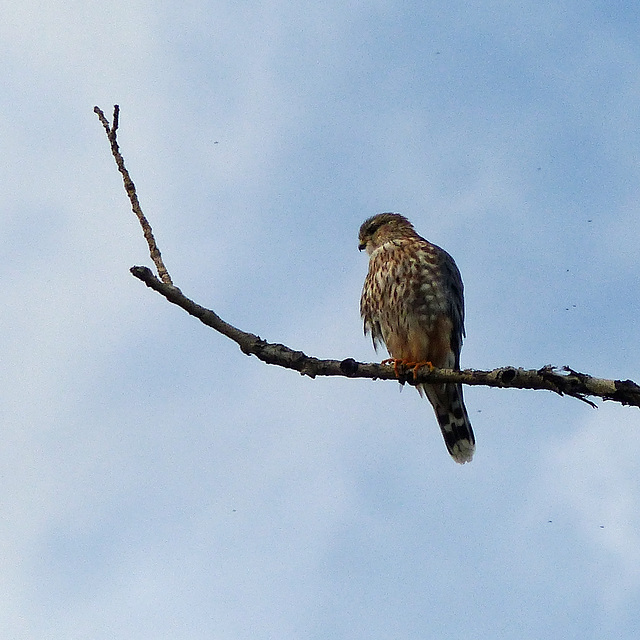

Very poor quality - posting just for the record : ) Almost always when I do see an American Kestrel, it is perched way off in the distance. Yesterday, 23 September 2016, was no different. I had a few errands that needed to be run and then I called in at Fish Creek Park, hoping that I might just see the juvenile Black-crowned Night-Herons that some people are still seeing down there. Totally out of luck, though I did see a Belted Kingfisher perched off in the distance. Luckily, I had seen the Night-Herons a few weeks ago, during a birding walk.
This was the second time this Kestrel flew to this branch. The first time, it landed with a dragonfly that it had caught. After eating the tasty parts, it flew off, circled and then returned to this perch. The sky turned blue just at the right time. I wonder if Kestrels eat Mosquitoes - there were quite a few of those around. I don't know if those are Mosquitoes that you can see flying nearby.
"North America’s littlest falcon, the American Kestrel packs a predator’s fierce intensity into its small body. It's one of the most colorful of all raptors: the male’s slate-blue head and wings contrast elegantly with his rusty-red back and tail; the female has the same warm reddish on her wings, back, and tail. Hunting for insects and other small prey in open territory, kestrels perch on wires or poles, or hover facing into the wind, flapping and adjusting their long tails to stay in place. Kestrels are declining in parts of their range; you can help them by putting up nest boxes." From AllAboutBirds.
www.allaboutbirds.org/guide/American_Kestrel/lifehistory
This was the second time this Kestrel flew to this branch. The first time, it landed with a dragonfly that it had caught. After eating the tasty parts, it flew off, circled and then returned to this perch. The sky turned blue just at the right time. I wonder if Kestrels eat Mosquitoes - there were quite a few of those around. I don't know if those are Mosquitoes that you can see flying nearby.
"North America’s littlest falcon, the American Kestrel packs a predator’s fierce intensity into its small body. It's one of the most colorful of all raptors: the male’s slate-blue head and wings contrast elegantly with his rusty-red back and tail; the female has the same warm reddish on her wings, back, and tail. Hunting for insects and other small prey in open territory, kestrels perch on wires or poles, or hover facing into the wind, flapping and adjusting their long tails to stay in place. Kestrels are declining in parts of their range; you can help them by putting up nest boxes." From AllAboutBirds.
www.allaboutbirds.org/guide/American_Kestrel/lifehistory
- Keyboard shortcuts:
Jump to top
RSS feed- Latest comments - Subscribe to the comment feeds of this photo
- ipernity © 2007-2026
- Help & Contact
|
Club news
|
About ipernity
|
History |
ipernity Club & Prices |
Guide of good conduct
Donate | Group guidelines | Privacy policy | Terms of use | Statutes | In memoria -
Facebook
X

Sign-in to write a comment.