

Grainy but cute
Hellebore beauty
Tree Swallow / Tachycineta bicolor
Yellow-headed Blackbirds in every direction
Willet / Tringa semipalmata
Backlit beauties
Still standing
Trying to impress the females
Purple Rain
American Wigeon pair
Indian Breadroot
Always a good mother
Water patterns in matching colours
One of my favourite spring garden flowers
A prairie song
Large Bee colony
After the rain
Watching closely
Mountain Bluebird protecting her nest box
Hepatica
Sharp-tailed Grouse in the early morning sun
Perched in the sun
Early Cinquefoil
Elephant Ears / Bergenia cordifolia
Singing its little heart out
American Avocet in rippled water
Green caterpillar on Balsamroot
Sharp-tailed Grouse female
A handsome mate
Golden Bean / Thermopsis rhombifolia
An old barn in winter
Starting to dance
Charcoal effect
A Tree Swallow's iridescence
Sharp-tailed Grouse
Beauty of spring
One of ten Meadowlarks seen yesterday
Art of nature
A recent spring arrival
Camouflaged as a rock
Hoverfly on European Pasque Flower
Gathering of the masses
Physoclaina orientalis
An over-the-shoulder glance
Physoclaina orientalis
See also...
Keywords
Authorizations, license
-
Visible by: Everyone -
All rights reserved
-
275 visits
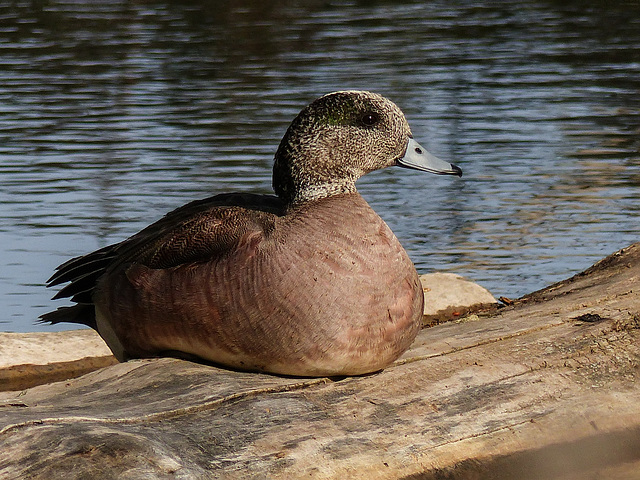
American Wigeon male, resting on a log

Brief update on the massive Fort McMurray wildfire: "The wildfire near Fort McMurray continues to grow northeast of the city and could double in size by Saturday (i.e. today, 7 May 2016) afternoon, according to officials."
Today, this is my main photo (i.e. the very last one to be posted). Yet again, some people have been recently seeing either my second or third photo as my main one. This morning, I uploaded each photo separately, so hopefully, my three photos will be seen by other people in the order in which I posted and in the order that I see them.
Three afternoons ago, on 4 May 2016, I had a volunteer shift and then thought I might call in at the Reader Rock Garden. Changed my mind when I discovered that new road construction was taking place at the very first corner I was going to take, so I couldn't turn right. Instead, I called in at Fish Creek Park to check on the Great Horned Owls.
I so rarely get photos of American Wigeons, as when I do see one, it is almost always way off in the distance. On this day, however, I was lucky enough to see a pair of them resting on a log, as well as a pair of Wood Ducks that were swimming nearby, all close enough to photograph. You can see just a tiny bit of iridescent green patch on this male's head, behind the eye.
"A common and increasingly abundant duck, the American Wigeon breeds in northwestern North America and is found throughout the rest of the continent in migration and in winter. Its small bill and the male's white forehead, as well as certain aspects of nesting and feeding behavior, distinguish this species from other dabbling ducks." From AllAboutBirds.
www.allaboutbirds.org/guide/American_Wigeon/id
Today, this is my main photo (i.e. the very last one to be posted). Yet again, some people have been recently seeing either my second or third photo as my main one. This morning, I uploaded each photo separately, so hopefully, my three photos will be seen by other people in the order in which I posted and in the order that I see them.
Three afternoons ago, on 4 May 2016, I had a volunteer shift and then thought I might call in at the Reader Rock Garden. Changed my mind when I discovered that new road construction was taking place at the very first corner I was going to take, so I couldn't turn right. Instead, I called in at Fish Creek Park to check on the Great Horned Owls.
I so rarely get photos of American Wigeons, as when I do see one, it is almost always way off in the distance. On this day, however, I was lucky enough to see a pair of them resting on a log, as well as a pair of Wood Ducks that were swimming nearby, all close enough to photograph. You can see just a tiny bit of iridescent green patch on this male's head, behind the eye.
"A common and increasingly abundant duck, the American Wigeon breeds in northwestern North America and is found throughout the rest of the continent in migration and in winter. Its small bill and the male's white forehead, as well as certain aspects of nesting and feeding behavior, distinguish this species from other dabbling ducks." From AllAboutBirds.
www.allaboutbirds.org/guide/American_Wigeon/id
Pam J has particularly liked this photo
- Keyboard shortcuts:
Jump to top
RSS feed- Latest comments - Subscribe to the comment feeds of this photo
- ipernity © 2007-2026
- Help & Contact
|
Club news
|
About ipernity
|
History |
ipernity Club & Prices |
Guide of good conduct
Donate | Group guidelines | Privacy policy | Terms of use | Statutes | In memoria -
Facebook
X

Yes.. am reading the BBC News updates.
Sign-in to write a comment.