

Horse Cinquefoil
Purple crowned
Mmmm ... Mini-Donuts
Abstract
Piggies at the Stampede
Mushroom
Juvenile Brown-headed Cowbird
Poppy
Fritillary
Barred Owl
European Skipper
Feathery ferns
Can you solve this mystery?
Dazzling to the eye
Yellow Avens
Wild Bergamot
Bladderwort
Droplet
Bought beauty
Musk Thistle
Small white poppy
Purple Prairie-clover
Red Longhorn Beetle on Goldenrod
Explore, photos 101-125
Black Henbane
Moulting sucks!
Two-spotted Ladybugs
Globe-flower
Dewberry
Love a Lily
Wild White Geranium
One-sided Wintergreen
A welcome encounter
Alfalfa
House Wren
Dahlia
Cicer Milkvetch
Purple Avens
Common Sainfoin
In my garden
Southern Bald Ibis
Last man loses
Gramma's eyebrows
Narrow-leaved Collomia
In support of Breast Cancer Research
Keywords
Authorizations, license
-
Visible by: Everyone -
All rights reserved
-
150 visits
A final treat
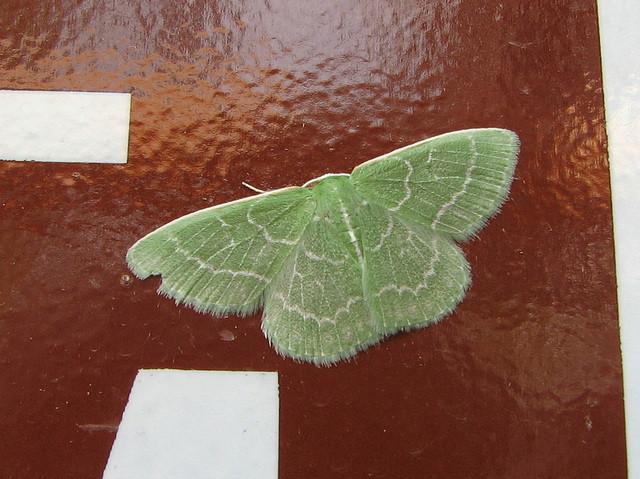

At the end of my walk this morning, I came across this green moth flattened out on the washroom door at the entrance of the park. I'm not sure, but I think this might be a Pale Beauty or some other kind of geometer. They are also called "inchworm moths" because it is their caterpillars that do the familiar inching along when they travel. There are at least 250 species of geometers in Alberta, but only a few are pale green.
"Many Geometrids have slender abdomens and broad wings which are usually held flat with the hindwings visible. As such they appear rather butterfly-like but in most respects they are typical moths: the majority fly at night, they possess a frenulum to link the wings and the antennae of the males are often feathered. They tend to blend in to the background, often with intricate, wavy patterns on their wings. Most are of moderate size, about 3 cm across but a range of sizes occur." From Wikipedia website.
"Many Geometrids have slender abdomens and broad wings which are usually held flat with the hindwings visible. As such they appear rather butterfly-like but in most respects they are typical moths: the majority fly at night, they possess a frenulum to link the wings and the antennae of the males are often feathered. They tend to blend in to the background, often with intricate, wavy patterns on their wings. Most are of moderate size, about 3 cm across but a range of sizes occur." From Wikipedia website.
- Keyboard shortcuts:
Jump to top
RSS feed- Latest comments - Subscribe to the comment feeds of this photo
- ipernity © 2007-2026
- Help & Contact
|
Club news
|
About ipernity
|
History |
ipernity Club & Prices |
Guide of good conduct
Donate | Group guidelines | Privacy policy | Terms of use | Statutes | In memoria -
Facebook
X

Sign-in to write a comment.