

wk13-21- 3318
EPERVIER D'EUROPE
wk14-21 3408
Ich hab' jetzt den Schnabel voll ...
wk15-21 3467
wk15-21 3506
Looking Up ..
Warning ..
Hello ..
wk15-21 3505 HFF & H.A.N.W.E
Canada Goose Hen & Goslings at Eel Lake, Tugman St…
wk17-21 3582
wk17-21 3588
wk20-21 3739
yes ---
wk21-21 3861
wk27-21 3961
wk27-21 3909
wk29-21 4119
wk29-21 4167
wk29-21 4161
wk31-21 4293
wk31-21 4306
wk11-21 3254
wk09-21 3117
wk09-21 3075
wk07-21 2902
wk06-21 2824
Ortolan Head Profil Shot
wk04-21 2706
wk03-21 2650 H.A.N.W.E
wk03-21 2618
Just the two of us ...
Upended Duckie at Paulina Lake (+8 insets)
Craggy Shore Scene at Humbug Mountain State Park B…
Wet Robin on the Beach Trail and More! (+3 insets)
'I heard something' ..
We're Having a Great Time, and Here's a Steller's…
White Pelican Flock
White Pelican Flock
Singing into Summer ...
Female Western Bluebird...and...We're Going Campin…
Ominous September Image (+1 inset)
The Darling Black Phoebe! (+1 inset!)
New Visitors! And an Update! :) (+1 inset)

See also...
Keywords
Authorizations, license
-
Visible by: Everyone -
All rights reserved
-
898 visits
Kayaker Appreciating Flock of Common Mergansers on Lake Paulina (+14 insets!)

(+14 insets!)
Volcanic Recap to Fully Appreciate Today's Images of Paulina Lake
Visiting a volcanic area really requires a bit of education because it's so important to understand why it's so incredible and should deserve an awed appreciation. So the other day I explained a few volcanic terms to you including volcano (the four main types are composite, shield, cinder cone, and supervolcano) cinder cone (a tiny volcano), crater (a large, bowl-shaped cavity within most cinder cones) and caldera (a large cauldron-like depression formed when a mountain collapses after a volcanic eruption). National Geographic explains that "craters are formed by the outward explosion of rocks and other materials from a volcano. Calderas are formed by the inward collapse of a volcano. Craters are usually more circular than calderas."
A Pair of Lakes in the Newberry Volcano Caldera
Both craters and calderas can be so huge that you can't even see them because they can cover many miles…even the size of a small country. The Apolaki Caldera . in the Philippines is 93 miles across, and South Africa's, Vredefort Crater is over 190 miles across! The Newberry Volcano's caldara is tiny in comparison--a mere 5 miles across--but unless you are high above, you cannot see the definition of this area.
The deepest depressions of the Newberry Caldera are the homes of two lakes--Paulina and East Lake. These pure water lakes are fed only by rain, snow melt and hot springs and thus, they are a gorgeous, deep blue (The most famous lake in Oregon is Crater Lake, known for its incredible blue color and pure, unsullied water fed only by snow melt and rain).
Today's Pictures
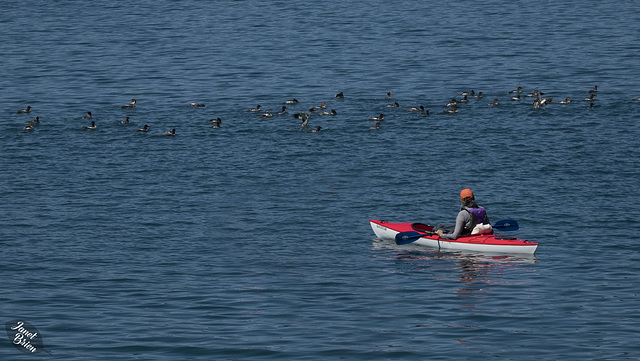
One day Steve and I drove 30 minutes from LaPine State Park to Paulina Lake and hiked around one side. It was an incredible day, shared by Pumpkin in her front-pack cage and all of us had a lovely adventure! The main picture shows a fellow in a kayak who was able to quietly approach a flock of fabulous-looking Common Merganser ducks.
Today's Insets
Although I wasn't able to get close to these birds, I did get a couple of nice group shots to share. As we walked around the edge of the lake I saw many scraggly trees bending over the water. I also got a picture of a boat owner enjoying the lake. At one point I saw a cluster of bees on a Bull Thistle and it was only later that I discovered how cool these grey-eyed bees are! Sadly, I didn’t get any great pictures of the bees' faces but this picture turned out nicely otherwise. (if you'd like to see their amazing eyes, take a look at this page: Featured Creatures: Common Long-horned Bee.) Finally, there was a stream that actually led from the lake in a very swampy marshy area and the light and shadow against the cloud-strewn sky is just delicious! :)
I am also adding the pictures I posted months ago of our walk around Paulina Lake for a more complete presentation. Some pictures show the jaw-dropping obsidian boulders, rocks and chunks we found along the trail here, one of Newberry's special features. AMAZING!
I hope everyone is doing well! The rollout of vaccine continues and we are hoping to get ours sometime in the next couple of months. Please stay safe, dry and warm! And thank you very much for all of your visits, comments and stars! :)
Explored on 3/25/21; highest placement #15.
Volcanic Recap to Fully Appreciate Today's Images of Paulina Lake
Visiting a volcanic area really requires a bit of education because it's so important to understand why it's so incredible and should deserve an awed appreciation. So the other day I explained a few volcanic terms to you including volcano (the four main types are composite, shield, cinder cone, and supervolcano) cinder cone (a tiny volcano), crater (a large, bowl-shaped cavity within most cinder cones) and caldera (a large cauldron-like depression formed when a mountain collapses after a volcanic eruption). National Geographic explains that "craters are formed by the outward explosion of rocks and other materials from a volcano. Calderas are formed by the inward collapse of a volcano. Craters are usually more circular than calderas."
A Pair of Lakes in the Newberry Volcano Caldera
Both craters and calderas can be so huge that you can't even see them because they can cover many miles…even the size of a small country. The Apolaki Caldera . in the Philippines is 93 miles across, and South Africa's, Vredefort Crater is over 190 miles across! The Newberry Volcano's caldara is tiny in comparison--a mere 5 miles across--but unless you are high above, you cannot see the definition of this area.
The deepest depressions of the Newberry Caldera are the homes of two lakes--Paulina and East Lake. These pure water lakes are fed only by rain, snow melt and hot springs and thus, they are a gorgeous, deep blue (The most famous lake in Oregon is Crater Lake, known for its incredible blue color and pure, unsullied water fed only by snow melt and rain).
Today's Pictures
One day Steve and I drove 30 minutes from LaPine State Park to Paulina Lake and hiked around one side. It was an incredible day, shared by Pumpkin in her front-pack cage and all of us had a lovely adventure! The main picture shows a fellow in a kayak who was able to quietly approach a flock of fabulous-looking Common Merganser ducks.
Today's Insets
Although I wasn't able to get close to these birds, I did get a couple of nice group shots to share. As we walked around the edge of the lake I saw many scraggly trees bending over the water. I also got a picture of a boat owner enjoying the lake. At one point I saw a cluster of bees on a Bull Thistle and it was only later that I discovered how cool these grey-eyed bees are! Sadly, I didn’t get any great pictures of the bees' faces but this picture turned out nicely otherwise. (if you'd like to see their amazing eyes, take a look at this page: Featured Creatures: Common Long-horned Bee.) Finally, there was a stream that actually led from the lake in a very swampy marshy area and the light and shadow against the cloud-strewn sky is just delicious! :)
I am also adding the pictures I posted months ago of our walk around Paulina Lake for a more complete presentation. Some pictures show the jaw-dropping obsidian boulders, rocks and chunks we found along the trail here, one of Newberry's special features. AMAZING!
I hope everyone is doing well! The rollout of vaccine continues and we are hoping to get ours sometime in the next couple of months. Please stay safe, dry and warm! And thank you very much for all of your visits, comments and stars! :)
Explored on 3/25/21; highest placement #15.
Cata Cat, ColRam, Frans Schols, micritter and 30 other people have particularly liked this photo
- Keyboard shortcuts:
Jump to top
RSS feed- Latest comments - Subscribe to the comment feeds of this photo
- ipernity © 2007-2026
- Help & Contact
|
Club news
|
About ipernity
|
History |
ipernity Club & Prices |
Guide of good conduct
Donate | Group guidelines | Privacy policy | Terms of use | Statutes | In memoria -
Facebook
X

Thanks for your recent visits to my photo-stream. Your comments are always appreciated.
OBSIDIAN (LAVA GLASS) HAS ALWAYS VACCINATED ME
HUGSSSSSS
Dunno where NatGeo got their definitions, but geologists just use "crater" as a descriptive term for a roughly circular depression. They can form in lots of different ways, and the mechanism is often added as a descriptor ("impact crater," "explosion crater"). A caldera is a type of crater that originates due to collapse of an undermined volcanic edifice. Also, "stratovolcano" seems more commonly used these days than "composite" volcano, I would guess because it's a bit more specific.
And welcome to The Beauty of Lakes!
Admired in:
www.ipernity.com/group/tolerance
Happy day!
A very nice set of picture, which I like very much - especially the wasps on the purple thistle!
Wonderful and interesting, with great colours.
I am lost for words!!
Best Wishes, a nice week ahead, and stay safe!!
Peter
Sign-in to write a comment.