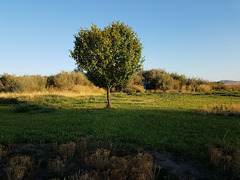
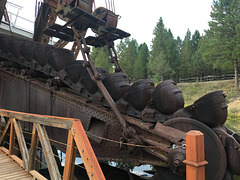
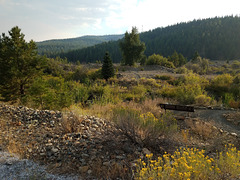
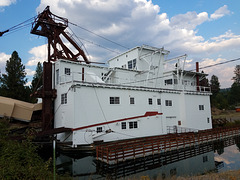
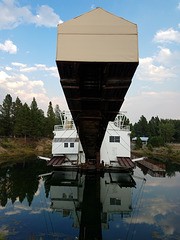
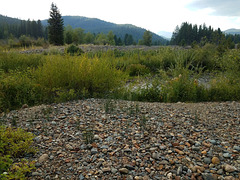
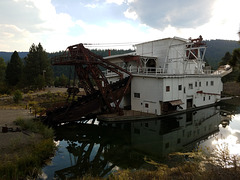
Historical mining park, Sumpter, Oregon, active 1913-1954. For bulk processing of placer deposits, and one of the most destructive mining techniques ever invented. The buckets (leftmost inset) would chew into the sediment at the front end, and the mix of soil, cobbles, and so on would pass through the body of the dredge where the gold would be separated by density, essentially a large-scale version of a sluice box. Then the spoil would be ejected on a conveyor out the back (inset 2nd from left)--with the fines dispersing while the cobbles would pile up into big heaps. The result was a wasteland consisting of rock piles and little else; and it was particularly problematic because the starting sediment was often farmland! It was especially poignant because typically the farmer would have sold the mineral rights under his land, but with no restrictions on how the minerals could be extracted. In the ~70 years since the dredge quit, the land is slowly revegetating; trees are now growing here and there among the cobble heaps, and soil will slowly start to fill in--but it will take a few centuries, most likely. (See the right insets.) Similar dredgelands occur around lots of old gold-mining areas; some of those outside Sacramento, California now host suburbs! Under the circumstances that's probably an improvement--