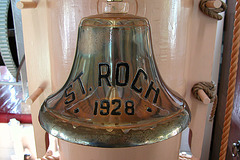
For a view of the bell of the St. Roch, click here .
[quote]
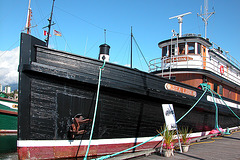
Built for the Royal Canadian Mounted Police Force to serve as a supply ship for isolated, far-flung Arctic RCMP detachments, St. Roch was also designed to serve when frozen in for the winter, as a floating detachment, with its constables mounting dog sled patrols from the ship. Between 1929 and 1939 St. Roch made three voyages to the Arctic. Between 1940 and 1942 St. Roch navigated the Northwest Passage, arriving in Halifax harbor on October 11, 1942. St. Roch was the second ship to make the passage, and the first to travel the passage from west to east. In 1944, St. Roch returned to Vancouver via the more northerly route of the Northwest Passage, making her run in 86 days. The epic voyages of St. Roch demonstrated Canadian sovereignty in the Arctic during the difficult wartime years, and extended Canadian control over its vast northern territories.
Retired after returning from the Arctic in 1948, St. Roch was sent to Halifax by way of the Panama Canal in 1950. This voyage made St. Roch the first ship to circumnavigate North America. Returned to Vancouver for preservation as a museum ship in 1954, St. Roch was hauled ashore in 1958. Housed over in 1966 and restored to her 1944 appearance by the Canadian Parks Service, the ship is the centerpiece of the maritime museum complex at Kitsilano Point.
[end quote]
source: www.hnsa.org/ships/stroch.htm
[quote]
Built for the Royal Canadian Mounted Police Force to serve as a supply ship for isolated, far-flung Arctic RCMP detachments, St. Roch was also designed to serve when frozen in for the winter, as a floating detachment, with its constables mounting dog sled patrols from the ship. Between 1929 and 1939 St. Roch made three voyages to the Arctic. Between 1940 and 1942 St. Roch navigated the Northwest Passage, arriving in Halifax harbor on October 11, 1942. St. Roch was the second ship to make the passage, and the first to travel the passage from west to east. In 1944, St. Roch returned to Vancouver via the more northerly route of the Northwest Passage, making her run in 86 days. The epic voyages of St. Roch demonstrated Canadian sovereignty in the Arctic during the difficult wartime years, and extended Canadian control over its vast northern territories.
Retired after returning from the Arctic in 1948, St. Roch was sent to Halifax by way of the Panama Canal in 1950. This voyage made St. Roch the first ship to circumnavigate North America. Returned to Vancouver for preservation as a museum ship in 1954, St. Roch was hauled ashore in 1958. Housed over in 1966 and restored to her 1944 appearance by the Canadian Parks Service, the ship is the centerpiece of the maritime museum complex at Kitsilano Point.
[end quote]
source: www.hnsa.org/ships/stroch.htm
The Sea Lion was launched on May 25, 1905.
Significance of the Sea Lion:
* First tug in British Columbia to have ship-to-shore radio and a searchlight.
* Played a role in the dramatic story of the immigrant ship Komagata Maru .
* Made the first tow of a 'Davis raft' in British Columbia.
* Struck a rock in the Yaculta Rapids (1930). The rock (Sea Lion Rocks) is named in memory of the event.
* Its whistle had a sliding scale, on which the crew could play songs.
* Still active 100 years after it was built.
From the sign near the boat.
Help & Contact|Club news|About ipernity|History|ipernity Club & Prices|Guide of good conduct Donate|Group guidelines|Privacy policy|Terms of use|Statutes|In memoria