

Alan H's photos
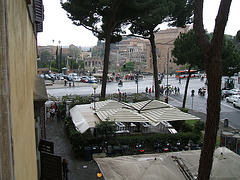
View toward the Roman Forum
| |
|
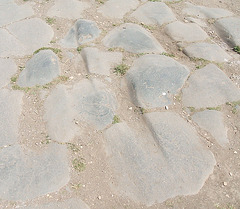
Cart Ruts
| |
|
Ruts caused through centuries of use by carts and wagons - in the main street (Decumanus Maximus) of Ostia Antica.

Tomb
| |
|
The tomb of C. Domitius Fabius Hermogenes in the Necropolis outside the Porta Romana gate of Ostia.
It was a high, square monument, perhaps decorated with marble (only part of the core has been preserved). The sarcophagus must have been placed in a room in the upper part, which was reached along a narrow staircase. Next to the tomb a long inscription was found (CIL XIV, 4642), that informs us that it was the last resting place of C. Domitius Fabius Hermogenes, priest of the deified Hadrian. The city council had honoured him with a public funeral and with an equestrian statue in the Forum, the base of which has been found (CIL XIV, 353). Fragments of a marble architrave were found on which the name of Hermogenes has been preserved.
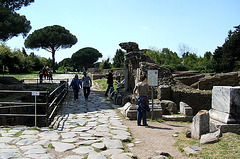
The Porta Romana Gate
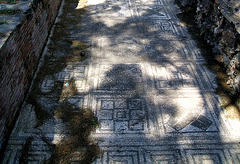
Mosaic in Baths of the Provinces
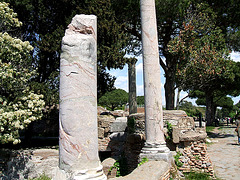
Christian Oratory

Mithraeum dei Serpenti
| |
|
One of the eighteen mithraea found so far in Ostia Antica, the port town of ancient Rome. It gets its name from the paintings at the back of the mithraeum.
The mithraeum may have been built about 250AD or somewhat later.

Reclining
| |
|
Reclining figure (no head, unfortunately - in fact none of the statues in Ostia have heads).

Aula del Buon Pastore
| |
|
The Hall of the Good Shepherd was named after a column with a relief of the Good Shepherd, found here during the First World War. It seems to have supported something. The Good Shepherd indicates that the hall was used by Christians, possibly the ferry-men, who used the Basilica as guild seat.
Ostia Antica.

Basilica

Temple of the Godess Roma

Statue
| |
|
To the south-east of the Forum is a portico which was built at the end of the reign of Hadrian (117-138 AD). Behind a long row of granite columns is a brick back wall. A statue of a man wearing a toga (the head is lost) is in a large niche in the centre of the back wall.
In Ostia Antica.

Circular Structure
| |
|
In the Forum of the Roman town of Ostia. Probably a nymphaeum (fountain-house) although, at one time, was thought to be a compitum - compita were shrines at crossroads where the gods of the crossroads, the Lares Compitales were worshipped.

Forum of Ostia

Inscription
| |
|
IVNIAE T(iti) POMPEI DII F(iliae) AT[---]
M(arco) MANLIO STEPHANO AV[G(ustali) ---]
TITIAE PYRALLIDI [---]
M(arcus) MANLIVS DILIGENS AVG(ustalis) QVINQ(uennalis) FE[CIT SIBI ET EPAPHRODITO]
LIB(erto) AVG(ustali) QVINQ(uennali) PROCVRATORI SVO TIT[IAE VERAE VXORI LIBERTIS]
LIBERTABVS SVIS EIS QVOS TESTAMENTO AVT [CODICILLIS MANVMISERO]
POSTERI[S]QVE EORVM
Ostia Antica.

Lizard

Forum

