

Alan H's photos

National Museum of Rome
| |
|
|
|
Part of a pavement Mosaic showing 'Satyr' and 'Pan'.
In the National Museum of Rome, Palazzo Massimo.

National Museum of Rome

National Museum of Rome
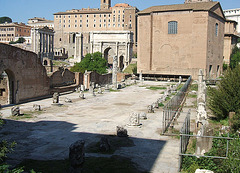
Basilica Aemilia
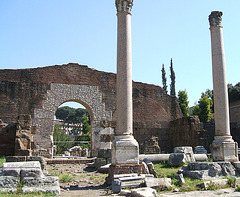
Basilica Aemilia Entrance
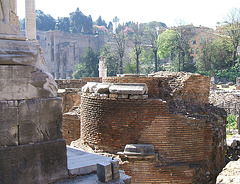
Umbilicus Urbis
| |
|
|
This unassuming brick structure is the Umbilicus Urbis - it marked the centre of Rome and hence the centre of the ancient world.
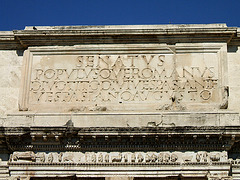
Arch of Titus
| |
|
SENATVS
POPVLVSQVE·ROMANVS
DIVO·TITO·DIVI·VESPASIANI·F(ILIO)
VESPASIANO·AVGVSTO
The Roman Senate and People (dedicate this) to the divine Titus Vespasianus Augustus, son of the divine Vespasian.
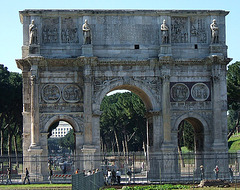
Arch of Constantine
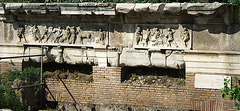
Basilica Aemilia
| |
|
This detail depicts Tarpea, who opened the city gates to the Sabines in exchange for what was on their arms, not realizing it would be their shields, under which she was buried for her treachery. It is a copy of the relief that adorned the architrave of the long central aisle of the basilica.
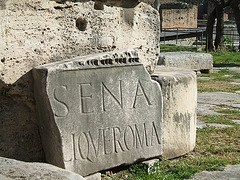
SPQR
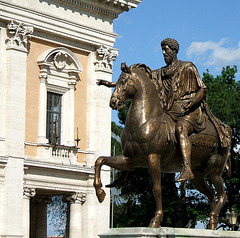
Marcus Aurelius
| |
|
Copy of an equestrian statue of Marcus Aurelius. The original is inside the Capitoline Museum.
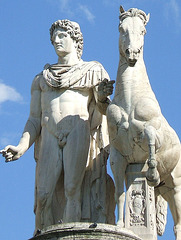
Pollux
| |
|
Situated in the Campidoglio this is a one half of a pair of statues of Castor and Pollux.

Theatre of Marcellus
| |
|
The Theatre of Marcellus (Theatrum Marcelli) in Rome was named after Marcus Marcellus, Caesar Augustus' nephew who died five years before its completion. Space for the theatre was cleared by Julius Caesar, who was murdered before it could be begun. The theatre was inaugurated in 12 BC by Emperor Augustus and completed in 13 BC.
In the Early Middle Ages the Teatro di Marcello was used as a fortress, in the 16th century the residence of the Orsini was built on top of the ruins of the ancient theatre. Now the upper portion is divided into multiple apartments, and its surroundings are used as a venue for small summer concerts.
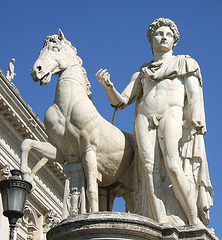
Castor
| |
|
Situated in the Campidoglio this is a one half of a pair of statues of Castor and Pollux.
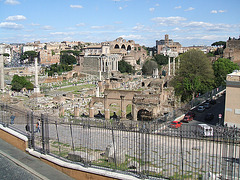
Roman Forum
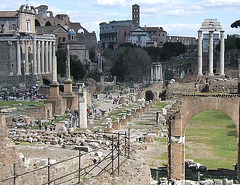
Roman Forum
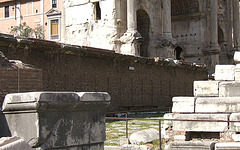
Rostra
| |
|
The brown wall with the holes in (behind the white marble blocks) is the Rostra. This is the platform where all the important speeches were made. Named after the beaks of the ships which were captured during the battle of Actium (338BC) and secured into the wall where the holes are. May have been closer to the Curia originally.
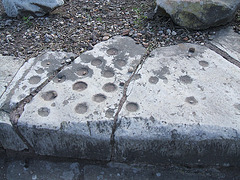
Steps of the Basilica Julia
| |
|
I spotted these on the steps of the Basilica Julia - the carefully carved out holes in the slabs are for a stone or seed game similar to 'Mancala'.
