

Bertha Hansbury
William Donnegan
Rehearsal for a chorus line at the Apollo Theater
Image Speak
Eliza Brooks
Aida Overton Walker
George Walker
A. Means
Aida Overton Walker
An Underdown Establishment
Blue Mouse Theatre
Josephine Baker
Aida Overton Walker
Thomas Morris Chester: The Lone Black Reporter of…
First Graders
First Black School in Kansas
Palmer Institute Faculty Members
Lucille Berkely Buchanan
The Graduate
Class of 1891
Clara Belle Williams
Sarah Lewis
Mary Henrietta Graham
Students from Covert School
Josephine Baker
Josephine Baker
Soldier
Jane Agnes Thompson Schuyler
Vintage Sisters
Murray Bros. Printing Co.
State of Virginia's First
Orpheus M McAdoo
Black Herman
Griffin Sisters
George Walker
See also...
Keywords
Authorizations, license
-
Visible by: Everyone -
All rights reserved
-
279 visits
Nancy Weston
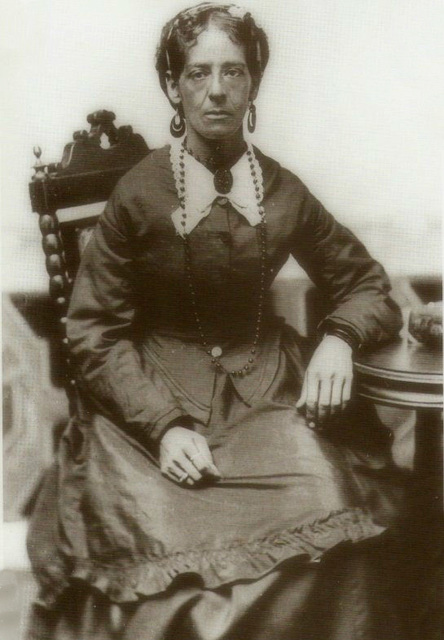

She lived in Charleston, South Carolina, in the 1850s as a free woman of color. However, in order to satisfy the laws of the state, she was a nominal slave legally owned by a white friend.
Nancy had three sons (Archibald who became an attorney, Francis who became a minister and John) by her white enslaver Henry W. Grimké, a widower. Henry was a member of a prominent, large slaveholding family in Charleston. His father and relatives were planters and active in political and social circles. Henry acknowledged his sons, although he did not manumit (free) them, or make the rest of his family aware of their existence.
She was the grandmother of Harlem Renaissance writer Angelina Weld Grimké.
Sources: The Face of Our Past: Images of Black Women from Colonial America to the Present edited by Kathleen Thompson and Hilary Mac Austin; Lift up Thy Voice: The Grimké Family's Journey from Slaveholders to Civil Rights Leaders by Mark Perry (2001)
Nancy had three sons (Archibald who became an attorney, Francis who became a minister and John) by her white enslaver Henry W. Grimké, a widower. Henry was a member of a prominent, large slaveholding family in Charleston. His father and relatives were planters and active in political and social circles. Henry acknowledged his sons, although he did not manumit (free) them, or make the rest of his family aware of their existence.
She was the grandmother of Harlem Renaissance writer Angelina Weld Grimké.
Sources: The Face of Our Past: Images of Black Women from Colonial America to the Present edited by Kathleen Thompson and Hilary Mac Austin; Lift up Thy Voice: The Grimké Family's Journey from Slaveholders to Civil Rights Leaders by Mark Perry (2001)
- Keyboard shortcuts:
Jump to top
RSS feed- Latest comments - Subscribe to the comment feeds of this photo
- ipernity © 2007-2026
- Help & Contact
|
Club news
|
About ipernity
|
History |
ipernity Club & Prices |
Guide of good conduct
Donate | Group guidelines | Privacy policy | Terms of use | Statutes | In memoria -
Facebook
X
