

Don Sutherland's photos

Daylily
| |
|
|
|
Daylily Hemerocallis ‘Raining Violets’ at the New York Botanical Garden (Bronx, New York)—July 12, 2026

Sunrise Behind a Veil of Smoke
| |
|
|
|
Smoky sunrise (Larchmont, New York)—July 17, 2026
Wildfire smoke transformed the rising sun into a muted disc suspended behind a dense atmospheric veil. Its usual brilliance was subdued, filtered through layers of drifting particulate matter that softened the horizon and stained the morning light with tones of amber, rust, and ash.
This photo captures a moment of unsettling beauty. The sun remains visible, yet distant and diminished, its radiance constrained by smoke carried far from the fires that produced it. What first appears serene is also evidence of disruption: a sunrise reshaped by wildfire, distance, wind, and a changing climate.

Memorabilia
| |
|
|
|
Limited-edition Louis Vuitton "France 98" commemorative football, produced in France to celebrate the 1998 FIFA World Cup, which was hosted by France. France would go on to win the 1998 World Cup. Later that year, on December 20th, Kylian Mbappé was born. I purchased this football while in Paris.
SC205 - post 12 July – Memorabilia

Meditation on Beauty
| |
|
|
|
Tulip photographed at The Cloisters (New York, NY)—April 18, 2026.
A pale pink tulip opens toward the sunlight, its petals caught between fragility and quiet confidence. The tulip invites a closer meditation on emergence, vulnerability, and the brief perfection of a moment in bloom.

United States: 1776-2026
| |
|
|
|
Generated by AI from photos I took in Philadelphia as follows: Independence Hall (December 7, 2022), the Liberty Bell (August 11, 2023), and the Declaration of Independence (August 11, 2023).
The Declaration of Independence is more than a formal document explaining why thirteen British colonies had chosen for themselves a new destiny. Its words echo across time. They belong to free peoples everywhere: “We hold these truths to be self-evident, that all men are created equal, that they are endowed by their Creator with certain unalienable Rights, that among these are Life, Liberty and the pursuit of Happiness.”
These words present liberty as a universal inheritance that is beyond the authority of any king, czar, or dictator to usurp. Its principles rest on human dignity, lawful self-government, and the right of communities to determine their own future. This universal language creates a shared moral vocabulary. Nations may differ in history, culture, religion, language, and political institutions, but free societies can recognize one another in the Declaration’s central claims that human beings possess rights government does not create, that legitimate authority depends on consent, that government exists to protect liberty, not extinguish it, and that people may rightly resist tyranny when power becomes destructive of their rights.
The Declaration also reminds the United States and its allies that friendship among free peoples is not simply transactional. It is a partnership in defense of human dignity, self-government, lawful liberty, and the hope that people everywhere may live without oppression. Free nations must be able to rely on one another in moments of danger, as they have on numerous occasions since July 4, 1776. After all, free nations are not distant strangers. They are partners in a shared human project for a better, more prosperous, and more tolerant future in a contested, turbulent, and still violent world.
Declaration of Independence (Philadelphia, PA—August 11, 2023)
Performance at the Metropolitan Museum of Art (New York, NY—July 4, 2026)

Emblem of a Burning Summer
| |
|
|
|
Close-up of a Red Gerbera Daisy at the New York Botanical Garden (Bronx, New York)—June 28, 2026.
In this view, the gerbera becomes less a flower than a sunburst. Its fire-red petals radiate outward like bands of heat. Its golden center glows with the intensity of a furnace. The image transforms a delicate botanical subject into a visual metaphor for a summer defined by extraordinary heatwaves.
The deep red petals suggest scorched afternoons, heat warnings, and landscapes saturated by relentless sun. At the flower’s center, the yellow-green core burns like a miniature sun. Pollen scattered across the surface evokes the invisible greenhouse gas particles that are relentlessly warming the world and bringing on ever more extreme heatwaves.

It's A Crazy World
| |
|
|
|
A burning globe stands before a background of climate stripes, transforming scientific evidence into a stark visual record of the world’s ongoing warming. Europe glows with dangerous heat, while a thermometer planted over France reads 40°C. In the lower left, fossil fuel infrastructure appears almost toy-like against the scale of planetary disruption: small in form, but immense in consequence. At the right, a pale sculptural figure evokes humanity’s mounting suffering under the pressure of a hotter world.
This work confronts one of the central absurdities of the modern age. The evidence is overwhelming and unequivocal. The burning of fossil fuels is driving anthropogenic greenhouse gas warming, and that warming is increasing the frequency and severity of extreme heatwaves. Yet humanity continues to extract, burn, subsidize, and consume the very fuels accelerating the crisis with seeming indifference to the harm it is inflicting on the world and its ecosystems.
The contrast between beauty and terror is deliberate. The climate stripes are visually elegant, but they record a destabilizing planet. The glowing continents are dramatic, but they signify real risk. The sculptural body, drawn from an image of suffering, gives human form to what can otherwise seem abstract. The quote from a young French climate activist anchors the work in moral urgency, insisting that the crisis is not distant, theoretical, or merely environmental. It is already a question of life and death.
It’s A Crazy World is not simply about heat. It is about knowing and continuing destructive business as usual anyway. It asks viewers to consider the madness of a civilization capable of measuring its own danger with precision while still choosing to feed the fire.
A Note on the Image’s Creation:
The image was created using Ed Hawkins’ climate stripes and a detail from Jean-Baptiste Carpeaux’s Ugolino and His Sons , photographed at the Metropolitan Museum of Art in New York City on June 19, 2026. The globe, which is shown steaming, cracking, and opening pores in a failing effort to cool itself from withering heat, was generated using AI. Western Europe, where an extreme heatwave was occurring at the time the image was created, was colored red to mark the region’s exposure to dangerous heat. The thermometer and fossil fuel infrastructure were also created using AI.

La Nuit
| |
|
|
|
La Nuit (Night) pitcher
Designed by Jean Coulon (French, 1853-1923)
Made by Pierre-Adrien Dalpayrat (French, 1844-1910)
French, Bourg-la-Reine, ca 1894
Stoneware
Metropolitan Museum of Art (New York, NY)—May 16, 2026
Alien Eden
| |
|
|
|
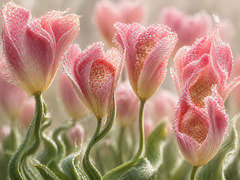
Digital art created using AI on June 11, 2026 from tulips photographed at the New York Botanical Garden (Bronx, New York) on April 12, 2026.
In Alien Eden , tulip-like blossoms emerge from an imagined world where beauty has evolved under unfamiliar laws. Their dew-lit petals, translucent textures, and luminous interiors suggest living forms shaped not only by light and atmosphere, but by the great cosmic forces themselves.
Alien Eden dares us to imagine that the great cosmic forces are not distant abstractions, but intimate artists. Gravity choreographs form. The strong nuclear force binds hidden radiance into living structures. The weak nuclear force allows transformation, decay, mutation, and renewal to become part of beauty itself.
Finally, Alien Eden invites us to imagine that the universe may be full of undiscovered gardens we have no language for yet. There, life may be delicate, radiant, and strange, but still recognizable as a form of wonder.
Rose in Superposition
| |
|
|
|
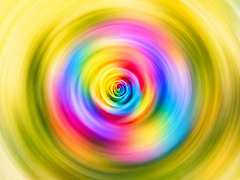
Adapted using Artificial Intelligence from a Floribunda Rose 'Bolero 2004' photographed at the New York Botanical Garden (Bronx, New York)—June 7, 2026.
In Rose in Superposition, the flower is reimagined through the language of quantum mechanics. The rose appears to rotate at extreme speed, its outer petals dissolving into luminous bands of color, while a tiny central core remains sharply resolved. This contrast between blur and clarity evokes the tension between motion and measurement.
Drawing on the idea of spin as an intrinsic property rather than ordinary rotation, the work transforms the rose into a poetic hybrid of botany and physics. The petals become orbit-like fields of color, suggesting superposition, energy states, and radiant probability. What emerges is not simply a flower in motion, but a meditation on identity itself. Even in turbulence, the heart of the bloom endures.

Nature's Masterpiece
| |
|
|
|
Rembrandt Tulip at the New York Botanical Garden (Bronx, New York)—May 10, 2026
A single tulip opens in a dramatic swirl of ivory-white petals, each streaked with deep crimson flames that seem painted by hand. The flower’s curling form gives it a sculptural quality, while the fine ribbing of the petals reveals delicate natural texture.
This bloom belongs to the tradition of Rembrandt-style tulips, prized for their bold feathered markings and painterly irregularity. Its red-and-white pattern recalls the historic “broken” tulips that captivated Dutch collectors centuries ago, transforming a simple flower into an object of beauty, rarity, and fascination.

Smile
| |
|
|
|
The poster was created as follows: “Smile” and the face were extracted from graffiti that was photographed in Patchogue, NY on June 23, 2024. The color was changed to better match the photos. The daffodils and red tulips were photographed at the New York Botanical Garden (Bronx, NY) on April 12, 2026. The pink tulip was photographed at The Cloisters (New York, NY) on April 18, 2026. Auguste Rodin’s “Eternal Spring” was photographed at the Metropolitan Museum of Art (New York, NY) on April 18, 2026. The poster, additional elements (including the heart above “Smile”) and additional text were generated using ChatGPT 5.5.
Smile is a celebration of tenderness, renewal, and everyday beauty. At the top of the composition, the hand-drawn word "Smile" becomes both title and gesture: spontaneous, playful, imperfect, and deeply human. The accompanying face, rendered with childlike boldness, transforms the poster from a decorative floral work into an invitation to joy, openness, and emotional release.
The classical sculpture introduces a note of intimacy and passion. The embracing figures in Eternal Spring are a symbol of care, vulnerability, and human connection. The sculpture’s stillness contrasts with the living energy of the flowers, creating a dialogue between permanence and fleeting beauty.
Together, these elements make Smile a visual meditation on simple joy, which can be found in flowers, kindness, love, and the decision to see beauty even in an imperfect and often troubled world.

Crimson Fire
| |
|
|
|
Sunlight passes through a cluster of tulips at peak intensity giving the flowers a monumental presence, transforming a garden scene into a study of color, translucence, and seasonal vitality. The result is a celebration of spring’s brief but brilliant abundance.

Spring Tableaux
| |
|
|
|
Spring Tableaux presents a lyrical encounter between photography, botanical memory, and the rapidly advancing language of artificial intelligence–assisted graphic art. The tulips were photographed at the Cloisters (except for the bottom left image which was taken at the New York Botanical Garden) and all the other flowers were photographed at the New York Botanical Garden during Spring 2026.
Those original spring photos were transformed by AI into a series of poster works. The resulting compositions blur the boundary between photograph, editorial design, botanical illustration, and museum object.
The works mark a significant moment in the evolution of AI as a graphic arts tool. Over the past year, AI’s capacity for visual composition, typographic sensitivity, image integration, and stylistic refinement has improved measurably. What once often appeared generic or technically uncertain can now achieve a level of polish, nuance, and conceptual cohesion approaching professional editorial and cultural design. Spring Tableaux uses that progress as a way of reimagining familiar natural beauty through the grammar of posters, print culture, and exhibition design.
Together, the three pieces form a seasonal triptych. They also offer an example of the expanding collaboration between human vision and AI.

She Was Known
| |
|
|
|
Marble portrait of a Young Woman (Roman, Trajanic period, ca A.D. 98-117 CE) at the Metropolitan Museum of Art (New York, NY)—May 16, 2026.
Her name has been lost. Her nose has been chipped. Still, the marble carries the force of recognition though its carefully arranged hair, composed face, captured youth. It shows status and offers memory.
In the world where this portrait first stood, she was almost certainly not anonymous. She may have been a daughter, wife, benefactor, priestess, or bride. People may have passed her image and understood exactly who she was, and why she deserved to be remembered. What survives across the vast and growing ocean of time is the form without the story. The face crossed nearly two thousand years. The chain of memory did not.
A photorealistic version of the young woman was generated using AI and is shown below:
A photorealistic interpretation can help bridge that distance. This image, which was created using AI, cannot restore her name, but it restores something essential. It restores the sense that this was not merely an “unidentified young woman,” but a living person whose existence carried weight, affection, consequence, and meaning. Those are the insights one should keep close at hand when viewing the sculpture.
She mattered.
The Orchid Show
| |
|
|
|
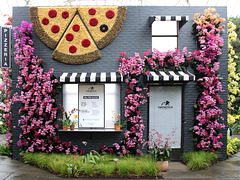
From the New York Botanical Garden's 2026 Orchid Show ( The Orchid Show: Mr. Flower Fantastic’s Concrete Jungle ) reimagines New York City through orchids (Bronx, New York)--March 8, 2026

Deep Freeze
| |
|
|
|
View of the George Washington Bridge in an ice-covered Hudson River (New York City--February 8, 2026). New York City has seen its coldest 16-day period since January 11-26, 1982.

Gaze Beyond Time
| |
|
|
|
Detail of a marble head and torso of Athena (Roman Imperial copy of a Greek original) at the Metropolitan Museum of Art (New York, New York)—August 12, 2025.
With a serene poise and otherworldly calm, this marble visage transcends the centuries that have passed since its creation. The gentle contours and measured gaze evoke both divine ideal and human vulnerability. In its stillness, we find a mirror to our own search for meaning beyond the fleeting present.
